A lot of rec players think the answer is simple: “Just poach everything.” Sometimes that works. A lot of times it does not.
The real answer is more nuanced. It depends on why your partner is staying back, what level you are playing, and whether you are trying to win that game, help that player, or just keep the match from turning into chaos.
First, understand why this is such a problem
The kitchen line is still the most valuable piece of real estate in doubles pickleball. USA Pickleball’s positioning guidance says the goal is to move through the transition zone quickly and establish at the kitchen line, while staying linked with your partner and maintaining 6–8 feet of spacing.
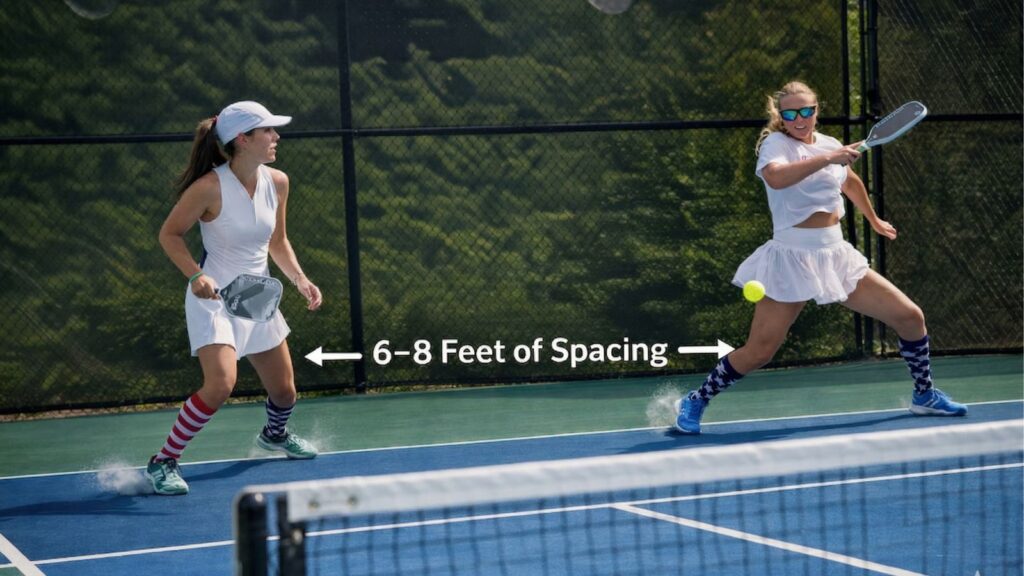
That matters because when one player is up and one player is back, three ugly things happen:
⮕ The first is the gap.
Opponents can hit through the space between you and your partner.
⮕ The second is the sitting-duck problem.
If your partner stays back and floats a weak ball, you — the player up front — often become the easiest target.
⮕ The third is asymmetrical court pressure.
Your opponents only have to worry about one player at the kitchen instead of two.
That is why newer players who fail to reach the kitchen line are giving away so much edge. One 2026 strategy piece built around pro-rally data says that when the serving team fails to reach the kitchen, they lose 65% of the time. The article cites analysis from more than 34,000 rallies and frames kitchen control as the biggest doubles advantage in the sport.
So no, this is not just an aesthetic preference.
It is a real structural problem.
But here’s the part many stronger rec players miss
Not every partner who stays back is doing it for the same reason.
And the reason matters. Sometimes it is an older rec player dealing with mobility limits or slower reaction time. Sometimes it is fear of getting hit, lack of confidence at the kitchen, or old tennis habits that keep pulling them into a one-up, one-back shape.
And sometimes it is simply a player who has never had the strategy explained clearly in a way that clicks. That matters because the right tactical response changes depending on the cause.
If the player is:
- new and teachable, the answer is one thing.
- physically limited, it is another.
- stubborn and territorial, it is something else entirely.
So before you decide what to do, figure out what kind of “stays-back” player you actually have.
Type 1: The player who doesn’t understand the strategy yet
This is common with beginners and former tennis players.
Better Pickleball lays out several reasons players stay back: they do not understand the kitchen strategy, they are carrying over tennis habits, they are overloaded with advice, they fear the lob, they lack speed, or they fear hard-hit balls.
This kind of player is often not refusing the kitchen. They just have not connected the dots yet. They may think:
- “I have more time back here.”
- “I’m safer on the bounce.”
- “I can always move up later.”
- “If I go up, I’ll just get body-bagged.”
What to do with this player
Do not start with, “You need to come up.”
Start with: “When we’re both up, we take time away from them. When one of us stays back, they get easy angles.”
That explanation works better because it gives them a reason, not just an instruction.
A useful on-court cue is: “Hit, then take two steps with me.”
✖️ Not “sprint all the way in no matter what.”
✖️ Not “get to the line at all costs.”
✔️ Just start the habit.
That matters because even small forward progress helps. If they are returning serve, ask for:
- a deeper, slightly higher return
- then a controlled move forward
- then a split step as the opponents hit
That is straight out of mainstream kitchen-approach coaching.
Best cue for this player
“You do not need to rush the kitchen. You need to earn your way there.”
That one sentence helps because it removes the all-or-nothing panic.
Type 2: The player who is scared of getting hit
For a lot of players, the real issue is not strategy at all. It is that they do not feel comfortable enough handling quick balls at the kitchen line.
This is not irrational. If someone has been body-bagged a few times, or if their hands are not ready for fast exchanges, the kitchen can feel like a bad neighborhood.
What to do with this player
First, stop acting like this is a character flaw. It is usually a confidence and technique problem. Second, help them with one or two survival cues, not a five-minute speech.
The most useful simple cues are:
- Paddle up early
- Elbows close to the ribs
- Short block, not full swing
- Hold your ground unless the ball is clearly attackable
A simple “paddle up” reminder helps a lot, and so does the reality that most players get more comfortable at the kitchen once they spend enough time there.
If you want to help them improve, give them the easiest kitchen reps possible:
- cooperative dinks
- soft block volleys
- controlled body-speed balls
- no hero speedups at their chest in warm-up
A lot of players do not need a new strategy. They need proof that they can survive up there.
Best cue for this player
“You do not need to win at the kitchen right away. Just learn to block one more ball.”
That is a much better bridge than “stop being scared.”
Type 3: The player who truly cannot get there easily
Sometimes the answer is not fear or bad habits. Sometimes the player is mobility-limited, recovering from injury, or simply cannot comfortably recover backward once they move up.
This is where a lot of stronger rec players make a mistake. They keep trying to force “normal” doubles on a partner who physically does not have normal doubles movement.
What to do with this player
Now you stop trying to “fix” the shape and start building the least-bad version of it.
That usually means:
- you take front-half responsibility
- they take lobs, deeper balls, and some backcourt coverage
- and you both agree on it ahead of time
At that point, you are really just building a front-back version of doubles, where one player owns more of the kitchen and the other takes more of the backcourt.
Is it ideal? No. Can it be playable in rec doubles? Yes, especially if the opponents are not good enough to exploit it consistently.
Tactical adjustment
Stand a little more middle-biased at the kitchen, not glued to your sideline. That gives you a better chance to poach floaters and protect the biggest central hole.
But do not poach so early that you expose your own sideline every rally.
Best cue for this player
“I’ll take more front court. You own the lob and anything that gets behind me.”
That turns the partnership from accidental chaos into an agreed compromise.
So should you stay up, stay back, or sit in the transition zone?
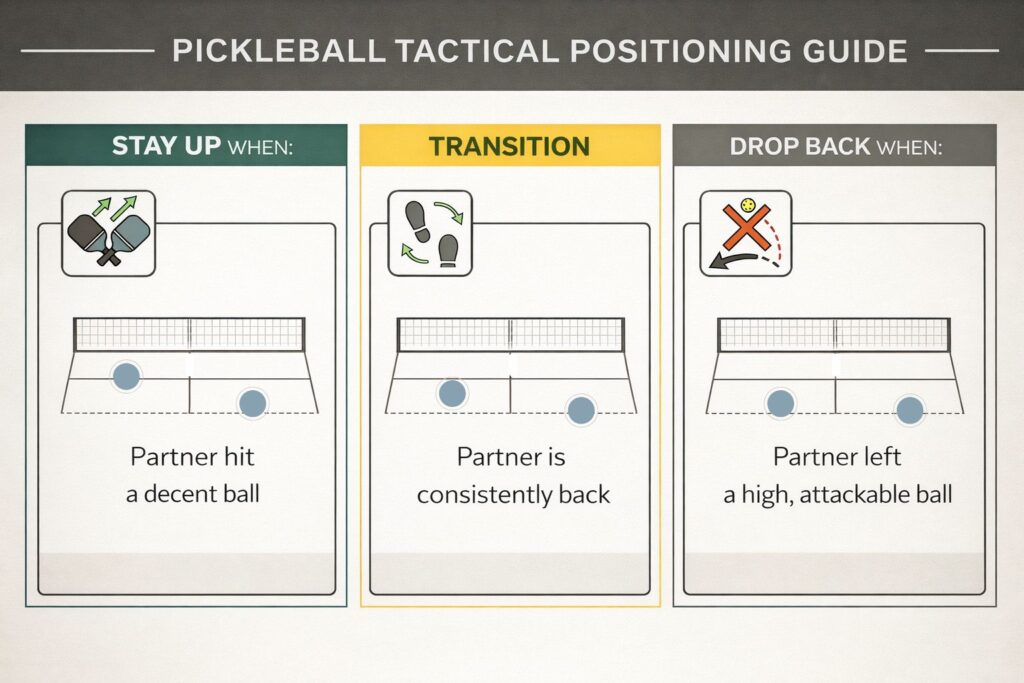
This is the tactical heart of the problem. And the honest answer is: it depends on the quality of your partner’s ball.
Stay up when:
- your partner has hit a decent ball
- you can pressure the middle
- you can realistically poach the next shot
- or your presence at the line still changes the opponents’ decisions
This is especially useful if you have quick hands and good anticipation.
Poaching is not just about stealing one ball. It changes patterns, adds stress, and can make opponents try to be too precise on future shots.
That is a big deal in this situation. If your partner is being targeted, your active presence at the kitchen can make the opponents less comfortable hitting through that lane.
Drop back when:
- your partner leaves a high, attackable ball
- the point is about to become a firefight at your feet
- or staying at the kitchen would leave you as the obvious victim of a smash
If your partner hits a poor ball and you stay planted at the kitchen, you are just asking to get punished. Move with the situation rather than blindly worship the line.
This is a key correction for rec players: “Get to the kitchen” is correct, but “never leave the kitchen” is not.
Use the transition zone when:
- your partner is consistently back
- you want to cover short balls without getting stranded
- and the opponents are not skilled enough to dissect every gap
It is not classic doubles shape, but in open play it can be the most realistic compromise. Living a bit in the transition zone can help you cover more space without leaving yourself completely exposed.
You are sacrificing some pressure to gain:
- better defensive balance
- better access to short balls
- less total exposure
The practical rule
If your partner hits well enough to let you pressure, stay up. If they leave you in a smash trap, retreat with the ball.
Not with your fear.
With the ball.
The biggest mistake: poaching emotionally instead of strategically
Many rec players respond to this problem by poaching everything. That usually goes wrong for two reasons.
⮕ First, it can irritate the partner and break trust.
⮕ Second, reckless poaching opens even bigger holes.
Poaching is part of the answer, but not all of it. Done well, it helps cover the gap. Done badly, it just creates frustration between partners. So if you are going to poach, do it with rules.
Good poach situations
Poach when:
- the ball is floating in the middle
- the opponent is in transition
- your partner is clearly not getting there first
- you can attack or neutralize without overreaching
- your momentum carries you into a better court position
Bad poach situations
Do not poach when:
- you are guessing
- you are crossing before the opponent even commits
- you are stealing a ball your partner can handle comfortably
- you cannot recover if they go behind you
- you are doing it mostly because you are annoyed
That last one is the killer. Poaching from frustration is usually bad poaching.
Best poaching cue
“Go if you can get there early and through the ball. Stay if you would be reaching.”
That cue alone will save a lot of ugly over-poaches.
If you are the stronger player, your best real skill is not poaching — it is ball selection
This is where better players can help a lot. When your partner stays back, you should start valuing shots that buy time, reduce angles, make their next move easier, or give you a clearer poach window. That means more:
- middle balls
- lower trajectory balls
- patient drops
- deeper returns
- less reckless crosscourt speed
The real idea is not just “dink more.”
It is: choose shots that reduce the opponent’s ability to expose the front-back gap.
That usually means avoiding easy attack balls, staying away from sharp crosscourt angles, keeping the ball lower and more central when possible, and using more patient balls to create a better approach window.
A simple practical game plan for rec play
If your partner stays back and you still want to compete without turning into the court police, here is the most practical sequence.
On returns
Encourage a deeper, softer return and have them move forward under the ball.
Your cue: “Return, walk in, split.”
Not “sprint to the line.”
On your team’s thirds
If your partner is the one hitting thirds and tends to stay back:
- watch the quality of the ball
- take one or two read steps in
- do not fully commit until you know whether the ball is attackable
This mirrors the movement concept from The Kitchen article: move in relation to the shot quality, not by autopilot.
In firefights
If they are still back:
- shade the middle
- protect the easiest attack lane
- and poach only the balls you can intercept cleanly
Against smart opponents
Expect them to:
- target your partner’s feet
- use short angles
- and hit behind your poach attempts
So your main defensive priority is: close the middle first, then react outward.
When you should say something — and when you should not
This is one of the trickiest parts of the situation. Some players will say something right away. Others only offer advice if they are asked. And plenty of players, especially in open play, prefer to stay quiet and simply adjust.
That balance is the right one.
Say something if:
- the player seems open to improvement
- they are clearly new
- they are asking questions
- or the same pattern is making the game miserable for both of you
Keep it simple:
Try:
“You’ll probably see me take a few more middle balls if you stay back.”
or
“If you can come in even a little after the return, it helps us close the gap.”
That works because it is:
- calm
- specific
- non-accusatory
- and practical
Do not say something if:
- they are clearly injured or mobility-limited
- they are defensive and territorial
- it is casual open play and you are mostly trying to keep the vibe good
- or you are saying it because you are mad
If you are irritated, wait until after the game or do not say it at all.
The hard truth: sometimes there is no tactical fix, only a social decision
This is the part rec players often dance around.
If your partner truly will not move up, does not want feedback, and you are playing against decent opponents, there is only so much you can do.
At a certain point, the honest answer is to cover what you can, keep the game moving, and then choose a more compatible partner next round.
That is not cruelty. It is just doubles geometry.
So What Should You Actually Do?
If your partner never comes to the kitchen, do not make the mistake of thinking there is one magic fix.
There are really three separate jobs:
First, diagnose the reason.
Is it fear, habit, lack of understanding, or physical limitation?
Second, choose the right court response.
Stay up when the ball allows it. Drop back when the point demands it. Live in the transition zone sometimes if that is the least-bad answer.
Third, keep your advice small and useful.
Most players do not need a lecture. They need one good cue.
If I had to boil the whole guide down to one practical sentence, it would be this:
Do not react to your partner’s location. React to the quality of the ball, while doing your best to keep the team shape from breaking completely.
That is the most adult version of this problem.
Not perfect.
Not glamorous.
But very real pickleball.
And honestly, that is what rec doubles is a lot of the time.