It is not the glamorous pickleball injury. Nobody posts a proud selfie of it. Nobody brings it up after open play unless the nail is already halfway black.
But a surprising number of rec players deal with the same weird problem: the big toenail, second toenail, or both start turning dark, loosening, thickening, hurting, or eventually falling off.
And if you have been around enough players, you already know how common the theories sound: tournaments, stop-start movement, thick socks, shoe fit, tight shoes, loose shoes, long nails, bad lacing, narrow toe boxes, and that familiar feeling of, “I thought I was the only one.”
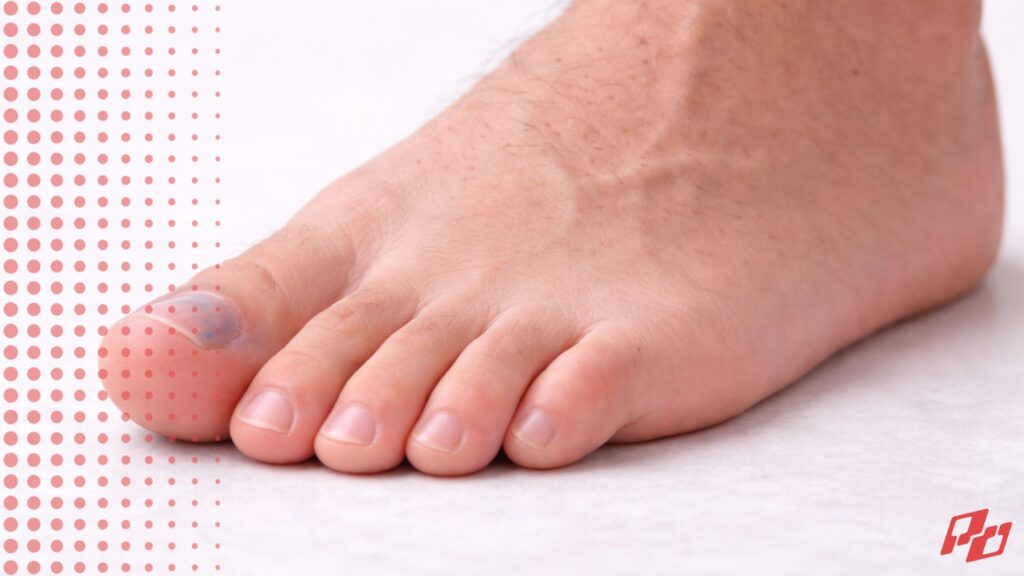
The truth is, this is a real sports injury. It is often called runner’s toe or tennis toe, and medically it is often a form of repetitive nail trauma that can lead to a subungual hematoma — bleeding and bruising under the nail. Cleveland Clinic describes runner’s toe as damage caused by pressure, shearing, and friction when the toenail repeatedly hits the front or side of the shoe, and notes that this repetitive impact can cause bleeding under the nail.
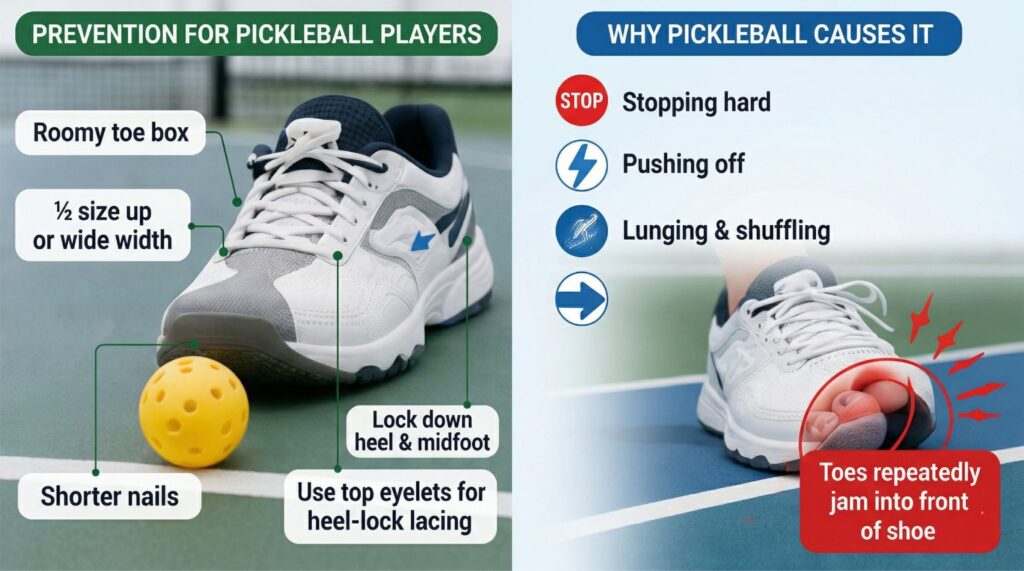
For pickleball players, that mechanism makes perfect sense. You are not jogging in a straight line. You are:
- stopping hard
- pushing off
- lunging forward
- braking backward
- shuffling side to side
- and often jamming your foot into the front of the shoe over and over.
That is why this article matters. Because a lot of rec players assume toenail problems are just cosmetic, or just “part of playing.” Sometimes they are minor. Sometimes they are fixable with smarter gear and foot habits. And sometimes they are a sign you need actual medical attention.
So let’s break it down clearly.
What this injury usually is
Most of the time, the classic pickleball toenail problem is repetitive trauma to the nail unit. That trauma can lead to:
- bleeding under the nail
- pressure and throbbing
- discoloration
- the nail lifting from the nail bed
- thickening or deformity later
- and sometimes the nail eventually falling off.
The trapped blood under the nail can create pressure, discomfort, tenderness, and even lift the nail plate. Do not rip off a loose nail, because that can damage the nail bed and affect how the nail grows back.
That last part matters. A lot of rec players treat this like a gross inconvenience and start picking at the nail. Bad idea.
Why pickleball causes this more than players expect
Pickleball looks light until you really start moving well. Rec players especially get into trouble because the game has a lot of short explosive braking.
That means your foot is often sliding forward inside the shoe just a little. Not enough to feel dramatic. Enough to matter.
Then add in:
- repeated tournaments or round robins
- hot weather and swollen feet
- older shoes
- socks that change the fit
- or one slightly longer second toe
and suddenly the nail keeps colliding with the front of the shoe all day.
The big fit mistake: players think “too small” is the only problem
A lot of players assume black toenails only come from shoes being too short. That is one common cause. But it is not the only one.
A paddle player’s shoe can create toenail trauma in two opposite ways:
1. The shoe is too short or too low in the toe box
Now the nail is constantly touching the front or top of the shoe.
2. The shoe is too loose or not locked in well enough
Now the foot slides forward every time you stop, plant, or lunge.
That second one is why some players swear that “going bigger fixed it,” while others say, “No, the shoe has to be snug or your foot will slam forward.” Both can be true depending on where the mismatch is.
The better way to think about it is this: you want room for the toes, but security at the heel and midfoot.
That is the sweet spot.
✖️ If the front is cramped, the nail gets crushed.
✖️ If the heel slips, the toes get rammed forward.
✖️ If both are happening, your toenail is living a bad life.
The symptoms that usually mean “sports toenail trauma”
The common pickleball version usually looks like one or more of these:
- black, blue, purple, or dark red discoloration under the nail
- throbbing or pressure
- tenderness
- a raised or lifting nail
- a nail that eventually loosens and falls off
- thickening or rough regrowth later
If the nail becomes black but does not hurt much, that often means the bleeding has already settled and you are now in the wait-it-out phase.
If it is throbbing hard, getting more painful, or feels like pressure is building, that is a different situation.
Worsening pain over the next few hours can mean you need medical evaluation, and a provider may consider drainage if there is painful pressure under the nail.
When it is just annoying… and when it is a real medical problem
This is the part rec players need most. A lot of sports toenail injuries are minor and ugly rather than dangerous. But not all dark toenails are “just pickleball.”
Usually more routine:
- the nail turned dark after clear sports trauma
- it is tender but improving
- there is no spreading redness
- no drainage
- no fever
- and walking is still manageable
Get medical help sooner if:
- the pain is intense or worsening
- blood seems to cover a large part of the nail
- the nail is lifted badly
- you cannot comfortably bend the toe or walk
- the toe may also be fractured
- there is swelling, pus, drainage, fever, or signs of infection
- or you have diabetes or poor circulation
Also important: not every dark nail is trauma
If you have a dark streak, new changing pigment, or a black/brown nail change that does not fit a clear injury story, that deserves medical evaluation. The American Academy of Dermatology specifically warns that nail color changes can sometimes signal melanoma and should not always be written off as “I must have bumped it.”
That does not mean panic over every ugly toenail. It means do not assume every dark nail is harmless sports bruising forever.
Quick Guide: Probably Routine vs. Get It Checked
Here’s a simple way to think about the difference between an ugly-but-common sports toenail and a situation that deserves quicker medical attention.
| What You’re Seeing | More Likely Routine Sports Toenail Trauma | Get It Checked Sooner |
|---|---|---|
| Color change | Dark nail after a clear pickleball or tournament session | Dark streak, spreading pigment, or color change without a clear injury |
| Pain | Mild soreness or tenderness that is improving | Throbbing, pressure, or pain that is severe or getting worse |
| Walking / movement | You can still walk and move fairly normally | Walking hurts a lot, the toe feels unstable, or bending the toe is difficult |
| Nail condition | Nail is bruised, a little loose, or slowly lifting | Nail is badly lifted, bleeding heavily, or looks significantly damaged |
| Signs of infection | No drainage, fever, or spreading redness | Pus, drainage, fever, warmth, or redness spreading around the toe |
| Possible bigger issue | Clear sports trauma story and symptoms match it | Possible fracture, diabetes, poor circulation, or a nail change that does not fit a trauma story |
What to do right away if you think you have a bruised pickleball toenail
If this happened after a hard session or tournament and the toe is sore:
1. Stop digging at the nail
Do not peel it, rip it, or “test how loose it is.”
If it is going to come off, it will do that on its own timetable. Pulling it can damage the nail bed and worsen regrowth.
2. Ice and reduce pounding if it is painful
For a simple bruised nail without obvious major damage, home care like ice wrapped in a cloth can help with swelling and pain.
3. Protect the toe
If the nail edge is catching on socks, protect it with light dressing or a toe cap if needed. Toe caps and gel protectors can make life a lot more tolerable, especially when the nail is loose.
4. Watch the pain curve
If pressure and pain ramp up instead of settling, that is when you stop pretending it is just ugly and get it looked at.
5. Do not try to drain it yourself
Cleveland Clinic is very clear: nail trephination — the procedure that relieves pressure by creating a hole in the nail — should be done by a professional, not at home.
That matters because a lot of athletes love DIY medicine right up until they give themselves an infection.
The best prevention plan for rec players
This is where the article should really help people.
First: treat shoe fit like performance equipment
A lot of players obsess over paddles and treat shoes like a generic afterthought. That is backwards if you keep losing toenails. Your shoe should do two things at once:
- give your toes enough room,
- and keep your heel/midfoot controlled enough that you are not sliding forward.
That means “bigger” is not always the full answer. Sometimes the answer is:
- half size up
- wide version
- roomier toe box
- better heel lockdown
- or a different shoe shape entirely
That pattern shows up over and over in real player experience: some solve it with a half size up, others with a wider toe box, others with heel-lock lacing, and some need both.
Second: use the top eyelets correctly
If your shoe has extra top eyelets and your heel is slipping, use them. A heel-lock or runner’s-knot style lacing setup can reduce forward slide by securing the rearfoot better.
Simple cue: toes need room, heel needs security.
That is the whole point of lacing here.
Third: keep nails shorter than you think
Not “fresh pedicure pretty.” Short enough that they are not jamming the inside of the shoe every time you stop.
A lot of players underestimate this badly.
Simple cue: if the nail edge is still contacting the shoe under hard braking, it is not short enough.
Fourth: pay attention to your longest toe, not your favorite toe
Many players have a second toe longer than the big toe. If that is you, do not size by the big toe and assume you are safe.
Fifth: test your match socks with your match shoes
Some players fix the problem with thicker socks. Others make it worse by crowding the toe box.
There is no universal sock answer. The right answer is the combo that reduces friction and sliding without packing the front of the shoe too tightly.
Simple cue: never evaluate shoe fit in different socks than the ones you actually play in.
Sixth: be cautious with “toughing it out” during tournament days
Tournament feet swell. Long ladder days do the same. A shoe that feels fine for one casual game can become a toenail trap by game six.
If you are prone to this problem:
- recheck laces mid-session
- change out soaked socks
- and do not ignore that “toe pressure” feeling
That feeling is often the warning shot.
What about toe caps, taping, and double socks?
These can help, but they are secondary tools, not the main fix.
Toe caps or gel protectors
Useful when the nail is already irritated or loose, or when one toe keeps taking the brunt of the trauma.
Taping
Some players tape the big toe and second toe or protect the front of the toe. That can reduce friction for certain foot shapes, but it will not overcome a truly bad shoe fit.
Double socks
Helpful for some, terrible for others. If double socks crowd the shoe, they can worsen the very thing you are trying to solve.
Rule of thumb: if the protection adds bulk but does not solve the slide, it may backfire.
How long does it take to grow back?
Longer than most players want.
Toenails grow slowly. Dark or damaged nails may take months to grow out, and many players say their “pickleball black and blue” nails take many months or close to a year to look normal again.
That is why prevention matters so much. You do not want to spend nine months regrowing a nail just to wreck it again in one tournament weekend.
One important clarification: black nail does not always mean fungus
Players mix this up all the time. Trauma-related nail changes often cause:
- dark discoloration
- pressure
- bruised appearance
- later thickening or deformity
Fungal nail problems more often look like:
- thickened nail
- yellow-brown discoloration
- crumbly or ragged edges
- misshapen nail
- separation from the nail bed
- and sometimes odor.
So if the nail change started clearly after pickleball trauma, bruising is more likely. If it is a slow, weird, persistent nail change without a clear injury pattern, that is a different conversation.
The best simple plan if this keeps happening to you
If I were giving one rec player a clean action plan, it would be this:
- Trim the nails shorter.
- Check which toe is actually longest.
- Reassess shoe length and toe-box shape.
- Lock down the heel better with lacing.
- Test shoe-plus-sock fit during lateral movement, not just standing still.
- Do not ignore pressure building under the nail.
- See a clinician if pain is severe, the nail is badly lifted, there are signs of infection, or the dark change does not fit a clear sports-trauma story.