
Pickleball injuries aren’t rare flukes anymore. Recent research shows that pickleball-related emergency department visits remain elevated into 2024, with national injury surveillance and newer clinical studies confirming sustained growth in serious injuries as participation expands—especially among players over 50.
Fractures and sprains/strains make up a big chunk of those cases, and most injuries happen in recreational play—especially among older adults.
That’s the macro picture.
The micro picture—the one that matters to rec players—is this: most injuries have a runway. They “announce” themselves for weeks through little patterns players dismiss as normal soreness.
Let’s decode those patterns.
First: Soreness vs. Injury (the science-based distinction)
DOMS (delayed onset muscle soreness) is normal training soreness. It usually appears 12–24 hours after activity, peaks around 24–72 hours, and gradually fades as muscle tissue adapts.
Many pickleball problems, however, aren’t DOMS. They involve tendon overload, joint irritation, or nervous system fatigue, and they behave very differently.
- DOMS: muscular, diffuse, delayed, steadily improves
- Tendon/joint overload: localized, repeatable, lingers or returns
- Nervous system fatigue: coordination and decision-making decline before strength does
Once you learn these signatures, you stop guessing.
The 7 “Not-Just-Soreness” Signals (and what to do about each)
1) The “Warm-Up Effect” Pain
This is the soreness that tricks players the most. Because it improves once you get moving, it feels harmless—until it keeps coming back after play and starts lasting longer each time.
What causes it: this pattern is classic early tendinopathy behavior. Movement temporarily reduces pain sensitivity, but underlying tissue irritation rebounds once load stops.
Why pickleball triggers it
Pickleball loads tendons repeatedly:
- gripping and wrist stabilization (elbow)
- split-steps and push-offs (Achilles)
- stop-start deceleration (knees)
Symptoms you can trust
- pain in the same spot every session
- loosens during play
- worse later that day or the next morning
What to do
- Do not play through it just because it warms up.
- For 7–10 days, cut volume 25–40% (fewer games, not softer effort).
- Keep intensity, reduce reps: shorter blocks, sit out a game.
- If pain increases during play, stop for the day.
Prevention
- 2–3×/week heavy-slow strength for the affected area.
- Stretching alone rarely fixes tendon problems—load management does.
2) “My Warm-Up Keeps Getting Longer”
This one sneaks up slowly. You don’t feel injured—you just need more time before your body feels “online,” and that warm-up window keeps expanding.game.
What causes it: a recovery-to-load mismatch. You’re starting sessions with residual stiffness and reduced tissue readiness.
Why pickleball triggers it: unpredictable intensity spikes stress the nervous system, not just the muscles.
Symptoms
- consistent early stiffness
- sluggish starts, normal later
- worsening trend week to week
What to do
- Track warm-up time. If it’s increasing, load is too high.
- Avoid hard back-to-back days for two weeks.
- Use a true ramp-up: mini-dinks, volleys, and split-step rhythm before points.
Prevention
- Limit to ~2 hard sessions per week.
- Rotate intensity instead of stacking medium-hard play daily.
3) “My Game Is Changing Without Me Choosing It”
This is when you swear you’re “just playing smarter,” but something feels off. You’re avoiding certain shots or movements—not consciously, but consistently.
What causes it: the nervous system quietly alters mechanics to protect irritated tissue—often before pain becomes obvious.
Why pickleball triggers it: repeated asymmetrical movement patterns amplify small compensations.
Symptoms
- avoiding certain shots
- stepping around balls
- protecting one side unconsciously
What to do
- Stop calling it strategy. Ask what you’re avoiding.
- Reduce exposure to the trigger for a week.
- Fix inputs: grip pressure, contact timing, swing length.
Prevention
- Switch sides occasionally.
- Warm up avoided shots gently to keep patterns balanced.
4) “I’m Not Tired, I’m Just Making Dumb Decisions”
Your legs feel fine, your lungs feel fine—but suddenly everything feels rushed. Balls seem faster, and timing falls apart late in sessions.
What causes it: neural fatigue—reaction sports degrade timing and coordination before strength declines.
Why pickleball triggers it: kitchen exchanges demand rapid perception → decision → execution cycles.
Symptoms
- late split-steps
- rushed blocks
- sloppy play late in sessions
What to do
- When decision quality drops, stop.
- Play in 20–30-minute blocks with short resets.
- Avoid “one more game” once reactions fade.
Prevention
- Warm up reactions, not just muscles.
- Sleep matters—reaction time is highly sleep-dependent.
5) “The Pain Moves Around”
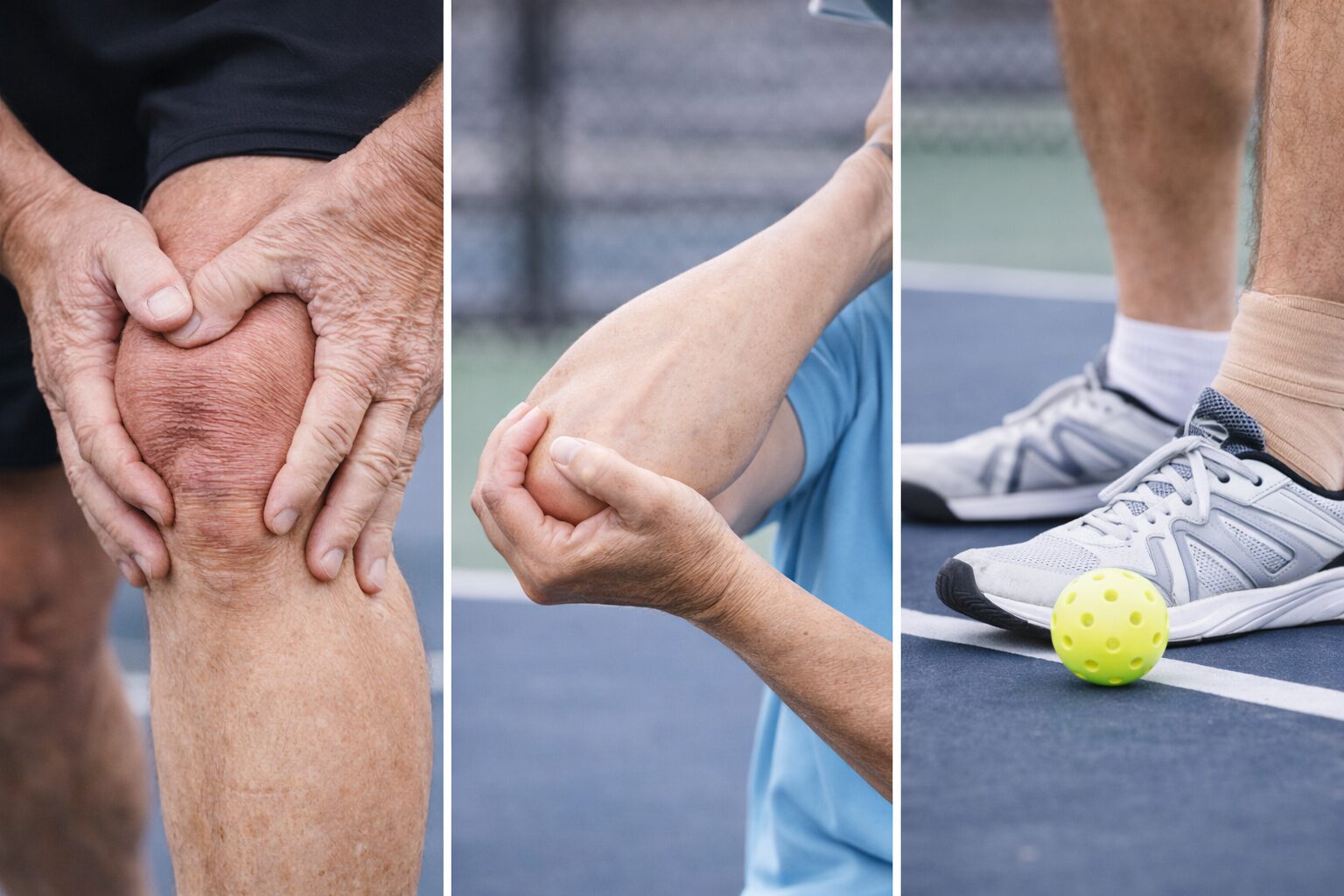
You rest one area and feel better—until something else starts hurting. The location changes, but the problem doesn’t disappear.
What causes it: load redistribution. When one area can’t tolerate stress, another takes over.
Why pickleball triggers it: same court, same shots, same patterns—compensations repeat.
Symptoms
- pain migrates over weeks
- new issues after resting the original
- tightness chains
What to do
- Identify the original weak link.
- Reduce volume for 7–14 days and rebuild.
- Prioritize ankle and hip strength for lower-body issues.
Prevention
- Minimize constant surface switching.
- Train movement chains, not isolated symptoms.
6) “I Feel Fine Playing… but the Next Day Wrecks Me”
During play, everything feels great. The real cost shows up the next morning—or even the day after.
What causes it: often connective tissue overload, not DOMS. DOMS is diffuse; tendon pain is pinpoint and repeatable.
Why pickleball triggers it: session length creeps up without planned recovery.
Symptoms
- consistent next-day stiffness
- morning Achilles pain
- shoulder ache after serves
What to do
- Apply a 48-hour rule: worse after 48 hours = too much.
- Cut duration or frequency—not both at once.
Prevention
- Treat long sessions like events requiring recovery.
- Avoid stacking long days.
7) “I Need Tape/Straps/Painkillers Just to Play Normally”
This is when support stops being optional. You don’t feel ready to play unless something is holding you together.
What causes it: your baseline has shifted—you’re no longer returning to neutral.
Why pickleball triggers it: high-frequency play plus social pressure.
Symptoms
- discomfort without support
- pre-session medication
- symptom management replacing capacity building
What to do
- Use supports temporarily, not permanently.
- Reduce load for 1–2 weeks and rebuild.
- If meds are required, seek evaluation.
Prevention
- Progressive strength and planned rest.
- Don’t let open-play culture dictate volume.
A simple system that prevents 80% of “surprise” injuries
Track these 3 numbers (mentally is fine):
- Warm-up minutes to feel normal
- Next-day soreness score (0–10) in the same spot
- Decision quality late in sessions (sharp vs rushed)
If any of those trends worsen for 2 weeks, you don’t need more grit. You need load management.
Quick Red Flags (Don’t Mess Around With These)
Most pickleball-related soreness is manageable. These symptoms are different—they signal structural injury, nerve involvement, or acute instability, and continuing to play can make them significantly worse.
If you notice sharp pain, visible swelling, or a feeling that a joint isn’t stable, stop playing immediately. Those signs often point to ligament injury, tendon tearing, or joint irritation that needs evaluation, not rest-and-see.
Pain that changes your gait or foot strike is another major warning. The moment you start limping or altering how you move, stress shifts to other joints, dramatically increasing injury risk elsewhere.
Night pain that wakes you isn’t typical sports soreness. It can indicate inflammation deep within a joint or tissue that isn’t calming down with rest.
Numbness, tingling, or sudden weakness suggests nerve involvement or compromised blood flow—issues that shouldn’t be “played through.”
Bottom line: these aren’t signals to modify your session. They’re signals to stop and get checked by a medical professional familiar with sports or orthopedic injuries. Ignoring them is how short breaks turn into long layoffs.