
PBCoR measures paddle rebound and power, not elbow safety. For players with elbow pain, swing weight, balance, grip pressure, stability, technique, and playing volume may matter more than the PBCoR number itself.
Pickleball paddles have become dramatically more powerful.
Foam cores, flexible faces, perimeter construction, and increasingly sophisticated materials have produced paddles that return more energy to the ball with less effort from the player.
That technological arms race is one reason PBCoR suddenly matters.
USA Pickleball introduced the Paddle-Ball Coefficient of Restitution test to put a measurable ceiling on how much rebound—or “trampoline effect”—a legal paddle can create. As of November 1, 2025, the USA Pickleball limit is 0.43.
But there is a claim worth clearing up immediately:
PBCoR is not an elbow-safety rating.
It limits paddle performance. It does not tell you how much vibration reaches your arm, how heavy the paddle feels, how tightly you grip it, or whether its balance is appropriate for your body.
And those factors may matter considerably more to your elbow.
So what exactly does PBCoR measure—and what should recreational players actually take from it?
First: What Does PBCoR Mean?
PBCoR stands for Paddle-Ball Coefficient of Restitution.
In simple terms, coefficient of restitution measures how efficiently two objects rebound after colliding.
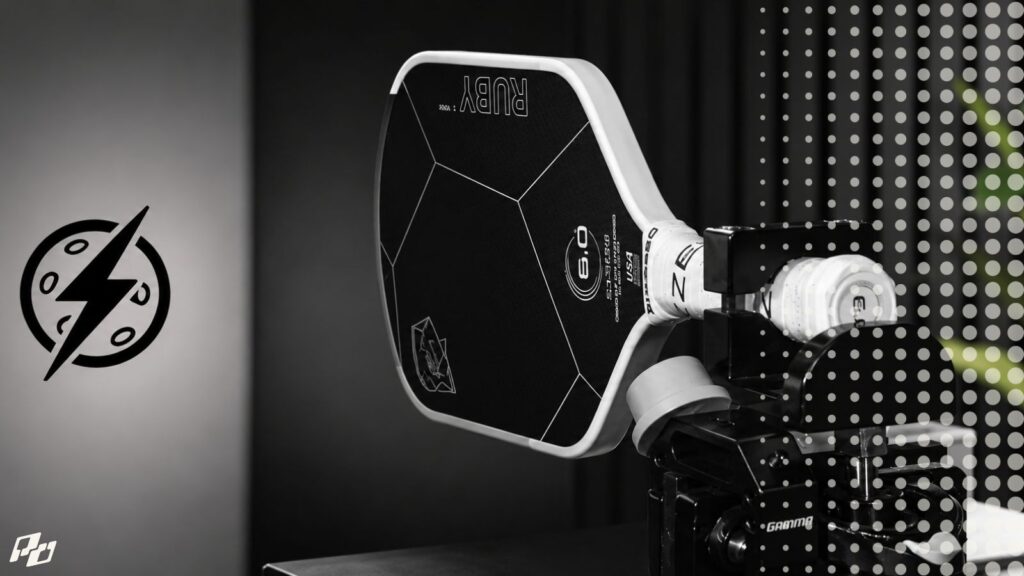
For pickleball, USA Pickleball fires a ball at the paddle at approximately 60 mph, measures the incoming and outgoing ball speeds, and uses those measurements along with paddle characteristics to calculate the paddle-ball response. The test was adapted from methods already used to evaluate baseball and softball bats.
A higher result generally indicates a more reactive paddle-ball collision.
Think: Ball arrives → paddle deforms/responds → ball rebounds.
A paddle with a stronger trampoline effect can return more energy to the ball without requiring the player to supply all of that speed through the swing.
That is what regulators are trying to limit.
Why Did Pickleball Need a Power Test?
Older paddle standards relied heavily on static stiffness testing. That worked reasonably well when most paddles used fairly simple, uniform honeycomb construction.
Then paddle technology changed. Manufacturers began using:
- perimeter foam
- thermoforming
- propulsion-style cores
- flexible structures
- multiple foam densities
- constructions deliberately designed to rebound
USA Pickleball concluded that its old static deflection test could no longer adequately characterize these dynamic designs. PBCoR was introduced specifically to measure paddle power and trampoline response during an actual ball collision.
The original limit was 0.44 in November 2024, dropping to 0.43 from November 2025.
Several previously approved high-powered paddles were subsequently removed from USA Pickleball certification, including versions of the JOOLA MOD TA-15, and Gearbox Pro Power Elongated.
Does a Higher PBCoR Mean More Power?
Broadly, that is what the test is designed to capture. But there is an important technical debate.
Independent paddle engineers have questioned whether the USA Pickleball PBCoR procedure perfectly isolates paddle power because the result is affected not only by paddle deformation but also by the ball, paddle motion, damping and test conditions. Pickleball Science has argued that the official test may therefore be less direct than the name suggests.
Meanwhile, independent testers such as John Kew use their own coefficient-of-restitution measurements alongside actual serve and punch-volley speeds rather than relying on one number alone.
For shoppers, the takeaway is straightforward:
PBCoR is a regulatory power limit—not a complete description of how powerful a paddle will feel in your hand.
Swing weight, shape, face response and your own swing mechanics still matter.
So What Does Any of This Have to Do With Your Elbow?
This is where things get interesting.
Every paddle-ball collision creates forces that travel through: paddle → hand → wrist → forearm → elbow.
Research from racquet sports shows that shock and vibration transmitted into the arm can be influenced by equipment stiffness, impact location and grip force.
But there is currently no good evidence showing:
PBCoR 0.43 = safer elbow
or:
higher PBCoR = more pickleball elbow
Those relationships have not been established. In fact, the interaction could theoretically work in both directions. A very reactive paddle may allow you to generate pace with a smaller swing.
That could mean less effort from the player.
But increasingly powerful paddles across the sport can also produce faster incoming balls, harder counters and more rapid exchanges—meaning players must repeatedly stabilize the paddle against greater pace.
So PBCoR affects the speed environment of the sport, but it does not directly measure the load on your elbow.
What Actually Matters More for Your Elbow?
For recreational players worried about elbow discomfort, these characteristics are much more useful:
| Factor | Why It Matters |
|---|---|
| Grip pressure | Excess squeezing increases forearm-muscle demand |
| Playing volume | Repetitive loading is a major driver of overuse problems |
| Swing weight | Higher swing weight requires more effort to accelerate and reposition |
| Balance point | Head-heavy paddles can place more rotational demand on the arm |
| Grip size | Poor fit may force unnecessary gripping effort |
| Mishits | Off-center impacts create more twisting and vibration |
| Technique | Excess wrist action and arm-only swings increase local loading |
| Paddle vibration/feel | Can influence comfort, although injury-prevention benefits are not well proven |
A 2025 study of 253 recreational pickleball players found that 41% reported at least one upper-extremity injury. Players who played longer, more frequently or on consecutive days had greater injury risk, while a tight baseline grip was associated with 2.67 times the risk of acute upper-extremity injury.
That is much more actionable for your elbow than knowing whether a paddle sits at 0.41 or 0.43 PBCoR.
The Grip-Pressure Connection Is Especially Important
Pickleball elbow—lateral epicondylitis—is largely an overuse problem involving the wrist-extensor tendons near the outside of the elbow.
Players often make it worse by gripping harder when:
- returning heavy pace
- swinging with a head-heavy paddle
- mishitting repeatedly
- becoming tired
- trying to manufacture power with the wrist
Harvard Health specifically identifies prolonged tight gripping and repetitive wrist movement as contributors to pickleball elbow.
And research from tennis biomechanics has shown that grip force influences the shock and vibration transmitted through the racquet-arm system.
So if your elbow hurts, obsessing over PBCoR while death-gripping your paddle misses the larger issue.
Cue
Let the paddle supply power. Don’t squeeze power out of it.
Why Swing Weight May Matter More Than PBCoR
A paddle can be extremely powerful yet easy for one player to swing. Another can have moderate rebound but feel exhausting because most of its mass sits near the tip.
Swing weight measures rotational inertia—essentially how difficult the paddle is to start, stop and redirect.
John Kew’s paddle testing explains the basic tradeoff well: higher swing weight generally increases stability and power but slows hand speed and requires more effort to move.
For a player with elbow or shoulder sensitivity, this matters.
Imagine performing hundreds of:
- drives
- serves
- counters
- overheads
with a paddle that feels slightly too demanding. One swing is irrelevant. Five hundred swings may not be.
So when comparing paddles, I would look at PBCoR/power data and swing weight separately.
They answer different questions.
Twist Weight Matters Too
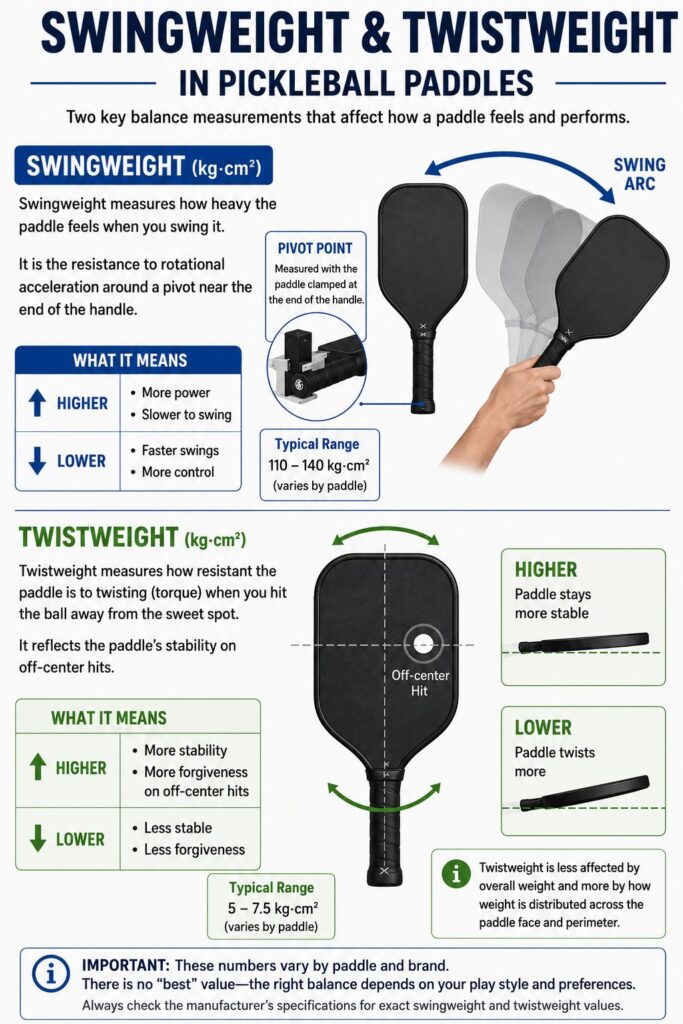
Twist weight describes how resistant the paddle is to rotating when you miss the center. Why should your elbow care?
Because off-center impacts create twisting forces that the hand and forearm must control. A paddle with better torsional stability may feel calmer on mishits.
That does not mean high twist weight has been proven to prevent elbow injuries. It has not.
But from an equipment-comfort standpoint, a stable paddle can reduce the amount of twisting you feel through the hand compared with a less stable design.
Again: PBCoR tells you about rebound. It does not tell you about stability.
So if PBCoR alone cannot tell you whether a paddle will be comfortable for your elbow, what numbers should you actually look for?
There is no medically established “elbow-safe” paddle specification, but for an arm-sensitive recreational player, I would generally start with moderate power, low-to-moderate swing weight, and enough twist weight to keep mishits stable. Think of these as shopping filters, not injury-prevention thresholds.
A Practical Paddle Starting Point for an Arm-Sensitive Player
| Spec | Starting Point | Why |
|---|---|---|
| PBCoR | Don’t chase a specific number; stay legal (≤0.43) | PBCoR measures rebound, not elbow load. There is no evidence that 0.40 is safer for your elbow than 0.42. |
| Swing weight | Roughly 105–113 (low range) is a useful shopping window. | Lower swing weight makes the paddle easier to accelerate, stop and reposition, reducing how demanding it feels over a long session. |
| Twist weight | Around 6.0–6.6+ | Moderate-to-high twist weight provides more resistance to rotation on off-center hits, so the paddle feels more stable on mishits. |
| Static weight | Roughly 7.5–8.0 oz as a starting point | Keeps overall mass manageable without automatically going extremely light and unstable. |
| Balance | Neutral to handle-biased rather than strongly head-heavy | Less mass concentrated toward the tip generally makes the paddle easier to maneuver. |
John Kew classifies swing weights below 113 as low, 113–120 as medium and 121+ as high; for twist weight, below 6.0 is low, 6.0–6.59 medium and 6.6+ high.
Pickleball Science specifically notes that players with tennis elbow or other arm problems may prefer a lower-swing weight paddle because higher swing weight requires more arm strength and can increase fatigue.
What About Paddle Vibration?
This is another area where paddle marketing gets ahead of the evidence. Manufacturers frequently promote foam, gel, carbon layups and dampening technologies as being “arm friendly.”
Some may genuinely feel more comfortable. But comfort and injury prevention are not the same claim.
Research on tennis racquets confirms that vibration travels from the equipment into the arm, but reviews also note that evidence connecting vibration reduction directly to prevention of lateral epicondylitis remains limited.
So I would trust your arm’s response without assuming that every “vibration-damping” technology is medically protective.
If one paddle consistently leaves your forearm sore while another does not, that is useful personal information.
Could a Powerful Paddle Actually Help Some Players?
Potentially. This is the part rarely discussed.
Suppose you are an older recreational player who struggles to generate pace. A paddle with more rebound may allow you to hit:
- deeper serves
- stronger returns
- firmer counters
with a shorter, more relaxed swing.
That may be preferable to repeatedly muscling a low-powered paddle using the forearm and wrist.
The problem comes when players buy a hotter paddle and then still swing at 100% on everything.
Now you have both: high paddle response + maximum player effort.
That may not be what your arm needs.
If you move into a noticeably more powerful paddle, experiment with using less swing effort, particularly on counters and returns.
Let the equipment do some of the work you paid for it to do.
PBCoR May Matter More to the Person Across the Net
This may actually be the strongest health argument.
USA Pickleball says excessively powerful paddles raised both competitive-equity and potential safety concerns. And that makes intuitive sense.
At the kitchen, players may be separated by only 14 feet. A paddle capable of producing unusually high rebound speeds gives the defender:
- less reaction time
- faster body shots
- harder hand battles
- potentially more severe ball impacts
So limiting paddle power can help prevent the sport from becoming an unchecked equipment race.
But that is different from saying:
“PBCoR was created to protect your elbow.”
It wasn’t.
What PBCoR Should Mean When You’re Buying a Paddle
For most recreational players, PBCoR should be background information rather than the number that determines which paddle you buy. You do not need to shop for the lowest PBCoR number you can find.
And many manufacturers do not publish the precise official result anyway. Instead, use performance databases and reviews to compare:
- power
- pop
- swing weight
- twist weight
- balance
- static weight
- grip circumference
- feel
JustPaddles’ Paddle Lab, for example, measures actual exit velocity by firing balls at paddles under standardized conditions, while John Kew combines coefficient-of-restitution testing with human-generated serve and punch-volley speeds.
Those numbers tell recreational players much more about the paddle they will actually experience.
If Your Elbow Already Hurts, Start Here
Do not begin by asking:
“Is my paddle PBCoR too high?”
Start with:
- Am I gripping too tightly?
- Did my weekly playing volume suddenly increase?
- Am I playing several consecutive days?
- Is the paddle too head-heavy for me?
- Am I frequently late or mishitting?
- Am I generating strokes mostly with my wrist and forearm?
- Does this specific paddle consistently increase my symptoms?
That list is much closer to what the current injury research supports.
Persistent elbow pain, loss of grip strength or worsening symptoms deserve evaluation from a qualified medical professional rather than another paddle experiment.
The Part I’d Remember About PBCoR
PBCoR matters. It gives pickleball something the sport badly needed: a standardized way to place a ceiling on increasingly reactive paddle technology.
But do not turn it into something it isn’t. It is a paddle-performance standard, not an orthopedic rating.
For your elbow, the more important question is not:
“How much energy can this paddle return?”
It is:
“How much work does my body have to do to use this paddle comfortably for two hours?”
That means considering power together with swing weight, balance, stability, grip fit, technique and playing volume.
A hotter paddle is not automatically harder on your elbow.
A softer paddle is not automatically safer.
The best paddle for your arm is usually the one that gives you enough performance without making you squeeze harder, swing harder or fight the paddle for an entire session.