The ATP fails most often because players swing before the lane exists. The ball must travel outside the post, drop low enough, and your body must get wide enough before you attempt it. It's a read before it's a swing. Wait for the side door to open, hook through the outside of the ball, and use controlled pace into open court — not maximum power.
The ATP is one of the most exciting shots in pickleball, but it is also one of the most misunderstood.
Most intermediate players know what it is. They know it happens when the ball gets pulled wide enough that you can go around the post instead of over the net. They know it looks amazing when it lands. They know it gets the whole court talking.
But knowing what an ATP is and knowing when the ATP is actually available are two very different things.
That is where most players miss.
They see a wide dink and panic. They sprint wide, swing too early, try to cut the ball around the post, and either hit the net, miss long, or dump the ball into the side fence. Then they say, “I almost had it.”
Maybe.
But more often, the problem was not the swing. The problem was that they tried to hit the ATP before the ATP existed.
That is the real secret: the ATP is not a shot you force. It is a shot you wait for.
The ATP Is a Read Before It Is a Swing
The biggest mistake intermediate players make is treating the ATP like a technique challenge.
They think:
“I need more wrist.”
“I need more spin.”
“I need to hit it harder.”
“I need to aim sharper.”
“I need a bigger hook.”
But the ATP starts before any of that. It starts with the read.
You have to recognize whether the ball is actually traveling wide enough to pass outside the post. If it is not, you are not hitting an ATP. You are just trying to bend a ball around a net that is still in the way.
That is why so many ATP attempts fail into the side of the net.
The player was not technically awful. They were early. They hit the ball while the post was still blocking the angle.
The cue is simple: Do not swing until the lane appears.
That lane is everything.
Why ATPs Feel Scary
A lot of rec players feel strange going for an ATP because it breaks the normal rules of how the court feels.
Most shots are hit over the net. The ATP asks you to trust a ball that is outside the sideline, outside your usual contact comfort zone, and often lower than you want.
That feels wrong. So players rush.
They think if they wait too long, the ball will get away from them. But the opposite is often true. Waiting is what opens the shot.
The lower and wider the ball travels, the more the angle opens. The ATP becomes easier only after the ball has moved far enough outside the post.
That is the weird mental shift.
On a normal volley or dink, waiting too long makes you late.
On an ATP, waiting a little longer may be exactly what makes the shot possible.
The Biggest Mistake: Hitting the Ball Too Early
If there is one ATP mistake to fix first, it is this one.
Most missed ATPs are early ATPs.
The ball has been pulled wide, but it has not traveled far enough outside the post. The player runs out, gets excited, reaches for it, and swings before the ball has opened the angle.
That early contact creates three common misses:
- The ball hits the side of the net.
- The ball goes too high and floats back into play.
- The player over-hooks the ball and misses wide or long.
When you hit too early, you have to manufacture the angle with your paddle. That is hard.
When you wait long enough, the court gives you the angle. Your job becomes much easier.
A better ATP should feel like you are sending the ball through an open side door, not trying to bend it through a wall.
The ATP Window: Wide, Low, and Outside the Post
A good ATP needs three things.
First, the ball must be wide enough. If the ball is still inside the post line, you probably do not have the shot.
Here’s how it’s done:
Second, the ball must get low enough. A ball that is still too high may not have traveled far enough to open the angle. Letting it drop often gives you more room to work around the post.
Third, your body must get outside enough to hit through the lane. If you are reaching from behind the ball, you will probably slap or scoop. If your feet take you wide enough, the paddle can work around the outside of the ball with control.
The best ATPs usually happen when those three things meet: wide ball, low contact, outside lane.
That is the ATP window.
Why Patience Creates the Angle
Intermediate players often think patience means being passive. Not here.
On an ATP, patience is aggressive.
When you let the ball travel wider and lower, you create a bigger hitting lane. You also give yourself a clearer visual target. Instead of guessing how much to hook the ball, you can see the path around the post.
The shot becomes less frantic.
You are not thinking, “Please curve.”
You are thinking, “There is the lane.”
That is the difference between a desperate ATP and a repeatable one.
A great cue: Wait for the side door to open.
If the side door is not open, do not force the shot.
Stop Slicing Everything Around the Post
A lot of players describe ATPs as a slice shot, but that can be misleading.
Yes, some ATPs can be hit with slice, especially from certain backhand positions or when the ball is very low. But many reliable ATPs are not really “sliced” in the way players imagine.
They are more of a hook or curve around the outside of the ball.
That matters because when players think “slice,” they often chop down. A big downward slice can send the ball into the net, float it, or make it curve too late.
The better image is this: Hook around the outside of the ball and send it through the lane.
You are not carving dramatically under it. You are guiding the ball around the post with forward intent.
The swing should still travel through the target. If all you do is brush sideways, the ball may spin but not go where you need it to go.
The Right-Side Forehand ATP
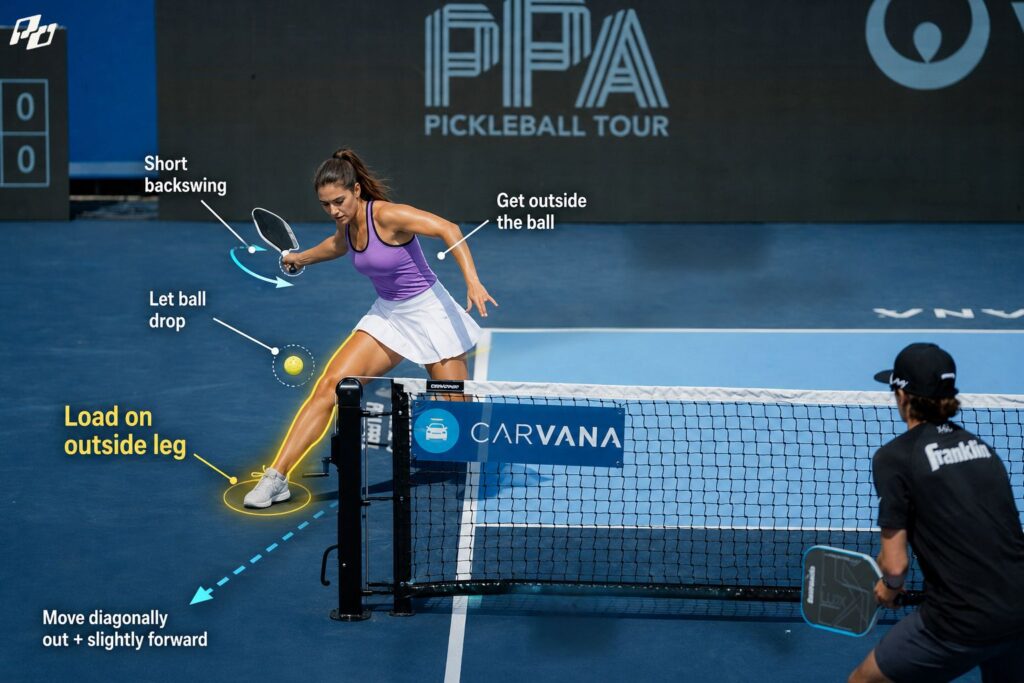
For many right-handed players, the right-side forehand ATP is the most natural version.
You get pulled wide in a crosscourt dink exchange. The ball travels outside the post. You move diagonally out and slightly forward, load on the outside leg, let the ball drop, and hook it back into the court.
The outside leg is important. It becomes your base and lever. If you are reaching with only your arm, the shot gets weak and wristy. If your body gets outside the ball and your outside leg supports you, the swing can travel through the lane with much more control.
Think: Get outside the ball before you get around the post.
The best forehand ATP does not need a giant backswing. In fact, a big backswing often ruins the timing.
You want forward extension, slight curvature, and a clean finish through the court.
The Left-Side Backhand ATP
The backhand ATP is trickier because you may have more than one option.
Some players prefer a two-handed backhand ATP when they have enough time and space. The second hand helps generate spin, stability, and direction. It can feel stronger, especially if you are trying to curve the ball back with pace.
But when you are really stretched wide, a one-handed backhand ATP may be more practical. It gives you more reach and lets you guide the ball around the post without forcing your body into a cramped two-handed position.
So the choice is not simply “one hand or two hands.”
The better question is: Do I need control, or do I need reach?
⮕ If the ball is wide but still manageable, two hands can give you more structure.
⮕ If the ball is very wide and you are fully extended, one hand may be the better survival option.
Either way, the same principle applies: do not hit it too early. Let the ball travel outside the post and drop low enough that the lane opens.
How Hard Should You Hit an ATP?
Usually, softer than you think.
This is another big reason intermediate players miss. They finally get the ATP chance, get excited, and swing like they are trying to create a highlight.
But an ATP is not always a power shot. It is an angle shot.
Once the ball is outside the post, you do not have to crush it. You just need enough pace to get it through the open lane before the opponent can recover.
Overhitting creates problems:
- the ball sails long
- the paddle face changes
- the swing gets too big
- the contact gets late
- or you lose balance after contact
The cleaner goal is: Enough pace to finish, not so much pace that you lose the lane.
A controlled ATP that lands is better than a violent ATP that hits the fence.
The Target Is Not Always the Sideline
A lot of players miss ATPs because they aim too perfectly.
They think the shot has to land an inch inside the sideline. It does not.
If the angle is open, you can often aim deeper into the court than you think. The opponent is already out of position because the ball has gone outside the post. You do not need to paint a line every time.
@officialppatour Is this the best ATP you’ve seen? To do it off of that shot is ridiculous 😳
♬ original sound – Carvana PPA Tour
Better ATP targets include:
✔️ the open backcourt
✔️ the opponent’s recovery path
✔️ deep middle if the defender is frozen wide
✔️ or the empty side behind the player who pulled you off court
The main goal is to hit into space before the opponent can reset.
A useful cue: Open court, not perfect line.
That keeps the shot from becoming too cute.
How to Know the ATP Is Not There
This is just as important as knowing when it is there.
Do not go for the ATP if:
❌ the ball is wide but still inside the post
❌ you are reaching from behind your body
❌ you cannot get outside the ball
❌ the ball is too high and still closing toward the net
❌ your only option is a wild wrist hook
❌ you are off balance and falling away
❌ or the opponent is already covering the outside lane
A missed ATP is not always a technical failure. Sometimes it was simply the wrong ball.
That is why disciplined ATP players actually pass on many ATP-looking balls.
What to Do When the ATP Is Almost There
This is where intermediate players need more patience. A ball can look tempting but not be wide enough yet.
Instead of forcing it, use a safer pressure shot:
- a soft crosscourt dink with more angle
- a middle dink to reset the pattern
- a low roll into the opponent’s feet
- or a controlled reset if you are stretched
This keeps you from turning a promising rally into a free error.
The best ATP players are not the ones who swing at every possible chance. They are the ones who wait for the ball that gives them the shot.
Why ATPs Miss Long
Not every ATP misses into the net. Some fly long. That usually happens for one of three reasons.
⮕ First, the player overhits because the shot feels exciting.
⮕ Second, the contact is too high, so the ball travels too flat.
⮕ Third, the player aims too far down the line instead of using the natural open angle.
The fix is not “baby it.” The fix is to let the ball get lower, reduce the swing size, and aim into open court with margin.
A lower contact point gives you a more natural path around the post. A smaller swing keeps the paddle face stable. A bigger target removes the need to be perfect.
Why ATPs Hit the Net
If your ATP keeps catching the side of the net, you are probably early.
That is the first thing to check.
The ball may be wide, but it has not cleared the post enough. You are swinging while the net is still between your paddle and the target.
The fix is patience and footwork.
Let the ball travel.
Get outside the lane.
Wait for it to drop.
Then swing through the open path.
Cue: If the net is still in the way, the ATP is not ready.
Why ATPs Get Popped Up
A popped-up ATP often happens when the player reaches late and lifts under the ball instead of swinging through the outside of it.
This usually comes from poor body position. The feet did not get wide enough, so the paddle has to rescue the shot. The result is a scoop.
The fix is to move wider earlier and contact the side/outside of the ball rather than getting trapped underneath it.
You want the ball to go around the post, not float back into the court like a desperate lob.
Common ATP Mistakes
- Swinging before the lane opens
You hit while the ball is still too close to the post, so the net is still in play.
Fix: Wait until the ball travels outside the post.
Cue: Let the side door open. - Trying to slice everything
You chop too much and lose forward direction.
Fix: Think hook and send, not slice and hope.
Cue: Hook through the ball. - Overhitting the finish
You swing like it has to be a highlight and miss long.
Fix: Use controlled pace into open court.
Cue: Enough pace, not max pace. - Reaching instead of moving
Your paddle gets there, but your body does not.
Fix: Move wide enough to hit from outside the ball.
Cue: Feet find the lane. - Aiming too perfectly
You try to paint the sideline and miss a makeable ball.
Fix: Aim into open space with margin.
Cue: Open court, not perfect line. - Going for ATP-looking balls
The ball is wide, but not wide enough.
Fix: Keep dinking until the lane is real.
Cue: Wide is not enough. Outside is enough.
The Best Cues to Remember
| Cue | What It Means |
|---|---|
| Wait for the side door to open. | Do not hit until the ball travels outside the post. |
| The ATP is a read before it is a swing. | Recognize the lane before thinking technique. |
| Feet find the lane. Paddle finishes it. | Move wide enough before trying to hook the ball. |
| Hook through, not around and away. | Add curve without losing forward direction. |
| Enough pace, not max pace. | Hit the open court, not the highlight reel. |
| Wide is not enough. Outside is enough. | A wide dink is only an ATP if it clears the post lane. |
| If the net is still in the way, the ATP is not ready. | Net misses usually mean you swung too early. |
Stop Forcing the Highlight
The ATP is not a magic shot.
It is not just for advanced players.
It is not just for pros.
It is not only about fast hands or crazy spin.
But it does require one thing many intermediate players struggle with:
⮕ patience.
You have to let the ball travel wide enough. You have to let it drop low enough. You have to move your feet far enough. Then, and only then, you swing through the lane that has opened.
That is why the best ATPs often feel calmer than they look.
From the outside, it looks like a highlight. From the inside, it should feel like you waited, saw the lane, and sent the ball through it.
So the next time you get pulled wide, do not rush the moment. Let the ball show you whether the ATP is really there.