
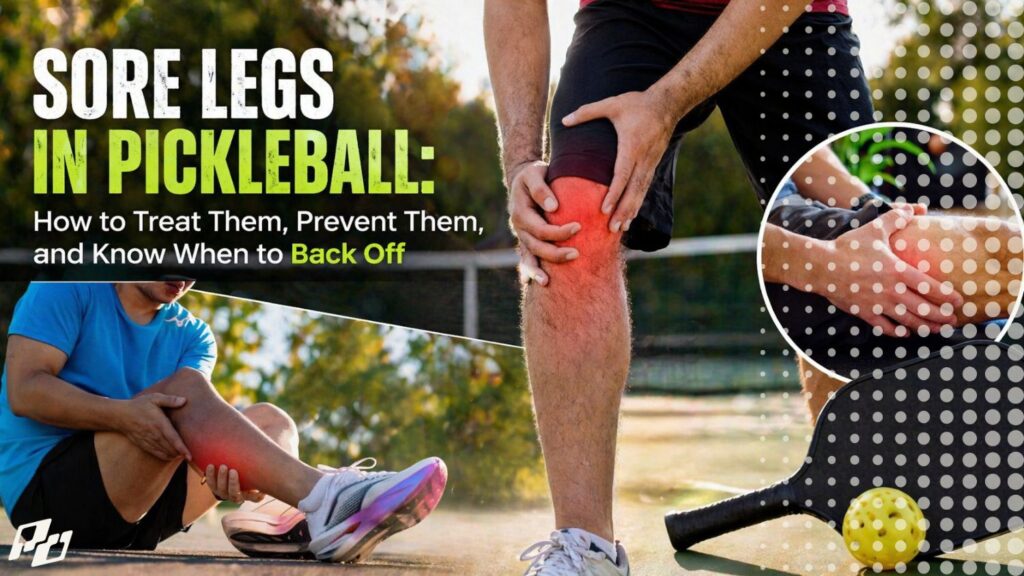
Sore legs from pickleball are usually caused by all the stopping, shuffling, lunging, and low positioning the sport demands, not just by how far you move. Mild soreness is common, but sharp pain, limping, swelling, or weakness are signs you should back off and take it more seriously.
If you play rec pickleball regularly, sore legs can sneak up on you in a weirdly annoying way.
Not dramatic injury. Not some obvious “I tore something” moment. Just that heavy, cooked feeling in your calves, quads, glutes, hamstrings, or groin where everything feels a half-step slower and a little more grumpy than it should. And the frustrating part is this: sometimes it happens even when you already work out.
That is not your imagination.
Pickleball hits the lower body with a very specific mix of short sprints, hard stops, deceleration, lateral shuffling, lunging, squatting, and repeated low positioning. Sports-medicine sources keep making the same point: pickleball may look lighter than tennis, but it still puts real demand on muscles, tendons, and joints, especially in adults who jump into it often or hard without matching recovery and preparation.
So let’s talk about the part rec players actually need: how to tell normal soreness from a problem, how to recover faster, why your legs can still get wrecked even if you “train,” and how to stop turning every good session into three bad days.
Why pickleball makes your legs sore in the first place
Pickleball punishes your legs less with pure mileage and more with change of direction.
That matters.
A lot of people compare their pickleball soreness to walking, jogging, or gym work and think, “This shouldn’t be happening. I’m in shape.” But pickleball is full of eccentric loading — your muscles braking your body as you stop, drop, shuffle wide, and recover.
That kind of load is one of the biggest triggers for delayed onset muscle soreness, or DOMS. Cleveland Clinic notes that DOMS is common after hard or unfamiliar exercise, especially when muscles are pushed harder than they are used to. HSS describes DOMS as aching, tightness, stiffness, and soreness that often shows up hours to a few days after a tough effort.
That is why your legs can feel worse after:
- a lot of low dinking
- repeated wide gets
- long kitchen exchanges
- or one session with too many stop-start points
even if you did not “run that much.”
Why your legs can get sore even if you already train regularly
This is one of the biggest rec-player misunderstandings. Being generally fit does not always mean you are specifically prepared for pickleball’s demands.
You can squat, bike, walk, lift, or do classes and still get smoked by pickleball legs because the sport layers together:
- lateral movement
- split-stepping
- deceleration
- quick recovery steps
- low stances
- and a lot of repeated partial-range positions
DOMS and overuse guidance both emphasize that soreness often comes from new or unusually demanding movement patterns, not just from being out of shape. That is why someone who is “active” can still get wrecked by a hard pickleball session if their body is not used to that exact combination of loads. HSS also warns that overtraining and under-recovering can pile up even in people who think they are handling things well.
In normal language: your legs may be strong enough for exercise, but not yet conditioned for pickleball-specific fatigue.
That is a huge difference.
The leg areas that usually complain first
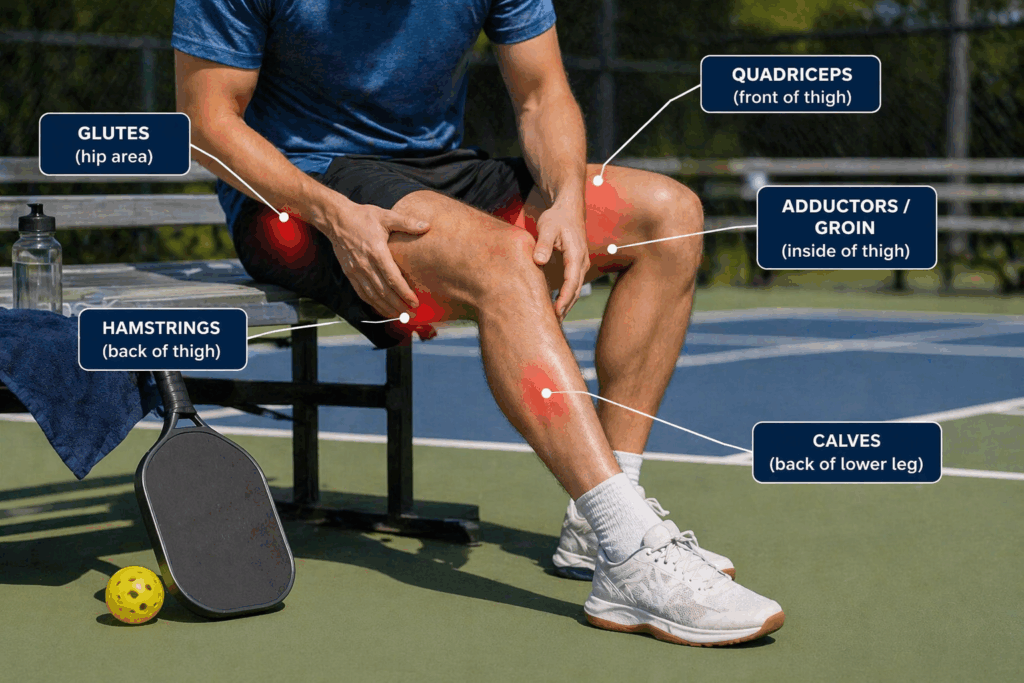
For most rec players, the usual problem zones are pretty predictable.
Your calves take a beating because of all the small reactive pushes, split steps, and quick stops. Cleveland Clinic notes that calf pain can come from cramps, strains, and other overload issues, and sports with lots of quick movement are common triggers.
Your quads and hamstrings work constantly to slow you down, stabilize your knee, and help you get back out of low positions. AAOS points out that thigh strains are common in sports because the quads, hamstrings, and adductors are doing so much acceleration-and-braking work together.
Your adductors and groin often get quietly overloaded by lateral movement and reaching wide. And your glutes can get sore if you are using more hip control and deceleration than usual, especially after long sessions or lots of defensive gets. That overall lower-body demand is one reason HSS keeps highlighting movement prep and strength as part of pickleball injury prevention.
Normal soreness vs. “something is wrong”
This is the part most rec players need help with.
Normal soreness usually feels like:
- a broad ache
- stiffness
- heaviness
- tenderness when you move or sit down
- and a “worked” feeling that peaks 24 to 72 hours later
DOMS generally goes away in a few days, and if it lasts a week or more, you may be dealing with something more than ordinary post-exercise soreness.
More concerning pain looks more like:
- one sharp spot
- swelling
- bruising
- limping
- a “pop” or tearing feeling
- pain that gets worse instead of better
- real weakness
- or pain that changes how you walk or play
Strains usually feel more specific and more clearly “injured,” often coming with weakness, muscle spasm, swelling, or even a tearing or popping feeling when the injury happens.
A good practical rule is this:
Soreness feels like your legs got worked.
Injury feels like something is wrong.
That is not perfect medicine, but it is a very useful rec-player filter.
When you should not “just play through it”
A lot of rec players are too proud here.
Low-level soreness is often fine to train around. Mild soreness after exercise can be okay if you dial things back and choose lighter activity. However, you should not push through pain while exercising.
That means you should not keep playing normally if:
- you are limping
- you feel sharp pain instead of soreness
- you cannot push off normally
- the leg feels weak or unstable
- the pain is concentrated in one spot
- you have swelling or bruising
- or the soreness has lasted long enough that it now feels more like a strain or overload problem.
If you felt a pop, cannot walk normally, or the pain is severe, that moves you out of “recovery tips” territory and into “get evaluated” territory.
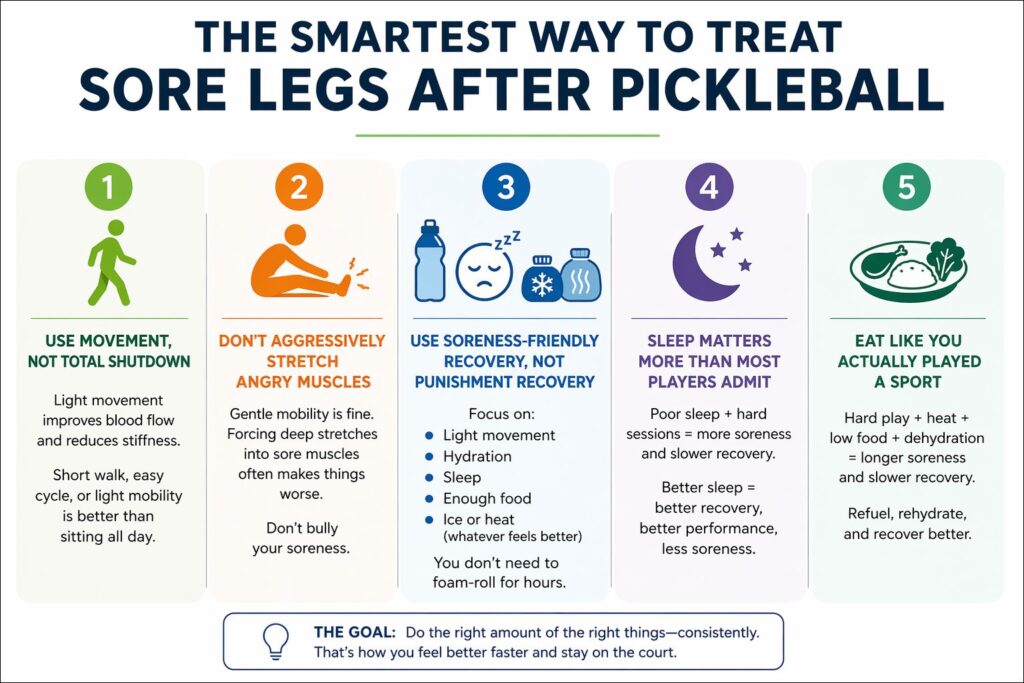
The smartest way to treat sore legs after pickleball
This is where most rec advice gets way too generic.
Yes, hydration matters. Yes, rest matters. But the best recovery plan is usually not “do everything.” It is “do the right amount of the right things.”
1. Use movement, not total shutdown
For ordinary soreness, light movement is usually better than becoming a statue.
Gentle walking, easy cycling, or light mobility can help reduce stiffness and get blood flow going.
That means the day after a hard pickleball session, a short walk and light mobility often help more than collapsing on the couch for 11 hours.
2. Do not aggressively stretch angry muscles
This is one of the not-so-obvious tips.
A little gentle mobility is fine. Trying to force deep stretches into already sore calves or hamstrings often just makes everything feel worse.
That does not mean “never stretch.”
It means: do not treat soreness like a knot you can bully into submission.
3. Use soreness-friendly recovery, not punishment recovery
The best immediate recovery for ordinary post-play soreness is usually:
- light movement
- hydration
- sleep
- enough food
- and maybe brief ice or heat depending on what feels better to you
You do not need to foam-roll yourself into another dimension.
4. Sleep matters more than most rec players admit
This is boring advice, but it is load-bearing.
If your legs are constantly sore, your recovery problem may not be on the court. It may be that you are stacking hard sessions onto mediocre sleep and asking your body to keep up.
5. Eat like you actually played a sport
Another non-obvious one: some rec players under-recover because they treat pickleball like social cardio and then do not refuel.
If you play hard, especially in heat, and especially more than once in a day, low energy intake plus dehydration plus muscle damage is a great way to stay sore longer than necessary.
Quick recovery when your legs are cooked but not injured
If your legs are sore in a normal post-session way, this is a solid same-day or next-day plan:
✅ 10 to 20 minutes of easy walking
✅ Gentle ankle, hip, and hamstring mobility
✅ Fluids and electrolytes if you sweated a lot
✅ An earlier bedtime than usual
✅ Easier activity the next day instead of another hard session
✅ No heroic “leg day” because you are annoyed at being sore
That is not sexy.
It is just effective.
The best prevention tip most rec players skip: stop treating every session like the workout
This is huge.
A lot of rec players say they “train regularly,” but in reality all their real intensity is still happening inside pickleball. That works until it doesn’t.
The real prevention move is not just “play more until your legs adapt.”
It is: build your legs to handle pickleball outside of pickleball.
That means a little strength and a little movement prep go a long way.
The lower-body work that actually helps pickleball legs
You do not need an NFL offseason program.
But if your legs are always sore, some combination of these usually helps:
- calf raises
- split squats
- step-downs
- glute bridges
- lateral lunges
- hamstring work
- and balance work
Why those? Because they train the exact things pickleball keeps asking your body to do.
Smart tips that are not obvious but actually help
Keep a “leg soreness map”
This sounds nerdy, but it works. Notice where you always get sore:
- calves after lots of split-stepping?
- groin after wide gets?
- quads after long kitchen battles?
- one leg more than the other?
That tells you whether the issue is general fatigue, movement pattern, footwear, or one side overworking.
Watch your low posture habits
Some players get sorer from the way they stay low than from the volume itself.
If you are constantly squatting with quad-dominant tension instead of using hips and glutes well, your quads may get overloaded fast.
Do not chase every ball in dead rec games like it’s match point
This is one of the most useful rec-player habits to fix.
You do not need to dive into full panic defense on every meaningless open-play point. A lot of leg overload is not from the total session. It is from too many max-effort saves sprinkled into normal games.
Rotate intensity inside the week
Not every pickleball day needs to be your “hardest day.” One of the best ways to stop chronic soreness is to have:
- one harder day
- one moderate day
- and one lighter / more social / more drill-based day
instead of three accidental war zones.
Footwear matters more than many sore-leg players realize
This is not just about blisters or ankles.
If your court shoes are old, dead, unstable, or wrong for the surface, your calves and legs may be absorbing more stress than necessary. Poor grip or worn cushioning can change how hard your muscles have to brake and stabilize.
So if your legs are always cooked and your shoes are ancient, do not ignore that clue.
A simple warmup that helps more than static stretching
Before you play, do not just stand there touching your toes and hoping for the best. A better warmup is:
- calf raises
- marching
- lateral shuffles
- bodyweight lunges
- mini split-step hops
- and a few low shadow movements like you are getting to a dink
For leg soreness specifically, dynamic movement usually makes more sense than long static holds right before play.