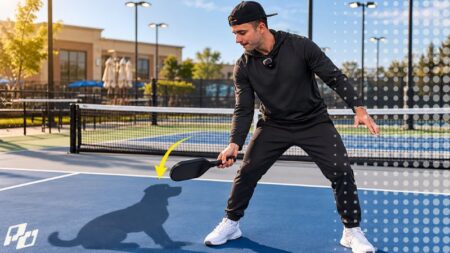

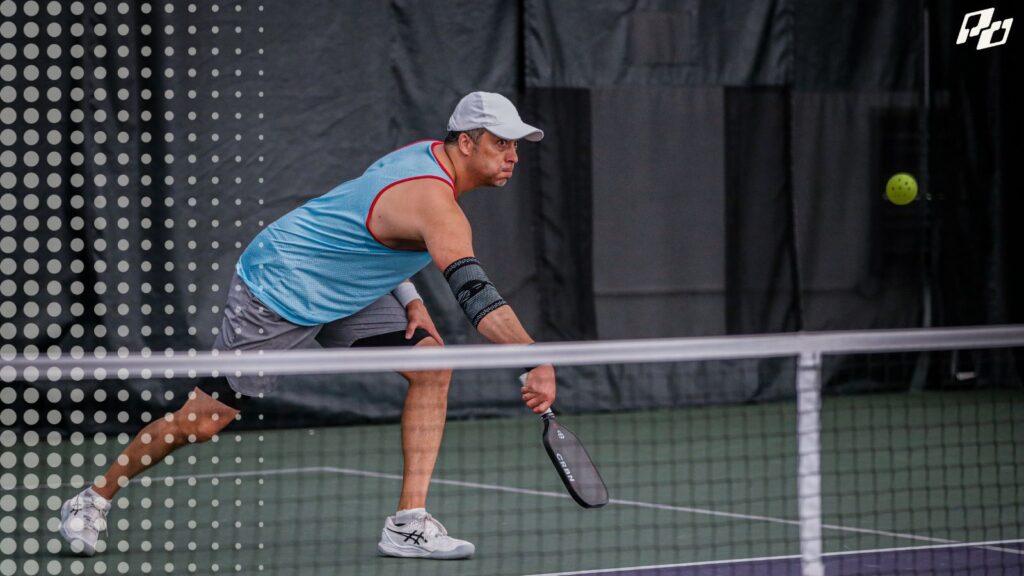
A pickleball half-volley is best handled by staying low, using a wide base, slightly opening the paddle face, and swinging sharply upward. When opponents attack your feet in transition, keep your lower body quiet and let the paddle create the lift so the reset stays low and controlled.
You hit a decent third-shot drop. You move forward. Your opponents see you in transition and do exactly what good players are supposed to do: they put the next ball at your feet.
It bounces just before your paddle. Now you have almost no time, the ball is inches off the ground, and your instinct is probably to scoop it, stand up, or push forward through it.
That is exactly where the half-volley falls apart. So pro player and Ben Johns’ brother, Collin Johns, teaches a much cleaner solution:
get wide, get low, drop the paddle tip, open the face slightly, and swing sharply upward while your lower body stays quiet.
This isn’t just a technique for making prettier half-volleys.
It’s a way to survive one of the hardest situations in intermediate pickleball: moving through the transition zone while the other team keeps attacking your feet.
Why Your Feet Are Such a Good Target
When you’re standing at the kitchen, a ball around your feet can often be volleyed before it drops. When you’re deeper in the transition zone, that’s harder.
You’re moving.
You’re farther from the net.
And opponents have more room to make the ball dip before it reaches you.
That’s why coaches teach players to keep the paddle lower when they’re deeper in transition for exactly this reason: opponents can drive or roll balls down toward the knees, shins and feet.
Pro Mari Humberg teaches the opposite side of the same equation: when an opponent is stuck in transition, attack the feet. A ball that dips and bounces in front of the advancing player can force an awkward low contact rather than an easier volley.
That’s where Collin’s half-volley technique becomes so useful.
The ball has bounced.
But barely.
You have to solve it from near ground level.
The Half-Volley Is Mostly a Geometry Problem
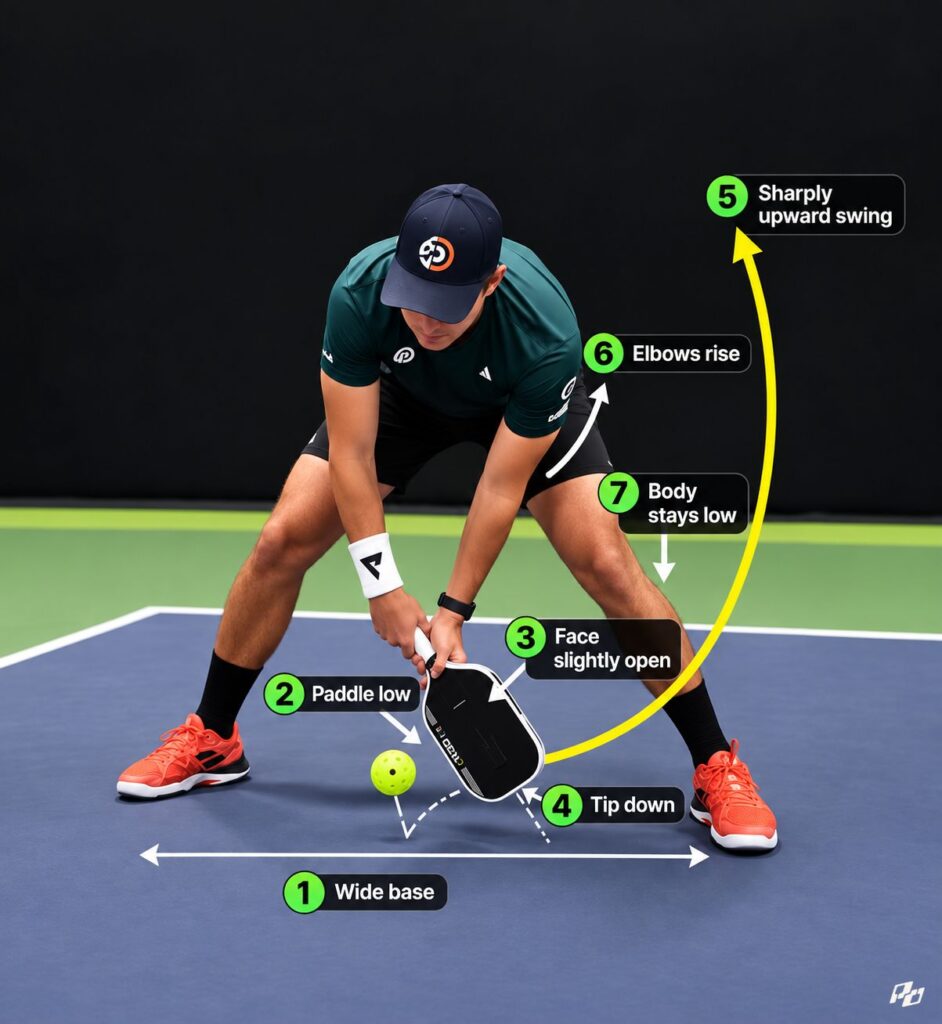
This is the part of Collin’s explanation that matters most. If you catch the ball immediately after the bounce, the contact point is extremely low.
But the net hasn’t moved. So the ball needs a steep upward launch. That’s why Collin does not want a normal forward dink swing.
His sequence is:
- wide base
- paddle low
- face slightly open
- tip down
- sharply upward swing
- elbows rise
- body stays low
The big mistake is trying to send the paddle too far forward. From such a low contact point, a forward push doesn’t give the ball enough vertical help. Then players compensate by opening the paddle face more.
Now the ball floats.
Collin’s answer is smarter: get the height from the swing path, not from an excessively open paddle face.
Why Dropping the Paddle Tip Matters
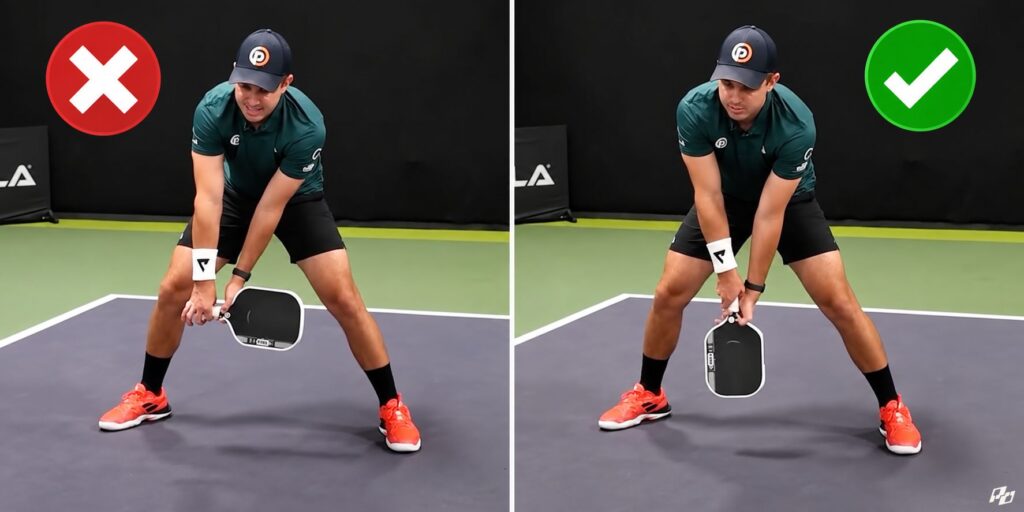
Hold your paddle sideways with the head roughly level with your hand. Now imagine the ball bouncing six inches off the ground. It’s difficult to get underneath it naturally.
Drop the paddle tip and suddenly your paddle is already arranged to travel upward. That’s the point.
The dropped tip helps create the low-to-high path without requiring a wristy scoop.
Think: tip down → paddle rises.
Not: face wide open → shovel underneath.
That difference is enormous.
The Most Important Part: Don’t Stand Up
This may be Collin’s best cue. The paddle needs to rise. Your body doesn’t.
Intermediate players often start in a decent athletic stance and then straighten their knees and waist as they hit the half-volley.
They literally lift their entire body to lift the ball. That creates too much movement.
Your head rises.
Your shoulders rise.
Your paddle rises.
Your face angle changes.
And suddenly a supposedly soft reset is sitting chest-high for your opponent.
Collin compares the arm motion to raising a kettlebell—but makes the key distinction that the waist stays down.
I like an even simpler cue: Lift the paddle, not yourself.
Your legs provide the platform. Your arms provide the trajectory.
Why This Is So Valuable in the Transition Zone
The half-volley isn’t just a defensive shot. It can help you keep the ground you’ve already earned.
Suppose you’re halfway from the baseline to the kitchen. Your opponent sends a low ball that lands at your feet.
If your only response is: back up and wait for the bounce, you may surrender several feet of progress.
Sometimes backing up is absolutely correct. But if you’re balanced and the ball is manageable, a controlled half-volley can let you neutralize it from where you are.
Drop it softly back into the kitchen. Then evaluate the next ball.
If your reset stays low, take another step or two forward.
If it sits up, stop and defend.
That matches a major theme in current transition coaching: you don’t sprint through the transition zone—you earn your way through it one balanced stop and reset at a time.
The half-volley can be one of those resets.
Here’s Collin Johns making the case for half-volleys — and why learning to handle them well can be such an important part of your transition game:
Don’t Confuse a Half-Volley With a Panic Short-Hop
They may happen at nearly the same moment after the bounce. They are not the same shot.
Controlled half-volley
- You’re balanced.
- Your feet have stopped.
- Your paddle is already low.
- You have room between the ball and your body.
- You catch it immediately after the bounce with a compact upward stroke.
Panic short-hop
- You’re still running forward.
- The ball jams your shoes.
- Your paddle drops late.
- You stab at it.
- And you hope.
Collin’s technique assumes the first situation. That’s why the wide, stable base comes first.
Before worrying about paddle angle, get your body organized.
Stop Before They Hit
This may actually determine whether the rest of Collin’s technique works. If you’re moving through transition when the opponent contacts the ball, you often arrive at the bounce with your momentum still carrying you forward.
Now the half-volley is hitting a moving target—your body. Instead, advance while you can, then split and get balanced as the opponent strikes.
Your pattern becomes: move → split → read → half-volley/reset → move again.
Not: run → hit while running → keep running.
That distinction alone cleans up a lot of transition errors.
Keep the Ball in Front of Your Feet
Another subtle point: a good half-volley happens low, but you don’t want the ball underneath your body. If it gets directly between your shoes, you have almost no swing path left.
The paddle can’t rise naturally. Now you’re forced into a scoop.
Ideally, your split step gives you enough balance to make a small spacing adjustment and catch the ball in front of your base, not buried underneath it.
Think: low and close, but not trapped.
The shot should feel compact. Not cramped.
Don’t Try to Generate Pace
This is especially important in transition.
The opponent may have just hit the ball fairly hard. You don’t need to send that pace back.
Often you’re trying to do the opposite. You’re taking a difficult ball at your feet and trying to place it softly into the kitchen so the opponent cannot attack the next ball from above the net.
So although Collin needs a sharply upward path on the half-volley, don’t interpret that as: swing harder upward.
Think: shorter, steeper, softer.
How Open Should the Paddle Face Be?
This is where players tend to overcorrect.
Collin says slightly open. If the paddle face points too far toward the ceiling, the ball launches upward and hangs. If it’s too closed, the low contact finds the net.
The correct face depends on:
- incoming pace
- spin,
- how low the contact is
- and how far you’re trying to send the reset
But the principle stays the same: don’t ask paddle angle to do all the lifting.
Use enough face to clear the net, then let the steep upward swing path provide the rest.
Your Best Feedback Isn’t Whether the Ball Went In
A half-volley can land in the kitchen and still be terrible.
If it sits shoulder-high after the bounce, your opponent is still attacking. Instead, watch what your shot makes them do.
A good transition half-volley should give the opponent a ball they have to
- hit upward
- take below net height
- or at least contact without a strong downward angle
Then you have potentially earned another step forward.
Your real test is: did my half-volley buy me ground?
If yes, it worked. If the opponent is smashing the next ball at your shoes again, you probably didn’t neutralize enough.
Don’t Automatically Advance After Every Half-Volley
This is another intermediate mistake. You hit one decent reset and immediately charge the kitchen. But your half-volley might still be a little high.
Watch the opponent. If they’re contacting the next ball from below the net, that’s your invitation to move.
If they’re reaching forward and contacting it above net level, stop.
Maybe even give yourself more space. Opponent contact height should determine whether you advance, hold, or defend.
So: good half-volley → look up → read contact → then move.
Don’t decide before you know what your shot actually produced.
A Better Half-Volley Drill
Don’t practice this by standing still at the kitchen. Practice where the shot actually hurts you: in transition.
Put one player at the NVZ. Start the other around midcourt. The kitchen player intentionally sends controlled balls toward the transition player’s feet. The transition player:
- gets wide before contact
- keeps the paddle low
- allows the ball to bounce
- catches it immediately after the bounce
- and resets softly into the kitchen
Then move forward only if the reset earns it.
The goal isn’t to reach the kitchen as quickly as possible. Count how many controlled half-volley resets it takes you to get there.
That makes the drill much more realistic.
The Five-Second Check
When your half-volley keeps popping up, check these in order:
Were my feet stopped?
Was my base wide and low?
Was the paddle already beneath the ball?
Was the face only slightly open?
Did the paddle travel up while my waist stayed down?
Don’t start by blaming “touch.” Most half-volley problems are easier to see than that.
When You Should NOT Half-Volley It
This shot is useful. It is not mandatory.
If you’re badly off balance, completely jammed, or caught moving through contact, forcing a delicate half-volley may be a poor percentage choice.
Likewise, if the ball is high enough to take comfortably out of the air, letting it bounce just to manufacture a half-volley doesn’t make much sense.
And if giving yourself one small step backward creates a dramatically easier contact, sometimes that’s the smart play.
The goal isn’t to prove you can half-volley. The goal is to get through transition without giving the opponent another easy attack.
Use the earliest contact you can actually control.