

If you’ve played rec pickleball long enough, you’ve seen it: a speaker shows up. One group loves it. Another group can’t hear the score. Someone makes a comment. Suddenly the vibe is… tense.
This guide isn’t here to be the “pickleball police.” It’s here to help you navigate the real-world mess of shared spaces—without starting a war over a playlist.
Why Music Becomes a Pickleball Problem (Even When It’s “Not That Loud”)
Pickleball isn’t background-noise friendly in the same way casual basketball or a solo workout is. Music on pickleball courts can create friction because it directly affects:
- Score calling and partner communication (“0-0-2,” “yours,” “out,” “switch”)
- Reaction timing (especially in fast kitchen exchanges)
- Focus and sensory load (some players genuinely struggle with noise)
- Shared-space fairness (your speaker doesn’t stay on your court)
- Community politics (noise complaints are already a thing in many towns)
The tricky part: music can be both “fun” and “rude” depending on context. That’s why you need etiquette—not a blanket opinion.
The Golden Rule on Shared Courts
If it’s a shared/public/open-play environment: music is “opt-in,” not “opt-out.”
➡️ Meaning: don’t play music unless the people around you are okay with it.
This is the biggest social mismatch I see:
- Speaker group thinks: “If you don’t like it, tell us.”
- Everyone else thinks: “If you want it, ask first.”
In rec play, the polite standard is: ask first.
Public Courts: What’s Reasonable (and What Isn’t)
Public courts are the toughest environment because:
- You didn’t reserve the space.
- People rotate in/out.
- You’re sharing with multiple courts and random park users.
- You have no “owner” to make a call.
Public court speaker etiquette that actually works:
✅ Ask nearby courts before you press play
“Hey—anyone mind if we play something low?”
✅ Keep volume “court-contained”
A good test: if people two courts away can recognize lyrics, it’s too loud.
✅ Choose neutral music
Instrumental / low-energy works better than aggressive or explicit tracks when strangers are around.
✅ Turn it off during peak open play
If courts are packed and rotating, it’s not “your environment” anymore.
✅ Be willing to stop immediately
If someone says it’s affecting play, you don’t debate. You adjust.
What usually doesn’t fly on public courts:
🚫 Starting music without asking
🚫 “We were here first” logic (it’s still shared)
🚫 Turning it into a vote mid-conflict (it gets tribal fast)
🚫 Treating objections as “Karen behavior” (instant escalation)
Clubs & Private Facilities: Different Rules, Different Expectations
Clubs are where this should be easiest—because they can set policy.
If you’re at a club:
- If open play: treat it like public courts (opt-in, ask first)
- If a reserved court: you have more freedom—but still keep it respectful
- If the facility has posted rules: rules win (even if you don’t like them)
Clubs that avoid drama usually do one of these:
- No speakers during open play
- Speakers allowed only on reserved courts
- “Low volume / no bleed” policy + staff enforcement
If your club has constant music conflict, the solution isn’t more arguing. It’s a written policy.
Tournaments, Leagues, Ladder Nights: Assume “No”
For anything structured or competitive:
- Music adds uneven conditions
- It makes communication harder
- It can irritate opponents and refs/organizers
➡️ Unless the organizer provides the music, don’t bring it.
“Can We Ban Music?” The Practical Answer
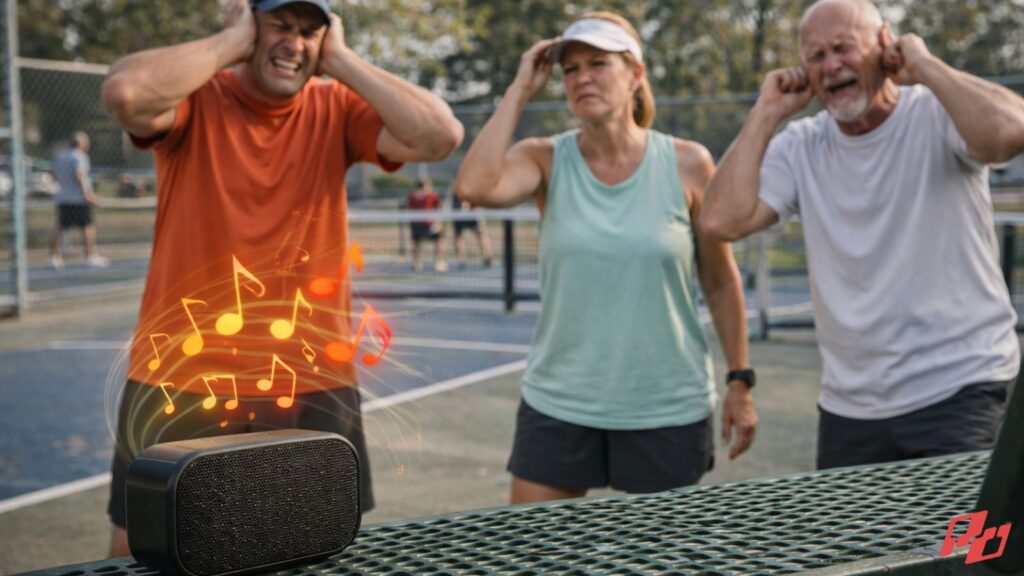
A true “ban” depends on the venue. But here’s the practical reality: you don’t need a dramatic ban to fix the problem.
You need a clear standard like:
- Open play = no speakers
- Reserved courts = speakers allowed at low volume (no bleed)
- If someone asks to lower/stop = you lower/stop
- Repeat offenders = staff steps in
That’s not anti-fun. That’s anti-conflict.
What To Do If Someone Else Is Playing Music (Scripts That Work)
Your goal is not to win the argument. Your goal is to solve the problem without escalating.
Best approach: friendly + specific + easy request
- “Hey—could you turn that down a bit? We’re having trouble hearing the score and partner calls.”
- “Mind turning it off during open play? It’s carrying across a few courts.”
Why this works:
- You’re not attacking their taste
- You’re naming a functional issue (communication)
- You’re giving them a clear fix
What not to say (if you want peace)
- “This is obnoxious.”
- “Nobody wants to hear your music.”
- “You’re ruining the courts.”
- “This should be banned.”
Those lines don’t solve the issue—they trigger defensiveness.
If They Say No (or Get Weird About It)
Use an escalation ladder that keeps you calm:
Step 1: Repeat the shared-space frame
“Totally—this is just a shared open play setup, so we try to keep it neutral for everyone.”
Step 2: Suggest a compromise
- “Could it be low enough that you can’t hear it off this court?”
- “Could you use it during warmup, then off during points?”
Step 3: Ask a neutral third party (if available)
A court monitor, ambassador, staff member, or the person running the paddle rack rotation.
Step 4: Use the “posted rules” path (if any exist)
If there’s signage, it removes personal conflict.
Step 5: Move + document (last resort)
Sometimes you can’t win the moment. But you can prevent the next one:
- Email the parks department / club
- Ask for a written policy
- Suggest signage
If You’re the One Bringing Music: How to Do It Like a Pro (Socially)
If you bring a speaker, the etiquette burden is on you—because you’re introducing something that affects others.
The “Speaker Owner Checklist”
Before you press play:
✅ Did I ask nearby courts?
✅ Is it open play or reserved?
✅ Can players still call the score normally?
✅ Is my speaker pointed inward (not out to other courts)?
✅ Am I willing to turn it off immediately if asked?
The best mindset: your music is a privilege, not a default.
Important Clarifications (Because This Topic Gets Personal Fast)
“But music helps me play better.”
Totally fair. But in shared spaces, you don’t get to optimize your experience by reducing someone else’s ability to play or communicate.
“Pickleball is supposed to be fun.”
Yes. That’s why we avoid turning courts into personal environments. Fun is shared, not forced.
“If you don’t like it, bring earplugs.”
Earplugs don’t help you hear the score. And it’s not reasonable to ask others to adapt to your added noise.
“What about earbuds?”
Earbuds are the best compromise—if you’re not responsible for calling score or coordinating with a partner constantly.
In doubles, one earbud at low volume can work for some people… but it can also create miscommunication fast. Use judgment.
“What about cultural differences?”
Music norms vary. In some communities, music at pickup sports is normal. In others, it’s considered rude. That’s exactly why the ask-first rule is so powerful: it respects the local vibe.
The “Public Court Peace” Code (Simple, Non-Embarrassing, Effective)
If you want a clean guideline you can repeat without sounding dramatic:
- Open play = no speakers unless everyone nearby agrees.
- If anyone asks to lower/stop, you lower/stop.
- Reserved courts get more freedom—still no bleed.
- Don’t argue. Adjust.
That solves 95% of the conflict.
What Venues Should Post (If You Want Fewer Fights)
If you ever talk to a parks department or club manager, here’s a policy that actually reduces drama:
Sound Policy
✔ No amplified music during open play.
✔ Speakers allowed only during reserved court time.
✔ Volume must not be audible beyond the assigned court area.
✔ If another group requests lower volume due to communication, volume must be reduced.
✔ Staff or court monitors may enforce the policy; repeated violations may result in removal.
Clear rules stop personal feuds.