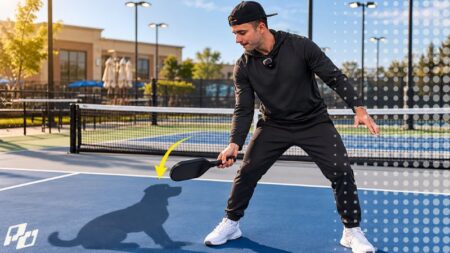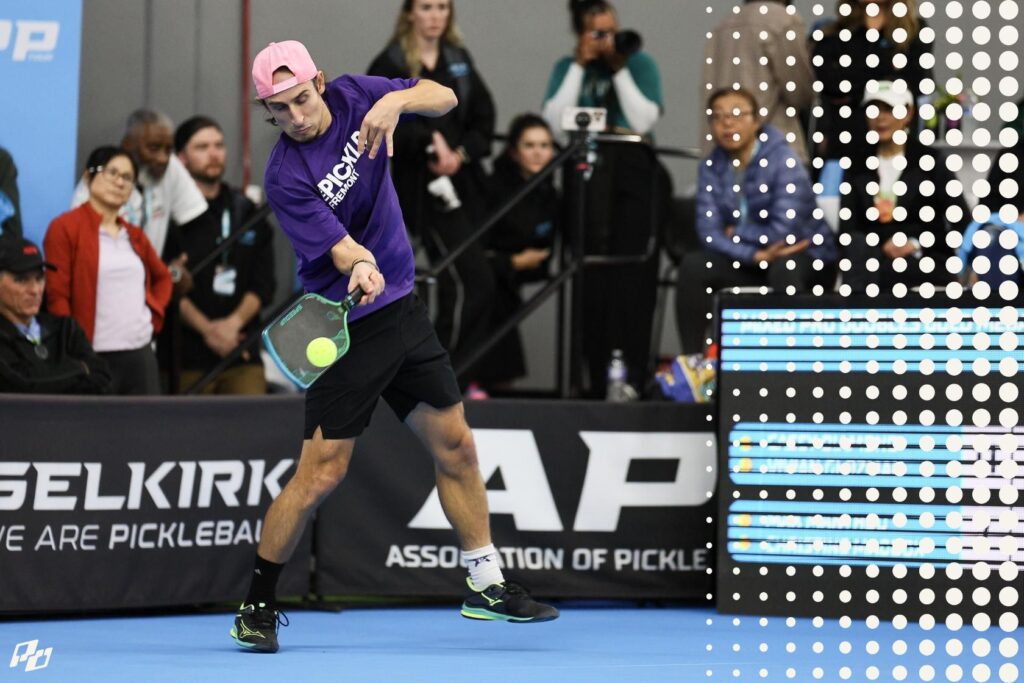
A consistent pickleball serve starts with a consistent ball release. Whether you use a volley serve or a drop serve, releasing the ball into the same contact window every time improves timing, accuracy, and confidence. Under the 2026 rules, volley and drop serves have different release requirements, but both reward a simple, repeatable motion that lets your swing stay relaxed and consistent.
Ever have one of those days when your serve feels automatic…
…then two days later you can’t seem to hit the same target twice?
Most intermediate players assume the problem is their swing. They start thinking about paddle angle, wrist position, or whether they should add more topspin.
But after listening to top coaches and watching countless recreational players, I’ve become convinced that many serving problems actually start before the swing even begins.
They start with the ball release.
It’s one of the least-discussed parts of serving, yet it determines something every great server depends on: a repeatable contact point.
If the ball arrives in a different place every serve—even by just a few inches—your body has to make last-second corrections. That’s when serves start drifting long, clipping the tape, or missing wide for reasons that seem impossible to explain.
The swing often isn’t changing.
The ball is.
First, Know What the 2026 Rules Actually Allow
Before talking technique, it’s worth clearing up one area that still confuses a lot of players. The rules for the volley serve and drop serve are no longer identical.
On a volley serve
You strike the ball before it bounces.
The paddle must still be moving in an upward arc, the highest point of the paddle head cannot be above your wrist at contact, and contact must occur below your waist. You may release or gently toss the ball before striking it, provided the release is visible and you don’t intentionally add spin with your hand. Natural rotation is allowed.
On a drop serve
The ball must simply be released from its natural height and allowed to bounce.
You cannot throw it upward.
You cannot push it downward.
You cannot propel it sideways.
The 2026 referee casebook also clarifies something many recreational players don’t realize—you should be stationary when you release the ball. In other words, “stop and drop.” The ball should fall under gravity rather than carrying forward momentum from your body.
Those are the rules. Now let’s talk about why your release matters even if you’re perfectly legal.
Your Release Has One Job
Forget power.
Forget spin.
Forget trying to ace someone.
Your release has one job: deliver the ball into exactly the same contact window every single serve.
Think about it this way.
Your swing shouldn’t have to find the ball.
The release should deliver the ball to your swing.
Every serve depends on three things staying remarkably consistent:
- how far in front of you the ball falls
- how far it is from your body
- when it gets there
Miss any one of those and your swing starts improvising. That’s why two serves can feel identical while producing completely different results.
The Hidden Reason Your Serve Feels Different Every Day
Here’s something I notice all the time with intermediate players. They’ll tell me, “I don’t know what happened. I was serving great yesterday.”
Usually, their swing hasn’t changed very much.
Their timing has.
More specifically…they’ve started releasing the ball before the rest of their body is ready.
The ball begins falling.
The paddle is still behind them.
Now the body has to rush.
That usually leads to one of three compensations:
- a quick wrist flick to catch up
- the shoulders dipping toward the ball
- reaching instead of swinging through it
Suddenly the serve feels completely different.
A simple self-check
Watch yourself on video. The instant the ball leaves your hand… what is your paddle doing?
⮕ If it’s already beginning a smooth forward motion, your timing is probably good.
⮕ If the paddle is still parked behind your body while the ball is falling, your release is probably happening too early.
Think of the rhythm as:
Set → Release → Swing
Not…
Release…wait…panic…swing.
Where Should the Ball Actually Fall?
Most players think only about release height. That’s only part of the equation.
Where the ball lands in relation to your body is usually more important.
Too close to your body
This is probably the most common mistake I see. The ball drops almost against your front hip. Now your elbow gets trapped.
Instead of swinging freely through contact, you have to steer around your own body. The result?
Usually:
- pulled serves
- excessive wrist action
- inconsistent depth
Too far in front
Now you’re reaching. Your chest opens early. The paddle face changes angle just before contact.
One serve flies long. The next one lands short.
Too far to the side
The serve becomes almost entirely arm-driven. You lose body rotation and start relying on hand speed instead of sequencing.
A useful cue is:
Deliver the ball to your swing. Don’t make your swing chase the ball.
The easiest way to do that is to make your setup repeatable. If your feet, release hand, and ball position all start in the same place, your contact point usually will too.
A Simple Setup That Promotes a Better Release
If you’re struggling with consistency, don’t overcomplicate your setup. Give yourself the same reference points every serve.
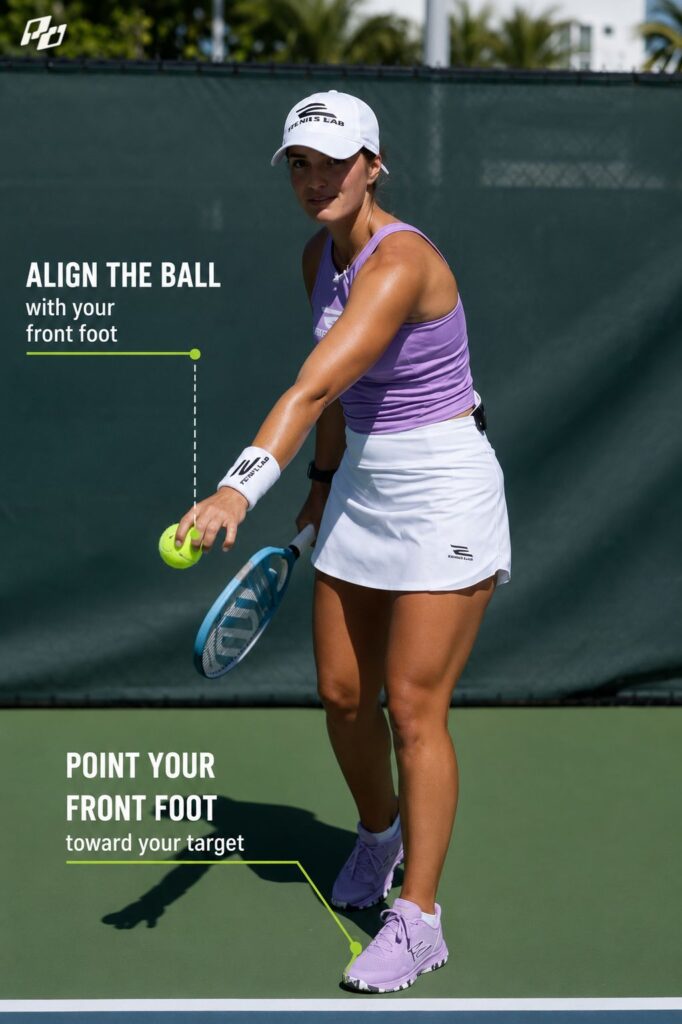
For a volley serve, point the toes of your lead foot (the foot opposite your paddle hand) generally toward your target. Then position the hand holding the ball roughly over that foot before you begin your motion. This naturally places the ball slightly in front of your body, making it easier to swing freely instead of getting jammed against your hip.
From there, simply open your fingers and let the ball fall into your swing—don’t flick it upward or toss it higher than necessary.
For a drop serve, think about where you want the ball to bounce, not where you release it. Become completely stationary, hold the ball over your intended bounce point a little in front of your body, then simply open your hand and let gravity do the work. Under the 2026 rules, don’t push the ball down or throw it forward—the cleaner the drop, the more repeatable the bounce.
Neither setup is the only correct way to serve, but both give you a consistent reference point. And that’s really the goal: present your swing with the same ball, in the same place, every single time.
The Biggest Difference Between the Volley Serve and the Drop Serve
Most people think the only difference is whether the ball bounces.
Mechanically, it’s much bigger than that.
With a volley serve, your release controls your timing.
With a drop serve, the bounce becomes your timing cue.
That’s why some players suddenly become more consistent after switching. They didn’t magically improve their swing. They simply removed one difficult timing variable.
The drop serve still has a common mistake
Many players drop the ball…
wait…
watch it bounce…
then start their swing.
Now everything becomes rushed. Instead, let the bounce trigger your motion. Think:
Stop → Drop → Load → Hit
As the ball falls, begin loading your body. As it rises from the bounce, the paddle should already be moving forward.
The bounce shouldn’t interrupt your rhythm. It should create it.
Should You Switch to a Drop Serve?
Not necessarily. The drop serve isn’t automatically better. The volley serve isn’t automatically more advanced. Each has advantages.
A drop serve usually makes sense if:
✅ you struggle to time direct-from-the-hand contact;
✅ you’re constantly worrying about volley-serve legality;
✅ your release changes from serve to serve.
A volley serve may suit you better if:
✅ your release is already highly repeatable;
✅ you prefer one continuous serving motion;
✅ different court surfaces produce inconsistent bounces.
The goal isn’t choosing the “better” serve. It’s choosing the one that produces the same contact point over and over again.
One Practice Drill That Reveals Everything
The next time you’re on the court, don’t evaluate your serve by whether it goes in. Instead, pay attention to what happens before contact.
Hit 20 serves while recording yourself from behind. Watch only the release.
Ask yourself:
- Did the ball leave from the same place every time?
- Did it fall into the same contact window?
- Did I have to reach for it?
- Did I have to wait for it?
- Did my body stay balanced through contact?
You’ll probably notice something surprising. Your misses aren’t random. They’re following the release.
It Changed the Way I Think About Serving
For years, I thought serving was all about what the paddle was doing.
The more I watched good servers—and the more I paid attention to my own game—the more I realized the serve often succeeds or fails before the paddle even reaches the ball.
A consistent release creates a consistent contact point. And a consistent contact point creates a serve you can trust under pressure.
So the next time your serve suddenly feels “off,” resist the urge to rebuild your swing. Instead, watch the first second of your motion.
Where did the ball leave your hand? Did it fall into the same spot? Or did your swing have to chase it?
Sometimes the smallest adjustment happens before the swing even begins—and that’s the one that brings your serve back.