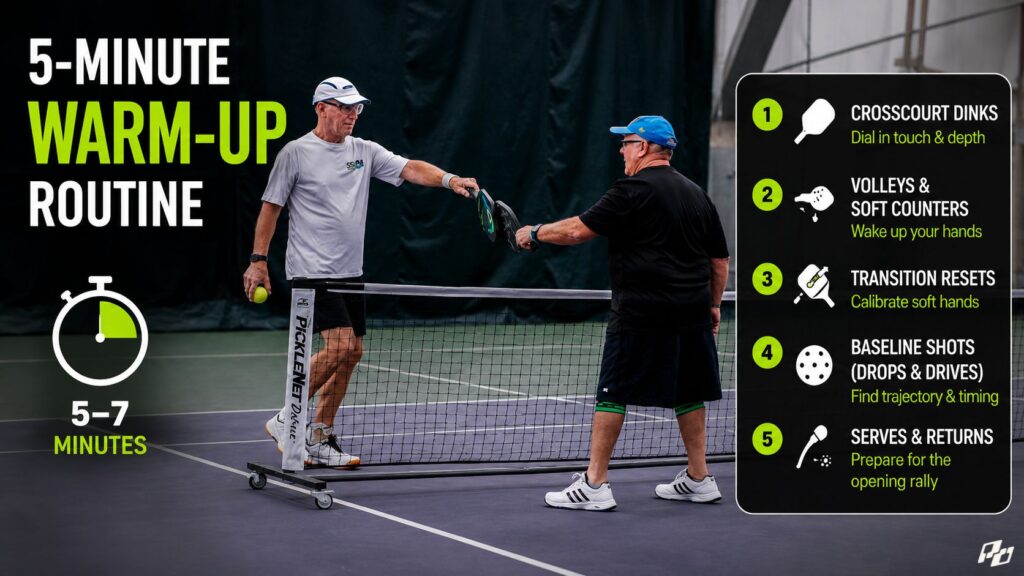
A good 5-minute pickleball warm-up should include crosscourt dinks, volleys, transition resets, third-shot drops, drives, serves, and returns. Start with touch shots, then gradually increase pace. The goal is to calibrate timing, control, and court feel—not turn the warm-up into a practice session.
Walk onto almost any public pickleball court and you’ll see the same warm-up.
Maybe two serves.
A few gentle dinks.
A couple of hard drives.
Maybe two serves.
Then someone says, “Good enough,” and the game begins. Five minutes later, someone dumps an easy third-shot drop into the net, pops up a transition reset, or misses a routine return long.
The problem isn’t that recreational players don’t warm up. It’s that most warm-ups don’t prepare you for the shots that actually decide games.
A good on-court warm-up isn’t about hitting every shot in your arsenal. It’s about quickly calibrating your touch, timing, reactions, and feel for the court so the first rally doesn’t become your practice session.
If you’re playing on busy public courts, you also need to respect everyone’s time. Fortunately, you don’t need a 20-minute routine.
For most recreational players, five to seven minutes is enough if you spend those minutes wisely.
Here’s the routine I’d recommend.
How Long Is It Okay to Warm Up?
The answer depends on where you’re playing.
Public Courts: 5–7 Minutes
If players are waiting, keep your warm-up to about five minutes and certainly no longer than seven.
Remember, other players are waiting for the same court. Warm-up time should prepare you to compete—not become an extra drilling session.
If you want more repetitions, arrive a few minutes early or use an empty practice wall before your court opens.
Private Clubs and Dedicated Facilities: 8–10 Minutes
When court availability isn’t an issue, eight to ten minutes is perfectly reasonable. That gives you enough time to work through every major shot without rushing.
If courts become busy, switch back to the same five-minute routine you’d use at a public park.
Tournament Warm-Ups
Tournament organizers often allow only 5–10 minutes.
Use every minute intentionally. Don’t spend half the warm-up rallying casually from the baseline.
Instead, move through a logical progression so every shot prepares you for the first point.
The 5-Minute Warm-Up at a Glance
| Minute | Shot | Purpose |
|---|---|---|
| 1 | Crosscourt dinks | Dial in touch and depth |
| 2 | Volleys & soft counters | Wake up your hands |
| 3 | Transition resets | Calibrate soft hands under pressure |
| 4 | Baseline shots (drops & drives) | Find trajectory and timing |
| 5 | Serves & returns | Prepare for the opening rally |
Notice something. The pace gradually increases. That’s intentional.
You start with feel.
You finish with game-speed shots.
Minute 1: Crosscourt Dinks
This is where every warm-up should begin.
Not with serves.
Not with drives.
Not with overheads.
Crosscourt dinks immediately help you judge three things:
- how today’s ball is bouncing;
- how quickly the court is playing;
- how much touch you’ll need.
Crosscourt is also more forgiving than straight ahead. The court is longer, the net is lower in the middle, and you have more room to develop rhythm before narrowing your targets.
Don’t try to hit winners.
Don’t try to test your partner.
Simply rally.
Focus on:
- consistent contact;
- comfortable height;
- controlled depth;
- recovering to ready position after every shot.
One minute is enough. If your dinks feel comfortable, your touch is usually calibrated.
Minute 2: Volleys and Soft Counters
Now move to the kitchen. Start exchanging cooperative volleys. The key word is cooperative. Many players immediately begin speeding the ball up. That’s one of the biggest mistakes I see.
Instead, begin around 50–60% pace.
After twenty or thirty seconds, gradually increase the speed.
Finish with several controlled counters.
Why?
Because your reactions need to catch up with your eyes. Hand speed isn’t just physical. It’s timing.
A gradual increase lets your nervous system adapt before you’re forced into a full-speed firefight during the first game.
Practice:
- forehand volleys;
- backhand volleys;
- shoulder-height blocks;
- hip-height counters;
- compact swings.
Cue: Catch. Block. Counter.
Don’t jump directly to countering. Build toward it.
Minute 3: Transition Resets
If I could add only one shot to the average recreational warm-up, this would be it. Almost nobody practices transition resets before playing. Ironically, it’s one of the first difficult shots many players face during a game.
One player starts around the transition zone.
The other remains near the kitchen.
Feed four or five manageable balls.
Reset each one softly into the kitchen.
You’re looking for three things:
- soft hands;
- balanced contact;
- consistent paddle angle.
If your resets feel solid, your touch usually is too. If they keep floating high, you already know what needs adjusting before the score reaches 0–4.
Don’t rush through this section. It often provides the biggest payoff during the first game.
Minute 4: Baseline Shots (Drops and Drives)
Now it’s time to back up. Alternate between third-shot drops and controlled drives.
I recommend:
- 3–4 drops;
- 3–4 drives.
That’s enough. The third-shot drop is probably the most sensitive shot in pickleball. A slight change in touch or trajectory can mean the difference between an unattackable drop and an easy put-away. This is exactly why it deserves several repetitions before the match starts.
The drives serve a different purpose. They wake up your rotational timing and help you feel how aggressively you can swing without losing control.
Don’t hit every drive at full power.
Start around 70%.
If the contact feels clean, increase slightly.
Remember: A warm-up isn’t an exit velocity competition. It is simply preparing your body and paddle for the first few rallies.
Minute 5: Serves and Returns
Finish your warm-up with the two shots that start every rally. Too many players hit six or seven serves, never practice a return, and then miss their first return long once the game starts.
I recommend each player hit:
- 4–6 serves
- 4–6 returns
Use your normal pre-serve routine. Aim for depth first, pace second.
On the returns, focus on clean contact, depth, and a balanced recovery. Use these few repetitions to re-establish your normal return routine, including advancing toward the kitchen under control while reading the developing point. It’s also the perfect time to judge the wind, sun, court speed, and how high the ball is bouncing that day.
If your serves and returns feel comfortable, you’ve already rehearsed the first two shots of nearly every rally before the game even begins.
Why This Order Works
This isn’t a random collection of shots. Each stage prepares you for the next one.
You begin with the slowest, most touch-oriented shot and gradually increase the speed until you’re hitting game-speed serves and returns.
Think of it like climbing a ladder.
- Dinks establish feel and depth.
- Volleys wake up your hands and reactions.
- Transition resets combine movement with touch.
- Drops and drives prepare full-court timing.
- Serves and returns finish by rehearsing how every point actually starts.
By the time the warm-up ends, you’ve practiced nearly every shot you’ll likely hit during the opening few rallies.
Just as importantly, you’ve done it in a logical progression that lets your timing build naturally instead of asking your body to jump from zero to full speed.
Common Warm-Up Mistakes
Even experienced players waste most of their warm-up. Here are the big ones:
1. Hitting only drives
Power is easy to find.
Touch isn’t.
If your warm-up is mostly hard drives from the baseline, you’re skipping the shots that usually need the most calibration.
2. Skipping transition resets
This may be the biggest rec-player mistake.
The transition zone decides a lot of rallies, yet most players ignore it before games. Even four or five reset reps can make the opening game feel smoother.
3. Trying to hit winners
Warm-up should be cooperative. If your partner never touches the ball because you’re trying to impress them, neither of you is warming up.
The goal is rhythm.
Not points.
4. Serving too long
After four or five serves, you usually know what you need to know.
Use the rest of the time on drops and resets instead. Those shots are much more sensitive to timing and touch.
5. Fixing your technique
Warm-up is not practice. If your first drop lands in the net, don’t rebuild your mechanics. Your timing just hasn’t caught up yet.
Save technical changes for drilling sessions. Not the five minutes before a game.
If You Only Have Three Minutes
Sometimes another group is already waiting. Sometimes you arrive late. Sometimes the next game starts immediately. When that happens, prioritize the shots that depend most on feel.
- Crosscourt dinks
- Volleys
- Transition resets
- A couple of drops
- A few serves and returns
Notice what’s missing: drives. I’d rather skip drives than skip drops.
Generating power is usually easier than finding the right touch, and touch is what most players struggle with during the opening few points.
Adjust the Warm-Up to Your Game
Every player has one shot that takes longer to feel comfortable.
For some, it’s the third-shot drop.
For others, it’s backhand volleys or transition resets.
Once you’ve completed the basic five-minute routine, spend any extra time on your slowest-adjusting shot—not your favorite shot.
If you always need ten minutes before your drops start landing consistently, use those extra repetitions there instead of hitting another dozen drives.
Your warm-up should prepare your game, not someone else’s.
Warm Up the Shots That Are Hardest to Feel
The biggest mistake recreational players make isn’t warming up too little. It’s warming up the wrong shots.
Most players spend their limited court time hitting the shots that already come naturally. Then they wonder why their drops, resets, and touch shots feel off during the first game.
I’d flip that approach. Use your first few minutes to dial in feel before power.
Start with dinks. Wake up your hands with volleys. Spend a minute on transition resets. Check your drops and drives from the baseline. Finish with serves and returns.
Five focused minutes will prepare you far better than ten minutes of random hitting.
Remember, the goal isn’t to look good during the warm-up. The goal is for the first rally to feel like your tenth.