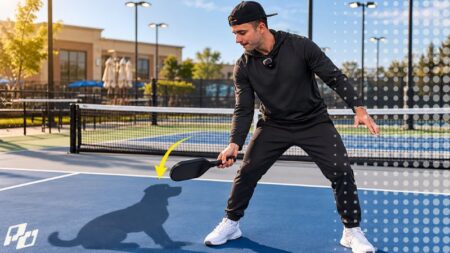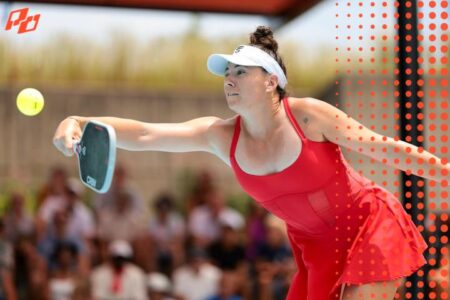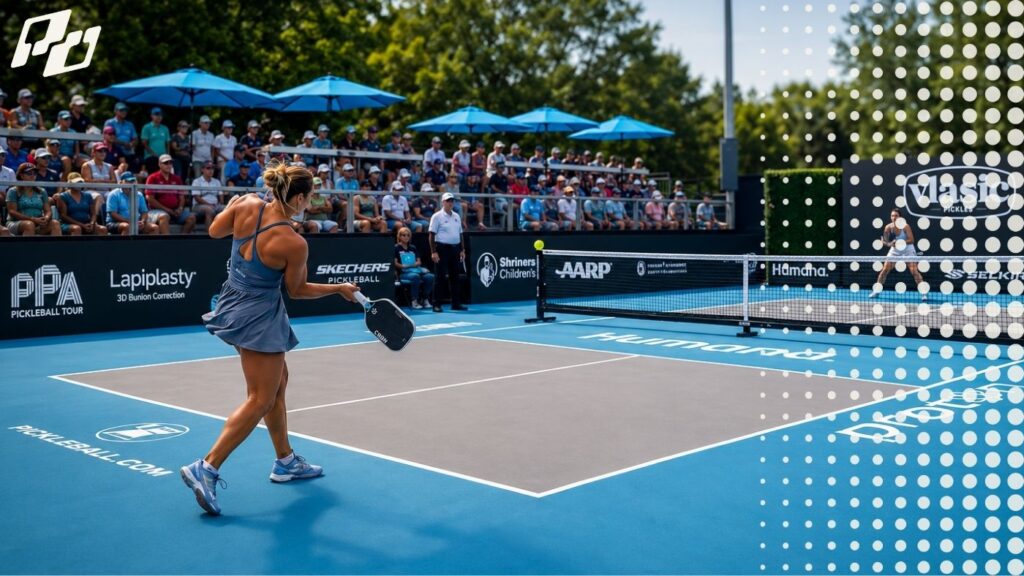
On a pickleball serve, shift your weight forward toward the target to add power without overusing the arm. More advanced players with enough pace can reduce that transfer and start more front-loaded to simplify the motion, improve consistency, and cut down on long misses.
Most pickleball players are taught the same serving pattern: start on the back foot, transfer forward, finish on the front foot.
That is still excellent advice for most recreational players.
But once your serve is already technically sound, there is another option worth experimenting with: starting more of your weight on the front foot and minimizing the back-to-front rock altogether.
Why?
Because every extra movement adds another timing variable.
If your serve is already powerful enough but occasionally sprays long, wide, or inconsistently deep, reducing the weight shift can make the motion simpler and easier to repeat.
The tradeoff is equally important:
Less weight transfer can improve consistency—but it may also remove an easy source of power.
So this is not a beginner serve fix. It is a refinement for players who already own a reliable serve and want to decide how much lower-body movement they actually need.
First: What Most Players Should Learn
For a right-handed player using a staggered stance, the classic pattern is:
right/back leg loaded → swing starts → weight moves onto left/front leg → contact in front.
That is what coaches Michael Loyd, Roscoe Bellamy, and many others teach because the weight shift helps generate pace without requiring the arm to do all the work.
But Bellamy points out a mistake I see a lot in recreational players: they transfer their weight sideways instead of toward the target.
The player loads, swings, and then falls off to the left or pulls away from the ball. It feels like they’re using their body, but that energy isn’t being directed through the serve. Bellamy’s advice is to drive your weight forward toward the target, using the legs to help generate power while keeping the arm loose.
That’s an important distinction:
Weight transfer should send energy through the ball—not pull your body away from it.
Check out this video where Roscoe Bellamy breaks down three keys to a huge serve. Pay special attention to key #2—how to transfer your weight forward instead of falling off to the side.
For most developing players, that makes traditional forward weight transfer a very good default, especially for:
- beginners
- 3.0 players developing depth
- players whose serve is too arm-dominant
- players struggling to generate pace
Cue
Load back. Flow forward.
Not: Rock back dramatically, then lunge at the ball.
And definitely not: Load back, then fall sideways.
So Why Would You Start on the Front Foot?
Because power is not the only goal.
Once a player already generates enough pace, a large rocking motion can sometimes create more problems than it solves.
Think about what changes during a big back-to-front transfer:
- your head moves
- your hips move
- your contact point moves relative to your body
- your timing with the ball release changes
- the paddle has to meet a moving body at precisely the right moment
For a skilled player, all of that can work beautifully.
For another player, it becomes unnecessary motion.
Some effective servers use a clear weight transfer, while others rely more on rotation. The goal is an efficient kinetic chain that moves energy into the ball—not copying one exact serving motion.
That is why a front-loaded serve can work.
You start with most of your pressure already over the lead leg, keep the body quieter, and generate the serve primarily through:
- hip and torso rotation
- shoulder swing
- relaxed arm acceleration
Pro player Ryan Fu shows exactly how this type of serve looks in action.
@ryanfupb Pickleball serving tip
♬ original sound – ryanfupb
What “Front Foot” Should Actually Feel Like
Do not interpret this as standing stiffly on one leg. For a right-handed player with the left foot forward, think approximately:
60–70% pressure left/front leg
30–40% right/back leg
rather than:
100% front leg, back leg doing nothing.
- Your knees remain soft.
- Your back foot remains grounded enough to help with rotation.
- Your torso stays athletic.
The main difference is that you do not deliberately rock backward before initiating the serve.
You are already closer to the position you want at contact.
Cue
Start where you want to finish.
That is what makes the motion quieter.
Why It Can Improve Consistency
Imagine hitting 50 serves.
With a large transfer, every serve requires you to reproduce: load → shift → swing → contact. With a front-loaded version: set → rotate → swing → contact.
One movement has effectively been reduced.
A repeatable serve should prioritize a smooth, efficient shoulder-driven motion over maximum effort. The goal is consistency first—then add pace without disrupting the sequence.
That is really the argument for front-loading.
Not that the front foot is magically more accurate.
It simply gives some experienced players fewer moving parts to synchronize.
Why It May Stop Balls From Flying Long
If you rock aggressively forward, your entire body adds momentum to the shot. That can be great for power.
But if your timing gets slightly ahead of the ball, contact can move too far forward or your paddle can accelerate more than intended.
The result?
Long.
Or occasionally pulled wide.
Too much body drift can shift your contact point, making an otherwise familiar serve launch differently from one swing to the next.
So if your serve already has plenty of pace but occasionally sails because you over-transfer, reducing that rock can calm the motion.
That is very different from telling a weak server to stop transferring altogether.
But You Still Need Rotation
This is the part players get wrong.
They hear:
“Keep the weight forward.”
Then they freeze the lower body and swing entirely with the arm. Now the serve becomes weak and stiff.
You still need the body. The difference is that rotation replaces much of the linear transfer.
A recent breakdown of open- versus closed-stance serving describes exactly this tradeoff: a closed stance tends to use more back-to-front weight transfer, while an open stance can generate power more through hip and torso rotation. Tyson McGuffin is cited as a pro example of generating substantial serve pace with relatively little obvious weight shift.
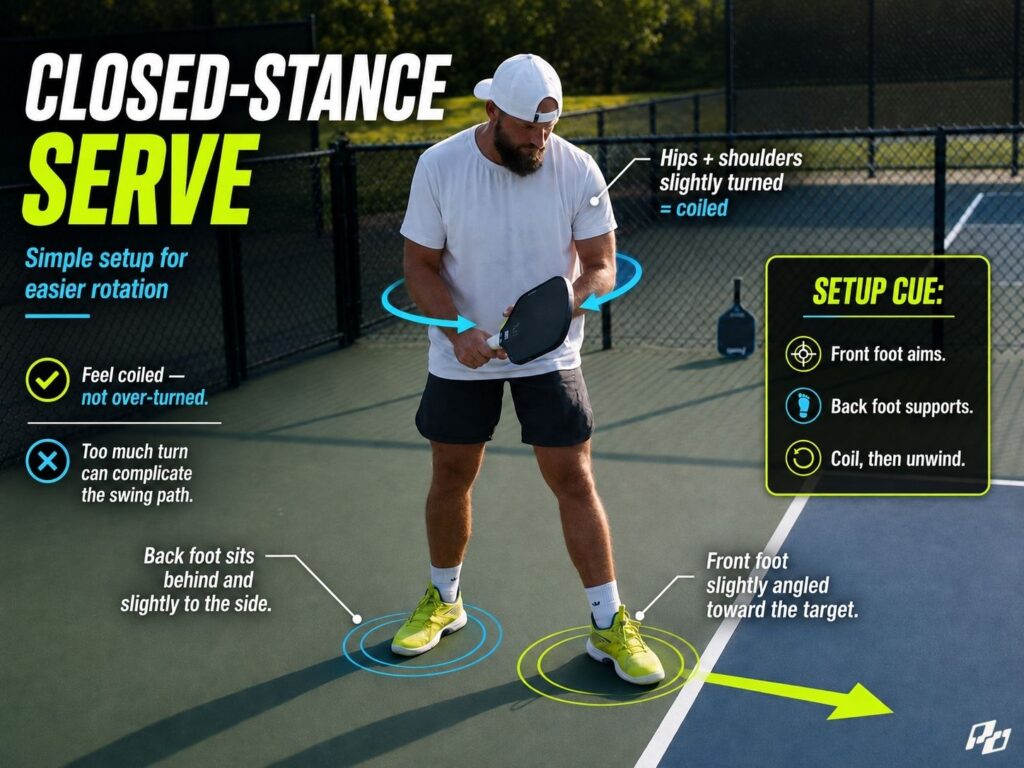
So a quiet base does not mean a dead body.
Think:
Less rock. More turn.
The Three Serve Styles You’ll Actually See
There is no single correct weight pattern.
| Serve Style | Weight Pattern | Best For |
|---|---|---|
| Classic transfer | Back → front | Most recreational players |
| Front-loaded | Mostly front throughout | Advanced consistency / quieter motion |
| Open rotational | More centered, little linear transfer | Players using strong hip/core rotation |
The important question is not:
“Which one is technically correct?”
It is:
“Which one gives me repeatable depth without unnecessary movement?”
Who Should Use the Front-Loaded Version?
I would consider it primarily for solid intermediate to advanced recreational players—roughly strong 3.5 and above.
Especially if:
- your serve already has enough pace
- you consistently reach good depth
- your biggest issue is occasional overhitting
- you feel yourself rocking excessively
- your contact point changes from serve to serve
- simplifying the motion immediately improves accuracy
This is more of a fine-tuning tool than a foundational technique.
Who Should Probably Keep Transferring Weight?
If you are a 2.5–3.25 player still learning to generate depth, I would not rush to eliminate the transfer.
A proper back-to-front shift helps teach you to use:
- legs
- hips
- torso
- momentum
instead of trying to arm the ball.
That standard sequence helps produce repeatable power without overswinging. A staggered stance with some forward transfer can also make it easier to connect the body to the swing, especially while learning the motion.
Build that first. Then decide whether you actually need all of it.
What About Open-Stance Servers?
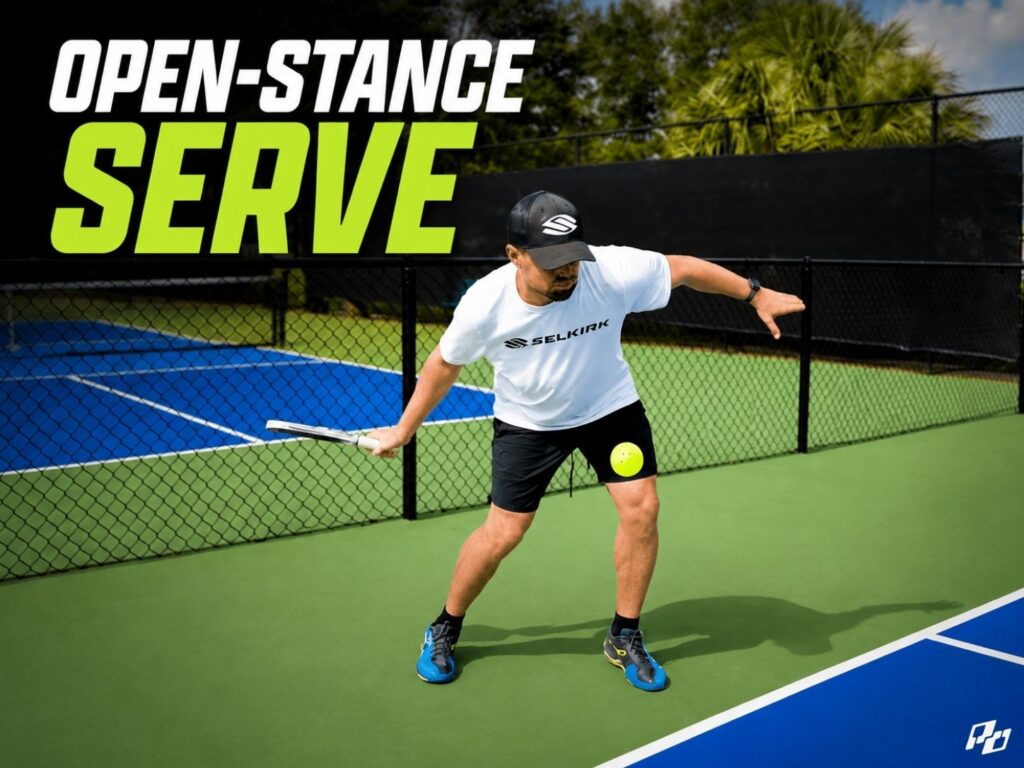
This is where the front-loaded idea becomes even more interesting.
If your feet are more square to the baseline, you naturally have less room for a dramatic back-to-front transfer.
Your power comes more from:
- knee flexion
- hip turn
- torso rotation
- relaxed arm speed
That means some players may never feel a large back-leg load. And that is fine.
Current coaching recognizes both closed and open serve stances as viable, with different sources of power. So do not judge a serve by how much rocking you can see.
Judge it by: depth + repeatability + pace + balance.
The Contact Point Still Matters More Than the Weight Pattern
Whether you transfer or front-load, the ball still needs to be contacted in a consistent place. For most right-handed players:
- slightly in front of the left/front hip
- comfortably away from the body
- with enough room for the paddle to accelerate through
A quiet stance with a terrible contact point will not save your serve. Neither will perfect weight transfer.
The Mistake: Rocking Because You Think You’re Supposed To
This is the real reason I like this topic.
Some players are not naturally using weight transfer. They are manufacturing it because somebody told them a serve needs one.
They sway backward.
Pause.
Then lunge forward.
That does not create an athletic kinetic chain. It creates timing work. If you recognize yourself there, try this:
- Set your stance.
- Put slightly more pressure into the front leg.
- Do not intentionally rock backward.
- Rotate the torso.
- Let the arm swing freely.
- Contact in the same spot.
- Compare depth and accuracy.
If your serve becomes cleaner without losing useful pace, you probably did not need the extra rock.
A Simple Test: 20 vs. 20
This is how I would determine whether the front-loaded serve actually helps you. Hit 20 serves using your normal weight transfer.
Record:
- serves in
- serves landing within roughly 3 feet of the baseline
- serves long
Then hit 20 front-loaded serves.
Same target.
Same effort.
Compare.
Do not judge by which one feels cooler. Judge by:
Accuracy: How many landed in?
Depth: How many pressured the baseline?
Miss pattern: Did long misses decrease?
Effort: Did you get the same depth without swinging harder?
If the front-loaded serve is more accurate but becomes noticeably weak, you may have removed too much useful lower-body contribution.
Don’t Sacrifice Depth for Consistency
A serve that lands in every time but sits halfway up the service box is not necessarily an improvement.
Michael Loyd recommends trying to land serves within roughly 2–3 feet of the baseline, because depth pushes the returner backward and can create a weaker return.
So the front-foot adjustment passes the test only if you still produce useful depth.
The goal is:
Remove unnecessary motion, not useful energy.
The One Thing I’d Tell Intermediate Players
If your serve still needs power, learn proper weight transfer. If your serve already has power but occasionally gets wild, experiment with starting more pressure on the front foot and reducing the rock.
And if a quieter motion gives you:
the same depth
the same spin
fewer long misses
and better repeatability
keep it.
At the intermediate-advanced level, serving is no longer about copying a perfect textbook motion. It is about finding the simplest motion that produces the ball you want repeatedly.
That is why some better servers appear almost motionless before they strike.
They are not doing less because they forgot the fundamentals. They have simply removed movement they no longer need.