Rec pickleball players generally value attitude as much as skill. Playful trash talk can add fun when everyone enjoys it, but repeated heckling, criticism, or distracting behavior quickly crosses the line. The best rec players compete hard, read the room, support partners, and make others want the rematch.
Here is a surprisingly revealing pickleball question: would you rather play with a good player with a bad attitude, a bad player with a good attitude, or a mediocre player with an OK attitude?
For tournament players chasing a medal, the answer might depend on what is at stake.
For recreational players, however, the response is much clearer.
Skill matters. Competitive games matter. Nobody wants every session to feel like a beginner clinic.
But once a player’s attitude starts affecting everybody else’s experience, a wicked backhand and a reliable third-shot drop lose some of their appeal.
And nowhere is that line easier to see than with trash talk.
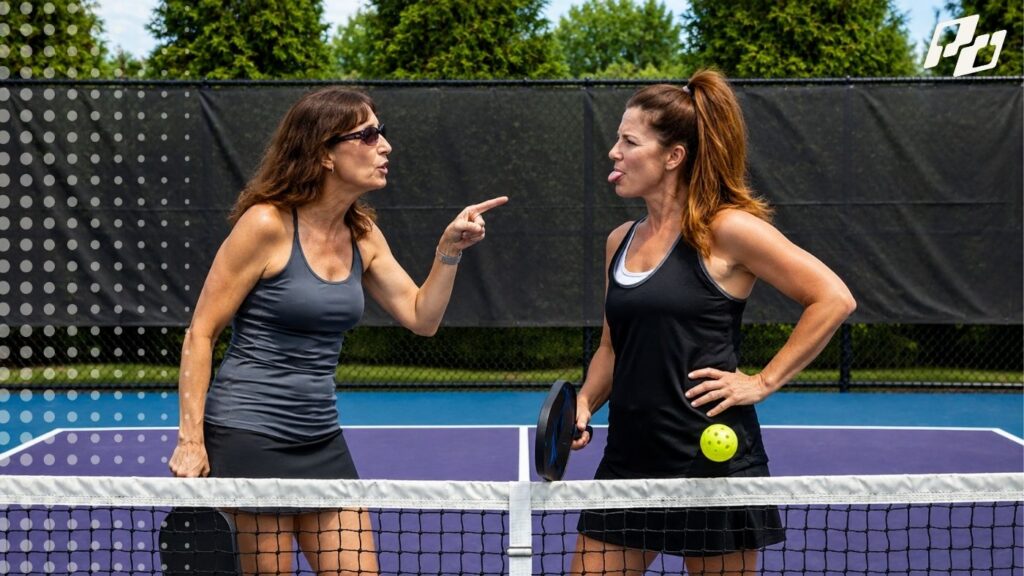
A little teasing between friends can make a game hilarious. The same comment from the wrong player, at the wrong time, can turn an otherwise good foursome into 15 uncomfortable minutes.
So where is the line?
And what should you actually do when the talented player across the net—or beside you—becomes the person nobody wants in the next game?
Rec Players Are More Tolerant of Weak Games Than Bad Attitudes
The most interesting thing about recreational players’ responses to the skill-versus-attitude question isn’t that everybody wants a great partner with a great personality. Of course they do.
It’s what happens when that option disappears.
By a wide margin, players favored the weaker or average player they could enjoy being around over the highly skilled player with the lousy attitude. Many essentially said the same thing in different ways:
A weaker player can improve.
A mediocre player can still produce a fun game.
A bad attitude can bring down the entire court.
Several players said they would play with almost anyone provided the person was pleasant, competitive in a healthy way, and enjoyable to share the court with. Others were willing to tolerate the difficult player only when something meaningful—such as tournament competition—was on the line. A smaller group actively preferred the highly competitive personality and felt strong players should be able to handle some attitude.
That last group matters, because the lesson isn’t simply “good players should be nice.” Recreational pickleball has room for intensity.
You can want desperately to win 11–9.
You can fist-pump after an Erne.
You can attack somebody’s backhand because it is weak.
You can groan after missing an easy putaway.
You can even talk a little trash.
The real question is whether your competitiveness makes the game better for the foursome or heavier for the foursome.
Trash Talk Is Probably the Best Test
Ask recreational players about trash talk and you get a much more divided answer. Some love it.
They laugh, return it, and consider it part of the social competition. Several players essentially said: give it back, laugh about it, and keep playing. Some even felt a little verbal challenge makes them concentrate harder.
Others want absolutely no part of it. Their response is to ignore the player, ask them to stop, or simply avoid playing with them again.
And there is a large middle group whose answer is basically: it depends. That is probably the smartest answer.
Trash talk between four friends who have played together for years is completely different from trash talk directed at a stranger during open play.
“Nice hands, Grandpa,” followed by everybody laughing may be perfectly normal in one foursome. The exact same sentence in another foursome could be insulting.
The difference isn’t the cleverness of the line. It’s relationship, timing and reciprocity. A simple rule works surprisingly well:
If they aren’t giving it back, stop giving it.
Good-natured trash talk works like a rally. Both people participate.
If you tease somebody and they grin and fire something back, you probably understand each other’s boundaries. If you tease somebody and they go quiet, force a smile or simply turn away, you’ve received useful information.
You don’t need another three jokes to confirm it.
Between Points and During Points Are Not the Same Thing
This is where etiquette becomes more technical.
Talking between rallies is one thing. Deliberately disrupting an opponent who is preparing to hit the ball is another.
USA Pickleball’s rules address distraction: players may not intentionally interfere with an opponent’s concentration or ability to play the ball through actions not normally part of the game. USA Pickleball’s broader sportsmanship guidance also emphasizes courtesy, respect, fair play and supportive behavior toward partners.
That doesn’t mean pickleball must become silent. Normal doubles communication is part of the sport:
“Mine.”
“Yours.”
“Bounce.”
“Switch.”
“Watch middle.”
There is a significant difference between communicating with your partner and suddenly yelling or making an unusual movement specifically as an opponent is striking the ball.
That distinction matters because rec players sometimes lump everything together as “trash talk.”
It isn’t.
A joke between points is an etiquette question.
An attempt to interfere with someone’s shot can become a rules question.
And shouting instructions at the opposing player while the rally is happening is very different from joking with them after the point.
What Should You Do With a Trash Talker?
The worst approach is often trying to prove that you’re tougher.
Player says something.
You respond.
They escalate.
You respond louder.
Three rallies later, nobody remembers how it started and everybody else on the court is wishing the game would end.
A better approach is to decide first whether the person is actually bothering you.
If it’s harmless, don’t manufacture a problem
Some players genuinely enjoy verbal competition. If you do too, fine. Laugh. Give a little back. Compliment a genuinely great shot five seconds later and make it obvious that the trash talk belongs to the game, not to the relationship.
One of the healthiest combinations in the player responses was essentially: talk some trash, then acknowledge a great shot by the same opponent.
That sends an important signal: I’m competing with you, not disrespecting you.
If it’s getting inside your head, stop playing their game
You don’t have to answer every comment. In fact, engaging is often exactly what the talker wants.
Calmly tell the person the behavior is distracting, avoid emotionally engaging with continued comments, and involve an organizer or facility representative if necessary.
For many intermediate players, however, the bigger battle is internal. You’ve already ignored the comment verbally—but you’re still thinking:
What an idiot.
I’ll show him.
Wait until I get a high ball.
Now you’re no longer constructing the rally. You’re constructing revenge. Try giving your attention a technical job instead.
Deep return.
Find the backhand.
Soft hands.
Attack the right hip.
Don’t speed up below the net.
A specific cue is far more useful than telling yourself, “Don’t let him bother you.”
Don’t Start Playing Revenge Pickleball
This deserves its own rule. If somebody annoys you, don’t suddenly decide that every ball needs to be blasted at their chest. Body attacks are legitimate pickleball.
Aiming at a player’s paddle-side hip, dominant shoulder or cramped backhand position can be excellent strategy.
But the decision should come from: “That’s the weak location.”
Not: “I want to hit this guy.”
There’s a tactical difference.
Angry players start forcing speedups that aren’t there. They ignore open court. They swing harder at overheads than necessary. They abandon patient patterns because winning the rally is no longer enough—they want to win it at someone.
In social play, stronger players should be considerate of weaker players, avoid excessive targeting, and avoid unnecessarily blasting balls directly at someone.
Play the best pickleball shot.
Don’t turn the ball into a message.
The Worse Version May Be the Bad-Attitude Partner
Trash talk from an opponent can be irritating. A miserable partner can change every shot you hit.
You miss a drop.
They sigh.
You float a return.
They turn away.
You leave a middle ball.
Here comes the lecture.
Pretty soon you aren’t thinking about the opponent’s positioning anymore. You’re thinking: Please don’t miss.
That is a terrible state for playing doubles.
Intermediate players generally know when they have made an obvious mistake. A 3.5 who dumps a third-shot drop into the net usually does not require an immediate explanation of why the ball needed to clear the net.
USA Pickleball’s sportsmanship guidance specifically advises players to avoid criticizing partners and to give coaching or advice only when requested.
There’s an enormous difference between useful teamwork—“Let’s protect middle a little more.”
—and post-point judgment—“You have to stop leaving those balls.”
One prepares your team for the next rally. The other reminds your partner that you are evaluating them.
What Good Competitive Attitude Actually Looks Like
A good attitude does not mean being relentlessly positive.
You don’t have to clap after every shot.
You don’t have to pretend losing 11–2 was wonderful.
You don’t have to stop caring who wins.
A strong competitive attitude is more practical than that.
You can be disappointed without making your partner responsible for your disappointment.
You can question a line call without turning it into a court case.
You can celebrate a huge point without directing it into someone’s face.
You can attack the weakest tactical spot without humiliating the weaker player.
You can play down a level without acting like you’ve performed community service.
And you can talk trash without continuing once it’s clear the other player isn’t enjoying it.
That is what separates competitive intensity from a bad attitude.
A Simple Rec-Court Test
If you’re wondering whether you’re becoming the player people quietly avoid, ask yourself three questions after a competitive game:
- Would the other three people willingly run this game back?
- Did my competitiveness improve the energy—or make everyone manage my mood?
- If another player behaved exactly the way I just did, would I enjoy playing with them?
Those questions are more revealing than whether you won 11–7.
Because recreational pickleball has an unusual economy. There are always more games. There are always more opponents.
And eventually players get surprisingly good at arranging the paddle stack so that the people who make games enjoyable keep finding one another.
That may be why so many recreational players would rather take the imperfect player with the good attitude.
Skills can improve.
A 3.2 can become a 3.7.
A shaky drop can become reliable.
A weak backhand can become dangerous.
But if every game with you includes complaints, unwanted coaching, hostile trash talk, arguments and visible irritation, eventually nobody cares how good your backhand is.
Play hard enough that people want to beat you. Carry yourself well enough that they also want to play you again.