
Most recreational pickleball frustration doesn’t come from losing points.
It comes from losing clarity.
You step on the court ready to compete, maybe even playing well, and within a few games something feels off. Your partner is missing routine shots. Opponents start targeting them. The score drifts away. And suddenly your own focus, energy, and enjoyment disappear with it.
Nothing dramatic happened — but your game feels hijacked.
This experience is so common that many rec players assume it’s just “part of open play.” In reality, it’s a predictable psychological response — and one that better players learn how to manage.
Why Partner Mistakes Affect You More Than You Think
From a performance psychology standpoint, humans struggle most when effort and outcome become disconnected.
When you’re playing well but losing anyway, your brain searches for meaning:
- Why am I trying if it doesn’t matter?
- Why should I take risks if they don’t pay off?
- Why stay locked in if we’re probably losing?
That mental uncertainty is far more draining than physical mistakes.
Research in competitive team sports consistently shows that perceived lack of control — not failure itself — is what triggers frustration, disengagement, and reduced performance. In rec pickleball, your partner’s errors remove control from the equation, even though nothing about your own ability has changed.
The Hidden Emotional Loop on Rec Courts
What most players don’t realize is that these situations create a feedback loop:
- Your partner misses → tension rises
- Tension changes body language → pressure increases
- Pressure causes more errors → targeting increases
- You feel stuck → motivation drops
- Your play subtly declines too
By the end of the game, everyone feels worse — even though no one intended for that to happen.
Importantly, this isn’t about being mentally weak. It’s about being human in a shared performance environment.
Why “Just Focus on Yourself” Doesn’t Actually Work
You’ve probably heard advice like:
- “Just play your game.”
- “Ignore the score.”
- “Don’t let it bother you.”
The problem? Those statements are emotionally vague.
High-performing athletes don’t ignore circumstances — they replace goals.
When winning becomes unlikely, strong players don’t disengage. They shift what success looks like, so effort still feels purposeful.
That’s the skill rec players rarely practice.
What Better Rec Players Do Differently
Higher-level recreational players aren’t immune to bad partner games. What separates them is how quickly they adapt their internal objective.
Instead of tying satisfaction to the outcome, they focus on:
- Decision quality (not shot result)
- Pattern execution (not point outcome)
- Emotional steadiness (not score swings)
- Playing the right shot even when it fails
This mental pivot keeps their nervous system calmer and their mechanics cleaner. Over time, it also makes them far more resilient in tournaments and league play.
How to Redefine “Winning” Without Giving Up
Staying engaged doesn’t mean pretending the score doesn’t matter. It means choosing a different scoreboard when the real one stops serving you.
Effective alternatives include:
- Executing high-percentage shot selection
- Practicing patience under targeting
- Managing body language intentionally
- Improving one specific skill per game
These goals restore agency. You’re no longer waiting for your partner to play better — you’re actively working inside the rally again.
Managing the Partner Dynamic (Without Making It Worse)
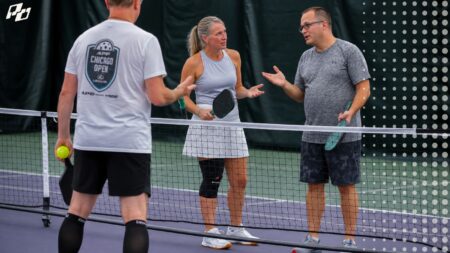
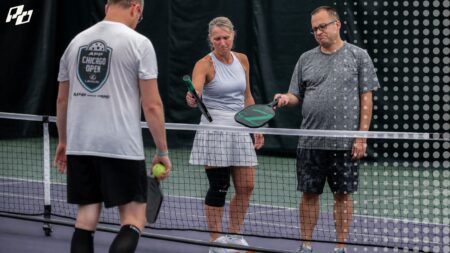
Most struggling partners already know they’re struggling. What makes things worse is accidental pressure — extra advice, visible frustration, or forced encouragement.
Here’s what actually helps.
Talk less, say simpler things.
Between points, keep communication neutral and short: “Next one.” “Same plan.” “All good.”
Avoid technical tips or anything that makes them think mid-game.
Keep your body language boring.
No sighs. No head shakes. Move and reset the same way after every rally. Calm posture lowers tension faster than words.
Adjust quietly instead of coaching.
Take more middle balls, play safer patterns, or shift your positioning — without announcing it. Stabilize the game without making your partner feel managed.
Slow the tempo.
Rushed play adds pressure. Walk back deliberately, breathe before serving, and let the game reset.
The goal isn’t to fix your partner. It’s to stop adding weight to the moment.
Why Tracking Wins Can Make This Worse

Many rec players track wins and losses as a way to measure progress. In environments with rotating partners and mixed skill levels, this can backfire.
Win tracking:
- Increases partner resentment
- Encourages safe, short-term decisions
- Discourages skill development under pressure
If your goal is long-term improvement, wins should be treated as information, not validation.
The Mental Reframe That Actually Helps
Instead of asking:
- “Why is this happening to me?”
Try:
- “What skill is this situation training right now?”
Bad partner games are accidental practice for:
- Emotional regulation
- Shot discipline
- Competitive patience
- Playing well without external reinforcement
Those are tournament-level skills — even if the setting is casual.
Leaving the Court Better Than You Found It
The most productive question after these games isn’t “Did we win?”
It’s:
- Did I stay composed?
- Did I make good decisions under stress?
- Did I help the environment or add tension to it?
Players who can answer yes consistently improve faster — and enjoy pickleball more — regardless of who’s on their side of the net.
The Reality Most Rec Players Eventually Learn
Rec pickleball will never be perfectly balanced.
Partners will struggle.
Games will feel unfair.
Effort won’t always equal results.
The players who grow are the ones who stop letting those moments decide how they show up.
You may not control who you’re paired with. But you always control whether the game takes something from you — or gives you something back.
And learning to stay engaged when winning isn’t the goal may be one of the most valuable skills rec pickleball ever teaches.