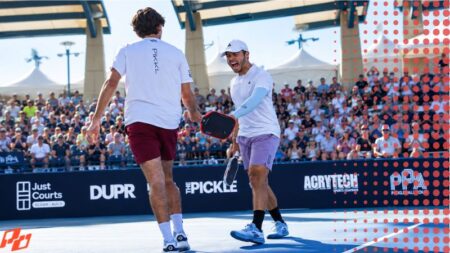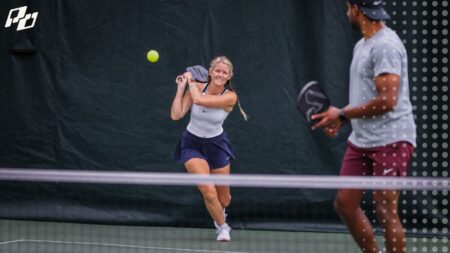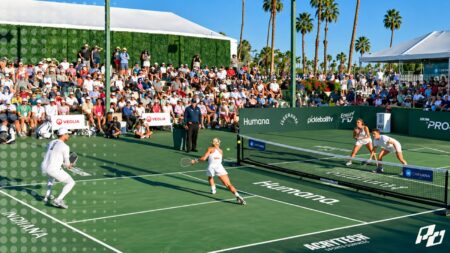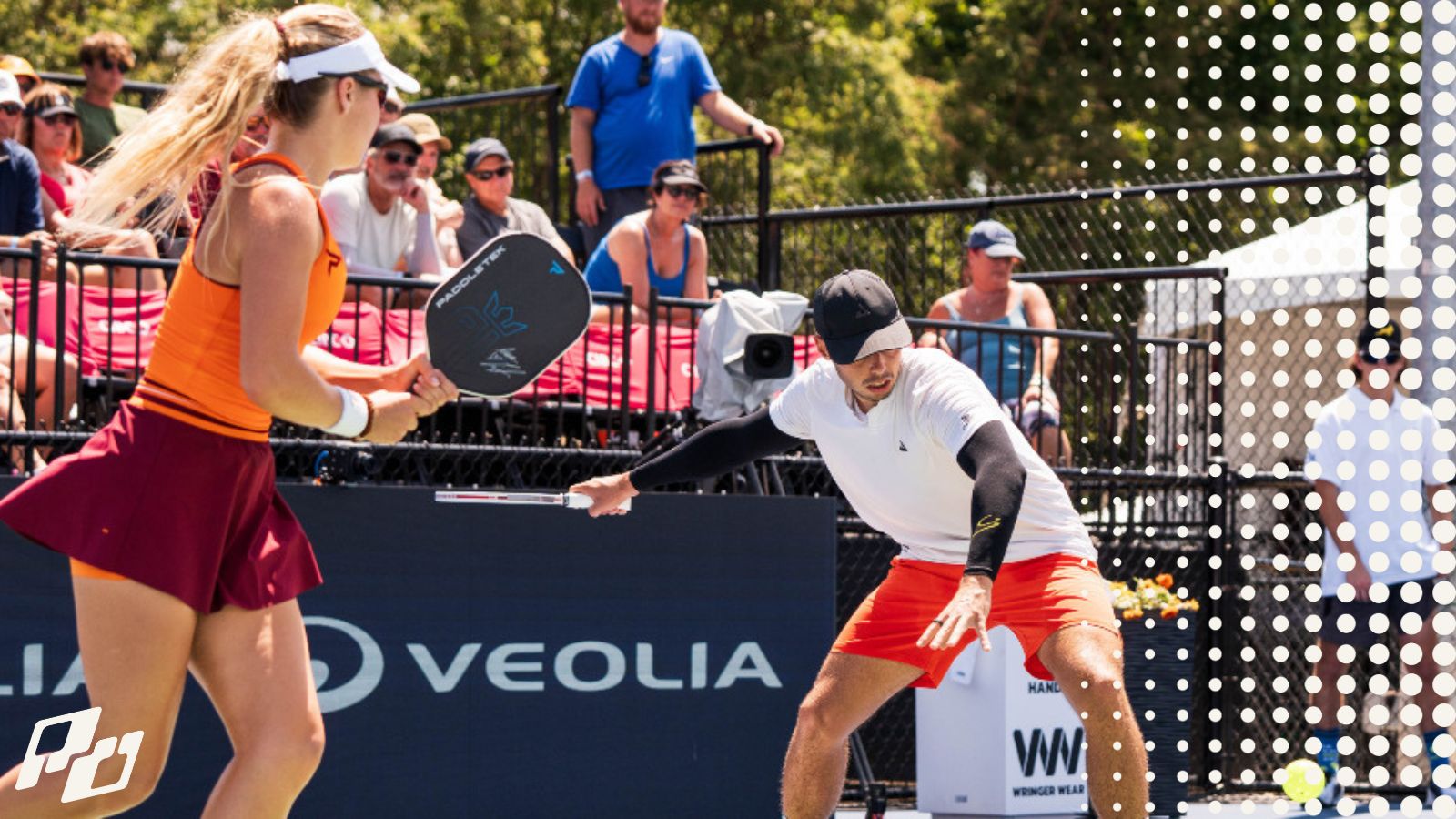
I spent this past weekend (Aug 9–10, 2025) watching the PPA Tour Veolia Bristol Open at the Bristol Sportsplex in Bristol, Tennessee—and it delivered a masterclass in pro doubles decision-making.
What actually separates pro pickleball players from the rest? It’s not just hand speed or power—it’s the small decisions, court awareness, and perfectly timed resets—and I saw every one of them on full display in one fantastic point, which carries so many lessons.
In this rally featuring JW Johnson, Jorja Johnson, Ben Johns, and Anna Leigh Waters, you’ll see elite anticipation, calculated dinks, and well-chosen speedups—exactly the subtleties that define pro-level play.
Whether you’re competing regularly or studying the game, this is a point worth replaying—and learning from.
The point I’m breaking down:
Serve + 3rd:
Jorja starts with a solid serve. Ben’s return lands a bit short, letting JW step in and float a controlled third-shot drop to Ben’s backhand.
Early dink pattern:
Ben rolls a backhand cross-court dink with some pop. JW handles it cleanly off the short hop and redirects down the line to Anna Leigh.
She answers with a forehand roll back cross-court to Jorja, but it sits slightly higher than planned—high enough for Jorja to take out of the air and initiate a hands battle with Ben.
First hands battle + net cords:
They trade fast exchanges before two consecutive net cords break the tempo and naturally reset the point back into dinks.
Re-applying pressure:
JW dinks to Anna Leigh’s side. Ben slides to cover and takes initiative with a firm forehand dink into Jorja’s inside foot—an assertive, well-placed ball that pressures the defense (not “taking too much court,” just smart aggression).
Erne threat, veteran answer:
Under pressure, Jorja fires a phenomenal backhand roll dink into Ben’s corner, hinting at an Erne.
Ben reads it early and makes the high-IQ play: a short, low backhand dink into the middle to kill the Erne window and neutralize.
Awareness into attack:
Seeing Jorja still recovering from her Erne move, JW tries to dink out of the air and redirect to Anna Leigh, but it floats. Ben recognizes the height and the space Jorja vacated and rolls a forehand speedup out of the air into that gap.
Great timing, great read.
Quality defense, composed reset:
Despite being out of position, Jorja gets a strong paddle on Ben’s ball. Knowing they’re on defense, JW steps in with two firm volleys to buy time.
Anna Leigh calmly resets with a smooth backhand drop, and the rally returns to neutral.
Second build-up:
JW adds pace, rolling a forehand dink into Ben’s corner. Ben diffuses with a short backhand dink to middle. Jorja follows with another controlled backhand dink center.
Ben tries to re-apply pressure cross-court to Jorja, but it sits up—a green light for Jorja to attack out of the air.
Counter–counter sequence:
Ben anticipates and sets early for the counter. Jorja attacks forehand; Ben fires it back with pace. JW reads the counter, slides middle, and gets a paddle on it—but it pops a bit.
Ben steps over and looks to finish down the line.
Match-winning poise:
JW recovers brilliantly—slides back, reacts instantly, and uses elite hand speed to counter Ben’s putaway. He redirects cross-court into the open space to seal the point. Wow.
Analysis & Takeaways
1. Don’t go Erne hunting unless it’s truly there
Jorja’s calculated Erne look was neutralized by Ben’s anticipation and a smart, shallow middle dink—followed by an attack into open space.
Lesson: Only take Ernes when the ball path and your position make it high-percentage. And… maybe don’t try one against Ben Johns.
Rec play application: Only attempt an Erne when the ball is clearly traveling outside the sideline, your feet are set, and contact will be in front of the NVZ; otherwise stay home and guard middle.
2. Speedups aren’t just about height
Ben’s speedup was triggered by opponent position and recovery, not height alone. He saw Jorja recovering and attacked the vacated lane.
Lesson: Read the whole board: Are they off-balance? Recovering? Split? That’s your green light.
Rec play application: Before speeding up, do a 1-second scan: if a player is recovering, off-balance, or late on the split step, attack the vacated lane or the near hip; if not, keep dinking.
3. Reset with purpose—when in doubt, go middle
Anna Leigh’s defensive reset wasn’t passive; it was a neutralizing choice. Ben used the middle, too, to reduce pressure and reclaim positioning.
Lesson: A great reset buys time and restores shape; the middle is your safest stabilizer.
Rec play application: When stretched, soften the hands and float a low, slow dink to the NVZ “T” (middle). Aim for net-tape height with 60–70% touch rather than trying to be perfect.
4. Anticipation + team coverage wins hands battles
JW’s final read and middle coverage turned defense into offense. Hand speed mattered, but the early move created the chance to use it.
Lesson: Train anticipation and first step—not just hands.
Rec play application: When your partner gets pulled wide, you step one pace to middle with paddle up and call “middle” early. Expect the counter and be ready to punch-block back to the feet.
5. Control the rhythm, control the point
This rally swung between soft dinks, fast hands, and composed resets—even two net cords didn’t rattle them. Both teams adapted instantly.
Lesson: Don’t fight tempo changes—manage them. Flexibility plus control beats raw power.
Rec play application: Use a simple rhythm rule: two soft dinks, one probe (slightly firmer or wider). If a firefight starts, take the first counter, then immediately block-reset to middle to slow it back down.
Turn Pro IQ into Rec Wins
This wasn’t just a fun clip—it was a rapid-fire chess match that shows how points are really won: with smart resets, disciplined court positioning, and well-timed aggression. If you want more wins in rec play, don’t swing harder—think cleaner.
Bring it to your next game:
- Default to middle when stretched. Float a low, slow dink to the NVZ “T” to buy time and reset shape.
- Scan before you speed up. Attack only if a defender is recovering, off-balance, or late on the split; otherwise, keep dinking.
- Be selective with Ernes. Only go when the ball’s clearly outside the sideline and you’re loaded; if not, hold the line and guard middle.
- Cover as a team. If your partner gets pulled wide, you slide one step middle with paddle up and call it early.
- Manage tempo. Two soft dinks, one probe; after any firefight, block-reset to the middle and slow it down.
Do those five things consistently and you’ll start winning points without swinging any harder.
If you’re interested in watching the full match, it can be found here: