
Targeting a weaker player in pickleball is legal strategy, but targeting someone simply because she is a woman is lazy and often rude. In competitive play, target skill gaps. In social rec play, keep the game respectful, safe, and fun: play the player, not the stereotype.
There are few rec pickleball topics that get awkward faster than this one.
You step onto the court for mixed doubles. One team has a man and a woman. The woman might be newer, smaller, older, less mobile, or simply less aggressive. The obvious strategy seems to be: hit more balls to her.
Then the internal debate starts.
Is that smart pickleball?
Is it rude?
Is it sexist?
Is it just normal doubles strategy?
Should men take it easy on women?
Do women hate being targeted — or hate being protected even more?
The honest answer is this:
Targeting a weaker player is strategy. Targeting someone because she is a woman is lazy, often insulting, and bad rec-play etiquette.
That distinction matters a lot.
In competitive pickleball, you are allowed to find weaknesses. In rec pickleball, you still need manners, awareness, and some emotional intelligence. The best players do both. They compete intelligently without making people feel small.
So let’s talk about the real rule, the real etiquette, the male perspective, the female perspective, and the practical way to play mixed rec pickleball without turning every game into a social crime scene.
First: Is It Legal to Hit More Balls to One Player?
Yes.
There is no pickleball rule that says you must divide shots evenly between opponents. Doubles strategy naturally involves choosing targets, isolating weaknesses, avoiding strengths, attacking poor court positioning, and making opponents hit uncomfortable balls.
The official rulebook describes pickleball as a game built on standard play and tournament play, and its underlying principles emphasize cooperation, courtesy, fair play, and giving opponents the benefit of doubt. It does not say you cannot target a player tactically. It does, however, make clear that sportsmanship and conduct matter.
So from a rules standpoint:
⮕ Legal: hitting more balls to the weaker player.
⮕ Legal: targeting a backhand, mobility issue, poor reset, weak return, or bad positioning.
⮕ Not okay: abusive comments, taunting, dangerous behavior, or conduct that crosses into unsportsmanlike territory.
The rulebook also gives referees authority to issue warnings and penalties for unsportsmanlike conduct, including objectionable language, aggressive arguing, threats, and other extreme behavior.
In short: the shot pattern is usually legal. The attitude around it is where people get in trouble.
The Bigger Question: Is It Good Etiquette?
That depends on the setting. This is where rec players need more nuance.
A tournament match is not the same as a Saturday morning social game. A challenge court is not the same as beginner open play. A league playoff is not the same as a mixed group where everyone just wants exercise and laughs.
The right question is not simply: “Can I target her?”
The better question is: “What kind of game are we playing, and am I targeting a weakness or stereotyping a person?”
That is the entire article in one sentence.
The Competitive Answer: Target the Weakness
In competitive doubles, the ball should go where it gives your team the best chance to win. That might mean targeting:
✓ the weaker returner
✓ the player with a weaker backhand
✓ the player who pops up dinks
✓ the player who cannot reset drives
✓ the player who struggles with pace
✓ the player who is slower moving side to side
✓ the player who panics under pressure
✓ the player who is mentally tilted
Sometimes that player is the woman. Sometimes it is the man.
Sometimes the woman is the best player on the court and the smartest move is to avoid her completely.
That is why “target the woman” is a bad strategy phrase. It is not specific enough. It does not tell you anything about skill, shot tolerance, court position, pressure handling, or matchup.
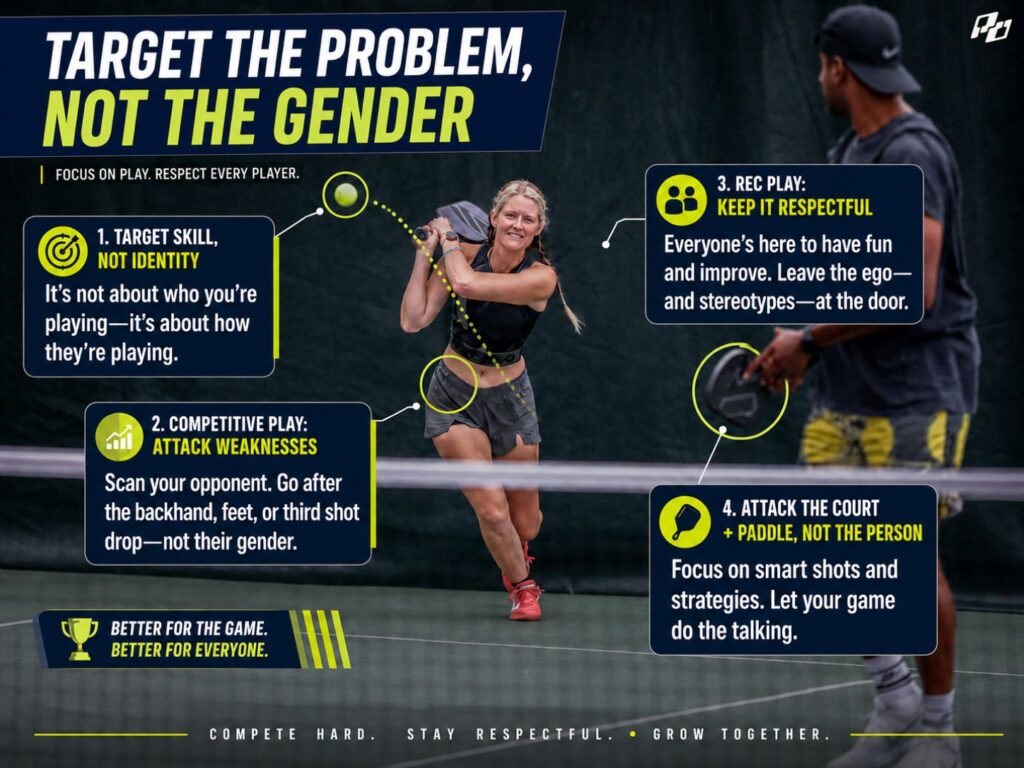
A better phrase is: Target the problem, not the gender.
That is legitimate pickleball.
The Rec-Play Answer: Don’t Be a Jerk About It
Now let’s be honest about rec play.
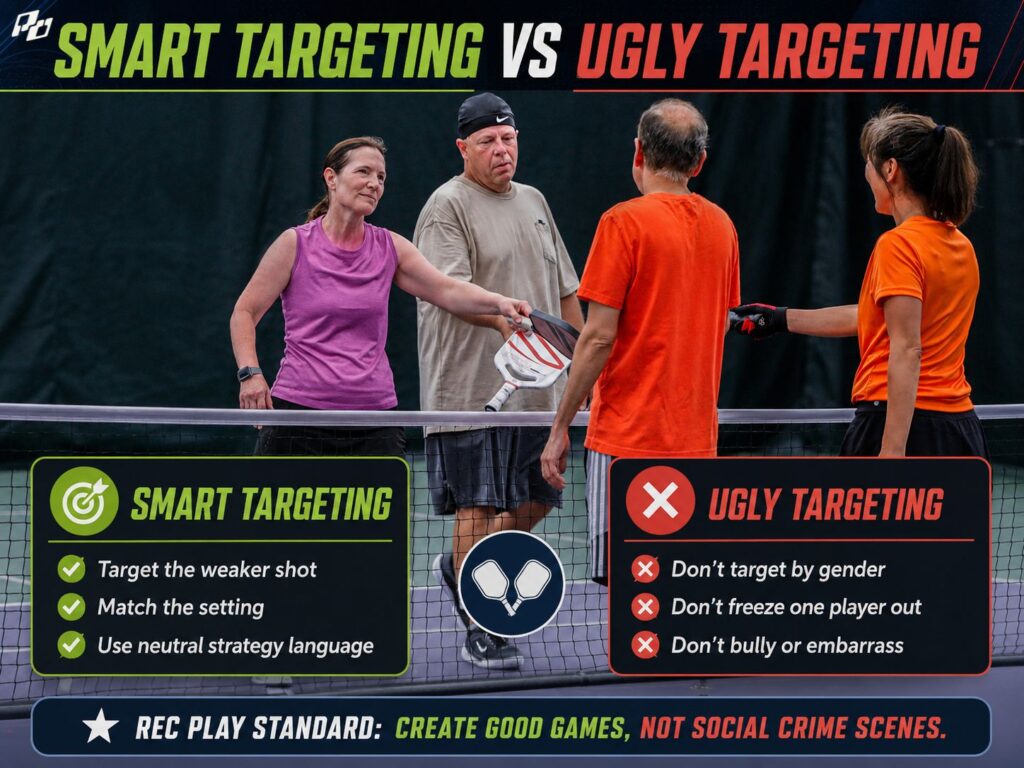
If you hit 95% of balls to one woman in a casual mixed open-play game, especially when she is clearly newer or just trying to get reps, people are going to notice. And they are probably not going to think, “Wow, what a tactical genius.”
They are going to think you are making the game less fun.
That does not mean you have to play fake pickleball. You do not need to hit every ball 50/50. You do not need to avoid a player’s weakness completely. You do not need to pretend a matchup does not exist.
But in social rec play, the goal is usually not just winning. It is good games. A good rec player can still play smart while keeping all four people engaged.
That means:
✓ do not freeze one person out completely
✓ do not repeatedly body-bag a weaker player
✓ do not celebrate when someone is clearly overwhelmed
✓ do not announce, “Just hit everything to her”
✓ do not use “strategy” as an excuse to bully
✓ do not patronize women by refusing to hit normal balls to them
The line is not always about where the ball goes. It is about whether your choices still respect the people on the court.
The Female Perspective: “Don’t Assume I’m the Weak Link”
A lot of women in pickleball are tired of being judged before the first rally. They walk onto a mixed court and can feel the evaluation happening immediately.
The man across the net may assume:
“She can’t handle pace.”
“She won’t counter.”
“She’s the safer target.”
“She won’t attack me.”
“She’s the weak player.”
Sometimes he is right about the matchup. Often he is just lazy. And that is what makes it annoying.
Many strong female players do not mind being tested. In fact, they may prefer it. What they dislike is being targeted before they have shown a weakness.
There is a big difference between: “Her backhand reset is floating; let’s pressure that.”
and “She’s the woman, so hit every ball to her.”
The first is strategy.
The second is a stereotype.
Also, do not assume women want “soft” treatment. Many competitive women would rather you play them honestly than float polite balls at them like they are fragile. Some of the most dominant players in pickleball are women; Anna Leigh Waters, for example, has been ranked No. 1 in women’s doubles, mixed doubles, and singles and is widely described as one of the sport’s most dominant athletes.
Simone Jardim is another obvious example: a former No. 1 player, multiple-time U.S. Open champion, and one of the defining figures in women’s and mixed pickleball.
So no, “woman” does not mean “weaker player.” At any decent club, there are women who will absolutely punish men who think that.
The Male Perspective: “I Can’t Win Either Way”
There is also a real male-player dilemma here. A man in mixed rec play may feel trapped:
If he targets the woman, he might be called rude.
If he avoids the woman, he might be called patronizing.
If he hits hard at her, he might look aggressive.
If he softens everything, he might look condescending.
If he plays normal strategy, someone may still read it through gender.
That tension is real. The solution is not to overthink every shot until you play weird, guilty pickleball.
The solution is to use the same standard you would use with anyone:
Respect the player’s actual level. Match the environment. Avoid dangerous shots. Don’t make gender the strategy.
If she is skilled, play her straight.
If she is newer, do not humiliate her.
If it is competitive, target weaknesses.
If it is social, keep the game enjoyable.
If she asks for full-speed play, believe her.
If she looks overwhelmed, adjust like you would for any overmatched player.
That is not complicated. It just requires awareness.
The Correct Way to Think About Targeting
Here is the framework I like:
1. Target skill, not identity
Do not target “the woman.”
Target the high dink.
Target the weak backhand.
Target the slow transition.
Target the player who cannot handle pace.
Target the person who keeps missing returns.
That might be anyone.
2. Match the setting
Tournament? Play to win.
Challenge court? Play hard.
League match? Strategy is expected.
Casual open play? Keep people involved.
Beginner session? Help create rallies.
Social mixed game? Do not turn it into an ambush.
3. Adjust by score and vibe
If the game is tight, strategy is natural.
If you are up 9-1, maybe stop pounding the same player.
If someone is laughing and competing, keep playing.
If someone is embarrassed and shrinking, read the room.
4. Do not be theatrical about it
The fastest way to make targeting feel ugly is to talk about it loudly.
Do not say:
“Hit it to her every time.”
“She can’t handle it.”
“Just keep picking on her.”
“Make her beat us.”
Even if the tactic is sound, the wording is terrible. Use neutral language with your partner:
“Let’s pressure the weaker backhand.”
“Keep it low to the player on the right.”
“Go middle until they prove they can handle it.”
“Make them hit one more.”
That is strategy without disrespect.
Tournament Pickleball: Yes, Targeting Is Part of the Game
In tournament play, nobody should be shocked when a team targets a weaker player.
That is doubles.
If one player cannot reset, they will see more drives.
If one player cannot return deep, they will see more serves.
If one player pops up dinks, they will see more dinks.
If one player loses hand battles, they will see more speedups.
This is not sexism. This is competition.
But even in tournaments, you should keep it clean. There is a difference between making a player hit difficult balls and acting like you are entitled to embarrass them.
You can compete hard without smirking, mocking, shouting instructions across the court, or drilling someone dangerously.
The official rules allow serious play, but they also establish sportsmanship expectations and penalties for conduct issues.
So yes, compete. But don’t be gross about it.
Rec Open Play: The Standard Is Different
Open play is where this topic gets emotional. Why?
Because people are not always there for the same reason.
One person is training for a tournament.
One person is brand new.
One person is there for cardio.
One person is trying to protect a knee.
One person is competitive.
One person is social.
One person is nervous.
One person just wants not to be humiliated.
That is why “but it’s legal” is not the whole answer. In social rec play, the better standard is:
Can I play a real point without making the game miserable for someone?
If yes, great.
If your entire strategy is to make one woman touch every ball until she breaks, and everyone knows she is clearly outmatched, that may be legal — but it is also probably why people stop inviting you.
The Difference Between Smart Targeting and Ugly Targeting
| Situation | Smart Targeting | Ugly Targeting |
|---|---|---|
| Competitive match | Pressure the weaker skill pattern | Mock or embarrass the player |
| Open play | Test weaknesses, but keep everyone involved | Hit 90% of balls to one overmatched player |
| Mixed doubles | Target the player who struggles, regardless of gender | Target the woman automatically |
| Speedups | Attack legal, reasonable targets | Blast at someone’s head or body repeatedly when unnecessary |
| Strategy talk | “Pressure the backhand” | “She can’t handle it — hit everything to her” |
| Big lead | Play controlled, work on placement | Keep hunting the same player at 10-1 |
| Strong female player | Play her honestly | Protect her because she is a woman |
Should Men Hit Hard at Women?
Here is the clean answer:
Hit hard when the ball, level, and setting justify it — not because of gender, and not without control.
If you are playing a strong female player in a competitive game, normal pace is fine. She probably expects it. She may be annoyed if you baby the ball.
If you are playing a beginner woman in social open play, blasting speedups at her chest is obnoxious.
But the same would be true if she were a beginner man. The issue is not male-to-female contact. The issue is mismatch, danger, and intent.
A hard drive to the feet? Fine.
A controlled speedup to the paddle-side hip? Fine in competitive play.
A repeated full-power shot at the face or upper body of a clearly overmatched player? Bad manners.
A useful rule: attack the court and the paddle, not the person.
Should Women Be Offended If They Are Targeted?
Sometimes yes. Sometimes no.
If you are being targeted because you are making more errors, that is just pickleball. It may not feel great, but it is how competitive doubles works.
If you are being targeted before you have shown any weakness, or if opponents openly say they are targeting you because you are the woman, then yes, that is fair to find insulting.
A good female-player response is not always to argue. Sometimes the best response is to punish it.
If they hit every ball to you:
✓ return deep
✓ keep dinks low
✓ reset instead of panicking
✓ counter the predictable speedup
✓ speed up behind the poacher
✓ communicate with your partner
✓ make them pay for being predictable
There is nothing more satisfying than watching a team keep targeting the “weaker woman” until they realize she is the reason they are losing.
The “Protective Partner” Problem
This happens constantly in mixed rec play.
The male partner sees opponents hitting more balls to the woman, so he starts overreaching. He takes balls that are clearly hers. He crowds the middle. He lunges across her body. He creates confusion. Then she plays worse because now she is not sure what is hers.
That is not partnership. That is panic.
Better support sounds like:
“I’ve got middle if it’s high.”
“Your crosscourt dink is working.”
“Let them keep hitting it to you.”
“Reset one more; I’ll look for the pop-up.”
“You’re fine. Make them play.”
Good partners build confidence. Bad partners accidentally confirm the opponent’s strategy.
What If the Woman Is Clearly the Stronger Player?
Then target the man. Seriously.
This is why gender-based strategy is dumb.
Many mixed rec games have a female player who is cleaner, steadier, and more disciplined than the male player. She may dink better, reset better, make fewer emotional attacks, and handle pressure with less ego.
Meanwhile, the man might have more power but worse decisions.
If you keep hitting to the woman because “that’s what you do in mixed,” you may be feeding the wrong player.
A smart team asks:
Who gives us errors?
Who gives us pop-ups?
Who returns short?
Who speeds up too early?
Who loses patience?
Who struggles under movement?
Who is protecting a weaker shot?
Not: Who is the woman?
The Best Scripts for Awkward Moments
If you’re being targeted too much:
“Hey, I’m good with competitive play, but can we keep it a little more balanced? This is supposed to be social.”
If opponents accuse you of targeting:
“Fair point. I’m trying to play the matchup, but I’ll keep it balanced since this is open play.”
If your partner is getting targeted:
“They’re going to keep testing you. You’re fine — just make them hit one more.”
If you want full competitive play:
“Are we playing tournament-style, or keeping it social?”
If someone says, “Just hit it to the woman”:
“Let’s target the weaker shot, not the gender.”
Simple. Clean. Correct.
My Opinionated Rule
Here is my honest take:
In tournaments, target whoever gives you the best chance to win. In rec play, target weaknesses without reducing a person to a weakness.
That is the line.
You can be strategic without being rude.
You can be competitive without being sexist.
You can hit to the woman without “targeting women.”
You can avoid patronizing female players by playing them honestly.
And you can still adjust when the game is clearly social, uneven, or uncomfortable.
The best rec players are not the ones who prove they can beat the weakest person on the court. Everyone can see that.
The best rec players are the ones who can create a good game, read the room, and still play smart pickleball.