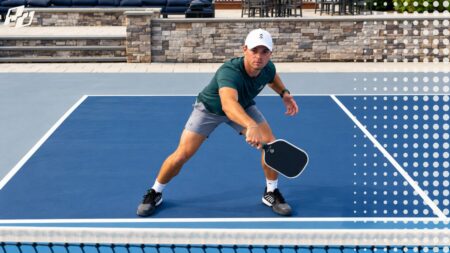
A pickleball swerve serve uses sidespin to make the ball bend or kick sideways, often pulling the returner off balance. It can be legal if the spin comes from paddle contact, not the release, but intermediate players should use it as a changeup—not a replacement for a reliable deep serve.
The swerve serve is one of those pickleball serves that looks almost unfair when it works.
The ball leaves the paddle, starts traveling toward the service box, then bends or kicks sideways enough to make the returner reach, jam, or move off the court. In singles, especially, that can feel like a cheat code. Pull the opponent wide, get a shorter return, step in, and suddenly the next ball is sitting exactly where you want it.
But here is the part rec players need to hear before they run to the court and start carving every serve sideways:
The swerve serve is not automatically a “better serve.” It is a specialty serve.
Used well, it can add variety, create awkward returns, and make opponents uncomfortable. Used badly, it can wreck your serve percentage, create rule questions, and turn your first shot of the rally into a low-percentage trick.
So let’s break it down the right way: what the swerve serve is, whether it is the same as a screwball serve, whether it is legal, how to hit it, when to use it, and whether intermediate rec players should actually risk it.
What Is a Swerve Serve?
A swerve serve is a pickleball serve built around heavy sidespin.
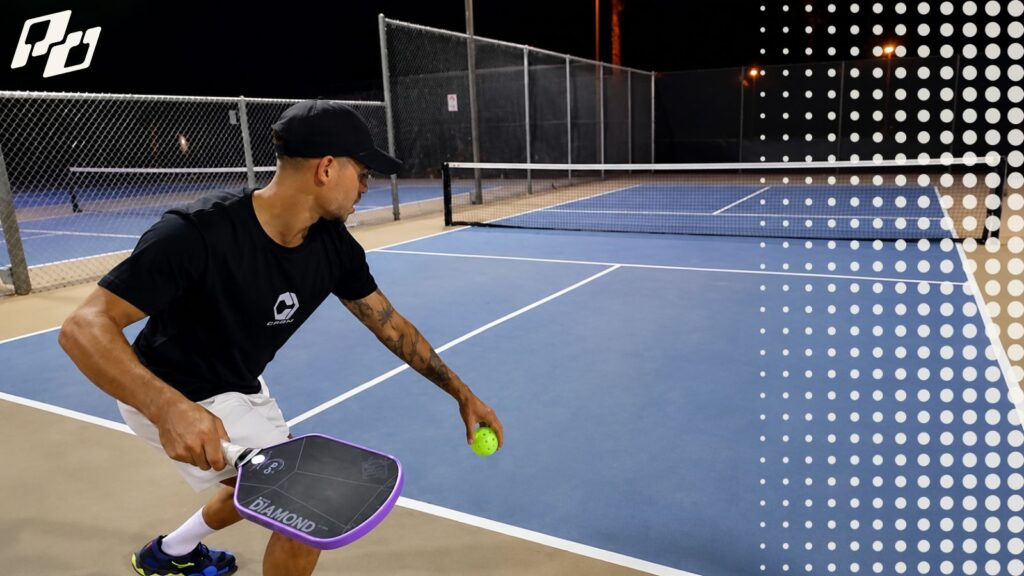
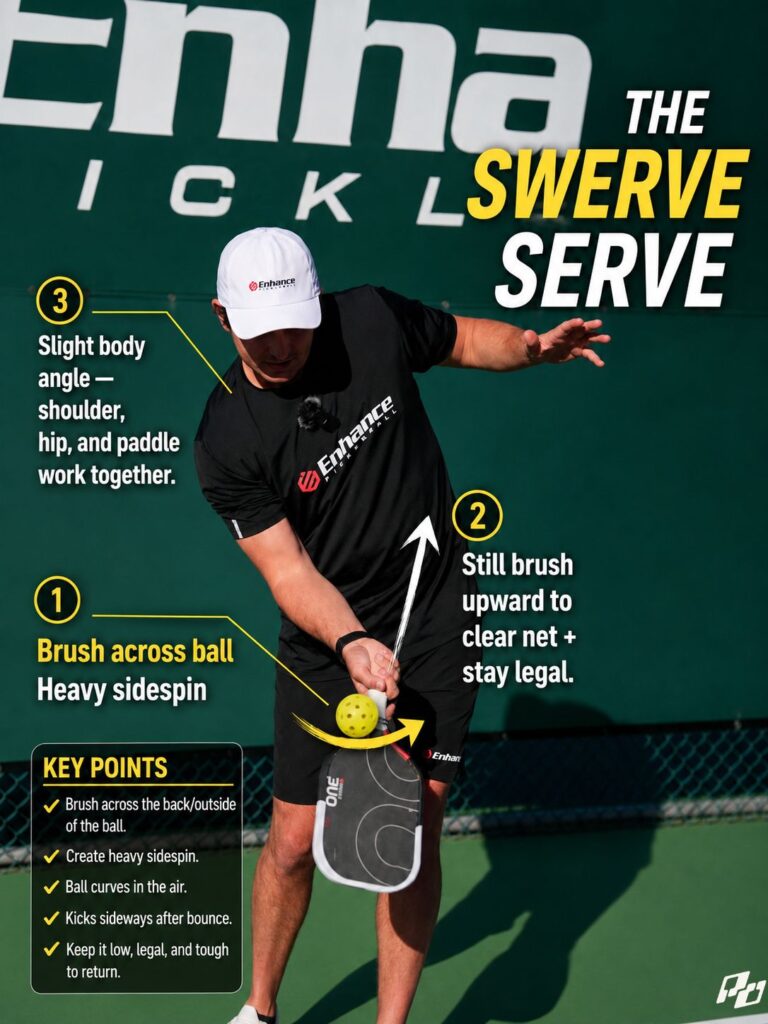
Instead of hitting mostly through the back of the ball, you brush across it. For a right-handed player, that often means brushing across the back/outside of the ball from right to left, depending on the target and contact point. That sideways brush makes the ball curve in flight, skid, or kick sideways after the bounce.
The goal is not just speed. The goal is movement.
A good swerve serve can:
✓ pull the returner wide
✓ jam the returner’s body
✓ force late contact
✓ create mishits
✓ produce shorter returns
✓ open space for the next shot
✓ make your regular serve more effective by contrast
In singles, that sideways movement can be especially valuable because one player has to cover the whole court. If you can move them off the court with the serve, you may open the opposite side for the next ball.
@yao.pickleball How to hit the swerve serve! 1. Slice under the ball rotate your core. 2. Step forward while contacting the ball. ##fyp #pickleball #pickleballtiktok #pickleballtips #pickleballislife ♬ Hazy Mercer – 5l33p
In doubles, the serve can still be useful, but the payoff is usually smaller because there is a partner covering the court and the returner’s job is often just to get the ball deep and get to the kitchen.
Is the Swerve Serve the Same as the Screwball Serve?
Usually, people use the terms loosely. But technically, they are not always exactly the same.
A swerve serve usually describes the effect: the ball curves, bends, or moves sideways because of sidespin.
A screwball serve usually describes the spin style: a serve hit with a more aggressive side/corkscrew-type action that makes the ball curve or kick awkwardly.
So in casual pickleball language, yes, many players use “swerve serve,” “screwball serve,” and “sidespin serve” to mean roughly the same family of serves.
But if we are being precise:
Swerve = what the ball does.
Screwball = one way players create that movement.
Sidespin serve = the broader technical category.
For rec players, the name matters less than the big idea: you are brushing the ball sideways enough to make the return less comfortable.
Is the Swerve Serve Legal?
It can be legal — but this is where you need to be careful.
Under the 2026 USA Pickleball rules, you are not allowed to manipulate the ball to add spin during the release. The ball must be released using only one hand or only the paddle, and the server cannot add spin with the body or paddle before striking the ball. However, spin may be applied when the paddle contacts the ball.
That means the old-style “spin the ball with your fingers before hitting it” idea is not legal under USA Pickleball rules. The spin has to come from the paddle strike, not from the release.
If you use a volley serve, the serve also has to follow the volley-serve rules: the paddle must be moving in a clear upward arc at contact, the highest point of the paddle head must not be above the highest part of the wrist joint, and the ball must be contacted no higher than the waist.
If you use a drop serve, the ball has to be dropped from a natural height and cannot be propelled in any direction before you hit it. Once it bounces, the drop serve does not have the same upward-arc, paddle-head, and waist-height restrictions as the volley serve.
So the safe version is this:
A swerve serve is legal if the spin comes from paddle contact, the release is clean, the serve lands in the correct service court, and your motion follows the rules for the type of serve you are using.
Why People Say It “Might Be Illegal”
This serve gets rule questions because players often chase side spin in ways that drift into illegal territory.
The common problems:
✓ spinning the ball during the release
✓ hiding the release
✓ using a sideways/chopping motion that no longer has a clear upward arc on a volley serve
✓ contacting the ball too high
✓ letting the paddle head rise above the wrist at contact
✓ trying to create so much side action that the serve becomes more like a swipe than a legal serve
That is why some coaches say not to use it in tournaments unless you are absolutely sure your mechanics are legal.
In rec play, people may let a lot of borderline serves slide. In tournament play, especially with a referee or experienced opponents, the same motion may get questioned.
The Big Question: Is It Worth Risking Consistency?
For most intermediate rec players, the honest answer is: not as your main serve.
A serve that misses too often is not a weapon. It is a gift.
The swerve serve is worth learning if you already have a reliable deep serve. But if you are still missing serves, serving short, or struggling with basic depth, you should not build your service game around a high-spin specialty serve yet.
A good benchmark:
Before using the swerve serve regularly, you should be able to make 8 or 9 out of 10 normal serves deep.
Then, when you practice the swerve, aim for:
7 out of 10 in play with meaningful depth before trying it in games.
If your swerve serve makes one returner look silly but costs you three faults, it is not helping.
Who Should Try the Swerve Serve?
Beginners
Not yet.
Beginners should focus on a legal, repeatable, deep serve. You need clean contact, consistent release, and reliable depth before adding heavy sidespin.
The swerve serve adds complexity: paddle path, ball position, spin control, legality awareness, and target discipline. That is too much if the basic serve is still shaky.
Early Intermediates
Use it as a practice serve, not a match serve.
If you are around the 3.0–3.5 level and already serve consistently, you can start experimenting. But treat it like a changeup, not your default.
Your goal is to learn feel, not win points with chaos.
Strong Intermediates
This is the sweet spot.
At 3.5–4.0, the swerve serve can become useful if you can keep it deep and legal. You can use it a few times per game to change rhythm, pull someone wide, or test a weaker returner.
Advanced Players
Advanced players can use the swerve serve more strategically because they usually understand the next ball better. They are not just trying to win the serve outright. They are using the serve to create a predictable return and attack the open court.
That is the real pro-level mindset.
Why the Swerve Serve Works Best in Singles
In singles, court space is everything.
If you can bend the serve wide and force the opponent to return from outside the sideline, you create a huge court-position advantage. Even if they get the ball back, they may be late recovering.
That can give you:
✓ an open opposite side
✓ a weaker floating return
✓ a chance to drive into space
✓ a chance to approach behind pressure
✓ a chance to force a running passing shot
In singles, the swerve serve is not just about the serve. It is about the next ball.
Think: serve wide, open court, attack the recovery.
That is why this serve can feel deadly in singles.
Why It Is Riskier in Doubles
In doubles, the returner has a partner. Pulling one player wide does not always open as much space because the other player can help cover the middle after the return.
Also, doubles rewards reliable deep serves more than tricky serves. If your swerve serve lands short, a good doubles returner can step in, drive or float a deep return, and get to the kitchen.
That does not mean the swerve serve is useless in doubles. It just means it should be used selectively.
Use it in doubles when:
✅ the returner struggles with spin
✅ the returner stands too close to the centerline
✅ you can keep it deep
✅ you want to disrupt timing
✅ you are not sacrificing serve percentage
Avoid it when:
❌ you are missing serves
❌ the returner handles spin easily
❌ your serve lands short
❌ the score is tight and your normal serve is more reliable
❌ you are using it just because it looks cool
How to Hit the Swerve Serve
Let’s assume a right-handed player trying to create a serve that bends or kicks left-to-right or right-to-left depending on target. The exact direction depends on the side of the ball you brush and your swing path, but the mechanics follow the same core principles.
1. Start With a Legal, Repeatable Release
This is non-negotiable.
Do not spin the ball with your fingers. Do not hide the release. Do not toss it sideways or manipulate it. Keep the release simple and visible.
Cue: clean release first. Spin comes later.
If the release is questionable, the serve is already in trouble.
2. Use a Slightly Closed Setup
A slightly closed stance gives your body room to rotate and lets the paddle travel across the ball without becoming all wrist.
You do not need to turn dramatically sideways. You just want enough body angle that your shoulder, hip, and paddle can work together.
Cue: turn enough to brush, not enough to get stuck.
3. Contact Slightly More to the Side of the Ball
A normal serve goes more through the back of the ball. A swerve serve brushes more across the side/back quadrant.
For many right-handed players, the feeling is brushing across the outside/back of the ball, rather than driving straight through the center.
Cue: catch the side, not the middle.
But do not carve around the ball so much that you lose depth.
4. Brush Across and Slightly Up
This is the key.
You need sideways brush for swerve, but you still need enough upward component — especially on a volley serve — to keep the motion legal and get the ball over the net.
The mistake is making the stroke too horizontal. That creates rule risk and often sends the ball wide or into the net.
Cue: across for spin. Up for legality and lift.
@everett.epa The SWERVE SERVE is a game changer in singles. Brush across the ball right to left to create heavy side spin that pulls your opponent off the court. It forces weak returns and opens up easy space for your next shot. If you want free points and control rallies, this serve is deadly. Deadly for singles.i do not recommend using this in a tournament it can be considered illegal depending on how you hit it. #pickleball #foryoupage #technique #topspin #legal ♬ Millionaire Mindset – bitchbaby
5. Keep the Serve Deep
A short swerve serve is not scary. It is a gift.
Your target should still be deep in the service box. The spin is the bonus, not the whole serve.
Cue: depth first, bend second.
If you cannot keep it deep, reduce the spin.
6. Finish Toward Your Target
Do not brush and quit.
After the sideways contact, your paddle still needs a destination. Finish toward the service box so the ball travels through the court instead of just spinning sideways.
Cue: brush it, then send it.
The Drop-Serve Version May Be Safer for Learning
For many rec players, the drop-serve version is easier to experiment with because you do not have to satisfy the volley-serve upward-arc, paddle-head, and waist-height requirements. You still cannot propel or spin the ball during the drop, but after the bounce, you can focus more on the paddle path.
That said, the drop serve has its own challenge: the bounce may not sit perfectly, and you may need more timing control.
A good learning progression:
- Learn the spin on a drop serve in practice.
- Build depth and consistency.
- Only then experiment with a legal volley-serve version if you want one.
The Best Score Situations
Good times to try it:
✓ early in a game to test the returner
✓ when leading by a few points
✓ after several normal deep serves
✓ against a player who keeps returning from the same spot
✓ in singles when you want to open the court
Bad times:
✕ match point against you
✕ after two serve faults
✕ when your team needs one clean hold
✕ when your opponent has already adjusted
✕ when your mechanics feel rushed
The serve should help your strategy. It should not satisfy your curiosity at the worst possible moment.
What Happens After the Swerve Serve?
This is the part rec players often miss. They hit the spin serve, admire it, and then have no plan for the return. A good swerve serve should create a next-ball pattern.
In singles:
- If you serve wide, expect a stretched return. Be ready to attack the open court.
- If you serve into the body, expect a shorter block or awkward chip. Be ready to step in.
- If you serve to the backhand, expect a softer return. Be ready to drive or approach.
In doubles:
- If the returner floats the return, your third shot may be attackable.
- If the return is deep but weak, you may have more time.
- If the returner slices the ball back low, do not force a drive. Use the third shot that fits.
Cue: spin serve, then hunt the next ball.
Common Mistakes
1. Trying to make it curve too much
Problem: You over-brush and lose depth or miss wide.
Fix: Reduce the sidespin and hit through the ball more.
Cue: Bend a little. Land deep.
2. Spinning the release
Problem: You create spin before the paddle strike, which is not allowed.
Fix: Use a clean release and create spin only at paddle contact.
Cue: Clean drop. Dirty contact.
3. Making the stroke too sideways
Problem: The motion becomes questionable on a volley serve and inconsistent overall.
Fix: Keep an upward component and finish through the service box.
Cue: Across and up.
4. Losing depth
Problem: The ball curves but lands short.
Fix: Aim deeper and hit through more of the back of the ball.
Cue: Depth before drama.
5. Using it too often
Problem: Opponents adjust and your own consistency drops.
Fix: Mix it with regular deep serves, body serves, and pace changes.
Cue: Changeup, not default.
6. Ignoring the next ball
Problem: The serve creates movement, but you don’t position for the reply.
Fix: Know what return you’re trying to create before you serve.
Cue: Serve with a plan.
The Rec Player Verdict
The swerve serve can be a legitimate weapon, especially in singles. It can pull players wide, jam their return, and create space for the next shot. But it is not worth sacrificing basic serve consistency.
For intermediate rec players, the right order is:
- Legal serve
- Deep serve
- Targeted serve
- Spin variation
- Swerve serve as a changeup
If you skip the first three and jump straight to heavy sidespin, you will probably miss more serves than you win.
So yes, learn it. But respect it.