
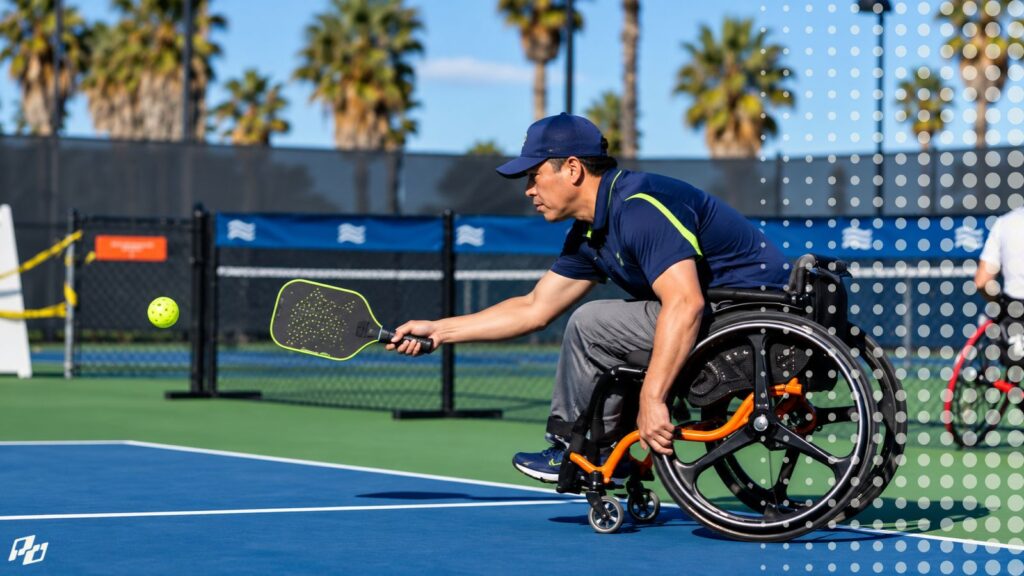
Wheelchair pickleball allows two bounces, but mixed open play also changes positioning, partner movement, and kitchen strategy. The key is simple: communicate early, leave room to turn, understand the wheelchair-specific rules, and let each player use the court in the way that works best.
After our recent story on the proposed 2027 rule changes, a reader sent us a note that stopped us for a second.
He is a wheelchair athlete in The Villages, Florida. He told us he has spent two years looking for another wheelchair pickleball player. So most of his pickleball is played with standing players—and when someone new joins the court, he usually introduces himself and explains the one rule difference they really need to know:
He gets two bounces.
That got us wondering: beyond the rulebook, what actually makes mixed wheelchair-and-standing open play work well?
Because the answer isn’t “just play normally.”
It’s close—but there are a few tactical and communication differences that can make the game dramatically better for everyone.
First, the rule most players need to understand
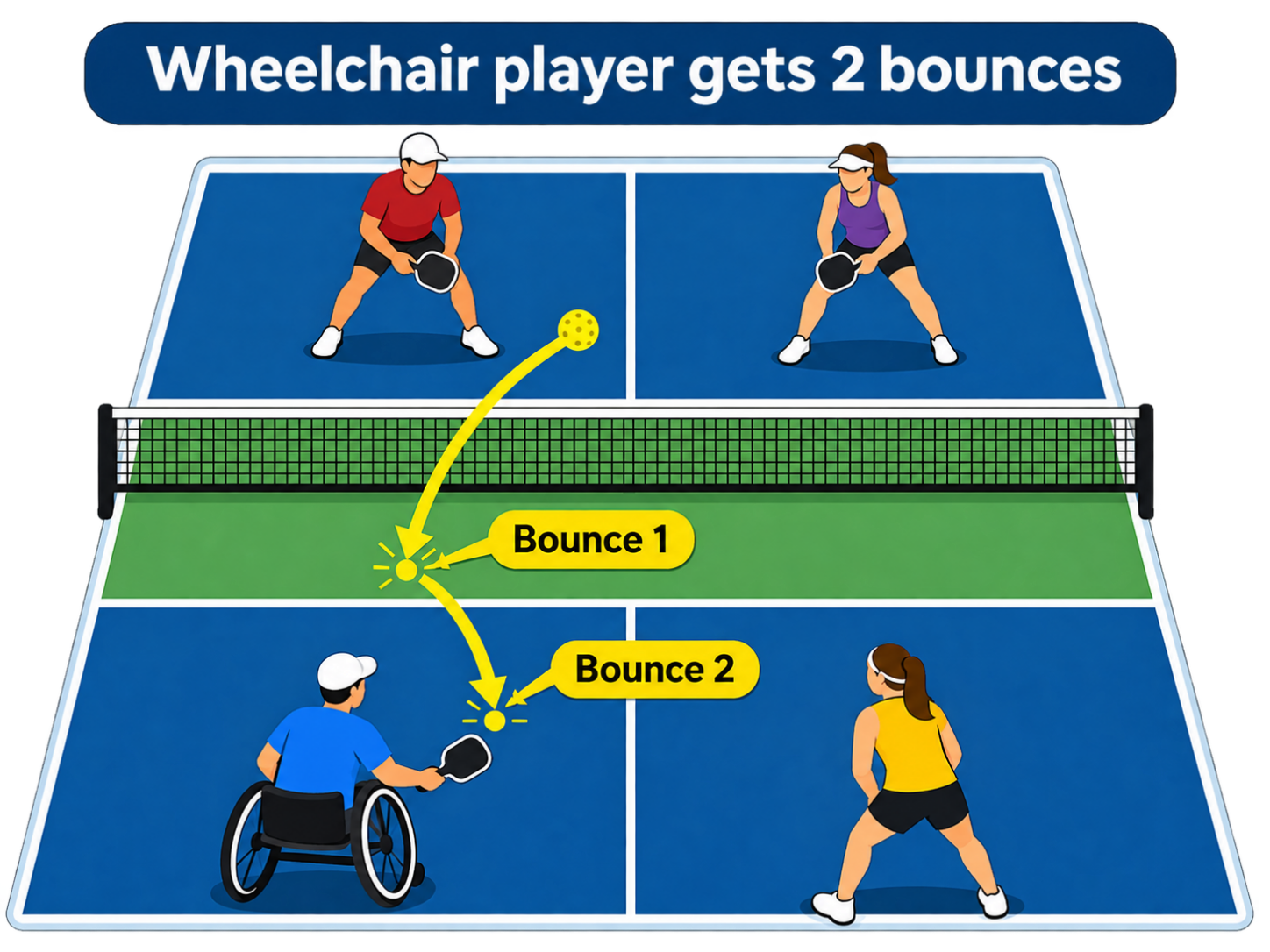
USA Pickleball’s 2026 rules allow a wheelchair player to let the ball bounce twice before returning it. The second bounce can be anywhere on the playing surface; the fault occurs if the ball bounces a third time. Importantly, that allowance belongs to the wheelchair player—not automatically to their standing partner.
That sounds like a small accommodation. Strategically, it’s much bigger.
A standing player sees a short ball and thinks: get there before bounce two.
A wheelchair player can sometimes think: let bounce one slow it down, use that time to turn the chair, then play bounce two from a better angle.
That extra bounce isn’t merely extra reaction time. It can be positioning time. And that is probably the first thing standing partners need to stop “helping” with.
Don’t steal the second bounce
This may be the biggest practical adjustment in mixed doubles. Standing players are trained to chase balls quickly. We see a ball dropping into the middle, our instinct kicks in, and off we go.
But if your wheelchair partner has called the ball and is setting up to use the second bounce, charging across to rescue it can actually make the point harder.
The wheelchair player may be using bounce one deliberately to:
- turn the chair
- create paddle clearance
- open a forehand or backhand angle
- or avoid trying to strike while still accelerating or changing direction
Adaptive pickleball instruction specifically emphasizes chair angle and recovery position because the chair has to be positioned for the shot and the next movement.
So mixed partners should agree on a very simple communication rule: call middle balls early. Not when both players are already moving toward them.
Early.
A quick “mine” or “yours” gives the wheelchair player permission to use the second bounce without wondering whether a partner is about to cross in front.
The kitchen works differently than you probably think
Here’s another rule standing players regularly misunderstand.
For wheelchair players, the small front casters and rear stabilizing wheels may enter the non-volley zone. The kitchen fault is tied primarily to the large rear wheels, which are treated much like a standing player’s feet for positioning.
That changes the visual picture. A standing opponent may look across the net and think: They’re in the kitchen. They may not be.
So before your first game together, that’s worth explaining along with the two-bounce allowance.
Something as simple as:
“I get two bounces, and for kitchen faults it’s my big rear wheels that matter.”
That is probably enough for normal rec play. You don’t need a five-minute rules seminar before 0-0-2.
The usual “rush the kitchen” advice needs an asterisk
Standing pickleball coaching constantly tells players to get to the kitchen line, and for good reason: controlling the non-volley zone generally gives a team an offensive advantage. USA Pickleball teaches players to advance while staying linked with their partner and following the ball forward.
But a wheelchair player has another variable: turning radius.
Being six inches closer to the kitchen may improve reach in front of you while making a sharp ball behind or beside you harder to recover. So “closer is always better” isn’t quite the right rule.
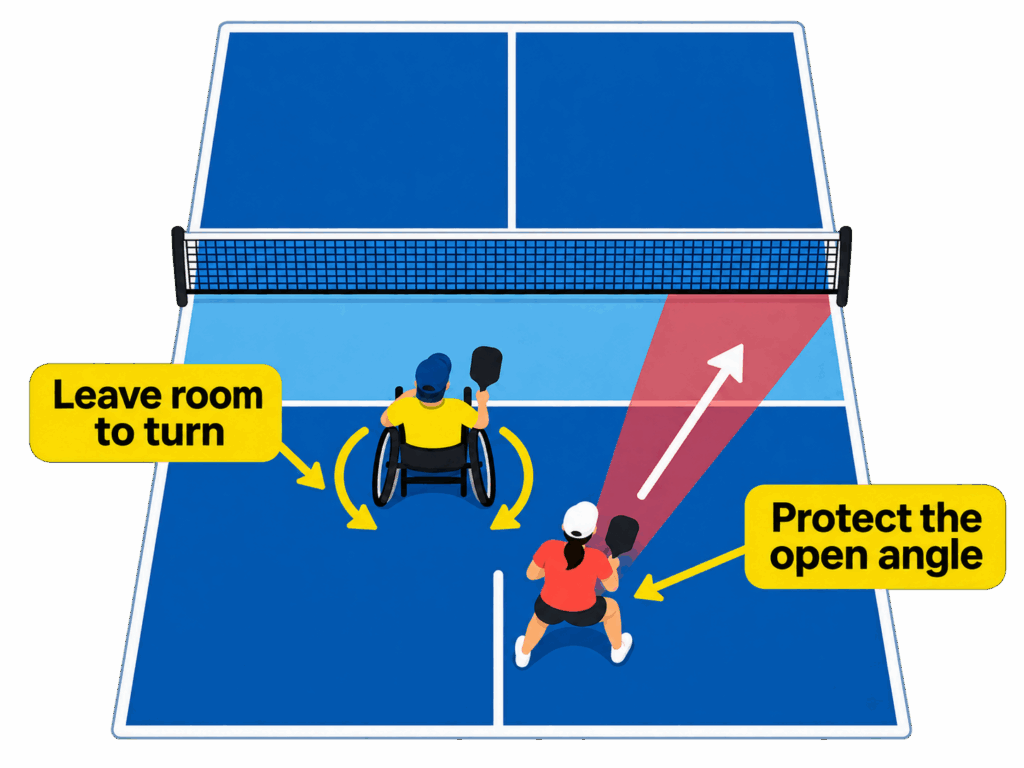
A better cue is: get as close as you can while still being able to turn.
That may mean playing slightly farther off the kitchen line than a standing partner. And the standing partner shouldn’t automatically copy that depth.
Mixed doubles doesn’t require both teammates to form a perfectly straight horizontal line. What matters more is closing the dangerous angles between you.
The standing partner may need to protect space differently
Here’s where mixed doubles becomes tactically interesting. A wheelchair player can cover surprising distance using the second bounce—but changing direction usually takes more space than a standing player’s shuffle step.
That means the standing partner should think less about covering exactly “their half” and more about protecting the first dangerous angle.
If your wheelchair partner is moving wide right, for example, the most dangerous next ball may be behind their movement toward the middle.
That doesn’t mean poach everything. It means recognize momentum.
The same principle applies in regular doubles: partners should move together and close space based on where the ball travels rather than guarding two imaginary rectangles.
In mixed play, that concept matters even more.
Think: they cover the ball they’re moving toward. I protect where the next ball is likely to go.
That feels much better than trying to “help” by taking every ball that looks difficult.
Give the returner room
Here’s another subtle one. If the wheelchair player is returning serve, the standing partner should be careful about crowding the middle too early.
Why?
The returner may need more lateral space to rotate the chair and recover after contact.
A standing player can hit a backhand, pivot and take two tiny adjustment steps. A chair player may need to strike, push, rotate and reorient.
Those few feet of open space beside them matter.
So after the return, don’t immediately collapse toward your partner. Let them finish the turn. Then close the gap together.
Use the second bounce—but don’t become dependent on it
The two-bounce allowance is a tactical weapon, not an obligation. If the ball arrives comfortably after one bounce, take it.
Waiting automatically for bounce two can surrender court position and give opponents more recovery time.
The valuable question is: does bounce two improve this shot?
- Use it when the first bounce leaves you:
- stretched
- still turning
- moving backward
- or unable to get the paddle comfortably around the chair
Skip it when you’re balanced and the first bounce gives you a clean strike. That distinction turns the rule from an accommodation into strategy.
Serving has its own chair-specific detail
When a wheelchair player serves, both large rear wheels must be on the playing surface behind the baseline and inside the proper serving area. The smaller front wheels may extend into the court.
Again, standing players sometimes see a caster across the baseline and assume a foot fault.
It isn’t.
Knowing that ahead of time prevents one of those awkward mid-game rule debates nobody came to open play for.
One thing we’d tell standing opponents: play normally
This may be the most important etiquette point. Don’t suddenly start feeding easy balls because someone is playing from a wheelchair. And don’t assume every short ball is unreachable.
Wheelchair players can use the second bounce, angles and chair momentum in ways that surprise players seeing adaptive pickleball for the first time.
Our reader isn’t asking opponents to create a different sport for him. He’s asking for a way to play the same sport together.
There is a difference.
Competitive ball? Hit it.
Good speed-up? Take it.
Open court? Use it.
Just understand the actual rules before deciding what somebody can or cannot reach.
And for the wheelchair player: explain less, earlier
Our reader told us he introduces himself to new players and explains the two-bounce rule, then gets into additional rules only if they ask.
We think that’s almost exactly right. Our slightly revised version would be:
“Just so you know, I’m playing under the wheelchair rules. I can use two bounces, and my big rear wheels are what count for the kitchen. Otherwise, let’s play.”
Done.
Ten seconds.
The surprising takeaway after digging into this is that mixed wheelchair pickleball doesn’t need a huge set of special tactics. It needs better anticipation between partners.
The standing player needs to resist rescuing balls too early. The wheelchair player needs space to turn and permission to use the second bounce strategically.
Both players need to communicate middle balls sooner.
And once those pieces click, the game starts looking a lot less like “adaptive pickleball.” It just looks like good doubles.