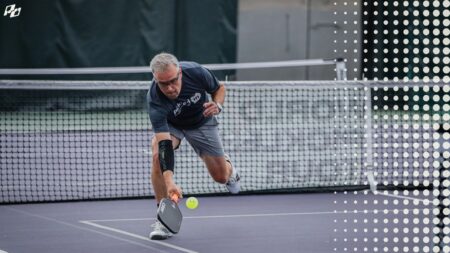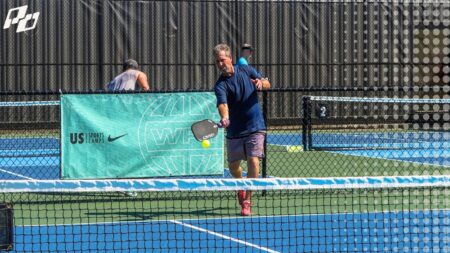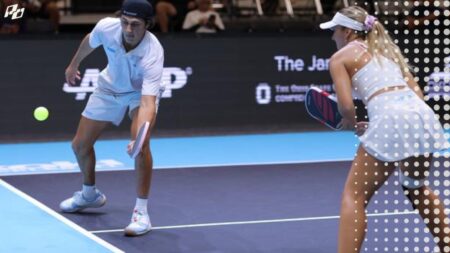

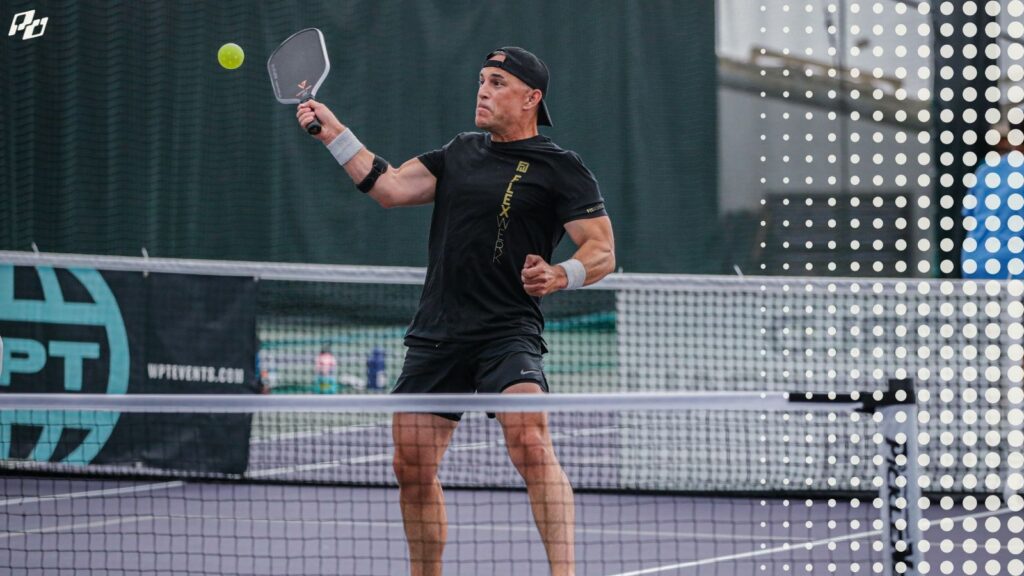
The biggest mistake against better pickleball players is giving them free points. Use bigger margins, smarter targets, patient defense, and attack only when the ball earns it. Make stronger opponents hit one more shot—and actually finish the rally.
There’s a strange thing that happens when you walk onto a court against someone you know is better than you.
Your targets get smaller.
Your swings get bigger.
A normal dink suddenly doesn’t feel good enough. A slightly high reset feels like a death sentence. And if they attack you, there’s this urge to immediately prove you can attack back.
In other words, you start helping them.
Zane Navratil, a longtime professional pickleball player, coach, and one of the sport’s best-known strategy voices, recently described the mindset in a much more memorable way: don’t respect your opponent so much that you deprive them of the opportunity to mess something up.
His point wasn’t “play recklessly.” It was almost the opposite. Make them actually win the point.
That sounds simple. But here are five ways intermediate players accidentally stop doing it.
1. You Try to Escape a Bad Position With a Great Shot
You’re stretched wide.
The ball is below the net.
You’re half a step late.
And because the player across from you is good, your brain immediately decides: I have to do something special here.
- So you attempt the sharp crosscourt winner.
- Or the counter down the line.
- Or a speed-up from your shoelaces.
That’s backwards.
When you’re behind in the rally, your job usually becomes less ambitious, not more.
✔ Get the paddle on the ball.
✔ Use height.
✔ Use the middle.
✔ Buy yourself enough time to recover.
Zane’s broader coaching advice fits perfectly here. He tells players to “play the ball, not the player”—don’t let the reputation of the person across the net change the shot the ball actually calls for.
That’s a very useful rule.
If the ball demands defense, defend it.
A bad position is not an invitation to hit your best shot. It’s an invitation to survive one more shot. And good players still have to finish.
They can hit the next volley long.
They can dump an overhead.
They can get impatient with a ball they expected to be easier.
But none of that can happen if you donate the point first.
2. You Avoid Their Best Shot Until They Know Exactly Where You’re Going
Suppose the stronger player has a nasty forehand. After getting burned twice, you decide: Fine. Everything goes to the backhand.
It feels smart.
For about three points.
Then they realize you’re never going to challenge the forehand side.
➜ Now they can shade toward the backhand.
➜ They can sit on your dink pattern.
➜ They can poach more aggressively.
And the target you thought was “safe” becomes extremely predictable. This is where respecting a strength can become over-respecting it.
You should absolutely know where the stronger weapon is. But that does not mean every neutral ball must avoid it.
In practice, deliberately hit more balls to the stronger player because it forces you to deal with better responses and make better decisions.
The match version is more nuanced. You don’t feed someone’s best attack. But you also don’t announce: “I am never hitting over there.”
Sometimes a safe dink to a strong forehand is exactly what keeps the player honest. Sometimes a deep return to that side prevents them from cheating toward the weaker wing.
The goal is to exploit weaknesses without becoming predictable enough that the weakness disappears.
3. You Try to Hit a Perfect Drop Because a Normal One Feels Unsafe
This might be the clearest example of giving a better player free points.
You know their kitchen game is excellent. So suddenly your third-shot drop has to clear the tape by two inches and land perfectly at their feet.
It feels logical: If I leave this even slightly high, they’ll attack it.
True.
But you know what they can attack even more easily?
A ball in the net.
Coach Tony Roig, a longtime pickleball instructor and founder of Better Pickleball, highlighted this after watching Anna Bright and Hayden Patriquin upset Ben Johns and Anna Leigh Waters.
On match point, Bright hit a third-shot drop that sat higher than she would have wanted. Johns attacked it—but Patriquin kept the rally alive, and they eventually won the point.
Roig’s lesson was simple: a high drop is still much better than one in the net. That is exactly the mindset rec players need against stronger opponents.
- Give the ball enough arc.
- Give yourself enough net clearance.
- Let the ball descend.
- If they attack it, defend.
Ashley Griffith, a professional pickleball player and coach known for his instructional work on shot mechanics and strategy, makes a similar technical point: players often hit drops too low because they think a “good drop” means barely clearing the net, when more height and a controlled arc can actually create a safer, more consistent ball.
The AHA here is: better opponents don’t require smaller targets. They require fewer free points.
4. You Treat Every Attack Like You Have to Win the Firefight Immediately
Strong player speeds up. You panic. And before you’ve even processed where the ball is going, you’ve decided: counter.
That’s another form of excessive respect. You’re assuming their attack is so good that simply blocking it won’t be enough.
But not every fast ball needs a faster response. If you’re balanced and the ball arrives in a good counter window, absolutely attack it.
But if you’re jammed, late, stretched, or contacting below your ideal zone? Put the paddle behind it.
✓ Block it.
✓ Reset it.
✓ Make them attack again.
This is where Zane’s “give them another chance to mess up” idea becomes very literal.
One good attack doesn’t entitle your opponent to the point. They may have to hit two. Or three.
And those extra contacts matter.
Anna Leigh Waters emphasizes exactly this broader problem among amateurs: she sees too many unforced errors, particularly early in rallies, and recommends focusing more on executing the serve, return, and third rather than giving away points unnecessarily.
Your opponent hitting a good ball is not an unforced error. Your attempt to hit a miracle counter from a terrible position often is.
5. You See a Weak Ball and Mentally End the Rally Before They Do
This one is almost invisible.
You pop up a dink.
Your shoulders drop.
You stop moving.
You’re already annoyed with yourself.
Meanwhile, your opponent hasn’t even hit the ball yet.
Or you leave a reset slightly high and immediately start thinking: That’s dead.
Maybe.
But recover anyway.
✔ Paddle up.
✔ Get compact.
✔ Protect your body.
✔ Expect another ball.
Anna Leigh Waters teaches players to mentally stay involved on every shot, even when their partner is hitting, so they’re already anticipating what happens next rather than reacting late.
That same principle matters when you hit a bad ball. The moment you decide the rally is over, your feet stop preparing for a ball that may still come back.
And this is where stronger players seem almost magical. They don’t always hit better defensive shots. They just stay alive in points longer.
Callie Smith, a longtime professional pickleball player and coach who has competed at the highest levels of the PPA Tour, has pointed out a related amateur mistake: players often hit their shot and then watch it instead of recovering immediately to a neutral ready position.
Against a strong player, that habit gets punished even faster.
Your job after a bad ball isn’t to apologize to yourself. It’s to prepare for the next one.
The Trap: Don’t Turn This Into Passive Pickleball
There is an important catch.
“Make them hit one more ball” does not mean dink forever and hope the better player misses.
Tanner Tomassi, a professional pickleball player, coach, and content creator, has talked openly about falling into that trap himself. Against players he believes are equal or better, he can become too defensive and switch into a “just make balls” mindset. His problem with that approach is that it becomes predictable and allows the opponent to dictate the rally.
That’s an important distinction.
The takeaway isn’t to stop attacking. It’s to stop forcing offense just because you’re afraid a neutral ball won’t survive.
If the attack is there, take it. If it isn’t, make them play one more shot.
The Rule I’d Use Against Better Players
Next time you’re playing someone who normally beats you, try this for one game:
➜ When you’re balanced, play your game.
➜ When you’re ahead, attack.
➜ When you’re neutral, make them uncomfortable.
➜ When you’re behind, make them hit another ball.
And don’t suddenly shrink every target just because you know their DUPR is higher.
Popular coach John Cincola makes a useful point about intention: when amateur players don’t have a specific target, they’re often just trying to put the ball somewhere in the court. Against better opponents, I’d take that one step further.
Have a target. Just don’t turn the target into a postage stamp.
Middle is still good.
Feet are still good.
A safe crosscourt dink is still good.
A drop with margin is still good.
A blocked attack that lands in the kitchen is very good.
You don’t need to suddenly start playing professional-level shots because a better player is standing across from you.
You just need to stop giving them professional-level respect.
Respect their ability. Don’t start scoring points for them.
Put one more ball over the net. Recover. Then make them prove they can finish it.