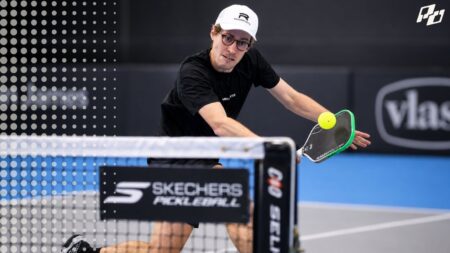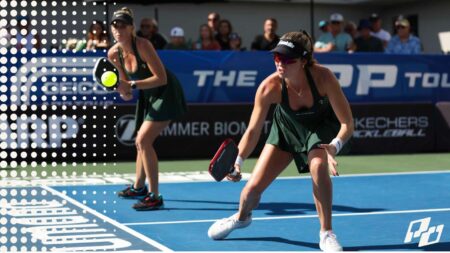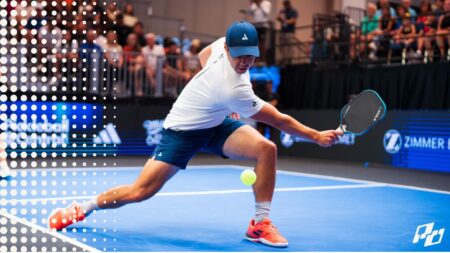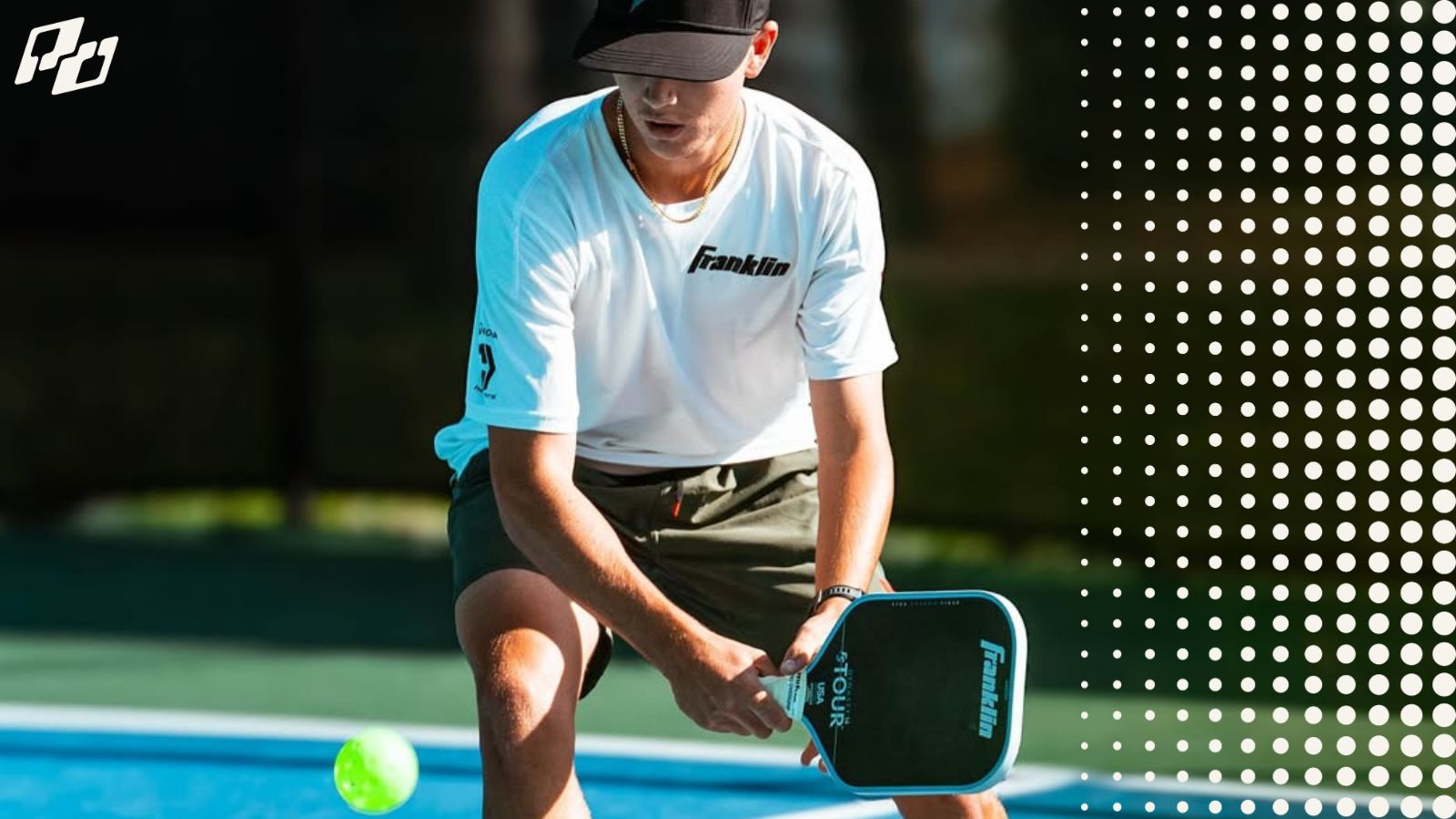
If you’ve ever watched a high-level doubles match, you’ve probably seen it — that smooth, confident two-handed backhand dink that seems to lift off the paddle and curl over the net like it’s on a string.
It’s becoming one of the most useful shots in modern pickleball, especially as rallies get faster and players look for ways to control the ball under pressure.
We analyzed pros Hayden Patriquin and James Ignatowich, who both teach and use this shot, to break down how it works — and how you can start using it effectively as an intermediate rec player.
Why the Two-Handed Backhand Dink Is Taking Over
A few years ago, you’d rarely see men on the pro tour use two hands on a backhand dink. Now, it’s everywhere. Women pioneered it because it adds power and stability, and the men are catching up fast.
The big reason? Control and spin.
Two hands give you better paddle stability, more topspin potential, and a built-in way to absorb pace without popping the ball up. For players who struggle with fluttering one-hand dinks or wristy flicks, this shot can feel like a revelation.
Hayden Patriquin: “Keep It Simple and Stay Forward”
Patriquin teaches a minimalist version of the shot — built around body positioning, not big movement.
“It’s not like a groundstroke when you’re hitting this ball,” Hayden says. “It’s an upward motion and cupping the ball — up and through it.”
His two-handed dink is all about staying balanced and letting the motion come from your shoulders and legs, not your arms.
🔹 Hayden’s Key Points
- Hit Out in Front: The most common mistake he sees? Contacting the ball too far back. You want it in the middle to front of your stance, so you can lift through it cleanly instead of flipping at it.
- Stay Low and Rise Through the Shot: “Getting low is super important,” he explains. “You want to come up through the ball, not just reach for it.” That means bending your knees first and using your legs to create lift.
- Stay Forward, Not on Your Heels: Your balance determines your touch. Lean slightly forward, keep your chest over your knees, and guide the paddle with your torso — not by flicking your wrist.
- Simplify the Motion: Patriquin emphasizes smoothness. No aggressive wrist action, no slapping. It’s mostly a soft, upward brush led by the shoulders and supported by the off-hand.
Takeaway: Patriquin’s version is your foundation — quiet, balanced, and controlled. Start here before adding spin or complexity.
James Ignatowich: “Let the Left Hand Do the Work”
Ignatowich takes the same foundation and adds finesse — a small but important wrist-driven component that gives the two-hander its modern edge.
“We’re always taught not to use our wrist on dinks,” James says. “Except on the two-handed backhand crosscourt dink — there’s actually some wrist motion.
For right-handers, the wrist moves from left to right through contact.”
This is the key difference between his two-hander and the traditional, purely locked style.That subtle wrist roll — led by the non-dominant hand — creates natural topspin and sidespin, helping the ball dip faster and stay low after the bounce.
The Grip Setup
- Right (Dominant) Hand: Continental grip — your basic “handshake” hold. It supports the paddle without overpowering it.
- Left (Off) Hand: Slightly higher and more eastern, giving a closed paddle face and easier access to topspin. The left hand is the driver here.
Ignatowich warns players not to squeeze too tightly with the right hand:
“If your right hand grips too hard, you’ll push the ball flat. Loosen it up and let your off-hand shape the shot.”
Technique: How the Pros Hit It
Ignatowich’s version of the shot is more dynamic than a simple block or push. It blends legs, torso rotation, and a low-to-high path to generate just enough topspin to make the ball dive quickly after clearing the net.
- Contact Point: Directly between your feet or slightly in front. If it’s farther away, use one hand instead.
- Footwork: Your outside leg (left leg for right-handers) gets behind the ball. Stay wide and stable, not crossed up.
- Body Motion: You rise slightly as you make contact. This mini “up” motion helps lift the ball cleanly without flicking.
- Shape the Ball: Hit around the side — not just the back — to add a touch of topspin and sidespin. This lets you be more aggressive without sailing it long.
- Follow-Through: Finish in front of your chest, paddle face high, ready for the next dink or speed-up.
“You don’t need to lock your wrist,” Ignatowich says. “But you’re not flinging it either. It’s a small brush — like a soft handshake.”
When to Use It
- When the ball’s slower or “dead.” If you have time and the ball sits up, the two-hander gives you control and the ability to attack slightly.
- When you’re behind the ball. If you can get your feet set, the shot stabilizes your paddle and helps you absorb pace.
- During longer crosscourt dink rallies. Ignatowich notes that players who can add topspin here often win these rallies because their ball stays low and kicks forward instead of sitting up.
“If I’m dinking crosscourt with topspin and my opponent is slicing, I win that rally most of the time,” he explains.
Practical Coaching Takeaways
1. Let the Off-Hand Lead
Your dominant hand’s job is support and feel, not force. Too tight, and the ball goes flat and long. Too loose, and it dies.
Start by practicing left-hand-only dinks to learn the feel of shaping the ball.
2. Knees First, Hands Second
Nearly every pro repeats this: bend your knees first, then swing. If you try to make this shot standing tall, you’ll lose the arc you need.
3. Control the Depth
Topspin dinks bounce differently — they skid and stay low. Aim for a deep bounce, a foot or two past the kitchen line, to avoid giving up ATPs (Around-the-Post opportunities).
4. Mix Push and Lift Dinks
Not every two-handed dink needs topspin. Alternate between flat push dinks and low-to-high lift dinks to keep your opponent guessing.
5. Drill for Feel
- Wall Drill: Stand close to a wall and dink using two hands, focusing on shape and height control.
- Target Drill: Place markers along the kitchen line (middle, corner, feet). Rotate targets to simulate match scenarios.
- Shadow Drill: Practice the low-to-high motion without the ball. Emphasize body rise and left-hand control.
Why You Should Add It
Ignatowich calls it a “modern necessity.” Patriquin calls it “simple and stable.” They’re both right.
The two-handed backhand dink gives you more margin for error, control under pressure, and versatility in both crosscourt exchanges and fast hands battles. It’s not about power — it’s about precision.
And the real payoff? Once your opponents start respecting your two-hander, they stop picking on your backhand — giving you a balanced, confident game at the kitchen line.
Final Tip: Start small. Add the two-hander in slow drills first. Focus on shape, not speed. Within a few weeks, you’ll notice your backhand no longer feels like a weakness — it feels like a weapon.