
If you’ve seen Mari Humberg play, there’s a good chance you’ve had one of those “Wait—what just happened?” moments. One second, she’s in a casual crosscourt dink rally. The next, she’s ripping a a backhand flick to the far sideline with minimal pace and maximum spin, breaking ankles like she’s on a basketball court.
It looks insane because it is.
But here’s the crazier part: You can actually learn this shot. This article breaks down Mari’s unorthodox backhand flick—why it works, how it’s different from anything else in pickleball, and how you can train it, disguise it, and use it to outsmart opponents at any level.
Let’s flicking go.
Why Mari Humberg’s Flick is Totally Insane
Most pro flicks are either pure power or a quick jab to catch you off guard. Mari’s? It’s a wrist-dominant, low-to-high, slow-motion ankle-breaker that doesn’t even look dangerous until it’s too late.
Here’s what makes it unique:
- Wrist-Focused, Not Shoulder-Driven: Most flicks (like Ben Johns’) use shoulder and upper-body momentum. Mari’s? It’s wrist-first. The wrist snaps upward in a motion similar to tossing a Frisbee—meaning faster deception, sharper angles, and more control.
- Spins Instead of Smashes: She wants her flick to dip. It’s not about pace—it’s about gravity and spin pulling the ball down at your feet.
- She Can Flick Anywhere: Down the line, at your hip, to the opposite corner—Mari’s paddle face never gives it away. She disguises it with a poker face and the same shoulder setup every time.
@kevindongpickleball Mari Humberg with the flick and the dropper all in one point! This was part of the 5s undefeated weekend in NYC last weekend. If you want to see Major League Pickleball in person, you can use KEVINDONG for 10% off your ticket. Follow for more pickleball highlights, tips, and clips #pickleball #pickleballhighlights #propickleball #pickleballtournament #pickleballmemes #pickleballtips #pickleballathlete #kevindongpickleball #kevindong #marihumberg #majorleaguepickleball @Major League Pickleball @The 5s | MLP Pickleball ♬ original sound – Kevin Dong Pickleball
When and Why to Use It
Mari doesn’t use this shot recklessly—and neither should you.
Here’s when it shines:
| Situation | Why It Works |
|---|---|
| Opponent is leaning middle | You flick wide crosscourt behind them. Ankle breaker. |
| Opponent leaves a dink high | Flick at the hip or shoulder, slow and spinning. |
| You’re losing dink battles | Disrupt rhythm with a disguised wrist flick. |
| You want to bait a counter | Set up the next ball instead of trying to win outright. |
“The goal of the flick isn’t a winner—it’s to get a pop-up or misdirection to set up the next attack,” — Mari Humberg
Step-by-Step: How to Do Mari Humberg’s Backhand Flick
Mari Humberg’s flick isn’t a brute-force move—it’s a precision-crafted, spin-loaded disruptor.
Mastering it means learning to generate danger with finesse, not speed.
Here’s how to do it from grip to execution:
1. Grip: Modified Continental
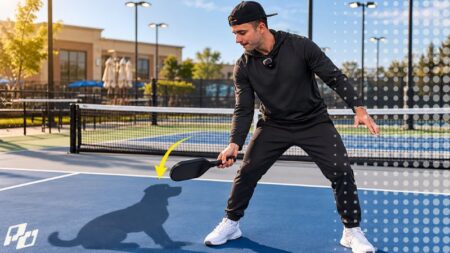
Start with a Continental grip, often called the “handshake grip.” Mari takes it slightly further by dropping the paddle face just a touch:
- Hold the paddle like you’re shaking hands.
- Then shift it slightly downward to allow more wrist flexion.
- This gives your wrist more range of motion and allows for better topspin with less movement.
2. Positioning: Balance First
Flicking while off-balance is one of the biggest mistakes players make. Your body must be:
- Square to the net or angled slightly toward the ball.
- Balanced evenly on both feet with knees bent.
- Paddle in front of your body—not drawn back or cocked too early.
Only flick when you’re well established. Reaching or lunging will destroy your control.
3. Ball Selection: Wait for the Right Opportunity
This shot isn’t meant for every dink. Look for:
- A ball that’s above net height or sitting slightly high in the kitchen.
- A floaty dink or a pop-up with room to work under the ball.
- Opponents leaning middle or looking away from their zone.
You can flick from the middle or the sideline, but the best chance of success comes when your opponent assumes you’ll stay in dink mode.
4. The Flick Motion: Low to High, Wrist-Only
Here’s the secret sauce: it’s not a swing—it’s a snap.
| Part of Motion | What to Do |
|---|---|
| Start Low | Get under the ball with your paddle face slightly angled up. |
| Use Wrist Only | Flick with a quick upward snap of the wrist. Keep your arm quiet. |
| Vertical Path | The motion goes low to high—not forward. This helps the ball dip instead of fly. |
| Controlled Finish | End with your paddle face up, ready to recover or slide into the next shot. |
Watch Mari break it down and demonstrate the flick in this quick video:
How It Compares: Mari vs. Ben Johns Flick
When it comes to backhand flicks in pro pickleball, Ben Johns popularized the backhand roll flick, particularly as a midcourt attack or counter. His signature roll flick—a powerful, shoulder-driven counterattack—has punished countless floaty thirds and mistimed dinks.
But Mari Humberg’s backhand flick plays an entirely different game.
Where Ben’s is about pressure, Mari’s is about precision. His is a hammer; hers is a scalpel. They may both use the backhand to flip the script, but the mechanics, mindset, and outcomes couldn’t be more different.
The signature Ben Johns backhand flick/roll attack:
So, how do these elite flicks stack up? Let’s break it down: power, grip, targeting, and intent.
| Player | Style | Grip | Power | Targeting | When Used |
|---|---|---|---|---|---|
| Ben Johns | Shoulder-heavy roll flick | Hybrid Eastern | Moderate to High | Chest / Paddle-side | Counterattack or pressure |
| Mari Humberg | Wrist-dominant snap flick | Continental | Low to Moderate | Hips, Crosscourt Sideline, Open Space | Disruption, setup play |
Pitfalls to Avoid: Why Most Players Botch the Flick (And How to Fix It)
Before you start wrist-snapping your way through practice, beware—this is not a brute-force shot. It’s delicate, deceptive, and incredibly easy to get wrong if you don’t understand the nuances.
Here’s a table of the most common mistakes players make when trying to emulate Mari’s flick:
| Pitfall | What It Looks Like | Why It Fails | How to Fix It |
|---|---|---|---|
| Too Much Power | Trying to blast the ball with pace | Ball sails long or pops up for an easy counter | Think “baby flick.” Use 50% power or less. Prioritize spin over speed. |
| Forward-Only Motion | Paddle moves straight ahead instead of low-to-high | Hits net or lacks arc, no dip | Visualize a windshield wiper: flick up, not out. Add vertical lift. |
| Too Much Shoulder | Full-arm swing instead of wrist flick | Shot becomes a roll, loses disguise and speed control | Keep the arm quiet. Use the wrist as the engine. |
| Poor Balance | Flicking while reaching or lunging | Pops up, loses accuracy | Only flick when you’re balanced on both feet. Stability = control. |
| Telegraphing the Shot | Paddle face gives away target | Opponent reads it, counterattacks | Keep paddle angle the same across all options. Let the wrist decide last-second direction. |
| Wrong Timing | Using flicks on low dinks or tough balls | Low success rate, exposed position | Save it for high or floaty dinks. Don’t force it on low balls. |
| Overusing It | Flicking every other ball | Becomes predictable, partner exposed | Use sparingly—especially crosscourt. It’s a surprise, not a staple. |
✅ Pro Tip from Mari: “The goal of the flick isn’t to hit a winner—it’s to set up the next shot. Stop thinking of it as a finishing move. Think of it as a chess opening.”
Pro-Level Wisdom from Mari
- “If your body is out of position, don’t flick. You’ll pop it up.”
- “Be balanced on both feet. Stability equals disguise.”
- “A good flick opens the door. A better flick walks through it.”
- “If you want to win outright, earn it with the second shot—not the first.”
The Hidden Genius: It’s Not Flash—It’s Function
What makes Mari’s flick so elite is that it’s strategic subtlety. While everyone else is hunting highlight reels, she’s breaking rhythm, pulling you out of position, and disguising intentions behind a slow, delicate snap.
It’s not a power shot—it’s a psychological weapon.
Steal This Shot (But Use It Wisely)
Mari Humberg’s backhand flick isn’t just “good”—it’s redefining what’s possible from that side of the court. It’s hard to read, harder to counter, and nearly impossible to predict when disguised well. But don’t just copy the motion—adopt the mindset:
- Be balanced.
- Think like a chess player, not a boxer.
- Use slow spin to win the speed game.
- Don’t try to win the point—try to win the rally.
Train it. Own it. And one day, someone might call your flick “insane.”