If you’ve played enough doubles pickleball, you’ve likely run into this scenario: you’re returning serve, hit a solid return, and sprint to the kitchen line… but your partner is still hovering near the baseline, hitting a shaky third shot. Suddenly, you’re stranded—exposed in no man’s land, wide open for a sharp angle or body shot.
So what’s the right move here? Should both players always move to the kitchen line together? Is there ever a situation where staggering your advancement works better?
Let’s break it all down, technically, tactically, and with real-match logic.
The Golden Rule: Move as a Team—Most of the Time
The prevailing wisdom in doubles pickleball is that both players should move forward together after the return and third shot. It’s not just about aesthetics—it’s about structural integrity. Think of it this way: when you and your partner move together, you form a wall.
When that wall is even and tight, it’s hard to break. When one part lags behind, gaps open up—and experienced opponents will exploit them.
Take this example:
You (Player A) rush to the NVZ line after returning serve. Your partner (Player B) stays back to hit a third-shot drop. Player B hits a mediocre drop, and your opponents attack it. You’re at the kitchen line with no backup; meanwhile, there’s a 15-foot hole between you and your partner. One flick of a wrist and the ball is past both of you. Point over.
This kind of positional disconnect is one of the most common causes of defensive breakdowns in doubles.
Why Moving Together Works
- Reduces Gaps: When players move together, they maintain lateral and vertical spacing, limiting crosscourt passing lanes and middle-targeted shots.
- Balances Offense and Defense: You’re less likely to get attacked at your feet mid-transition if both players are staged similarly.
- Split-Step Ready: When both players stop and split-step as the opponent hits, they’re in an athletic position to volley or defend, regardless of shot quality.
Imagine you’re tethered to your partner by an invisible 8-foot rope. That’s your spacing guideline: move laterally and vertically as if you’re tied together. Break the tether, and you create seams in your defense.
Check out how it’s done:
So… Why Doesn’t Everyone Do It?
Many recreational players hesitate to move forward because:
- They lack confidence in their volleys.
- They’re not sure if the third shot is “good enough.”
- They believe staying back gives them more time.
Sometimes, one partner aggressively pushes up, while the other hangs back for safety. The result? A defensive disaster.
You’ll go from a great offensive position to suddenly on the defensive,” one player noted in a community discussion. “That can make a team go from winning to scrambling.
The Alternative: Staggered Movement (a.k.a. The “Read and React” Strategy)

There are situations—especially at intermediate levels—where moving together isn’t automatic. The “read and react” strategy asks one key question:
Was the third shot good enough to advance?
If not, stay back. You’re better off defending from the baseline than getting caught in the transition zone.
How to Know If It’s Safe to Advance:
- Clue 1 – Shot Quality: Was it a low, soft drop that will bounce in the kitchen? Or was it high and attackable?
- Clue 2 – Opponent’s Body Language: Are they leaning forward, paddle up, ready to crush it? Or are they reaching low and scrambling?
- Clue 3 – Your Partner’s Signal: Good teams use verbal cues. “Too high!” or “Nice drop!” are quick, actionable indicators.
Start reading your partner’s third shot,” one commenter advised. “If it looks good, go. If it’s a pop-up, stay and get ready to defend.”
When to Use Each Strategy
Move Together When:
- You hit or see a good third-shot drop.
- You’re confident in hands battles at the NVZ.
- Your opponents are out of position.
- You and your partner have played enough together to sync movement.
Stagger Movement (Creep Up) When:
- You’re unsure about the drop quality.
- You’re playing with a new or inconsistent partner.
- Your opponents are strong attackers with sharp counters.
- You’re trying to reset the point rather than immediately pressure.
A good hybrid approach is to “creep” forward—move slowly toward the NVZ line while staying ready to retreat or stop with a split step. This gives you forward pressure without the commitment of a full charge.
Special Situations: The “Shake & Bake”
This aggressive tactic involves a 3rd shot drive followed by the partner charging in to poach the 5th shot. Works well if:
- Your partner hits a powerful, low drive.
- You have fast hands and like to volley.
- Your opponents are slow to reset or pop balls up.
But it’s risky if you charge and your partner’s drive is soft or sits up. As one advanced player noted, “Unless your partner hits a laser, you’ll get lit up”.
Communication is Key
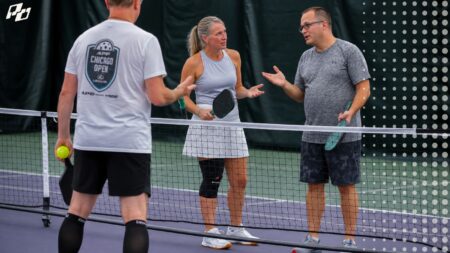
Before each match—especially in rec play—talk to your partner. Ask:
- “Do you prefer drops or drives?”
- “Are you comfortable moving to the kitchen quickly?”
- “Should we move up together or play it more cautiously?”
In rec games, many players aren’t confident volleyers and may prefer to play from the baseline. Pushing them to charge the net too early can backfire.
Try encouraging them with phrases like, “Let’s try to get up together” or “Nice drop—move up with me!” But ultimately, let them play their game, especially in low-stakes settings.
Bottom Line: Don’t Blindly Crash the Net
Yes, the kitchen line is the most powerful position in pickleball—but only if you arrive there in control.
Blindly sprinting to the line regardless of context is one of the biggest mistakes intermediate players make. Instead, earn your way forward. Read the shot, move with your partner, and build your wall one step at a time.
Pro tip: Move until the opponent is about to strike the ball—then split-step. Keep doing this until you’re both at the NVZ. Whether it takes one shot or five, that’s how you take control of the net the smart way.
Takeaways:
✅ Moving together is the safest, most consistent way to take the net.
✅ Avoid leaving your partner behind—it opens massive gaps.
✅ Read the 3rd shot and opponent reaction before committing.
✅ Communicate clearly and encourage teamwork, especially in rec play.
✅ Visualize yourselves as a moving wall—strong only when even.
Next time you hit the court, don’t just run forward—think forward. Sync your steps, watch the ball, and move as a team. That’s how points—and games—are won.