
“He got me again!”
Ever muttered that to yourself after getting blasted in a firefight you didn’t see coming?
One second you’re in a calm dink rally, the next your opponent rockets a ball at your chest and you’re left wondering:
Was there a way to see it coming?
Yes. And it’s not magic. It’s called reading micro-tells—the small, often subconscious movements players make just before launching a speed-up. These subtle cues—like a tiny elbow drop, a grip shift, or a paddle angle change—are the earliest warning signs that a storm is coming.
And once you know how to read them?
You’ll feel like you’ve got X-ray vision on the court.
What Are Micro-Tells?
“Micro-tells” are just that—micro movements that give away macro intentions. Think poker face, but with a paddle.
These are the little things that players unconsciously do right before speeding up the ball:
- A slight drop in the elbow or shoulder
- A tightening of the grip or creeping fingers
- A subtle paddle face adjustment
- A momentary freeze in their eyes or stance
They’re the tells that separate elite defenders from the ones who get tagged over and over again.
As pro Catherine Parenteau puts it:
“You can often tell a speed-up is coming by the way their paddle moves behind their body. The elbow or wrist gives it away. Sometimes their eyes do too—they lock in.”
The Most Common Micro-Tells (And What They Mean)
Let’s break down the major micro-tells and what each one typically predicts:
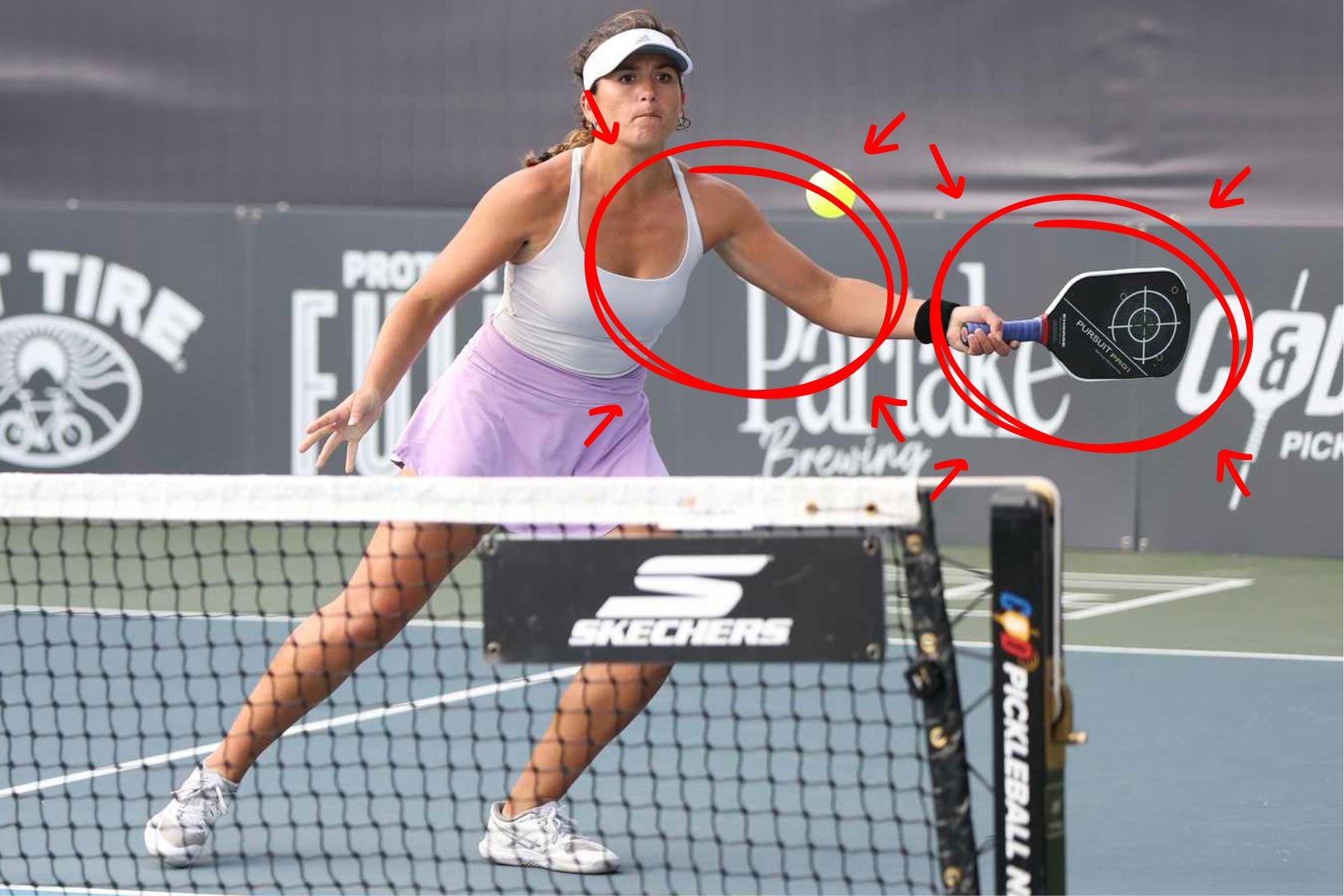
1. Elbow Drop or Arm Retraction
- What to look for: A small backward pull of the elbow, or sudden “coiling” of the arm.
- What it means: They’re prepping to generate force. This often precedes a shoulder-driven speed-up or flick.
2. Grip Shift or Squeeze
- What to look for: The hand “chokes up” on the paddle or fingers slide higher. Sometimes the knuckles whiten as the grip tightens.
- What it means: They’re ready to drive, not dink. Watch out—this is often the last tell before the attack.
3. Paddle Tilt & Angle
- What to look for: A flat or downward-tilted paddle face. You may also spot a very compact, high paddle position—ready to strike.
- What it means: They’re going low-to-high. It’s a common posture before a flick or topspin drive.
4. Body Tension or Stillness
- What to look for: A subtle pause—shoulders rise, feet go quiet, eyes fixate.
- What it means: It’s that moment of coiled tension right before they explode forward. Like a sprinter before the gun.
Watch the Speed-Up in Action:
In this slow-motion breakdown from PaddleSpeed, you can clearly see the mechanics of a speed-up—leg uncoiling, hip acceleration, shoulder rotation, and paddle acceleration. It’s a perfect visual for spotting the exact micro-movements discussed above.
Why Micro-Tells Work: The Anticipation Edge
You’re not just reacting to the ball—you’re reading the pre-shot pattern.
Most recreational players rely on reflexes. But top players rely on prediction. And prediction comes from cue recognition.
Pro coach Josh Jenkins explains:
“When you watch pros, they’re not faster than you physically. But they’re mentally 3 shots ahead. They pick up visual clues so early, they seem like they have more time. That’s what makes them seem fast.”
Real Scenario: Catching the Speed-Up Before It Catches You
You’re in a dink rally on the right side.
Your opponent, a righty, leans ever so slightly over their right foot, paddle face flattens, elbow shifts back—Boom! They rip a forehand flick straight at your paddle shoulder.
But this time, you saw it.
You noticed the micro-tells, slid back half a step, lifted your paddle, absorbed the ball, and countered.
That’s not luck. That’s trained observation.
Drills to Train Your Micro-Tell Radar
Learning to see micro-tells takes time. Here are drills that will fast-track your radar:
| Drill Name | Purpose | How To Do It |
|---|---|---|
| Call It Out | Build prediction confidence | During warmup dinks, call “speed-up” or “drop” before contact. Partner confirms if you were right. |
| Video Freeze Game | Visual pattern recognition | Watch match footage. Pause before speed-ups. Try to guess based on body language. |
| Slow-Mo Surprise | Simulate disguised speed-ups | Play slow kitchen rallies. Occasionally, one player attacks. Partner must identify prep cues and reset or block. |
| Mirror Tells | Build body awareness | Practice with a partner or mirror. Repeat speed-up prep moves slowly. Watch how your own body shifts—then reverse engineer what you need to watch in others. |
Pro-Level Cue Recognition: How to Read Opponents Like a Book
Elite anticipation doesn’t rely on a single signal—it comes from layering multiple pre-contact cues into a predictive model.
Here’s how to upgrade your micro-tell reading system:
1. Prioritize the Pre-Contact Setup, Not the Swing
By the time the swing starts, it’s already too late. Train your eyes to observe posture, paddle position, and grip changes during the neutral phase. Focus on:
- Paddle location relative to the body (is it moving behind the hip?)
- Shoulder and elbow loading mechanics
- Sudden stiffening or stillness in the legs or core
2. Read the Non-Hitting Side for Hidden Tension
The off-hand and non-dominant shoulder are often early indicators of intent. Before a speed-up, players may:
- Tighten the off-hand for balance or brace
- Lean slightly with their non-dominant shoulder to load into a drive
- Use the off-hand to subtly re-center before launching
These movements often begin milliseconds before the paddle reveals anything.
3. Scout Shot Habits Early—Even During Warm-Up
Many players unknowingly show their tendencies during warm-up:
- Are their dinks compact or wristy? Likely to flick.
- Do they reset with the paddle high or low?
- Do they favor cross-court drops or middle dinks?
Watch for prep patterns, even in casual shots. They’ll likely surface again under pressure.
4. Stack Multiple Tells to Confirm Intent
Micro-tells are probabilistic—not definitive. A single cue might mislead. But if you notice a cluster, the likelihood of a speed-up spikes dramatically.
For example:
- Paddle face flattens
➕ Grip chokes up
➕ Elbow drifts back
= Prepare for speed-up with a compact block stance.
When two or more tells align, don’t just hope—it’s time to react.
Bonus: Don’t Be Easy to Read Yourself
Everything you just learned? Your opponents can learn too.
So, if you want to disguise your own speed-ups:
- Keep your paddle in a neutral zone before attacking.
- Change your grip late—after your opponent commits.
- Mix in fake dinks: Set up like you’re about to dink but at the last second, snap into a speed-up. That contrast catches opponents off guard because they’ve already mentally relaxed into dink mode.
Check out this short video on disguising your speed-ups:
The goal is to be unreadable—but to read everyone else like a book.
Micro-Tells Aren’t Just Cool—They’re Transformational
Once you start seeing the tells, it’s like someone turned the lights on in the middle of the game.
You’ll find yourself blocking attacks before they even leave your opponent’s paddle.
You’ll feel more balanced, more in control, and way more confident in the kitchen.
Start with one cue—maybe grip or paddle face. Build your radar slowly.
The next time someone unleashes a body bag… you’ll already be waiting.