You’re mid-kitchen, locked in a cross-court dink exchange. Your opponent’s rhythm feels automatic — dink, dink, dink — until you slide one step left and, with a sudden whip of your wrist, send a line drive screaming down the sideline.
That’s the one-handed backhand speed-up off the bounce — one of the most deceptive quick-attack options in modern pickleball. It’s fast, compact, and explosive, but it’s also misunderstood. Many players assume you need a two-handed backhand to pull it off.
Not so, says James Ignatowich, who’s brought the one-handed version into the spotlight.
“If somebody tells you you can only speed-up with two hands off the bounce, they’re lying,” Ignatowich says. “The key is getting as low as possible and staying low through contact so you have leverage under the ball.”
Why This Shot Exists
A speed-up in pickleball is a soft-to-hard transition — that moment when you go from neutral to attack, usually off a dink or reset, to surprise your opponent and force a hands battle.
The goal isn’t necessarily to hit a winner. It’s to pick the right ball, hit it clean, and win the next two exchanges because your opponent never saw it coming.
Most players rely on the two-handed backhand speed-up for stability. But the one-handed version? That’s the sneaky cousin — faster, more flexible, and perfect for players who like feel and finesse:
The Keys to Hitting It
1. Get Low and Stay There
This is the foundation.
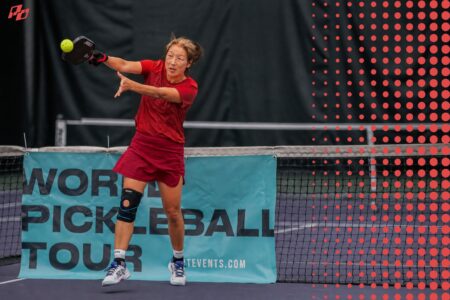
Bend your knees — especially the inside leg — and drop the paddle head beneath the ball. The lower your starting point, the more upward brushing force you can create:
Most misses happen because players stand up too soon and hit through the middle of the ball instead of brushing from below.
2. Contact Out Front
The magic happens when the ball meets your paddle slightly ahead of your lead knee. Too close to your body, and it floats. Out front, you can drive through it like a mini forehand punch.
Ignatowich compares it to boxing: you’re strongest when your arm extends near full range, not when it’s cramped in tight.
3. Think “Throw,” Not “Swing”
This isn’t a big backswing. The shot should feel like you’re tossing or pushing the ball forward with your paddle. Smooth acceleration, short follow-through.
Over-swinging ruins the disguise — keep it quick and compact.
4. Shape, Don’t Smash
Topspin gives you the drop. You’re not trying to blast it flat; you’re brushing the ball so it drives forward but still arcs down. That’s what lets you swing fast without sailing long.
Speed-Up vs. Flick: What’s the Difference?
At first glance, the one-handed speed-up might look like a flick, but they’re completely different animals.
- The flick (like Ben Johns’ or Mari Humberg’s) uses wrist snap and contact above net height — a quick, explosive motion mostly driven by the forearm.
- The one-handed speed-up happens off the bounce, often on a ball that’s below net level. It uses the legs and shoulder for power, not wrist whip.
If the flick is your quick trigger, the one-handed speed-up is your ground-level ambush — quieter, lower, and far harder to read.
When to Pull the Trigger
Like any speed-up, the one-hander is about choosing the moment, not forcing it.
✅ Green light situations:
- The ball bounces up slightly in front of you.
- You’re balanced near or just inside the kitchen, ready to take the ball off the bounce.
- You see your opponent leaning middle or relaxing mid-rally.
🚫 Red light situations:
- You’re stretched wide or falling back.
- The ball’s too high — better to flick.
- You’re behind the kitchen and can’t close quickly.
When it’s there, it’ll feel natural — the bounce sits just right, your body’s loaded, and your paddle path feels effortless. That’s the shot you go for.
How to Practice It
Start simple. The goal is to build feel, not power.
- Self-toss drill: Drop a ball in front, let it bounce, and “throw” it forward off your backhand.
- Wall drill: Stand 8–10 feet from a wall and hit short, low one-handed drives, focusing on brushing up.
- Live dinks: Rally with a partner, then call “go” at random to practice switching from dink to speed-up.
- Target practice: Alternate hitting to the body and down the line — same setup, different release.
Consistency beats aggression. A 70% clean shot at the right time wins more than a 100% rip at the wrong one.
The Common Mistakes
- Standing tall: Pops the ball up every time.
- Hitting too close to the body: Causes loss of leverage and spin.
- Overusing the wrist: Adds inconsistency.
- Swinging too big: Destroys disguise and timing.
- Forgetting spin: Flat shots go long; brush slightly up for safety.
Fix these and the shot starts to feel effortless — low setup, fast release, smooth finish.
Learning From James Ignatowich
Ignatowich often blends both one-handed and two-handed speed-ups, choosing based on position and angle. The one-hander, he says, isn’t about pure strength — it’s about control.
“With the one-hander, treat it like a throw. Get low, meet it in front, and stay through it. If you do that, you can go down the line or crosscourt with real pop.”
It’s that blend of leverage, disguise, and simplicity that makes it so dangerous — the motion looks slow until the ball explodes off the paddle.
Power Through Precision
The one-handed backhand speed-up isn’t about flash — it’s about feel. It rewards calm hands, steady legs, and the confidence to strike when the moment’s right. When you trust your posture and timing, power shows up naturally.
You’ll know when you’ve nailed it. The ball sits just right — low, neutral, begging for acceleration. You stay down, meet it out front, and there’s that crisp pop that feels effortless but sounds like thunder.
It’s addictive. Once you learn to disguise it, you’ll start catching opponents flat-footed — that split-second of surprise followed by, “Wait… how did you even hit that?”