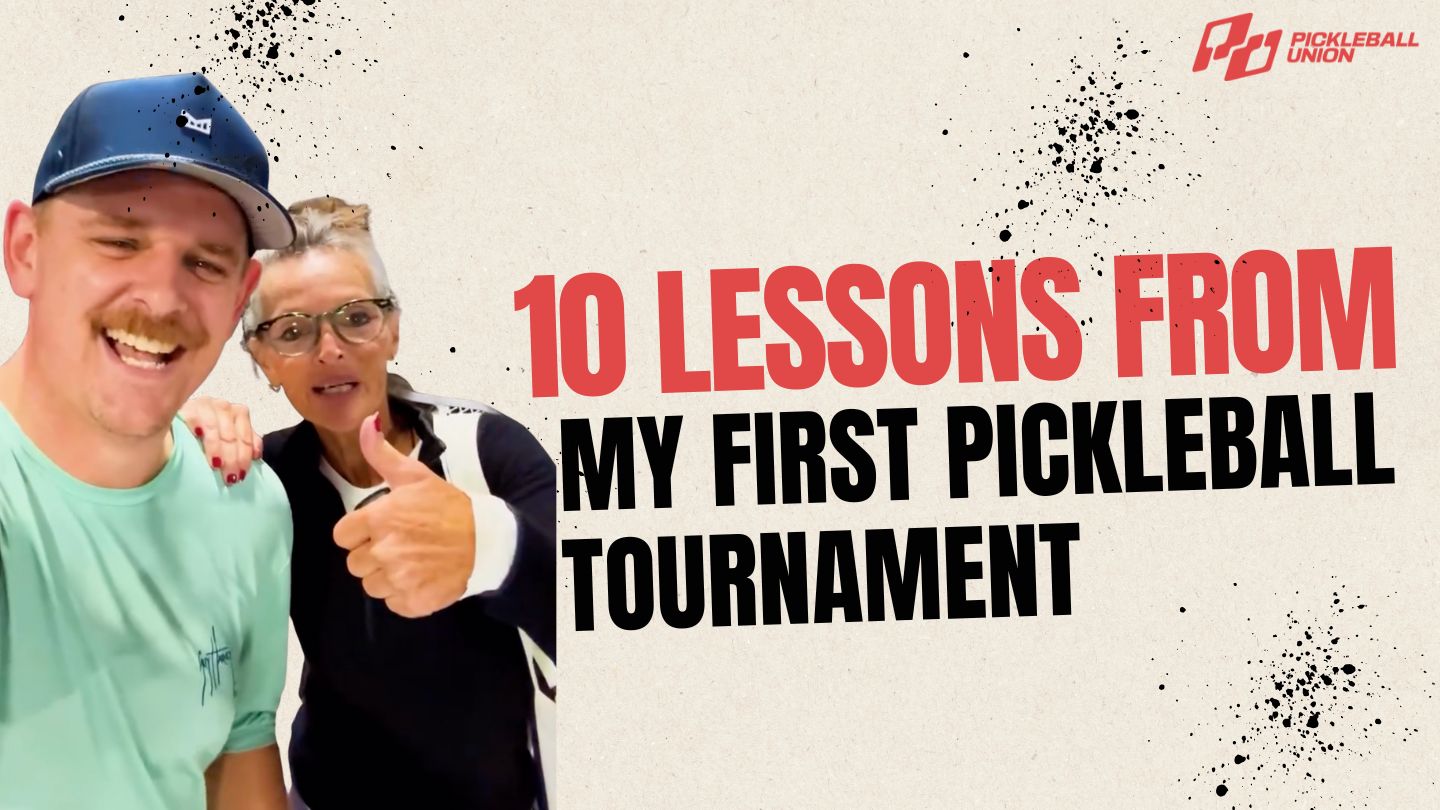
I’ll be honest, I thought my first pickleball tournament would feel like a slightly more serious rec session.
Same rules, same gear, same court. How different could it be?
Then I stepped onto that court.
The energy hit different. Every sound echoed louder. The points felt heavier. Suddenly, I was aware of everything — my grip pressure, my footwork, even how dry my mouth was.
And to make things more interesting? My partner was a lefty. A great player — but someone I’d never played a tournament with before. If you’ve ever partnered with a lefty for the first time, you know the dance: who takes the middle, how far you slide, which angles overlap. It’s like learning choreography with someone who mirrors every move.
So, a week before the tournament, I decided to ask for help.
I reached out to pickleball coach Marko Grgić — known for his smart, practical approach to tournament play — and asked:
“How should we approach our first tournament together and actually maximize our performance?”
Marko gave me a breakdown that changed how I think about doubles strategy and team communication. You can actually watch that full pre-tournament conversation here.
Watch: Coach Marko Grgić’s Pre-Tournament Advice Video
Armed with his advice and a lot of caffeine, we hit the courts. Here’s everything I learned — what worked, what didn’t, and what I’d tell any rec player stepping into their first tournament.
1. Make Every Serve and Return Count
Coach Marko’s first tip was almost boringly simple — until you realize how many points it saves:
“Make all your serves and all your returns. Focus on the middle. Nice, smooth, consistent. Don’t go for too much.”
In open play, you can afford a missed serve or return. In tournament play? That’s free gas for your opponents.
My Advice:
Your goal is rhythm, not risk.
- Hit deep, high-margin serves to the middle.
- Get your returns in every single time — no flare, no drama.
- Let consistency be your pressure weapon.
A rally you start cleanly is one you can win. A serve you miss is one you never even fought for.
2. Communicate Like It’s a Team Sport (Because It Is)
Tournaments expose every silent assumption. With a lefty partner, it’s double the opportunity for confusion — and chaos.
Marko hammered it in:
“Determine who’s taking the third. If that’s not working, pivot. With a lefty, she might take your forehand. But talk about it every single time.”
We learned that the hard way. The first few matches, a couple of “yours!” turned into “oh no’s.” After that, we overcorrected — and started talking constantly.
My Advice:
Use short, clear calls before every rally.
- “Yours on third.”
- “Middle’s mine.”
- “Switch if lobbed.”
Even at the risk of sounding robotic, keep it loud, fast, and clear. Silence loses points — talking wins them.
3. Protect Each Other Like You Mean It
This was my favorite piece of Marko’s advice:
“If your partner hits a short return, step in and protect them. Don’t wait for them to recover — cover the middle.”
That one line completely changed our dynamic.
Instead of guarding “my side,” I started defending “our court.” It made us move like a single unit — flexible, responsive, confident.
My Advice:
When your partner’s return hangs short, shift forward and take command of the middle. Be their safety net.
The best doubles teams aren’t divided down the middle — they overlap where it counts.
4. Hydration Is a Strategy, Not a Checklist
I sweat like a human faucet, and in the heat of match play, I flat-out forgot to hydrate.
By the semifinals, my legs were concrete, my brain foggy. Not ideal.
My Advice:
Hydration is your fifth teammate.
- Start the day before the tournament.
- Bring your own water, electrolytes, and snacks — don’t count on the venue. I swear by the TIIGA Gut-Friendly Hydration Drink Mix — it’s clean, effective, and keeps your energy steady all day.
- Sip after every match, even if you’re not thirsty.
If you wouldn’t go into a match with a dead paddle, don’t go in with a dehydrated brain.
5. Build Confidence in Each Other (Out Loud)
During warm-ups, I realized something funny — I was thinking supportive thoughts, but not saying them.
Then I started voicing them: “Nice roll.” “You’ve got that third.” “Perfect setup.”
The shift was instant.
You could feel our energy sync.
My Advice:
Never assume your partner knows you’re impressed — say it. Verbal confidence builds rhythm and trust. And when tension spikes, that encouragement is what keeps you connected.
🎥 Tournament Day!
This was it — our first real tournament as a team.
Between the nerves, adrenaline, and the learning curve of facing teams who wanted to win, every rally felt like a mini adventure. We had moments of chaos, laughter, and a few “how did we pull that off?” shots.
You can catch the best of it here:
Spoiler: we learned more in one day than in months of rec play.
6. Warm Up Like You Mean It
You can always tell who skipped warm-up — they’re the ones losing their first three points to bad footwork.
My Advice:
Treat warm-up like prep, not a formality. Jog or shuffle to wake up your legs, do a few shoulder rolls and twists, and shadow some drops and dinks before the first serve.
For smart, quick routines, check out my friend Brady Burman-Magday, a strength coach and personal trainer specializing in pickleball. His videos — “7 Warm-Ups in 7 Minutes,” “A Great Pickleball Warm-Up Tip to Prevent Injuries,” and “Easy Back Stretches for Pickleball” — are fantastic.
And if you want to take it further, Brady’s course “Strategic Stretching for Pickleball: A Game-Changing Routine” is a must. Your body (and your first three points) will thank you.
7. Record Everything — It’s Brutally Helpful
We recorded every match, and I was not ready for how revealing it was. The camera doesn’t lie — it caught my lazy split steps, my drifting, and every time I stood flat-footed after a return.
My Advice:
Even if you never post it, record at least one match. Reviewing video gives you the truth you don’t feel in real time — and that truth is pure gold for improvement.
8. Stick With the Plan, Especially When You’re Losing
In one match, we were down 5–9. The temptation to “mix it up” was huge.
But we remembered: our opponents couldn’t get the ball over the net from the baseline. So we kept them there. Deep returns, patience, rinse and repeat.
We won 12–10.
My Advice:
Stick with what’s working — even when emotions tell you to panic. Doubt kills consistency faster than nerves do.
9. Don’t Get Down on Your Partner
Our opponents in one match visibly imploded. Eye rolls, muttered frustration, no smiles. You could see their chemistry fall apart mid-point.
My Advice:
Be the calm, not the chaos.
Your partner’s mistakes don’t define the match — your reaction to them does.
Frustration drains confidence; laughter restores it.
10. Be the Player Everyone Wants to Play With
Between matches, we cheered for others, complimented good rallies, and shared post-match laughs. And guess what — it made the day better.
My Advice:
Be generous with your energy. Whether you win or lose, leave every opponent thinking, “That was fun.” It’s the best kind of legacy.
What the Tournament Actually Taught Me
Going into my first tournament, I thought I was testing my pickleball skills. Turns out, I was testing my patience, teamwork, hydration, and humility.
Tournament play doesn’t just show how you hit — it shows how you handle pressure. It shows whether you can stay calm, connected, and kind when everything’s moving twice as fast.
And honestly? That’s the real win.
Pickleball isn’t just about paddles and points — it’s about connection. It’s about learning to adapt, to laugh, to trust, and to have fun even when you’re down 0–9.
So when your tournament day comes, remember:
You’re not just playing for medals. You’re playing to prove that you can compete without losing your joy.
And that, to me, is the real victory.