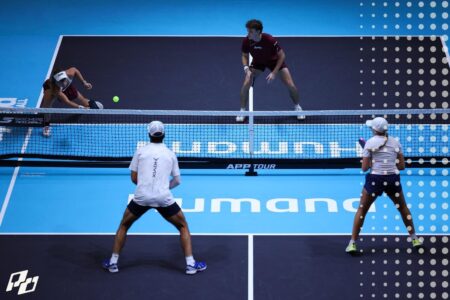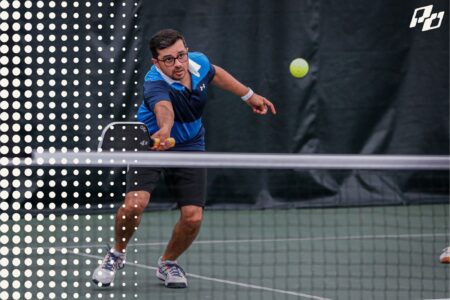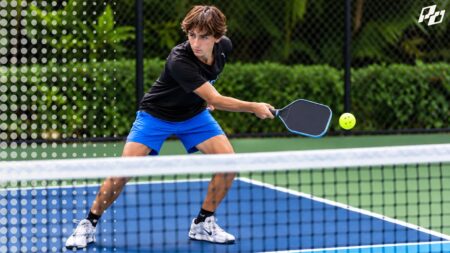

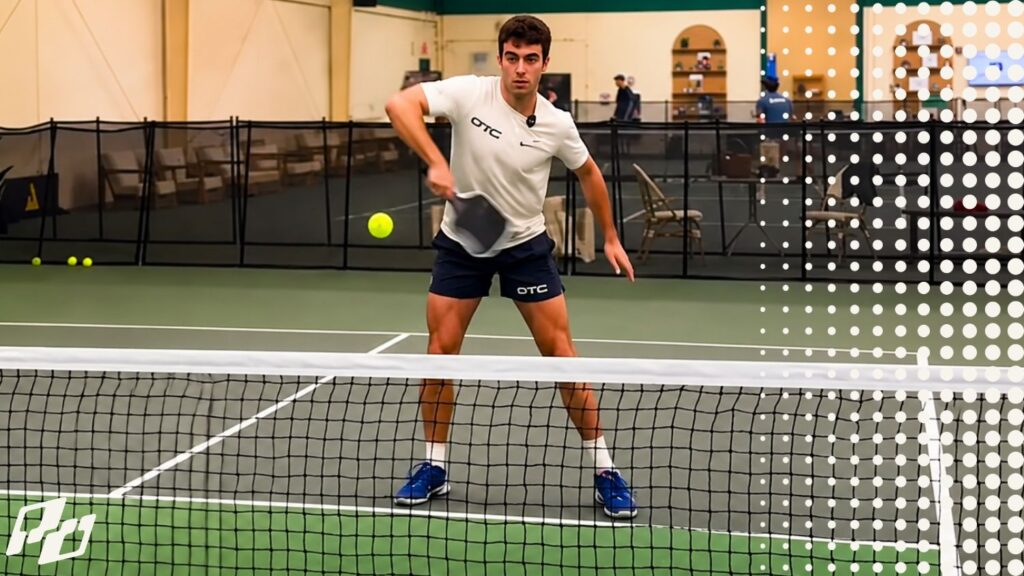
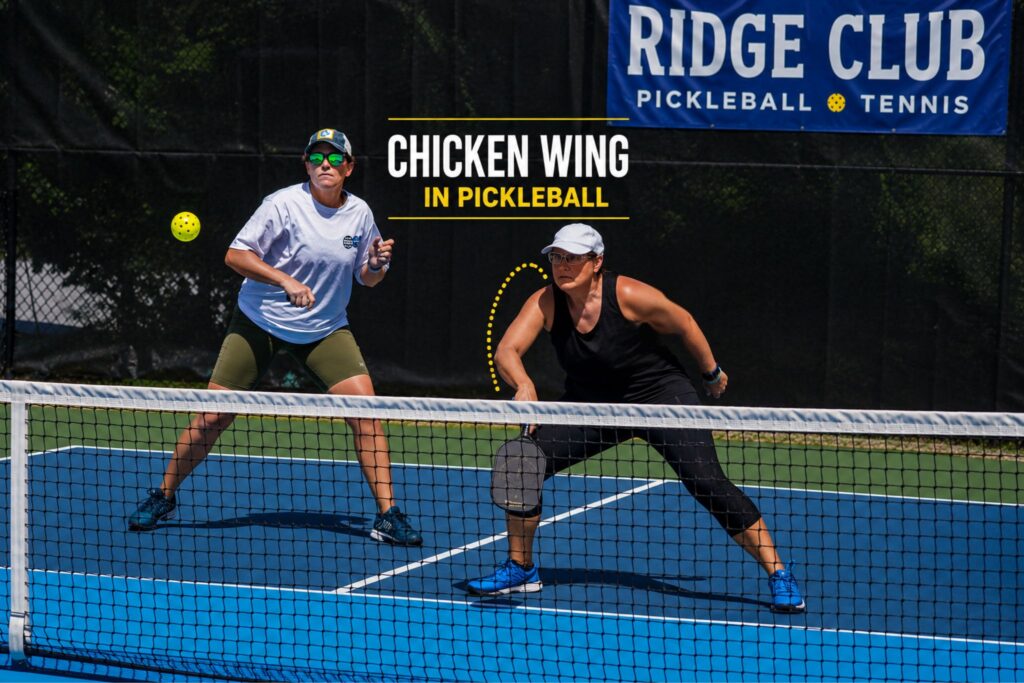
The chicken wing in pickleball is the awkward area around an opponent’s paddle-side hip, ribs, elbow, or shoulder. Target it when you are balanced and contacting near or above net height. Use a compact swing, controlled pace, and recover quickly, because the first attack often creates a weaker second ball rather than an immediate winner.
The chicken wing is one of pickleball’s most useful targets, but it is also one of the most misunderstood.
Many recreational players treat it like a magic spot: aim somewhere near the opponent’s shoulder, hit hard, and hope for a pop-up.
That approach works occasionally. It also produces plenty of misses, easy counters, and balls that would have flown long if the opponent had moved.
A good chicken-wing attack is more deliberate. You are not simply attacking the body. You are sending the ball into the awkward transition area between an opponent’s forehand and backhand responses, then preparing for the reply that target is likely to produce.
Used correctly, it is less of a winner attempt and more of a reaction-management strategy.
What Is the Chicken-Wing Target?
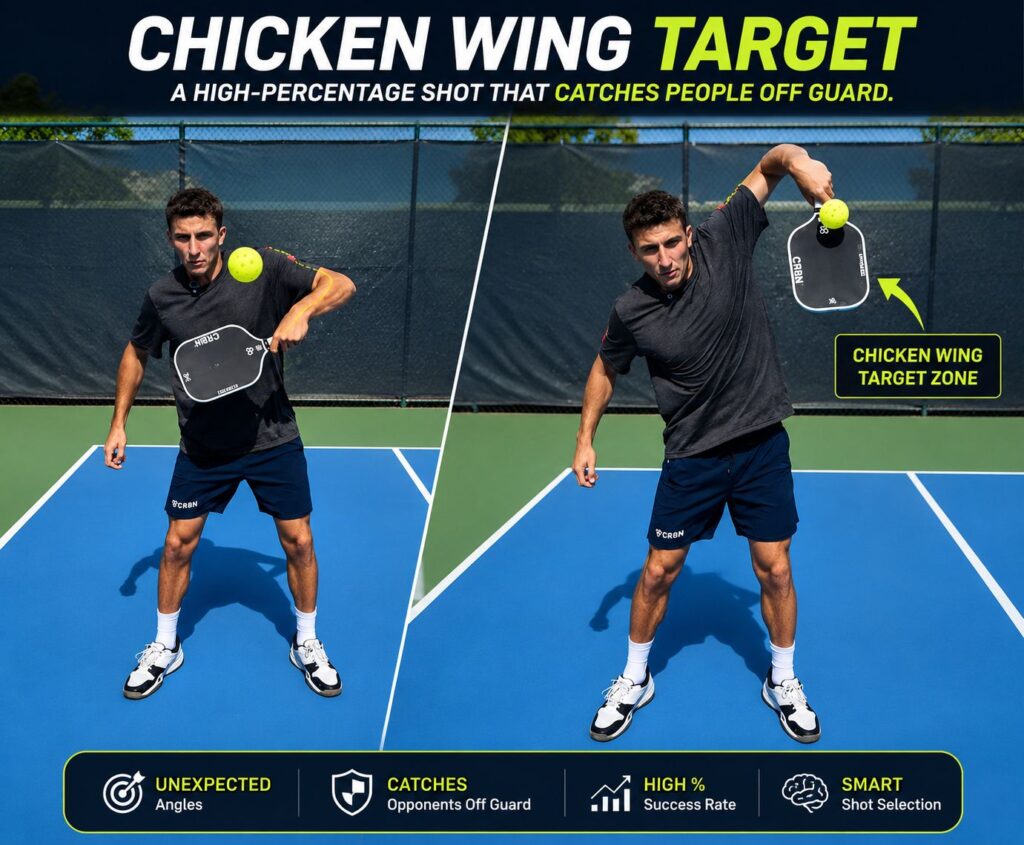
For a right-handed opponent, the traditional target is around the right hip, ribs, armpit, or paddle-side shoulder. Against a left-handed player, the target shifts to the left side.
The exact location depends on the height of your contact and the opponent’s ready position.
| Your contact | Practical target |
|---|---|
| Below net height | Paddle-side hip or upper thigh |
| Around net height | Hip, ribs, or hitting-side elbow |
| Clearly above the net | Armpit or paddle-side shoulder |
| Fast volley exchange | Center mass, shaded toward the paddle shoulder |
The phrase “chicken wing” describes the awkward defensive shape that can result: the elbow lifts away from the body while the paddle becomes cramped between forehand and backhand positions.
The target works because the opponent may have to make three decisions almost at once:
- Forehand or backhand?
- Move the paddle inward or outward?
- Block, counter, or evade the ball?
That moment of uncertainty can produce late contact, an open paddle face, or a weak block.
Why It Works Better Than Aiming at Open Court
Open space looks attractive, but it often gives the defender a clean swing path.
A ball aimed toward the sideline may allow an opponent to extend the arm and counter with the center of the paddle. A ball aimed directly at the body takes away that extension.
The chicken-wing target creates pressure in three ways.
It jams the swing
The opponent cannot comfortably extend through contact. The elbow may move outward while the paddle gets trapped close to the torso.
It creates indecision
The ball enters the overlap between the forehand and backhand zones. Even a brief hesitation matters during a fast kitchen exchange.
It makes direction harder to control
A cramped defender may still return the ball, but often with fewer options. The reply is more likely to come back through the middle or float slightly higher.
That last point is important. Your attack does not need to win immediately. If it produces a predictable block, you have created the next attack.
When the Chicken Wing Is a High-Percentage Target
The target itself does not make a poor attack good. You still need the right ball.
A chicken-wing attack is strongest when you are balanced, contacting in front, and able to send the ball on a relatively flat or slightly downward path.
Best situations
Use it when:
✓ a dink sits near net height;
✓ a reset floats into your strike zone;
✓ you receive a shoulder-high volley;
✓ an opponent is moving laterally or recovering;
✓ the defender is crowding the kitchen line;
✓ the opponent strongly favors one side in the ready position.
A body attack becomes especially effective against players who hold the paddle too far toward their backhand or forehand. Their preferred side may look protected, but the opposite edge of the paddle-side shoulder often becomes exposed.
Poor situations
Pass on it when:
✗ contact is below your knees;
✗ you are reaching across your body;
✗ your feet are still moving;
✗ the ball is dropping rapidly;
✗ you must lift sharply to reach shoulder height;
✗ you are attacking from deep transition against settled opponents.
A useful test is:
Can I reach the body without sending the ball upward through the opponent’s strike zone?
If the answer is no, reset or choose a lower target.
Aim Through a Window, Not at a Tiny Spot
Trying to hit one exact point on the shoulder can make your swing tight.
Instead, picture a vertical target window running from the paddle-side hip to the armpit. Choose the height within that window based on your contact point.
If the ball is low, target lower.
If the ball is high, target higher.
That keeps your shot trajectory realistic. A below-net ball aimed at shoulder height must rise significantly, which gives the opponent time and may send the ball long. A low attack toward the hip can still jam the defender without requiring the same lift.
For a right-handed opponent, imagine a strip running up the right side of the torso. For a left-hander, reverse it.
Your cue:
Match target height to contact height.
Do not force a high body target from a low ball.
How Hard Should You Hit It?
Usually, not as hard as you think.
At kitchen distance, placement and disguise create much of the pressure. A controlled attack at roughly 60–75% can be more effective than a full swing because it gives you better accuracy and faster recovery.
Maximum pace creates three problems:
- the swing becomes easier to read;
- your paddle may finish too far from the ready position;
- a slight error in face angle can send the ball long.
The objective is to arrive quickly enough to jam the opponent—not to prove how hard you can hit.
Think compact acceleration, not a large backswing.
Start from a position that resembles your dink preparation. Accelerate late, keep contact in front, and return the paddle toward neutral immediately.
A well-disguised attack gives the opponent less time than a harder shot telegraphed by a large windup.
Where to Aim on Different Opponents
The chicken wing is not identical for everyone.
Against a backhand-dominant defender
Some players sit heavily toward the backhand because it covers the middle efficiently. Their paddle-side hip or shoulder can become vulnerable, especially if the forehand requires the elbow to move outward.
Start at the hip, then move higher if they are handling the lower ball comfortably.
Against a forehand-dominant defender
These players may shade the paddle toward the hitting side and try to run around body balls.
Attack closer to the inside edge of the paddle shoulder. This forces them to choose between a cramped forehand and a late backhand.
Against a player with fast hands
Do not keep feeding the same spot at the same speed.
Use the chicken wing to establish body pressure, then change direction. A good defender will adapt after seeing the same attack repeatedly.
Against a player backing off the line
The chicken wing becomes less effective as the opponent creates space. With extra reaction time, they can move around the ball and counter cleanly.
In that case, target the feet, use a wider angle, or slow the ball down and move them forward again.
Plan the Second Shot Before the First
This is where better players separate themselves.
A chicken-wing speed-up often produces a predictable reply, but only if you know which side of the body you attacked.
When you jam the paddle-side shoulder, the opponent may:
- block the ball back through the middle;
- produce a high backhand-style counter;
- pull the paddle across the body;
- pop the ball toward your backhand side;
- move away and let the ball travel long.
Your job is to recover based on the likely response.
After contact:
- Stop the follow-through before it wraps excessively.
- Return the paddle in front of your chest.
- Stay low.
- Expect the next ball rather than admiring the attack.
A useful tactical cue is:
Attack the shoulder; prepare for the middle.
That will not predict every reply, but it gives you a strong default because cramped blocks frequently return toward the center of the court.
If the first ball creates a pop-up, finish.
If the defender produces a strong counter, block or reset.
If the reply is neutral, do not force another attack from a worse position.
Do Not Ignore the Out Ball
Body attacks often feel playable because they are headed directly toward you. That does not mean they are staying in.
The same applies when you are the attacker. If you aim at shoulder height from a low contact point, the ball may be travelling long unless the opponent volleys it.
Train your attack with a defender who occasionally moves out of the way. That gives you immediate feedback about trajectory.
A chicken-wing attack should ideally:
- cross the net with modest clearance;
- reach the opponent before they can fully extend;
- stay inside the baseline if untouched.
If it depends on the opponent saving it from going out, it is not yet a reliable attack.
A Practical Three-Stage Drill
The best way to develop this target is to progress from accuracy to decision-making.
Stage 1: Target recognition
Place a marker or hold a paddle cover near the defender’s paddle-side hip and shoulder. Feed 20 attackable balls.
Hit:
- 10 toward the hip;
- 10 toward the shoulder.
Use moderate pace. Score only whether the ball travels through the target window and stays in if untouched.
Stage 2: Attack plus recovery
The defender blocks every attack back into play.
The attacker scores one point for hitting the target and one additional point for controlling the next ball.
This prevents the common habit of treating the speed-up as the end of the drill.
Play four sets of 10 feeds.
Stage 3: Live recognition
Begin with crosscourt dinks. Either player may attack only when contact is at least near net height.
Award:
- one point for choosing an appropriate attack;
- one point for hitting the intended body target;
- one point for winning or improving the next ball.
A missed attack loses one point.
This teaches the complete skill: recognize, target, recover.
Quick Tactical Guide
| Situation | Best response |
|---|---|
| Low ball below the net | Reset or attack the hip with controlled topspin |
| Ball near net height | Target hip, ribs, or elbow |
| High ball | Attack armpit or paddle-side shoulder |
| Opponent shades strongly backhand | Test the paddle-side hip |
| Opponent steps back | Use feet or angle instead |
| Opponent handles repeated body attacks | Change pace or direction |
| First attack produces a block | Expect the next ball through the middle |
| You are off balance | Do not force the attack |
Find Their Awkward Spot
Do not think of the chicken wing as a body bag attempt. Think of it as a way to reduce the quality and number of responses available to your opponent.
The best version is not necessarily the hardest ball. It is the one that arrives at the correct height, jams the paddle arm, stays in the court, and leaves you ready for the next shot.
Here is the extra adjustment that makes the tactic much more useful: spend the first few rallies locating the opponent’s actual transition point.
Some players get jammed at the hip. Others are comfortable there but struggle closer to the armpit. A few protect the shoulder well but leave the middle exposed when they move the paddle outward.
Test the target before committing to it.
Once you find the height where their paddle decision becomes uncomfortable, keep returning to it—but never so predictably that they can sit on the shot.