
Make pickleball skills transfer from drills to games by adding variable feeds, movement, shot decisions, and score pressure. Connect each skill to a clear trigger, use one simple cue, and test it later in open play. Practice should become less predictable before the skill can hold up under pressure.
Intermediate pickleball players often know exactly what they are supposed to do.
They know not to attack below the net.
They know to reset from transition.
They know to contact the ball in front.
They know to return deep and move forward.
Then the game starts, the ball gets messy, and none of it shows up. That is not necessarily a knowledge problem.
It is a transfer problem: the skill exists in a lesson, drill, or video, but your body cannot yet retrieve it when the feed, movement, score, opponent, and decision all change at once.
The fix is not another tip.
It is practicing the skill in a way that teaches your body when to find it, how to adjust it, and whether to trust it under pressure.
Why a Skill Can Look Great in a Drill and Disappear in a Game
A clean drill removes most of the hard parts.
You know where the ball is going.
You know which shot to hit.
You get several attempts in a row.
Nobody is trying to fool you.
A miss has no consequence.
That is useful when you are first cleaning up mechanics.
But a real point asks for much more. You must recognize the ball, choose a response, move into position, control the shot, recover, and prepare for what comes next.
That is why repeating 50 identical drops may improve the drop motion without teaching you when to use it from a bad return, while moving, or against an opponent crowding the kitchen.
Motor-learning research generally finds that blocked repetition can improve performance during practice, while variable or randomly mixed practice often creates more difficulty in the moment but can improve retention and transfer later.
In plain language: looking good during practice is not the same as learning.
First, Identify Which Transfer Problem You Actually Have
“I can’t do it in games” is too vague. There are three different failures hiding inside that sentence.
| What Happens in Games | Your Real Problem |
|---|---|
| You never notice the opportunity | Recognition problem |
| You recognize it but choose the wrong shot | Decision problem |
| You choose correctly but cannot execute | Movement or technique problem |
Suppose you have been working on transition resets.
If you keep attacking low balls, you do not need 100 more reset feeds. You need to practice choosing reset versus counter.
If you choose the reset but contact every ball behind your hip, you need movement and spacing work.
If you recognize the ball, move correctly, and still pop it up, then the stroke itself needs attention.
This distinction matters because players often drill the shot when the real weakness is the decision that comes before it.
Ask after a miss: “Did I fail to see it, choose it, or execute it?”
That answer tells you what to practice next.
Use the Transfer Ladder
Do not jump directly from a lesson into competitive open play and expect the new skill to survive.
Move it through these four stages.
Stage 1: Build the Shape
Start with predictable feeds and clean repetitions.
This is where you adjust the contact point, paddle path, grip pressure, or body position. Keep the environment simple enough that you can feel the change.
But leave this stage once you can produce roughly seven or eight usable shots out of ten. Do not stay there just because it feels good.
Stage 2: Change One Variable
Now vary one part of the problem.
For a third-shot drop, change the return depth.
For a reset, alternate forehand and backhand.
For a flick, mix low dinks with attackable balls.
For a return, vary pace and location.
Your technique now has to adapt instead of replaying the same answer.
Stage 3: Add the Decision
The feeder gives you at least two possible balls, and you must choose the correct response.
Drop or drive.
Reset or counter.
Dink or flick.
Volley or let it bounce.
This is where transfer truly begins because the skill is now connected to a visual cue.
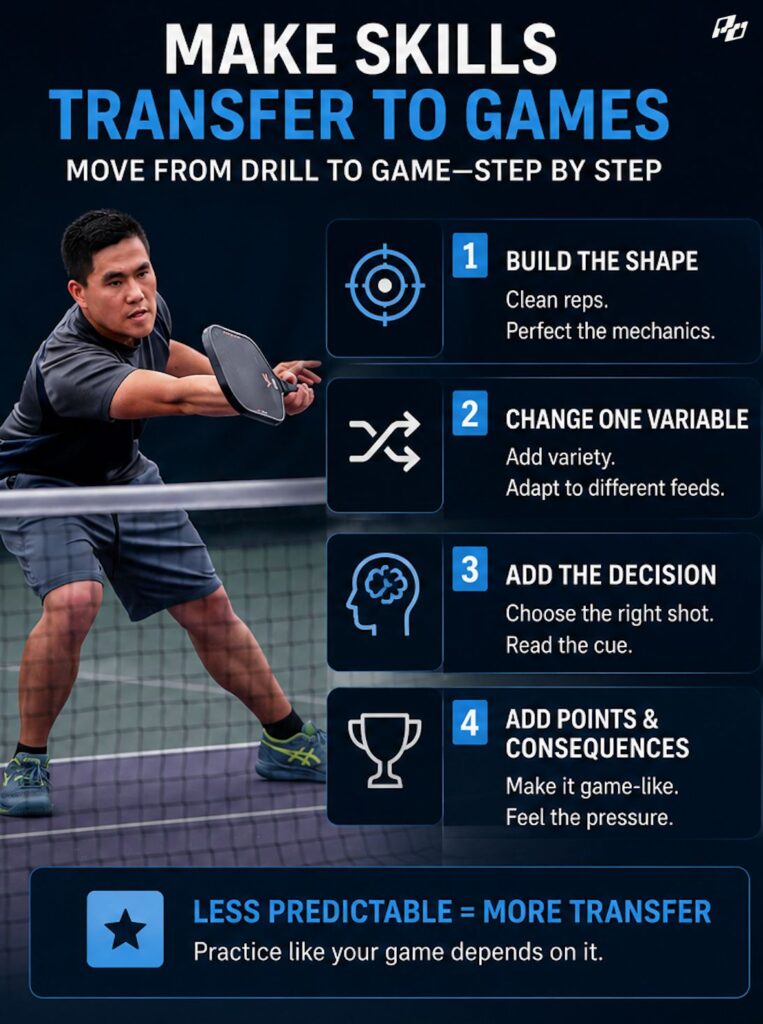
Stage 4: Add a Point and a Consequence
Play the situation live, but constrain the game so the target skill appears often.
For example, start every rally with a deep return and third shot. Award two points when the serving team reaches the kitchen through a successful reset or drop. Lose one point for forcing an attack below net height.
The practice should begin to look like the game you want the skill to survive in. Pickleball coaching guidance increasingly emphasizes representative, game-like practice because the decisions and movement patterns must resemble match play for learning to carry over.
Stop Practicing a Shot Without Its Trigger
A skill is easier to retrieve when it is connected to the situation that calls for it.
Do not just practice a reset.
Practice: “When the ball is below my paddle and I am not balanced, I reset.”
Do not just practice a speedup.
Practice: “When contact is in front and above the net, I attack the hip.”
Do not just practice a third-shot drive.
Practice: “When the return is short and I can contact inside the baseline, I drive.”
This creates a simple if–then rule your body can recognize under pressure.
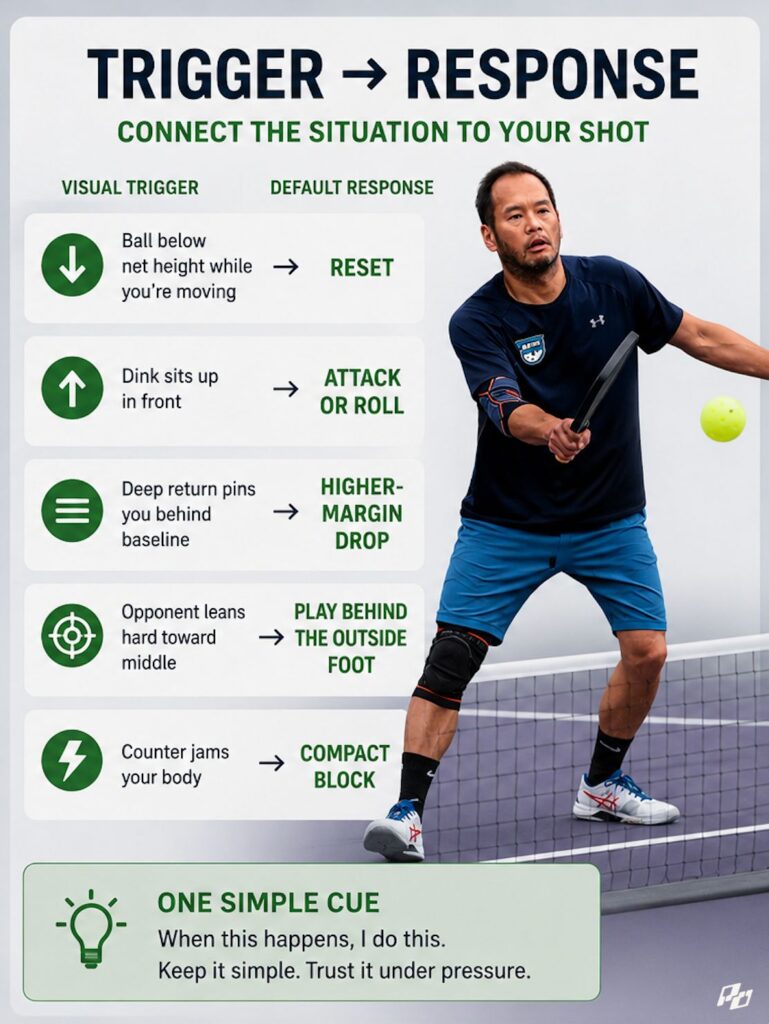
| Visual Trigger | Default Response |
|---|---|
| Ball below net height while you are moving | Reset |
| Dink sits up in front | Attack or roll |
| Deep return pins you behind baseline | Higher-margin drop |
| Opponent leans hard toward middle | Play behind the outside foot |
| Counter jams your body | Compact block, not a bigger swing |
The trigger matters because your body does not retrieve techniques from a filing cabinet labeled “pickleball tips.”
It retrieves responses from situations it recognizes.
Use One External Cue, Not Five Body Instructions
Players often carry too much technical language into a game.
“Bend the knees, loosen the grip, keep the wrist stable, contact in front, finish toward the target.”
That may help during a lesson.
During a rally, it is mental traffic.
Research on attentional focus commonly finds advantages when performers focus on the movement’s effect—such as the ball’s path or target—rather than consciously controlling several body parts. The evidence is not absolute in every setting, but external cues have repeatedly supported motor learning and transfer in sport tasks.
Turn the mechanics into one usable cue:
| Too Much Internal Detail | Better Game Cue |
|---|---|
| Soften grip and absorb with shoulder | “Land it short.” |
| Get paddle below ball and brush upward | “Make it dip.” |
| Stop moving before contact | “Quiet body at impact.” |
| Extend through the return target | “Drive it deep middle.” |
| Keep counter compact | “Beat it to the window.” |
The cue should direct the shot, not narrate your anatomy.
Use the Two-Ball Rule in Open Play
Here is a practical way to bring a new skill into games without turning the whole match into an experiment.
Give yourself two legitimate attempts per game.
Working on a backhand flick? Take it only on the first two balls that genuinely meet your trigger.
Working on a third-shot drop? Commit to it on two suitable returns, then play normally.
Working on transition resets? Identify two rallies where your only goal is to neutralize the fourth ball.
Why only two?
Because forcing a new skill on every opportunity changes your decision-making and creates fake repetitions. Two honest attempts keep you focused without making the whole game about proving the shot works.
Afterward, review only those attempts:
Did I recognize the right ball?
Was the decision sound?
What broke in the execution?
That gives you better feedback than saying, “My drops were bad today.”
Don’t Rescue the New Skill Too Quickly
A new movement often gets worse before it becomes automatic. The moment it breaks down, players usually return to the old version because the old version feels safer.
That protects today’s score but blocks tomorrow’s transfer.
Use a three-miss rule during practice.
- After one miss, repeat the same intention.
- After two, simplify the target or reduce pace.
- After three similar misses, stop and identify whether the problem was recognition, movement, or contact.
Do not rebuild the entire technique after every error.
Random and variable practice can feel less successful during the session precisely because the learner must repeatedly reconstruct the solution. That added difficulty can support stronger retention later, even though the practice looks worse.
Messy practice is useful when the errors contain information.
It is not useful when you are simply repeating panic.
Add Pressure Gradually, Not Dramatically
You do not need tournament nerves to practice pressure. Add one small consequence:
Missed target: minus one.
Successful transfer shot: two points.
Lose the rally after forcing the wrong attack: start over.
Reach 7 before your partner reaches 5.
Then add social or score pressure:
Play the pattern at 8–8.
Let your partner choose the feed.
Record the drill.
Alternate the target without warning.
The goal is not to make practice miserable. It is to teach your body that the skill still belongs to you when the outcome matters.
Test Retention Instead of Celebrating One Good Session
A skill is not transferred because it worked once with your coach.
Test it later.
Come back after 48 hours and try it without reminders. Start with mixed feeds, not perfect feeds. Then use it in a constrained game.
Ask:
Can I recognize the opportunity without being told?
Can I execute after a different shot?
Can I use it from more than one court position?
Can I recover and play the next ball?
If the answer is no, that is not failure. It tells you which rung of the transfer ladder you skipped.
A Practical 20-Minute Transfer Session
Use this structure for almost any skill.
| Time | Practice |
|---|---|
| 4 minutes | Predictable reps to establish the movement |
| 5 minutes | Vary depth, pace, direction, or movement |
| 5 minutes | Mix at least two shot choices |
| 6 minutes | Play a constrained game where the skill earns bonus points |
For a transition reset, that could look like:
Four minutes of controlled resets.
Five minutes alternating feet, forehand, and backhand feeds.
Five minutes choosing reset or counter.
Six minutes of 7–11 where successful neutralization earns an extra point.
That is far more likely to transfer than spending all 20 minutes hitting identical cooperative balls.
Stop Collecting Answers
Most intermediate players already possess enough information to improve. What they lack is a practice environment that forces the information to become a response.
So the next time a video gives you a useful tip, do not immediately search for another one.
- Build a trigger for it.
- Vary the feed.
- Add a decision.
- Add movement.
- Add a consequence.
- Test it again two days later.
That is how knowledge enters the body.
Not through one perfect explanation.
Through repeated retrieval in situations that look enough like the game that your body no longer has to ask what to do.
You will know the skill has transferred when you stop remembering the tip during the point—and simply find yourself making the right play.