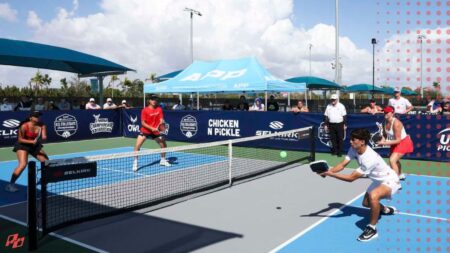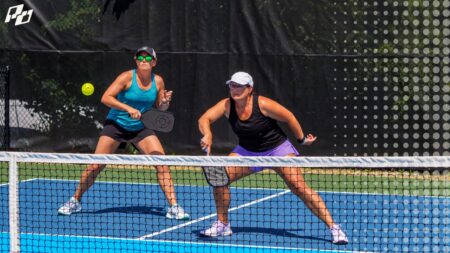


Every ball comes your way. Dinks, speed-ups, resets, lobs — all yours. Your partner starts feeling invisible, and you start feeling rushed, exposed, and slightly annoyed.
Here’s the thing most players miss: targeting only works when you keep playing the same patterns.
Once you change the geometry of the rally, the advantage disappears fast.
First Adjustment: Make Your Side of the Court Smaller
When you’re targeted, the instinct is to “cover more.” That’s backwards.
Instead, slide slightly closer to your sideline and stop trying to guard everything. This does two important things immediately:
- You reduce emergency reaches that lead to pop-ups
- You give your partner clearer permission to own more middle
You’re not hiding. You’re simplifying your job so your execution improves.
Most players who get targeted don’t miss because they’re bad — they miss because they’re stretched and late.
Second Adjustment: Break the Crosscourt Jail
If opponents keep dinking crosscourt to you, it’s because it’s safe and predictable.
You have to break that rhythm on purpose.
The easiest ways:
- a down-the-line dink (not aggressive — just intentional)
- a straight-ahead dink to change the return angle
- an occasional middle dink to force communication
The goal isn’t to win the point. It’s to force the next ball to go somewhere else — ideally toward your partner:
If you keep sending the same crosscourt dink back, you’re helping them isolate you.
Third Adjustment: Give Your Partner a Job (Without Saying a Word)
Telling your partner “poach more” doesn’t work unless your shots make it possible.
Two simple cues that help immediately:
- When you dink straight ahead, your body naturally follows the ball toward center — that opens the poach lane
- When you stand a bit closer to your sideline, the middle becomes visually yours together, not yours alone
Good teams don’t wait for poaches. They design rallies that invite them.
👉 If You’re Being Targeted, Do This Instead
| If This Is Happening… | What to Do Immediately | Why It Works |
|---|---|---|
| You’re getting every crosscourt dink | Hit a controlled dink down the line or straight ahead | Forces a new return angle and breaks the isolation pattern |
| You feel rushed and stretched | Slide closer to your sideline | Shrinks your responsibility and cleans up footwork |
| Your partner isn’t touching the ball | Go straight ahead, then recover slightly toward center | Invites a poach without verbal coaching |
| You’re tempted to force speed-ups | Switch to push dinks or roll dinks only on sitters | Applies pressure without gambling |
| Opponents camp at the kitchen comfortably | Focus on a strong 4th shot (deep or controlled) | Prevents them from settling into easy patterns |
| You keep missing “easy” balls | Pre-pick a target before contact (middle, hip, straight) | Reduces indecision and rushed swings |
| They keep attacking your backhand | Change geometry, not technique (line, middle, height) | Makes the attack less predictable and less repeatable |
| You feel mentally overwhelmed | Run a simple plan for 3–4 points | Structure calms nerves and restores control |
* Don’t try to fix everything at once. Pick one row, apply it for a few points, then reassess. Targeting falls apart fastest when patterns change — not when you swing harder or try to “prove” something.
Fourth Adjustment: Add Pressure Without Gambling
When you’re targeted, the worst thing you can do is force attacks from neutral balls. Instead, think “pressure,” not “winner.”
That can look like:
- a firmer push dink that moves feet
- a roll dink when the ball sits up
- a counter-speedup only when the ball is clearly attackable
If the ball isn’t above net height and in front of you, it’s probably not green-lit.
Being targeted doesn’t mean you need to prove anything. It means you need to stay disciplined.
Fifth Adjustment: Stop Letting the Ball Decide Everything
One subtle trick better players use: pick a target before contact.
When you’re targeted, indecision is what creates rushed swings. Choosing “middle hip,” “deep middle,” or “straight ahead” before the ball arrives keeps your swing calm and repeatable.
Purpose beats panic every time.
Sixth Adjustment: Use the 4th Shot to Change the Tone
Most players obsess over the third shot. When you’re targeted, the fourth shot matters just as much.
A solid fourth shot can:
- keep opponents back
- prevent easy kitchen establishment
- break their favorite pattern early
This doesn’t require power — just intention. If you let opponents settle comfortably into their rhythm, targeting becomes effortless for them.
The Mental Reframe That Actually Helps
Getting targeted isn’t disrespect. It’s information.
It means opponents think:
- you’ll play safe
- you won’t change patterns
- you’ll eventually crack under volume
The moment you adjust spacing, vary direction, and involve your partner, that assumption collapses.
Targeting only works when you stay predictable.
Once you stop doing that, it becomes a liability — because now they’re feeding you reps, and you’re controlling where the rally goes.
And that’s when the pressure quietly shifts back to them.