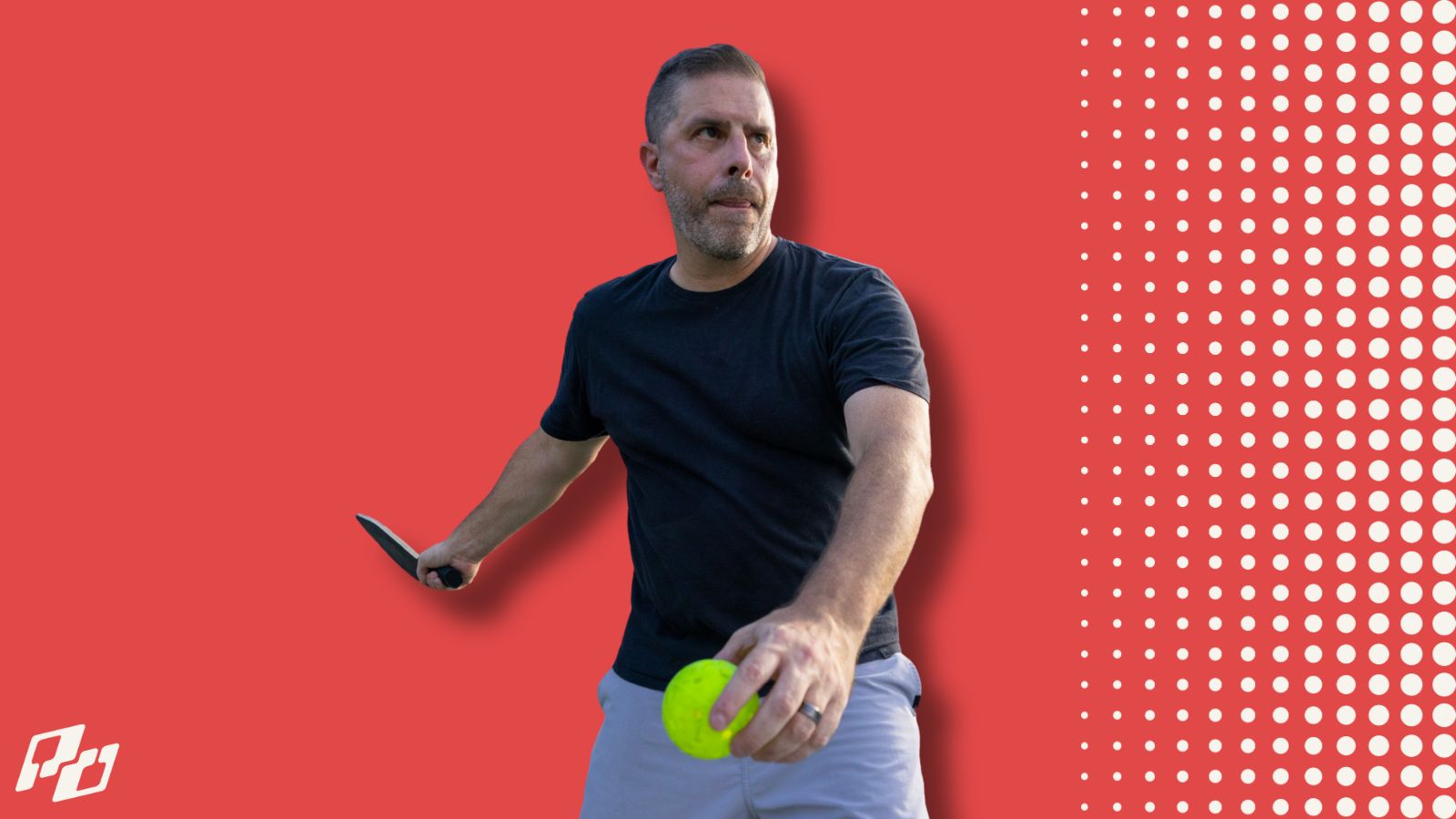
You know him. You miss one dink by two inches and he hits you with:
“Yeah… I’ve been playing for years.”
Not “close”. Not “good idea”. Not even “let’s reset.”
Just… credentials. Like time served = skill earned.
And here’s the annoying part: sometimes he actually has been playing for years. So why does it still feel like you’re being coached by a traffic cone?
Because this isn’t really a pickleball problem. It’s a status + identity problem.
On a rec court, nobody has official authority. No coach. No captain. No contract. So a certain type of player creates authority the only way he knows how:
- by reminding you he’s “experienced,”
- by correcting loudly,
- by turning feedback into judgment,
- and by making mistakes feel like your problem.
Your goal isn’t to “win” the interaction. Your goal is to protect your focus, protect the partnership, and stop the vibe from hijacking the match.
Let’s talk about what’s happening psychologically, then exactly what to say (and what not to say).
What’s really going on in his head
1) Years played becomes identity
When someone leads with “I’ve been playing for years,” they’re not sharing info. They’re protecting identity.
If they’re “the experienced one,” then the court stays emotionally safe for them. If they have to admit confusion, adjust, or learn? That threatens the identity.
That’s why “experienced” players can be weirdly resistant to tiny changes. It’s not about the change. It’s about what the change implies.
2) He’s chasing competence + status, not solutions
In motivation research, people respond better when their needs for competence, autonomy, and relatedness are supported.
The “years guy” often feels shaky in at least one of those:
- Competence: “Am I actually good… or just familiar?”
- Autonomy: “Don’t tell me what to do.”
- Relatedness: “Respect me.”
So he tries to secure those needs the quick way: by positioning himself above you.
3) Low-feedback environments create overconfidence
Rec pickleball gives you tons of repetition… and surprisingly little accurate feedback. You can play 1,000 games and never learn why you’re losing points.
That’s why confidence and competence can drift apart (classic overconfidence problem, closely related to the Dunning–Kruger dynamic: people can lack the skill to accurately evaluate their own skill).
So yes—he may have “years.” But years without feedback is just… years.
The mindset shift that makes this easy
Here’s the trick:
Treat him like a nervous manager, not an evil person.
The second you label him as “toxic,” you’ll start reacting emotionally, trying to win, prove, or punish. Instead, treat his comments as a stress behavior:
- He wants control.
- He wants credit.
- He wants safety.
- He wants respect.
You can work with that—without letting him run you.
The 3 rules that stop 90% of blow-ups

Rule 1: Don’t argue about the past point
The “years guy” loves court trials. Especially when other people can hear. You’ll never out-debate someone whose real goal is status.
Your best move is to redirect to a forward plan:
- “Got it. Next one, let’s do ___.”
- “Okay. On the next return, I’ll ___.”
- “Yep. Next ball, I’m looking cross first.”
That’s not weakness. That’s control.
Rule 2: Use “we” language, not “you” language
“You” triggers ego defense. “We” signals partnership.
This is basic conflict de-escalation, and it maps cleanly onto Nonviolent Communication’s core idea: stay on observations + needs + requests rather than judgment.
- Bad: “You’re making bad calls.”
- Better: “Let’s tighten our calls—if we’re not sure, we play it in.”
Rule 3: Ask questions that force specifics
Vague criticism is pure ego. Specifics create coaching. So you don’t fight him—you invite precision.
That’s straight out of motivational interviewing style: open questions + reflective listening to reduce resistance and move the conversation into problem-solving mode.
- “What do you want me to do on that ball next time?”
- “Are you wanting me to take that earlier, or reset it cross?”
- “Do you want middle covered by you or me on those?”
If he can’t answer, the “years” line collapses on its own.
Exactly what to say in common situations
Situation A: He corrects you after every point (and it’s killing your rhythm)
Your goal: stop the constant feedback loop without sounding defensive.
Say:
“Appreciate it. Can we keep feedback to quick one-liners during the game, and talk details between games? I play better when I stay in flow.”
Why it works:
- You validate (competence/relatedness).
- You frame it as performance, not ego.
Do NOT say:
- “Stop coaching me.” (He hears: disrespect.)
- “You’re not even right.” (Now you’re in debate court.)
Situation B: He says “I’ve been playing for years” as a trump card
Your goal: don’t reward the status play, but don’t escalate.
Say (light, calm):
“Totally. Let’s use that experience—what do you want our plan to be on their third shot?”
You just took his identity claim and turned it into a request for leadership—but leadership with specifics.
If he’s legit, great. If he’s not, he either:
- offers something generic (you nod and move on), or
- gets quieter because now he has to produce value.
Situation C: He blames you for his mistakes (classic)
This is the self-serving bias at work: credit for wins, external blame for losses.
Your goal: stop the blame spiral fast.
Say:
“Maybe. Either way, what adjustment do you want us to make next point?”
Translation: we’re not doing blame; we’re doing solutions.
If he repeats blame:
“I’m good owning my part. I just want a clear plan for the next ball.”
That line is magic because it’s adult and calm—and it removes his favorite fuel: your defensiveness.
Situation D: He gives advice that’s wrong (and costly)
This is where players get stuck. You don’t want conflict—but you also don’t want to donate points.
Use the two-option redirect. It sounds cooperative, but it gives you control.
Say:
“Got it. On those, do you want me driving middle, or dropping cross? I’m leaning drop cross because they’re camping for the block.”
You just:
- acknowledged him,
- offered choices,
- and quietly introduced a more correct read.
If he insists on the wrong plan:
“Okay—let’s try it for two points and see what we get.”
Now the court provides feedback without you “challenging” him.
Situation E: He gets loud / snippy (public status move)
When he performs for the group, he’s chasing dominance.
Your goal: de-escalate publicly, reset privately.
Say (short, neutral):
“All good. Next point.”
That’s it. Don’t explain. Don’t justify. Don’t debate in public.
Between games, you can go private:
“Quick note—when feedback gets sharp mid-game, it throws me off. I’m here to play well with you. Can we keep it constructive?”
That’s essentially NVC structure: observation → impact → request.
The “secret” move: create psychological safety on purpose
Most rec partnerships fail because they’re not safe enough to learn in real time.
In team research, psychological safety is about feeling able to speak up, make mistakes, and learn without punishment. You can create that in 10 seconds—before the game even starts.
Try this at the paddle tap:
“Quick plan: if either of us sees something, let’s keep it short and positive mid-game. Between games we can talk details.”
You’re basically setting a team culture.
And ironically? The “years guy” often calms down when the norms are clear—because he no longer has to fight for control.
What not to say (even if you’re right)
These are the phrases that turn a mildly annoying partner into a full-time courtroom attorney:
- “You’re not as good as you think.”
- “Years doesn’t mean anything.”
- “That’s not how the pros do it.”
- “I know what I’m doing.”
- “Relax.” (Nobody has ever relaxed because someone said relax.)
Even if true, they attack identity. And identity attacks create retaliation.
When to set a hard boundary (and how)
Sometimes, the guy isn’t just insecure—he’s disrespectful. Repeatedly.
Hard boundary, calm voice:
“I’m happy to play, but not with the commentary. If it keeps going, I’m going to rotate off after this game.”
No anger. No lecture. Just a consequence. This protects your energy and signals you’re not available for emotional chaos.