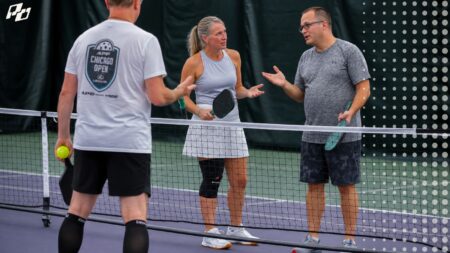
This is one of the most uncomfortable moments in recreational pickleball.
Your partner calls a ball out.
You’re pretty sure it was in.
Everyone pauses… and suddenly you’re standing between integrity, team loyalty, and not wanting to blow up a casual game.
If you’ve played long enough, this will happen to you. Probably more than once. And how you handle it matters far more than the single point at stake.
Let’s talk about what actually works—on court, socially, and long term.
First, Reframe the Problem
Most rec players treat this moment like a rules dispute.
It’s not.
It’s a relationship test under mild pressure.
The fastest way to ruin open play isn’t a bad line call—it’s how players react to disagreement. Yelling, posturing, or “sticking to your call” at all costs turns a plastic-ball game into something personal. That’s when people stop wanting to play with you.
So the real goal isn’t “being right.” The goal is:
- keeping the game moving
- keeping trust intact
- keeping your reputation clean
The One Principle That Solves Most Situations
Here it is, plain and simple: call what you clearly saw. Nothing more. Nothing less.
➡️ Not what you think might have happened.
➡️ Not what feels fair.
➡️ Not what keeps your partner comfortable.
What you clearly saw.
That single principle removes ego from the moment—and that’s why experienced players and coaches lean on it.
When You’re Certain Your Partner Is Wrong
This is the hardest scenario emotionally.
Your partner calls it out.
You saw it clip the line.
You know it was in.
Here’s the clean, drama-free way to handle it:
What to say (short and neutral)
- “I saw it in.”
- “I’m pretty sure that caught the line.”
That’s it. No speeches. No tone. No explaining physics. Once you say it, the point is resolved. The opponents get the benefit, and the game moves on.
You didn’t embarrass your partner.
You didn’t accuse them.
You didn’t escalate.
You just told the truth and kept playing.
When You’re Not Sure (This Is Where Most Players Slip)
Uncertainty is where games unravel. If you think it might have been in—but didn’t clearly see it—don’t inject doubt.
Avoid phrases like:
- “I don’t know…”
- “It looked close…”
- “It might’ve been in…”
Those statements don’t improve accuracy. They just invite debate.
If you didn’t have a clean look, the most disciplined move is silence—or later, a quiet comment to your partner:
“I didn’t see it clearly.”
Silence isn’t dishonest. It’s controlled.
Body Language Does More Talking Than You Think

Even when you say the right thing, your body can undermine you.
Good signals:
- relaxed shoulders
- quick paddle tap
- eyes forward to the next rally
Signals that create tension:
- head shaking
- sighing
- staring at the line
- looking to opponents for validation
People remember how you handled the moment, not just what you said.
If Your Partner Gets Defensive or Upset
Some players take disagreement personally. That’s not your job to fix. The smartest response is boring:
- don’t argue
- don’t explain
- don’t match their energy
A calm reset works better than logic:
“Hey, I’m just calling what I see. All good.”
If they keep pushing, that’s information—not an invitation to debate. Finish the game politely. Rotate away next round.
Rec pickleball has a quiet enforcement system: choice.
The “After the Game” Rule
One rule experienced players follow almost universally: if you didn’t handle it calmly in the moment, don’t relitigate it afterward.
Post-game breakdowns rarely repair anything. They just turn a brief moment into a lingering memory—especially with people you’ll see again next week.
If you do say something later, keep it light and short:
“Just so you know, if I clearly see one in, I’ll say it. Nothing personal.”
Then let it go.
What Never Helps (Even If You’re Right)
Avoid these at all costs:
- “You can’t overrule me.”
- “That was my call.”
- “Everyone saw that.”
- “You always do this.”
Those phrases don’t protect fairness—they trigger ego. Once ego enters, nobody wins.
What I’ve Learned the Hard Way
Here’s the truth most rec players only learn after a few awkward moments: your reputation on court matters more than any single call.
People don’t remember whether a ball clipped the line in game three. They remember how you handled yourself when it did.
So here’s the bonus advice I wish I’d followed sooner:
- If you clearly saw it in, say so—once—and move on.
- If you didn’t see it cleanly, protect the game, not your ego.
- If a partner reacts badly, don’t try to fix them mid-match. Finish the game, rotate, and keep your peace.
One more thing that doesn’t get said enough: you’re allowed to choose who you play with.
Walking away from a bad dynamic isn’t being dramatic—it’s being smart.
The players who last the longest in rec pickleball aren’t the loudest or the most “right.” They’re the ones who keep games calm, honest, and enjoyable—even when things get a little messy.