
One of the hardest decisions in pickleball happens in a split second at the kitchen:
Do I speed this ball up… or do I reset and live to fight another dink?
Most rec players guess. And guessing is exactly why speed-ups feel random—sometimes brilliant, sometimes disastrous.
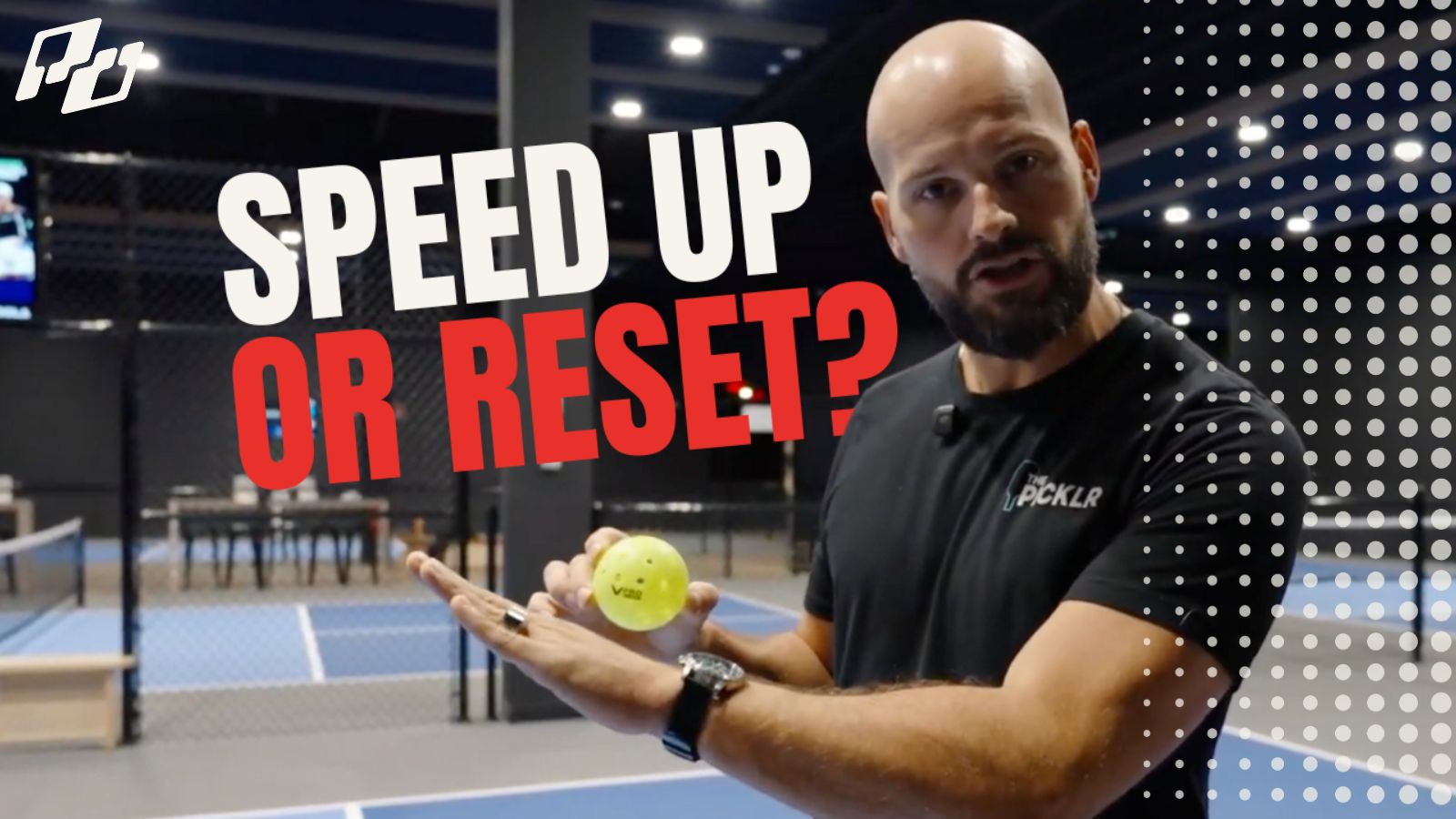
That’s why we shot this video with our friend and pickleball coach Marko Grgic. Marko has a gift for taking messy, feel-based decisions and turning them into clear, repeatable rules you can actually use mid-rally. This one might be his simplest—and most useful—cue yet.
Before we break it down and add context, watch the clip below.
Video: When to Speed Up vs When to Reset (with Coach Marko Grgic)
The Core Rule (And Why It Works)
Marko’s rule of thumb is refreshingly simple:
If you can see the bottom half of the ball, you can consider attacking.
If you can’t see the bottom half of the ball, you should reset.
That’s it. No talk of percentages or patterns—at least not at first.
Why this works so well is that it removes emotion and replaces it with geometry.
The geometry behind the cue
- When you can see the bottom half of the ball, the ball is high enough that your paddle can travel forward through contact.
- When you can’t, the ball is too low, forcing your swing to travel upward, which:
- opens the paddle face
- increases launch angle
- creates pop-ups instead of pressure
In other words:
Seeing the bottom half = forward attack angle.
Not seeing it = upward, risky angle.
This is why so many speed-ups that felt right end with the ball sitting up perfectly for your opponent.
Height Matters More Than Speed
A common mistake rec players make is thinking speed-ups are about how fast the ball is moving.
They’re not. They’re about contact height.
Marko gives a very practical reference point in the video: knee height (or even shorts height).
- Below knee / shorts height
→ You likely can’t see the bottom half
→ Reset or dink - Above knee / shorts height
→ You can often see the bottom half
→ Now a speed-up becomes an option
Notice the wording: option, not obligation.
This cue doesn’t tell you to attack—it tells you when attacking becomes physically possible without donating points.
Why Rec Players Get This Wrong So Often
At the rec level, most speed-up mistakes come from two habits:
1) Confusing opportunity with impatience
Players see a ball that’s slower or slightly higher and assume it’s “attackable,” even if it’s still below their ideal contact window.
2) Overvaluing pace
Many players think, “If I hit it hard enough, it’ll work.” But when the ball is low, harder usually makes things worse, because the launch angle stays high.
Marko’s cue cuts through both problems by forcing one simple check:
Can I see the bottom half of the ball?
If not, the decision is already made for you.
Drill 1: The Dinking Recognition Drill (Say It Out Loud)
This drill is powerful because it trains decision-making, not mechanics.
How it works
- Dink back and forth with a partner.
- On every ball you receive:
- Say “no” out loud if you cannot see the bottom half.
- Say “yes” and attack if you can.
Why saying it out loud matters:
- It slows your brain just enough to see instead of react.
- It builds a visual habit you can later internalize.
Most players are surprised by how few balls are actually “yes” balls.
Drill 2: Silent Live Play (Internalizing the Cue)
Once recognition is clear, Marko removes the talking and lets the rally flow. You’re still asking the same question internally:
Bottom half visible… or not?
Now the decision happens at game speed, which is where rec players usually break down.
This drill bridges the gap between:
- knowing the rule
- trusting it under pressure
What Happens After You Decide to Attack Matters Just as Much
Seeing the bottom half of the ball gives you permission to attack—but it doesn’t tell you how to attack. This is where many rec players undo a good decision with a bad expectation.
Marko makes an important point in the video: a speed-up isn’t meant to end the rally. It’s meant to change the rally. When you attack the right ball, the goal is to force a predictable response and move the point into a hands exchange you’re ready for.
That’s why many of Marko’s demonstrations involve speed-ups straight ahead, not sharp angles or all-or-nothing swings.
Straight speed-ups:
- keep the ball traveling forward instead of lifting
- reduce margin errors over the net
- force controlled blocks rather than surprise counters
- help you stay balanced and prepared at the kitchen
Trying to win the point outright—especially on a ball that’s only barely attackable—usually defeats the purpose. It turns a high-percentage decision into a low-margin gamble.
Why This Cue Actually Works Under Pressure
What makes Marko’s cue so effective isn’t that it’s simple—it’s that it’s binary. Most rec players miss speed-ups because they’re running a fuzzy checklist mid-rally:
Is this slow enough? Am I balanced? Can I surprise them? Should I go cross?
That’s too much.
Marko’s cue collapses all of that into one physical question:
Can I see the bottom half of the ball?
From a technical standpoint, this does two important things:
- It ties decision-making to body position, not confidence.
Whether you feel aggressive or hesitant doesn’t matter. The ball height dictates the option. - It synchronizes your eyes, paddle path, and margin.
When the bottom half is visible, your swing naturally wants to go forward—not up—which keeps speed-ups lower and more predictable.
Instead of asking “Should I go?”, your brain learns to ask “Is this ball physically attackable right now?”
That shift alone eliminates a huge percentage of rushed, low-percentage speed-ups—especially late in games.