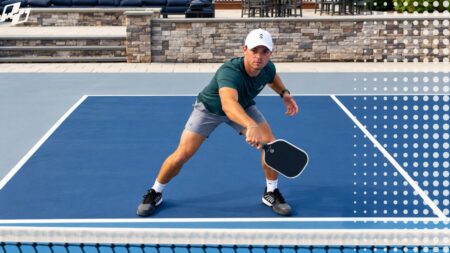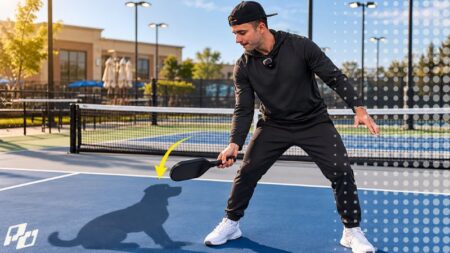

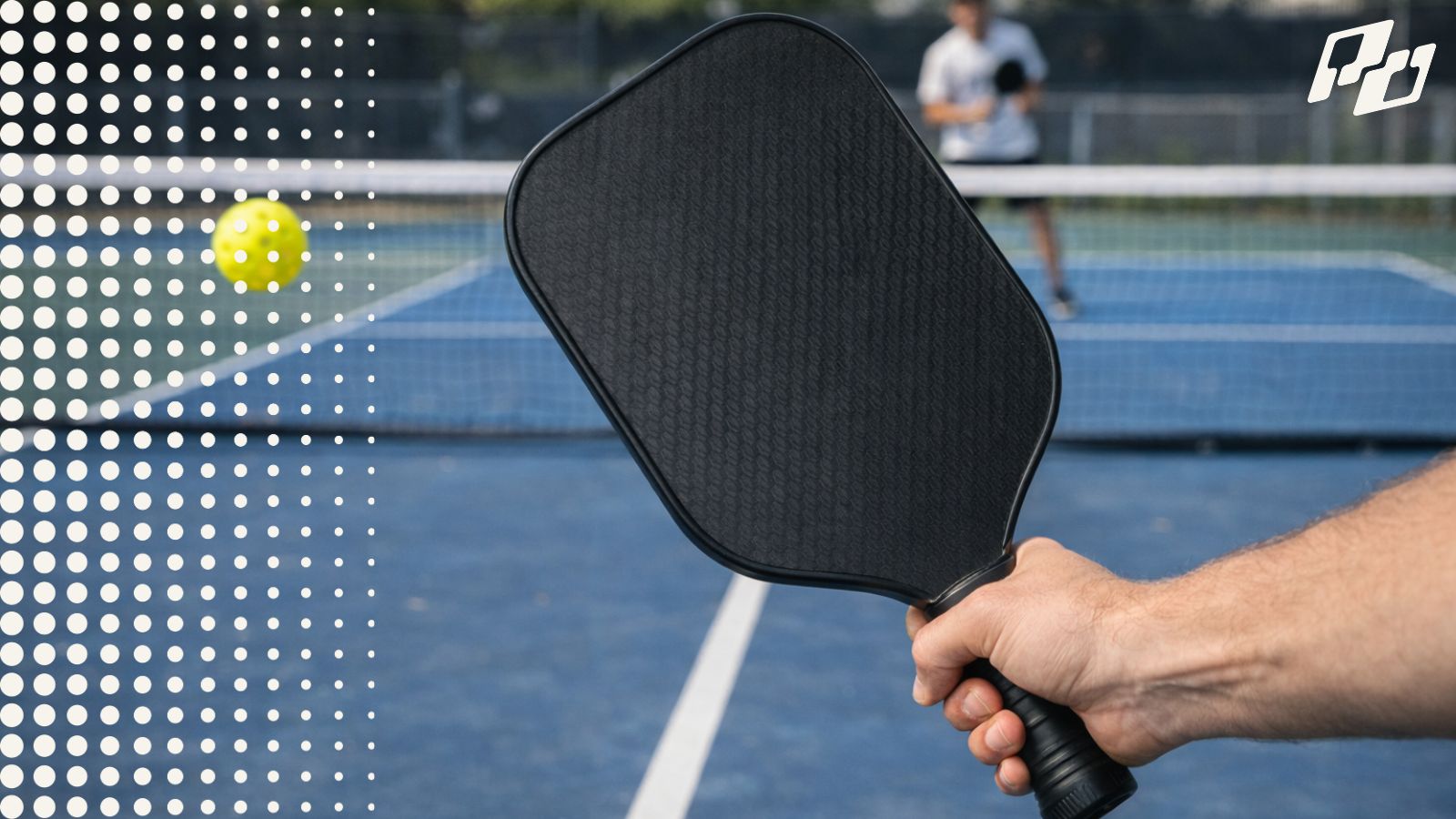
Grip changes in pickleball should be situational, not constant. Use a neutral Continental grip during fast exchanges and at the kitchen. Rotate slightly toward Eastern only when you have time, are balanced, and want to add topspin or drive.
Grip is one of the most misunderstood skills in recreational pickleball. Some players never change it and wonder why certain shots feel cramped. Others try to change grips constantly and get caught mid-rally holding the paddle wrong when the speed-up comes.
The truth sits in the middle.
Grip changes in pickleball are situational—not constant. And more importantly, grip adjustments are often micro-rotations and pressure shifts, not dramatic re-grabs.
If you’re a beginner to early intermediate player, here’s what you actually need to understand:
- What your neutral grip should be
- When rotation helps
- When it hurts
- How to change safely
- And why kitchen speed changes everything
Let’s build this properly.
First: What Grip Actually Controls (Mechanically)
Grip affects three mechanical variables:
1. Paddle Face Angle
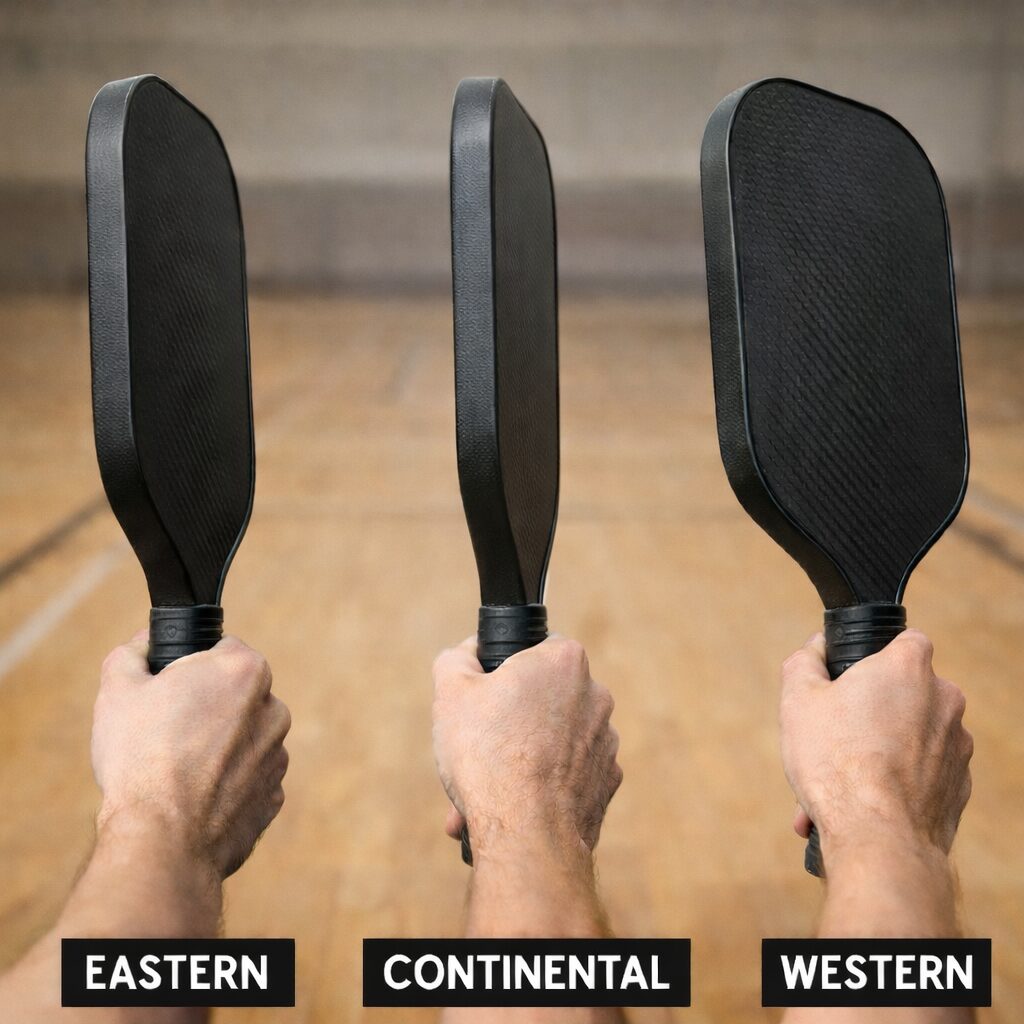
The more you rotate toward an Eastern or semi-western forehand grip, the more naturally “closed” your paddle face becomes on forehands.
The more neutral (Continental) your grip, the more vertical your paddle face stays by default.
That directly impacts:
- Launch angle
- Spin production
- Pop-up risk
- Counter stability
2. Forehand vs Backhand Comfort
A forehand-dominant grip (Eastern/semi-western) makes forehands feel natural—but makes one-handed backhands feel awkward and late.
A neutral grip (Continental) balances both sides, which is why it dominates at the kitchen.
3. Wrist Freedom
Grip rotation changes wrist mechanics.
- Closed forehand grips allow easier topspin brushing.
- Neutral grips allow easier blocking and stable punch volleys.
This is why grip becomes more important as rallies move closer to the net.
The Core Principle: Time Determines Grip Change
This is the rule that prevents 90% of rec mistakes:
➡️ If you have time, you can choose your grip.
➡️ If you don’t have time, you keep your neutral grip.
Let’s define “time.” You have time:
- Before serving
- On serve return
- On a slow third shot drive
- When the ball floats high
- When you’re fully balanced
❌ You do NOT have time:
- In a hands battle
- When jammed
- While scrambling in transition
- When the ball is dipping fast
- When stretched wide
Rec players get burned because they try to rotate grips during fast exchanges. At the kitchen, stability beats spin.
The Grip Hierarchy for Rec Players
If you’re early intermediate, your system should look like this:
Primary Grip: Continental (Neutral)
This is your defensive and kitchen grip. Use it for:
- Dinks
- Resets
- Blocks
- Counters
- Backhand volleys
- Most transition shots
Why?
Because Continental keeps the paddle face stable under speed. It reduces accidental face opening on counters. It allows you to react without recalculating.
If you are getting sped up often, this should be your home base.
Secondary Grip: Slight Eastern Forehand
This is your controlled offensive forehand grip.
Use it when:
- Driving forehands from baseline
- Returning serve aggressively
- Rolling a forehand volley when early and balanced
- Serving with forward penetration
This grip slightly closes the face and makes brushing up the back of the ball easier.
But here’s the tradeoff: the more you bias forehand, the more awkward your one-handed backhand becomes.
That’s why grip rotation must be temporary—not permanent.
Micro-Adjustments vs Full Grip Changes
This is where most rec players misunderstand technique. Good players rarely re-grab the paddle completely.
Instead, they:
- Slightly rotate the paddle using the bottom fingers
- Adjust pressure in ring/pinky
- Allow small shifts in palm angle
Think of it as “rolling the handle,” not “resetting your hand.”
➡️ Full re-grips take time.
➡️ Micro-adjustments are fast.
In this clip, Coach Shea Underwood breaks down why using the same grip for every shot limits your control—and how simple grip adjustments can instantly clean up paddle angle:
@sheaunderwood Follow @sheaunderwood_ ✅ more info below👇 Stop using the same grip for every shot! The best pickleball players adjust their grip depending on the shot, and so should you. The ball goes where your paddle face is facing 99% of the time, and the easiest way to control that is by switching grips. Here’s why grip adjustments matter: Backhand Rolls – If you use a semi-western grip, you’ll have to bend your wrist a ton to get the right angle. But if you switch to a continental grip, your paddle naturally faces the right direction with less strain. Forehand Slice Dink – With a semi-western grip, you have to twist your wrist awkwardly to scoop the ball. But a slight grip adjustment makes the shot effortless. If you can comfortably change grips in a rally, it’ll improve your control and shot consistency! If it’s too much to think about mid-point, just stick with the Continental grip—it’s a solid all-around option! Mastering grip adjustments is a small change that makes a huge difference in your game! Who’s trying this in their next match? #pickleball #selkirksport #selkirk #selkirkedit #wearepickleball #crackedpb ♬ original sound – Shea
Shot-by-Shot Grip Strategy (With Real Context)
| Situation | Recommended Grip | Why | Common Mistake |
|---|---|---|---|
| Serve | Continental or Slight Eastern | You have time; choose control or forward penetration | Over-rotating grip and losing consistency |
| Return of Serve | Slight Eastern (if driving) / Continental (if prioritizing depth) | Eastern helps shape drives; Continental keeps it simple | Staying in Eastern too long as you approach kitchen |
| Third Shot Drive | Slight Eastern (forehand) | Easier topspin + lower launch angle | Forcing grip change while off-balance |
| Third Shot Drop | Continental (especially under pressure) | Stability matters more than spin | Rotating grip instead of managing paddle angle |
| Transition Zone Reset | Continental | Neutral face = fewer pop-ups under speed | Trying to re-grip during scramble |
| Dinks (Neutral) | Continental | Best balance between forehand/backhand coverage | Using forehand-heavy grip and getting countered |
| Forehand Roll Dink (Advanced) | Slight Eastern (if early & balanced) | Easier brushing action | Staying in this grip during fast exchange |
| Speed-Up (High Ball) | Slight Eastern (temporary) | Natural closed face helps drive downward | Not returning to neutral afterward |
| Hands Battle / Counters | Continental | Maximum stability + reaction speed | Staying in forehand-biased grip |
| One-Handed Backhand Volleys | Continental | Keeps paddle face neutral and stable | Using Eastern and feeling cramped |
Notice the pattern:
- The closer you are to the kitchen and the faster the rally becomes, the more neutral your grip should be.
- The further back you are — and the more time you have — the more you can afford slight rotation.
1. Serve
You have full control and time.
- Continental is safest for consistency.
- Slight Eastern allows more forward penetration and topspin.
- Semi-western is advanced and unnecessary for most rec players.
If your serve is inconsistent, the issue is usually timing or swing path—not grip.
2. Return of Serve
You typically have time here.
If driving aggressively: slight Eastern works well.
If prioritizing depth and control: Continental is fine.
Important: if you rotate to Eastern, begin returning toward neutral as you move forward to the kitchen.
Do not arrive at the kitchen stuck in a forehand-heavy grip.
3. Third Shot Drive
If you’re balanced and hitting forehand: slight Eastern can help shape and depth.
If rushed: stay neutral and focus on contact quality.
Remember: power comes from sequence, not grip alone.
4. Third Shot Drop
Under pressure, do NOT rotate grip.
Drop shots fail more from tension and swing size than from grip angle.
Stability > spin.
5. Dinks
Most rec players should default to Continental.
Advanced forehand-heavy players may slightly bias toward Eastern—but only if they can instantly defend a counter.
If you’re experimenting with forehand topspin dinks and getting countered high, your grip may be too closed or too rigid.
6. Speed-Ups
If the ball sits high and you are balanced: a slight forehand bias can help shape the attack.
But immediately return to neutral after contact.
Never stay in an aggressive grip after a speed-up attempt.
7. Hands Battles
Do not change grips here.
This is where Continental wins.
➡️ Neutral face = faster reaction.
➡️ Forehand-heavy grip = more pop-ups under speed.
If you struggle with counters flying long, check your grip rotation first.
Backhand Considerations
One-handed backhand players: Continental is non-negotiable for stability.
Two-handed backhand players: you have more flexibility because your non-dominant hand helps control paddle face.
But early intermediates should still prioritize a strong neutral base before experimenting.
Grip Pressure (More Important Than Rotation)
Most rec players focus on where their hand sits on the handle. But often, the bigger issue isn’t rotation — it’s pressure.
Grip pressure directly affects:
- Launch angle
- Ball rebound off the paddle
- Reset softness
- Counter stability
If you squeeze too tight, your wrist locks. A locked wrist makes the paddle face more reactive instead of absorbent. That’s when resets float, counters pop up, and drives fly long.
If you grip too loose, the paddle can wobble slightly at contact. You lose precision. Balls land short. Direction becomes inconsistent.
The goal isn’t tight or loose. It’s controlled firmness — think “firm handshake.”
And here’s the nuance most players miss: on soft shots like dinks and resets, your grip pressure should soften slightly at contact to absorb pace. On harder shots like drives and speed-ups, pressure firms up slightly for stability — but never becomes a death grip.
Use this as a guide:
| Situation | Grip Pressure (1–10) | Goal |
|---|---|---|
| Dinks | 3–4 | Soft touch, absorb pace |
| Resets / Blocks | 4–5 | Controlled absorption |
| Serve / Return | 5–6 | Stable contact |
| Drives / Speed-Ups | 6 | Firm but relaxed acceleration |
| Hands Battles | 5–6 | Face stability without tension |
Pattern to remember:
- Soft shots = softer hands.
- Hard shots = slightly firmer hands.
- Never 8–10 unless you’re trying to snap the paddle in half.
If your grip rotation looks correct but you’re still popping balls up, check your pressure first.
5 Common Rec Player Grip Errors (And Why They Hurt You)
1. Staying in Eastern too long and getting jammed
Players rotate slightly for a forehand drive — then forget to return to neutral as they move forward. When a fast ball comes to the backhand side, the grip feels cramped and late. The result? Weak counters or pop-ups. Rotate for offense, return to neutral for defense.
2. Trying to re-grip during a hands exchange
Fast kitchen rallies are not the time to rotate your hand on the handle. Even a small delay can cost reaction time. In speed situations, adjust paddle angle — not your entire grip.
3. Changing grip when balance is already compromised
If you’re stretched, moving, or leaning, the problem isn’t grip — it’s footwork. Rotating your hand won’t fix poor positioning. Stabilize your base first. Grip changes work best when you’re early and balanced.
4. Confusing spin production with grip change
Many players assume they need a new grip to add topspin. In reality, spin mostly comes from swing path and contact mechanics. Changing grip won’t fix a flat swing.
5. Over-rotating instead of micro-adjusting
Grip changes in pickleball are subtle. Big re-grabs slow your hands and create inconsistency. Think small rotations using the bottom fingers — not full resets.
The pattern behind all five mistakes? Trying to solve timing or positioning issues with the hand instead of the body.
The 3-Level Progression
Level 1: Master Continental everywhere.
Level 2: Add slight Eastern for forehand drives and returns.
Level 3: Learn to rotate subtly and recover to neutral quickly.
If you cannot defend consistently yet, you are not ready for advanced grip systems.
➡️ Defense first.
➡️ Variation later.