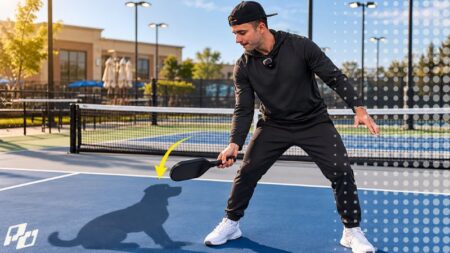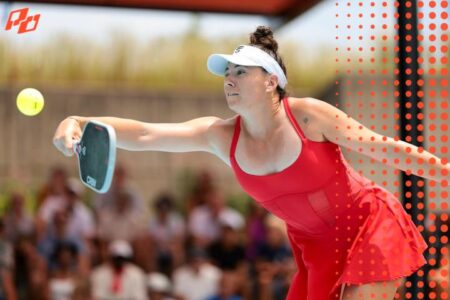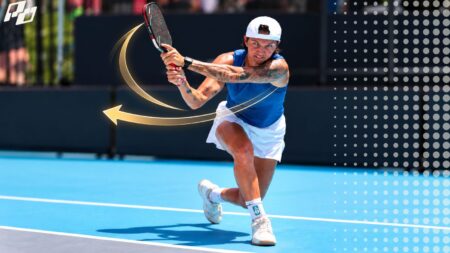

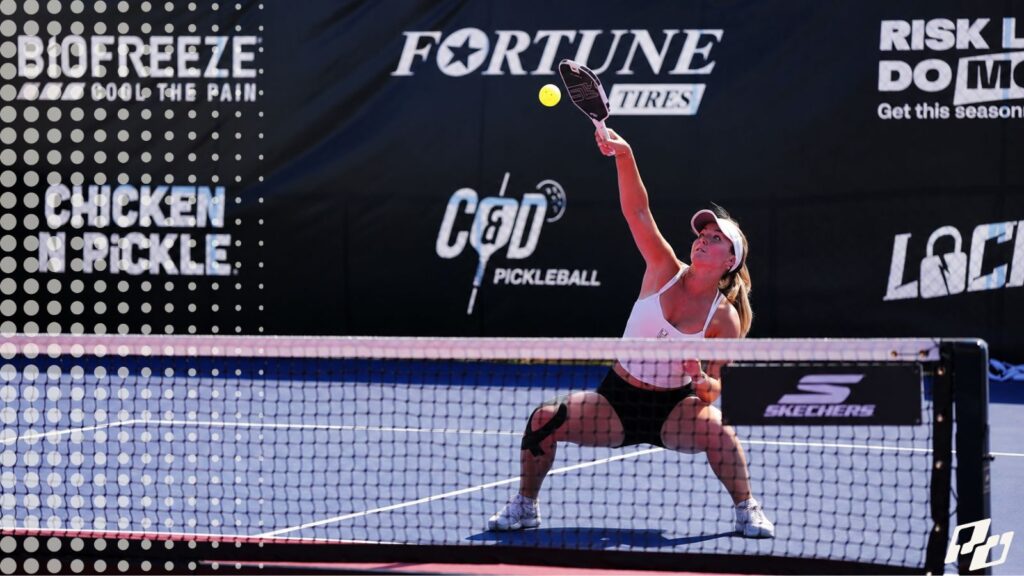
Pros sometimes squat for a pickleball overhead to lower their body beneath a head-high ball, creating more arm extension and a steeper downward angle. Recreational players should use it only when balanced and early to the ball; otherwise, a punch volley or traditional overhead is safer and easier.
We recently published a guide with our Pickleball Union coach Marko Grgic on how to hit a traditional overhead smash properly—getting behind the ball, rotating, and contacting it high and in front.
Today, we’re looking at something stranger.
If you watch high-level pickleball, you’ll occasionally see a player drop into a deep squat and hit an overhead-like putaway from a ball that isn’t really high enough for a normal overhead.
It looks awkward. Sometimes it looks almost ridiculous.
But there is a real technical reason for it.
By lowering their body underneath the ball, pros can transform an awkward shoulder- or head-height volley into a contact point that behaves more like an overhead. That gives them more room to extend the arm, create a downward paddle path, and attack the opponent’s feet instead of simply punching the ball forward.
The shot overlaps with what players often call the scorpion, although the exact situation can vary. The key principle is the same:
Lower the body to raise the ball relative to your hitting shoulder.
Should recreational players copy it?
Sometimes—but only on a very specific type of ball.
Why Would You Squat Instead of Just Volleying?
Imagine you are standing at the kitchen line and the opponent gives you a ball around head or shoulder height.
It is obviously attackable.
But it is also in an awkward zone.
It may be:
- too low for your normal full overhead mechanics
- too high for a comfortable topspin roll
- too close to your body for a clean forehand punch
If you stay upright and try to smash downward anyway, your arm can become cramped. You lose extension, the paddle path becomes steep and wristy, and the ball often goes directly into the net.
Instead, drop your hips.
Now the same ball that was around your shoulder is effectively above your head relative to your new body position.
That creates space for an overhead-like swing. Watch pro player Callie Jo Smith explain the logic behind this shot and why the pros use it:
This is the same basic geometry behind the scorpion counterattack: by squatting, players turn a ball that would otherwise jam the shoulder or torso into something they can attack from above. Coaches specifically teach the scorpion for rising balls aimed around the paddle-side shoulder.
What Squatting Actually Changes
The squat does not magically add power. It changes your relationship to the ball.
⮕ Upright
A shoulder-high ball may be beside your arm. Your paddle has limited room to extend above it, so your stroke tends to become:
- sideways
- cramped
- wrist-dominant
- difficult to direct downward
⮕ Lowered
Drop your center of mass and suddenly the ball is higher relative to your shoulder. Now you can:
- extend the hitting arm
- place the paddle above or behind the ball
- accelerate through a larger path
- send the ball forward and downward
That is why the shot can produce more usable pace even though the player is physically lower.
The extra power comes from better leverage and extension, not simply from squatting harder.
This Is Not the Same as a Normal Overhead
A traditional overhead usually comes from a lob or high popup. You have time to turn sideways, position underneath and behind the ball, load the body, and use a full throwing-style motion. Proper overhead instruction consistently emphasizes high contact in front, body rotation, and balanced positioning.
The squat overhead is different. It usually appears when:
- you are already at the kitchen
- the ball is around head height
- you have less preparation time
- there is not enough height for a normal overhead setup
- the ball is still high enough to attack downward if you lower yourself
Think of it as a compact overhead putaway, not a replacement for your standard smash.
Why Pros Use It
1. It turns an awkward height into an attacking height
This is the biggest reason. Pros hate wasting attackable balls.
A recreational player might simply punch a shoulder-high volley back into the court.
A pro sees an opportunity to manipulate body position so the ball can be struck downward.
Dropping the hips effectively raises the contact point relative to the player.
2. It creates a steeper attacking window
From an upright position, a head-height ball may force you to hit mostly forward. Get lower, and your paddle can attack from above the ball.
That helps send pace down toward the opponent’s feet, rather than simply deeper through the court.
This is exactly why scorpion instruction emphasizes lowering the body so a rising speed-up can be redirected downward.
3. It gives the arm more extension
A ball near the shoulder can jam the elbow. Lowering the body creates separation between the shoulder and contact point.
More arm extension generally means a cleaner lever and more room to accelerate.
4. It can disguise the target
The squat itself is visually unusual, and the compact overhead preparation does not necessarily reveal whether the player is going:
- straight ahead
- crossbody
- toward the sideline
- directly at the feet
But I would consider disguise a secondary benefit. The real advantage is geometry.
The Ball You’re Looking For
This shot should not be used simply because the ball is “kind of high.” For an intermediate player, I would look for four green lights.
✅ The ball is roughly head height
If it is significantly higher, hit a normal overhead.
If it is only chest height, a roll, punch, or swinging volley will often be easier.
✅ You have time to lower your body
If the ball is already on top of you, squatting late can make the contact worse.
You should recognize the height early and get low before beginning the forward swing.
✅ The ball is in front
Just like Marko emphasized in our traditional overhead guide, contact still needs to happen in front.
Squatting does not rescue a ball that is already behind your head.
✅ You are balanced
This is non-negotiable.
If lowering into the shot makes you fall backward, collapse at the waist, or lose your base, choose the simpler volley.
How to Hit It
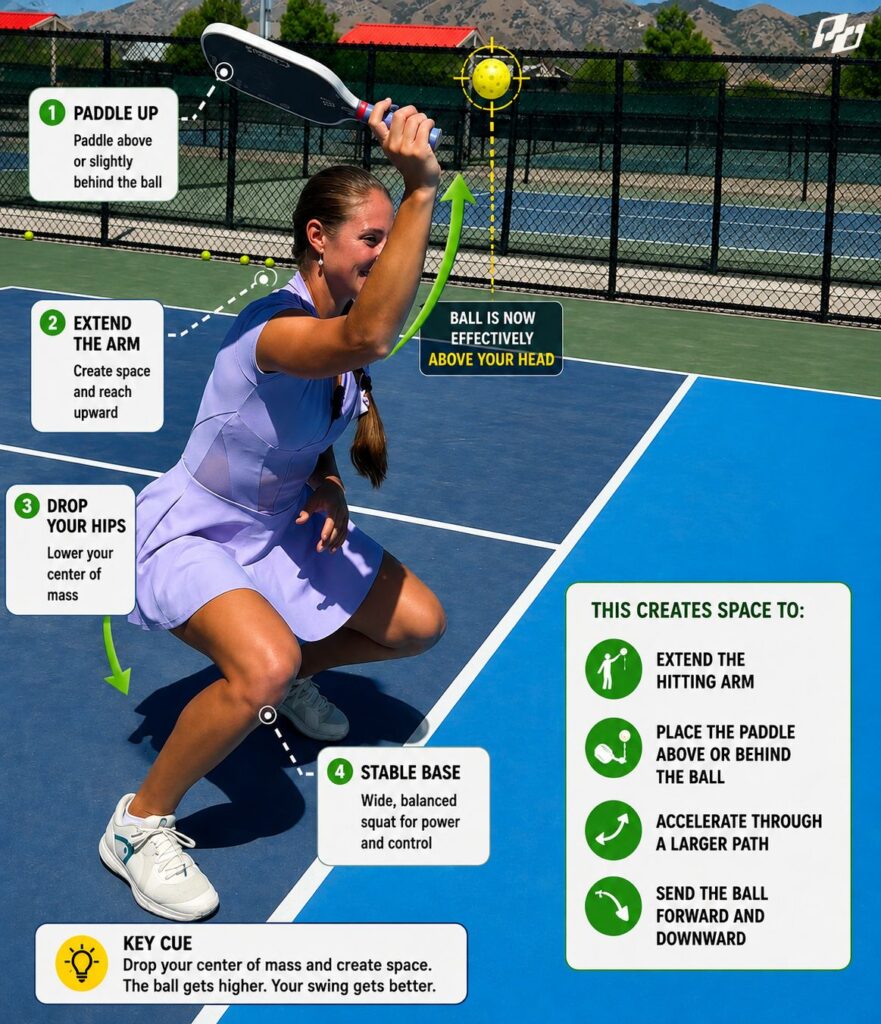
The mechanics are simpler than they look.
✔️ Widen your base
Set your feet slightly wider than your normal kitchen stance so you can get lower without leaning.
✔️ Sit through the knees and hips
Think sit, not bend. Keep your torso relatively upright and lower your eye level.
✔️ Keep the paddle compact
No big backswing. Bring the paddle above the hitting shoulder and use a short throwing or punching motion.
✔️ Contact high relative to your stance
Your body drops. The ball doesn’t. That creates space to attack from above or behind the ball.
✔️ Drive forward and slightly down
Don’t chop straight down. Keep a strong forward component while directing the ball toward the opponent’s feet.
Cue: Sit under it. Extend over it. Drive through it.
Aim at Feet, Not the Baseline
This is probably the biggest tactical mistake recreational players would make with the shot.
The squat overhead gives you a steeper angle. Use it. Do not lower yourself just to blast the ball horizontally toward the baseline.
Aim:
- at the opponent’s feet
- through the middle seam
- toward an open short angle
- behind a player who is moving
Pro overhead instruction increasingly emphasizes angle and placement over maximum power, because an opponent defending a ball at their shoes has fewer options than one receiving a faster ball around waist height.
Cue: Down at them, not through them.
Is This Basically a Scorpion?
Sometimes. The terms overlap, but I would separate them slightly.
A classic scorpion is typically a counterattack against a fast ball coming toward your shoulder or body. You anticipate the speed-up, squat beneath its path, raise the paddle above your head, and counter downward.
The squat overhead we are discussing can also happen on a slower popup or high volley where you have more time to prepare.
So:
| Shot | Typical Ball | Main Purpose |
|---|---|---|
| Traditional overhead | Lob/high popup | Full putaway |
| Squat overhead | Head-height popup/volley | Turn awkward height into downward attack |
| Scorpion | Fast rising body speed-up | Counterattack a ball aimed at shoulder/chest |
| Punch/roll volley | Chest-to-shoulder height | Compact attacking volley |
There is some overlap, and terminology is not perfectly standardized.
The important thing is recognizing the contact situation, not winning an argument about what the shot should be called.
When You Should NOT Copy the Pros
This is where I would be cautious with recreational players. Pros have:
- excellent hip and ankle mobility
- strong legs
- fast anticipation
- thousands of repetitions at the kitchen
- very precise paddle control
The squat overhead demands more physically than a normal punch volley. If you have difficulty getting low and returning to an athletic stance quickly, there is no reason to force it.
For many 3.0–3.5 players, the better answer on a shoulder-high ball is simply: move your feet, create space, and punch or roll the volley.
That is easier to repeat and easier to recover from. And if the ball is genuinely high enough for a normal overhead, stay with the normal overhead.
The squat version is a solution to an awkward middle height, not a flashy technique you should manufacture whenever possible.
Don’t Stay Down After Contact
There is another reason this shot is harder than it looks. Recovery.
If the opponent digs the first attack, you may need to counter again immediately. After contact:
✔️ Allow the legs to extend
✔️ Recover the paddle in front
✔️ Return toward normal kitchen height
✔️ Expect the next ball
Scorpion coaching makes the same point: the aggressive counter is only useful if you recover quickly enough to handle the next shot.
Pros make the squat look easy because the transition out of it is almost as fast as the movement into it.
A Simple Drill Before You Try It in Games
Do not start by having someone blast balls toward your face. Have a partner feed slow balls around head height while you stand at the kitchen.
- First hit five normal punch volleys.
- Then hit five with a controlled squat overhead.
Notice what lowering the body changes. You should feel:
- more space above your hitting shoulder
- greater arm extension
- a steeper path toward the opponent’s feet
Then randomize the feeds:
- chest height → punch/roll;
- head height → squat overhead;
- high popup → normal overhead.
That trains the most important skill: choosing the right overhead variation based on contact height.
Should Recreational Players Learn It?
If you are below about 3.5, probably not yet. There are higher-value skills to develop first:
- traditional overhead mechanics
- forehand and backhand punch volleys
- roll volleys
- basic counter defense
- footwork and spacing
For a solid 3.5–4.0 player who already owns those shots, however, the squat overhead can be extremely useful.
It fills a real technical gap.
There is a band of balls around head height where a standard volley feels cramped but a traditional overhead feels too big.
Instead of accepting awkward contact, you move your body to change the contact relationship. That is the advanced idea worth copying from the pros.