A lot of beginner and early intermediate players think popped-up dinks are mostly a hand problem.
They blame the paddle face.
Or their grip.
Or their touch.
Sometimes those things matter. But a lot of pop-ups start with bad spacing.
More specifically, they happen when the ball bounces too close to your feet, you stay planted, and then you are forced to lift or scoop the ball from a cramped position. That is exactly why taking a pivot step to create space, leads to your dinks getting easier to keep low.
That sounds simple. But it is actually a big technical idea.
Because for rec players, the real issue is often not “How do I soften my hands more?” It is “Why am I making myself hit from such a bad contact zone in the first place?”
And that is where this footwork tip becomes a game-changer.
What the pivot step is really solving
At the kitchen, a lot of players get caught in the same trap.
They see the dink coming.
They wait.
The ball bounces close to their toes.
Now they are jammed.
USA Pickleball’s kitchen-line footwork guidance emphasizes staying light, balanced, and moving efficiently rather than reaching or getting stuck flat-footed. It frames good kitchen footwork as the foundation for control at the net.
That is why the pivot step matters. It is not just a fancy movement. It is a way to restore spacing so you can contact the ball from a stronger, calmer strike zone.
In plain English: the pivot step gives your paddle room to work.
And that is a huge deal on dinks, because dinks are touch shots. Touch disappears when spacing disappears:
Why dinks pop up when the ball gets too close
Let’s get technical for a second. When the ball bounces too close to your feet, especially your lead foot, you lose three things at once:
1. You lose your contact window
Instead of contacting the ball out in front and slightly away from your body, you are now contacting it cramped and late.
That forces compensation.
2. You lose your paddle path
A clean dink usually has a compact, controlled path. But when the ball crowds you, the paddle often has to lift more steeply just to clear the net.
That is where the pop-up starts.
3. You lose balance
If your feet stay frozen and the ball crowds your base, you usually bend from the waist, reach with the arm, or fall inward.
That makes soft control much harder.
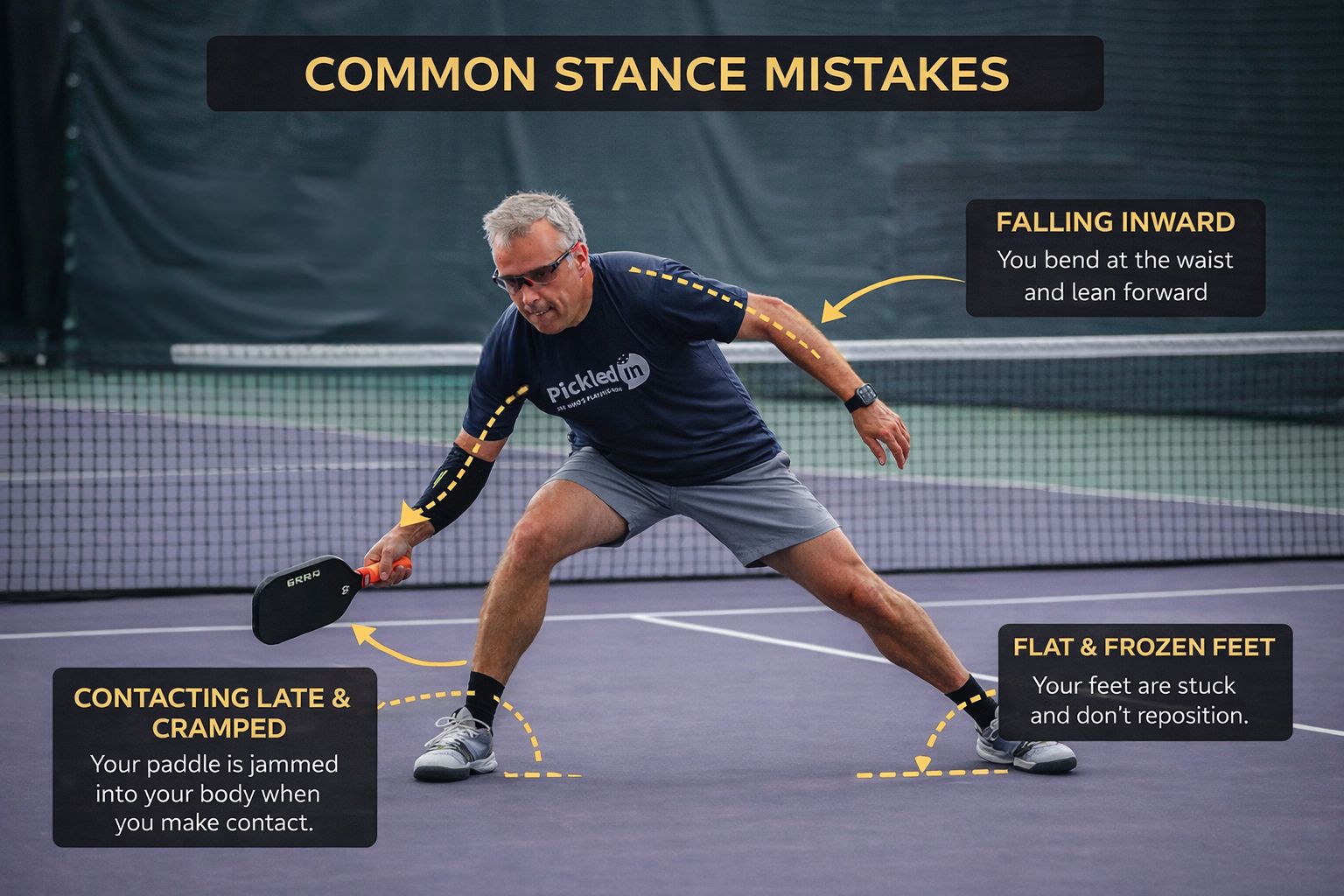
This matches what several coaching sources keep repeating: rec players pop dinks up not just because of paddle angle, but because they are too upright, too narrow, or too slow with their feet. Better Pickleball specifically points to narrow stance and poor knee bend as common causes of pop-ups, while USA Pickleball emphasizes balance and efficient movement at the kitchen.
So when we say to take a pivot step and create space, we’re really telling you to solve the problem before the paddle ever touches the ball.
That is the key.
What the pivot step actually is
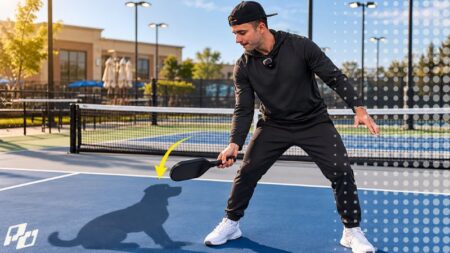
For most rec players, think of the pivot step as a small foot adjustment that pulls your body out of the ball’s path so the ball can fall into a cleaner strike zone.
It is not a dramatic retreat.
It is not a panic hop.
It is not backing off the kitchen line for no reason.
It is a subtle reset step.
Usually, that means one of two things:
- a small pivot or open-up move that turns your hips and clears space, or
- a slight pullback step with the outside foot so the ball is no longer bouncing right under you.
The exact look can vary depending on forehand or backhand side, but the purpose stays the same: move your body so the ball is no longer crowding your feet.
PlayPickleball recently described a similar pivot-back strategy at the kitchen, explaining that stepping back to let the ball rise can buy time, improve control, and open up more options on neutral or defensive dinks.
That is important, because many rec players think any backward movement at the kitchen means they are “giving up ground.” Not necessarily.
Sometimes the smartest way to keep a dink low is to move just enough to let the ball enter a better contact zone.
The easiest way to picture it
Think of it like this:
A crowded dink forces you to pick the ball up.
A spaced dink lets you guide the ball.
That is a completely different feel.
When you are jammed, you feel like you have to rescue the ball.
When you have space, you feel like you can shape it.
And shaping is where consistency lives.
Why this matters so much for beginners and early intermediates
At higher levels, players already make lots of little spacing adjustments automatically. At lower levels, players tend to stay planted too often.
That means they are trying to solve a footwork problem with their hand. And that usually creates a bunch of familiar rec-player habits:
- scooping up on the ball
- overusing the wrist
- popping up crosscourt dinks
- leaning into the kitchen line
- or getting jammed on the backhand side and flicking the ball too high
This is one reason footwork advice can feel like such a breakthrough. It changes the problem from:
“Why are my hands bad?”
to
“Why am I letting the ball trap me?”
That is a much better question.
Sarah Ansboury’s dink progression teaching also emphasizes that paddle work and footwork have to develop together, not separately. She specifically ties dink consistency to coordinated movement and positioning rather than just hand feel.
So if you are a beginner or early intermediate player, this is one of the biggest mindset shifts you can make: bad dinks are often born in the feet before they show up in the paddle.
When it is often misunderstood
A lot of players hear “create space” and do too much.
They back way off.
They drift.
They lose court position.
Or they turn every dink into a reset from the transition zone.
That is not the goal. This is where many players get the tip wrong:
❌ Wrong version
“I’ll back up every time a dink feels uncomfortable.”
✅ Right version
“I’ll make the smallest footwork adjustment needed to contact the ball from a better spacing window.”
That difference matters a lot.
The forehand version vs. the backhand version
This is where the article gets a little more technical.
On the forehand side
If a dink is bouncing too close to your forehand-side foot, the pivot step often helps by opening your hips slightly and clearing your body away from the bounce. That gives your paddle more room to stay compact and slightly out front.
What you want to avoid is letting the ball crowd your thigh and then trying to “flick save” it.
On the backhand side
This is where many early intermediate players really struggle. They let the ball jam the inside of the lead foot, then poke up on it with the wrist. Pop-up.
A small pivot or pullback adjustment can create the bit of room you need to:
- set the paddle face earlier,
- keep the wrist quieter,
- and guide the ball instead of flipping it.
Players should get the outside leg behind the ball to create more balance and control.
A few practical cues you can use tomorrow
Instead of overthinking the move, use a few simple cues:
⮕ “Create room.”
This reminds you that the goal is spacing, not panic.
⮕ “Don’t let it bounce in your shoes.”
Crude, but effective.
⮕ “Move it, then meet it.”
Move the feet first. Then let the paddle do its job.
⮕ “Small step, soft hand.”
This keeps you from overreacting.
⮕ “Out front, not underneath.”
This helps reduce the scooping feel.
A common misunderstanding: this does not mean every dink should be taken after a bounce
One more clarification.
The pivot-step idea is most useful when you are taking the dink off the bounce and the bounce is crowding you.
It does not mean you should stop taking dinks out of the air when the opportunity is there.
In fact, higher-level dinking often involves volleying more balls precisely to avoid getting jammed by awkward bounces.
So the real point is not: “Always let it bounce and pivot.”
It is: if you are taking it off the bounce and it is getting into your feet, create space instead of trying to hand-fix the problem.
That is a much smarter way to think about it.
A simple drill progression to build this
Here is a great progression for beginners and early intermediates:
Stage 1: cooperative feed
Have a partner feed soft dinks that land slightly too close to your feet. Your only goal is to create room and guide the ball back crosscourt.
Do not try to win the rally.
Stage 2: random placement
Now have the partner vary the location. Some to your comfortable strike zone, some crowding you. Your job is to recognize when you need the pivot step and when you can just hold your ground.
Stage 3: live dink game
Play a normal dink exchange, but your only scoring goal is this: no pop-ups caused by crowding.
That trains awareness, not just movement.