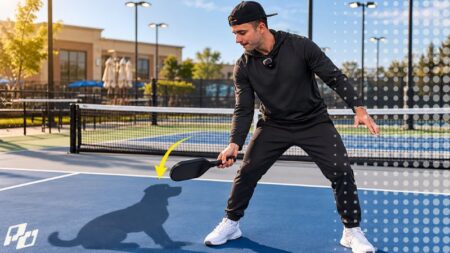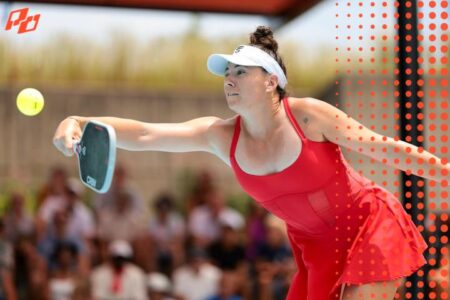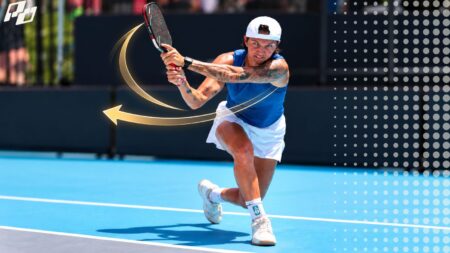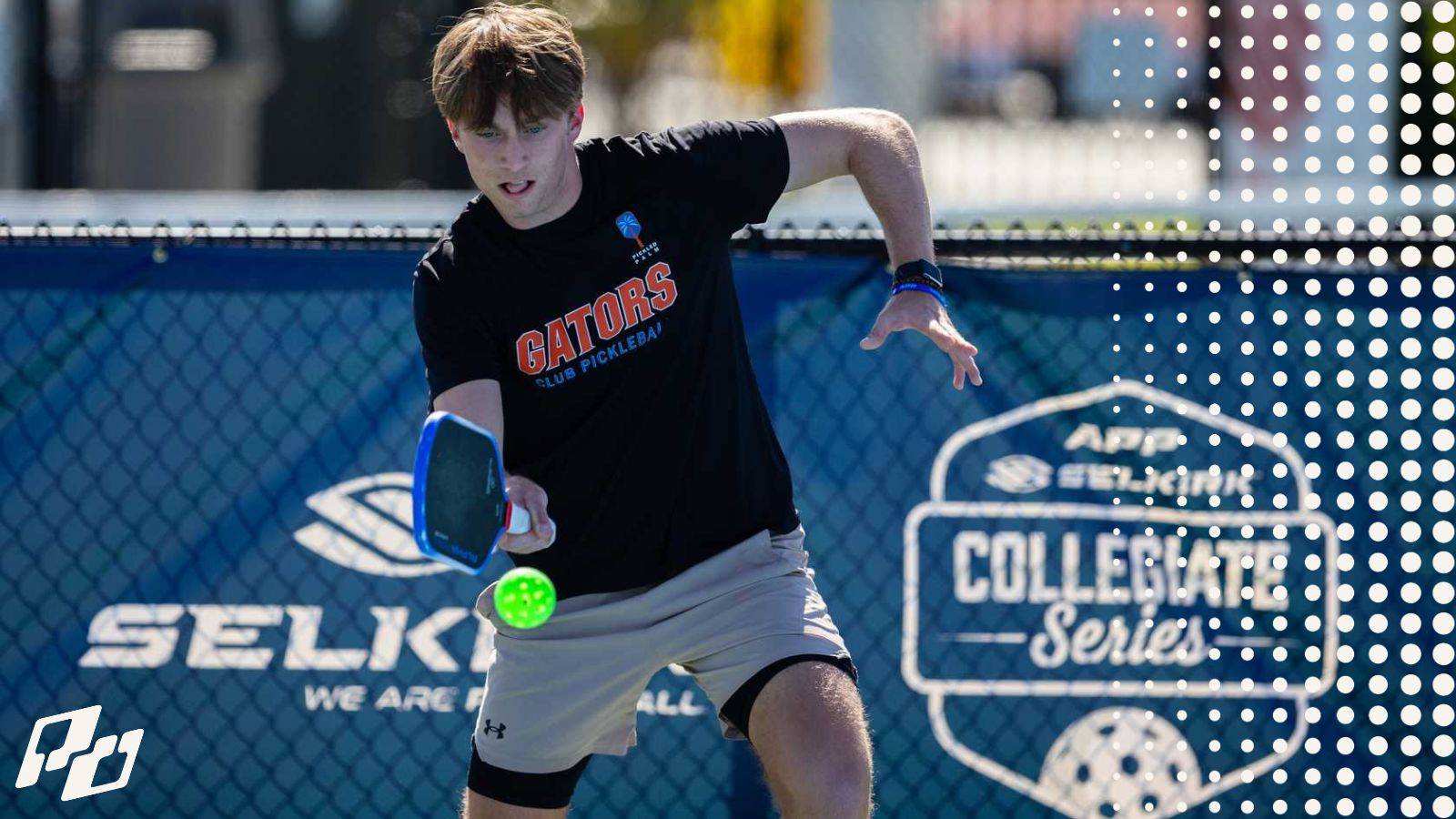
In pickleball, you should stabilize your wrist on control shots like dinks, resets, and counters by setting the angle early and keeping it steady through contact. On power shots like drives and serves, natural wrist lag can occur, but it shouldn’t be forced with a snap. Reducing unnecessary wrist movement improves consistency and control.
There’s one technical tip that improves almost every shot in pickleball — dinks, resets, counters, drives, even speed-ups — and most recreational players overlook it.
➡️ Stabilize your wrist.
➡️ Not lock it. Not snap it. Not flick it at the last second.
➡️ Stabilize it.
The problem is that wrist advice in pickleball is confusing. Players hear “use more wrist for power” and “keep your wrist firm for control” — without understanding when each applies. The result? Inconsistent contact, unpredictable paddle face angles, and shots that feel different from rally to rally.
In this guide, we’re going to clear up the confusion. We’ll break down what wrist stability actually means, how it differs from true wrist lag, when each belongs in your game, and how to apply both without sacrificing consistency or power.
The #1 Wrist Tip in Pickleball: Stabilize It
Not “lock it like a cast.” Not “freeze it.” Stabilize means: pick your wrist angle early, then keep that angle quiet through contact.
Why this matters: the paddle face is basically a steering wheel. If your wrist is moving (flexing, cupping, flicking) during contact, your paddle face is changing during contact. That’s how you get the classic rec-player miss pattern:
- one ball pops up
- next ball dumps in the net
- next ball sails long
…and you swear it’s your paddle.
It’s usually not the paddle. It’s wrist noise.
What “stable wrist” actually looks like
A stable wrist has three properties:
- Set early (before the ball arrives)
- Quiet through contact (no last-second flip)
- Same face angle after contact (the follow-through matches the intention)
This becomes especially clear on dinks: whether you’re lifting, pushing, slicing, or rolling for topspin, the wrist should remain stable before, during, and after contact.
Spin doesn’t come from a last-second wrist snap — it’s generated by the swing path of the shoulder and arm. Coach Jordan Briones demonstrates exactly how to create that controlled, repeatable brush without relying on wrist flip:
The Big Confusion: “Stable Wrist” vs “Wrist Lag”
Here’s the truth that clears up 90% of the internet arguments:
➡️ Stable wrist is a control concept.
➡️ Wrist lag is a power/acceleration effect.
They are not opposites. They’re different tools for different jobs. If you only remember one line from this article, make it this:
At the kitchen: stabilize the wrist. From the baseline: allow lag, but don’t manufacture it.
Let’s break that down.
Part 1 — Why Wrist Movement Wrecks Rec-Player Consistency
1) The ball is too close, too fast, too reactive
At the kitchen, you’re often contacting the ball close to your body with tiny margins. The ball also arrives with weird variables: pace, spin, skid, and “emergency contact” situations.
When your wrist is flippy, your paddle face becomes a moving target.
That’s why players who “feel athletic” still miss easy kitchen balls. Athleticism makes you faster—but it also makes your wrist more tempted to improvise.
2) Wrist timing is a high-skill demand
A wristy shot can feel amazing… the one time you time it perfectly. But consistency comes from repeatable geometry—stable face + consistent swing path.
The idea is simple: more wrist can create highlight shots, but it also raises your miss rate — especially on dinks, counters, and pressured speed-ups — because you’re relying on perfect timing instead of stable mechanics.
3) Injury risk rises when you combine: tight grip + lots of wrist
If you’re squeezing the handle and repeatedly cranking the wrist, your forearm extensors get cooked.
That’s one reason “pickleball elbow” shows up so often in players who are muscling the ball with the wrist and grip. (Harvard Health has a good explanation of the overuse mechanism.)
Part 2 — How to Stabilize Your Wrist (Without Becoming Stiff)
Step 1: Pick your “default wrist shape”
Most rec players do best with a slightly extended wrist (think: “firm handshake”), not a collapsed, cupped wrist.
- Too cupped (flexed): paddle face tends to open/close unpredictably; dinks pop up
- Too rigid/locked: you lose touch and absorbency; blocks fly
A great mental cue:
➡️ “Quiet wrist, active shoulder.”
You still swing. You just swing from the bigger hinge.
Step 2: Use “set → hit” sequencing
This is huge, and it’s straight out of the attached content:
- Set the wrist angle before the ball arrives
- Then hit with a small shoulder/arm motion
- Avoid snapping at contact
If you want a super practical test: freeze your paddle right at contact in a slow-motion video.
If your wrist is changing shape at the hit, you’re gambling.
Step 3: Grip pressure that matches the shot
This is where players get it backwards:
- They grip too tight on soft shots
- Then too loose on hard counters
- And the wrist becomes chaotic in both cases
A nice way to think about it:
- soft game: light-to-moderate grip (enough stability to keep face predictable)
- fast exchanges: slightly firmer (enough to prevent the paddle from twisting)
Part 3 — “Stable Wrist” by Shot Type (What You Actually Do in Games)
Dinks (open, push, slice, topspin)
Your job is repeatability: same contact point, same face control.
- Stable wrist = consistent launch angle
- Spin comes mostly from brush path, not wrist gymnastics
If your topspin dink disappears when you stabilize your wrist, that’s a sign you were getting “spin” from last-second wrist flip—high variance, low trust.
Resets (midcourt or kitchen)
This is the most “stable wrist” shot in pickleball.
When the ball is coming hot and you’re just trying to neutralize, any wrist motion changes the paddle face and turns a reset into a lottery ticket.
Think: guide + absorb, not “swing.”
Counters
Counters are where wrist overuse punishes people the most. Why? Because counters happen at high speed. If your wrist is late by a fraction, you dump it. If you’re early, you pop it.
A better model:
- punch with the shoulder/upper arm
- wrist stays set
Speed-ups
Here’s the nuance most people miss: there are two categories of speed-ups.
Category A — “Pressure speed-up” (opponents in transition / ball sitting up)
These should be arm-driven more often than not:
- longer, cleaner swing
- stable wrist
- controlled face
Category B — “Flick speed-up” (tight hands battle, small window)
This is where some wrist can appear—but it’s still not a sloppy snap.
It’s usually a pre-set wrist angle + quick forearm/hand action:
If you’re a 3.0–4.0 player trying to win more points fast, stabilize first. Flick later.
Part 4 — A Simple “Wrist Decision Tree” You Can Use Mid-Point
Ask yourself one question: Am I absorbing/control-resetting… or accelerating/attacking?
If you’re absorbing / defending:
- stabilize the wrist
- shorten the swing
- guide the ball
- prioritize shape and height over pace
If you’re accelerating / attacking:
- allow lag (don’t force it)
- keep contact in front
- use unit turn + body
- keep the face predictable through contact
That’s it. That’s the whole game.
Troubleshooting: If You “Stabilize the Wrist” and Still Miss
“I stabilized and now everything goes into the net.”
Usually: your paddle face is too closed or you’re contacting too far out in front with no lift.
Fix: keep wrist stable, but add:
- slightly more knee bend
- slightly more upward swing path on soft shots
“I stabilized and now everything floats high.”
Usually: you stabilized in a cupped position (face too open) or your grip is too loose under pace.
Fix:
- set wrist to a firmer handshake position
- slightly firmer grip on counters/blocks
“When I stop using wrist, I lose topspin.”
That’s a sign your “topspin” was mostly wrist flip.
Fix:
- focus on brush path (low-to-high) and contact out front
- let forearm rotation support spin, not wrist snap
Most rec players don’t need “more wrist.” They need less emergency wrist.
Stabilizing your wrist isn’t about playing safe or soft. It’s about building a paddle face you can trust—so when you do accelerate (and allow lag), you’re doing it from a stable platform instead of chaos.