A pickleball tweener is a last-resort shot used when a lob gets behind you. Let the ball drop to knee height, swing upward between your legs, and keep moving for balance. Focus on getting it back in play—usually as a soft lob—rather than hitting a winner.
Let’s clear this up right away. The tweener — hitting the ball between your legs while chasing it down — is not a “you need this to level up” shot.
You are not losing matches because you can’t hit a tweener.
But…
If you’ve ever been lobbed, sprinted back, realized you’re about to get burned, and thought “I have no good option here” — that’s exactly where this shot lives.
The tweener is not about showing off.
It’s about buying yourself one more chance in a point you were about to lose.
And once you understand it that way, it actually becomes a lot more interesting — and a lot more useful.
Why This Shot Exists at All
In pickleball, most lobs that beat you are not about speed. They’re about positioning and timing.
- You’re at the kitchen.
- You’re leaning forward.
- The lob goes over your head.
- You turn late.
- Now you’re chasing.
At that moment, you’re in what I call a “recovery race”:
- Can you turn your body, get behind the ball, and hit a normal shot?
- Or are you going to arrive too late and too off-balance?
The tweener only shows up when the answer is:
⮕ “I’m not getting there in time to do this properly.”
So instead of trying to fix a bad situation with perfect technique, you switch to: imperfect technique that still keeps you in the rally
That’s the real role of the tweener.
The Big Misconception (And Why Most Players Miss It)
Most rec players think the tweener is about hitting a crazy shot. It’s not.
It’s about timing your body to the ball when you’ve already lost ideal positioning.
That’s why when you watch someone learning it, the struggles are always the same:
- “Why am I not getting it over?”
- “Why does it feel awkward?”
- “Why am I missing contact?”
Because they’re trying to treat it like a normal swing. It’s not a normal swing.
It’s a moving, transitional contact point underneath your body. And that changes everything.
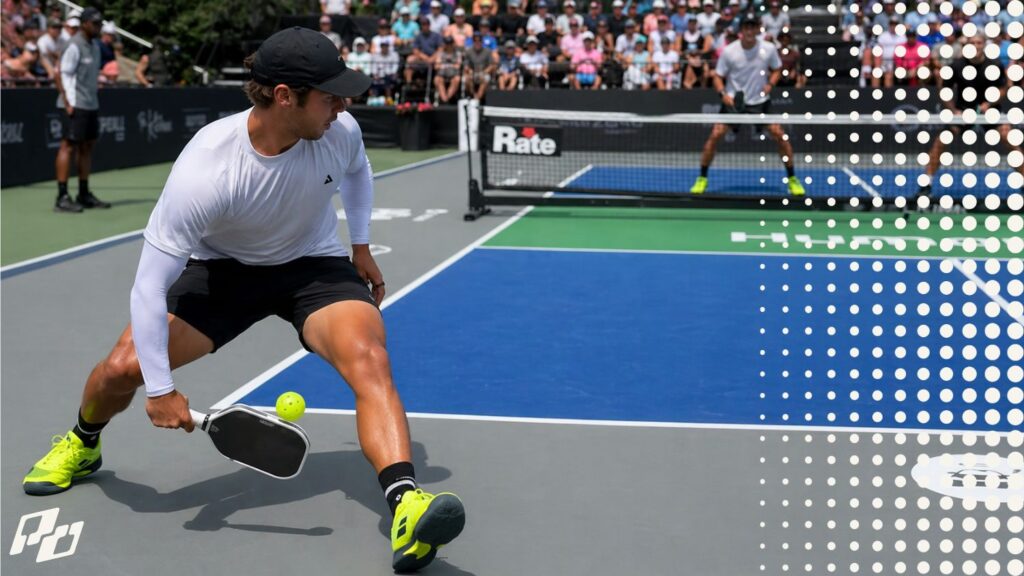
Watch how Ben Johns pulls it off:
The One Concept That Makes This Shot Work
If you only take one idea from this entire article, make it this:
👉 You do not chase the ball with your paddle. You get your body to the ball and let it drop under you.
That sounds small, but it changes everything.
Your instinct is usually to sprint back, reach behind you, and try to flick the ball before it gets too low. That is what makes the tweener feel rushed, awkward, and dangerous.
Instead, the better sequence is:
You chase the lob.
You get your body positioned over the dropping ball.
You let the ball fall low enough for a fully extended arm.
As your trail leg comes through, you swing between your legs.
Then you keep moving through the shot.
So the cue is not: “Run past the ball.”
The cue is: “Get over it, let it drop, then swing through.”
Once you understand that, the tweener stops feeling like a wild trick shot and starts feeling like a timed recovery move:
What the Timing Actually Feels Like
Let’s make the footwork simple.
As you chase the lob, you want to arrive with the ball dropping under your body, not behind your heels and not too far in front of you.
For a right-handed player, the timing often feels like this:
Right foot steps first.
Left foot comes through.
Swing as that left leg is moving forward.
That is the moment when your legs naturally open a window for the paddle to swing through.
The cue is:
⮕ “Step, let it drop, swing.”
If you swing too early, you usually miss or hit the ball into your leg.
If you swing too late, the ball is already behind you.
If you stop your feet, you lose balance.
The goal is not to freeze and hit a perfect shot. The goal is to time the swing with your stride so the ball is low, under you, and reachable.
Why Most Balls Go Straight Into the Net
If you’ve ever tried this shot, you already know the most common outcome:
👉 Ball straight into the net.
That is not bad luck.
That is mechanics and timing.
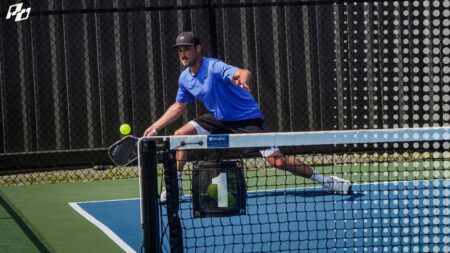
The tweener only has a real chance if the ball is in the right window. You need to get to the ball first, then wait until it has bounced, risen, and started to come back down. For most rec players, the best contact point is around knee height or slightly lower, not up near your waist and not already behind your heels.
That timing matters because your paddle has to move upward through the ball.
If you swing flat, the ball drives forward and dies into the net.
If you swing downward, it has almost no chance.
If you hit it too early, while it is still rising, the contact usually feels rushed and awkward.
The fix is simple, but not easy:
⮕ Let it drop, look at the contact, and swing up.
Not a giant scoop.
Not a wild flick.
Just enough upward paddle path to lift the ball back over the net.
Think: “Wait for the drop, then lift it over.”
What You Should Actually Be Trying to Hit
This is where expectations matter. You are not hitting a winner here. You are not threading a passing shot.
You are trying to:
👉 Reset the rally
The best version of this shot for rec players is:
- a soft lob
- or a high, safe return
Something that gives you:
- time to turn around
- time to get back into position
- time to breathe
If you try to be aggressive here, you’re playing the wrong game.
The Part Nobody Talks About: Staying on Your Feet
Let’s talk about the real risk — because it’s not just missing the shot.
⮕ It’s losing your balance.
On a tweener, you’re chasing a lob, adjusting your steps, letting the ball drop under you, and swinging between your legs while your body is still moving. That is a lot to ask of your balance.
The key is to stay controlled, but not frozen.
Where players get into trouble is when they sprint back, suddenly plant, bend awkwardly, and try to “save” the shot from a dead stop. That hard stop can throw your weight backward or sideways, which is where slips, stumbles, and ugly falls happen.
Instead, think of the tweener as a moving recovery shot.
Get to the ball, let it drop, swing up through it, and then keep your feet moving after contact. You do not need to sprint wildly through the shot, but you also do not want to lock your body in place.
A good cue: “Control your steps, then flow through the swing.”
When You Should Actually Try It (Real Match Situations)
Let’s make this practical. You should consider a tweener when:
- the lob has already beaten your shoulder turn
- you’re running straight back, not at an angle
- the ball is dropping just behind your stride
- turning would cost you the shot entirely
👉 In other words: You are already late.
That’s the green light.
When You Should Not Even Think About It
This is where discipline matters. Most rec players try this shot way too early.
If you can:
- turn your shoulders
- get behind the ball
- set your feet
Then do that. Every time. Because a normal overhead or forehand is:
⮕ easier
⮕ safer
⮕ and far more effective
The tweener is what’s left when those options are gone.
The Smarter Alternatives (What Better Players Do First)
Here’s the reality: better players rarely need tweeners because they manage the lob earlier.
They:
- recognize the lob sooner
- turn earlier
- take better recovery angles
So before you get excited about learning this shot, make sure you’re also working on:
⮕ early shoulder turn
⮕ crossover steps instead of backpedaling
⮕ tracking the ball sooner
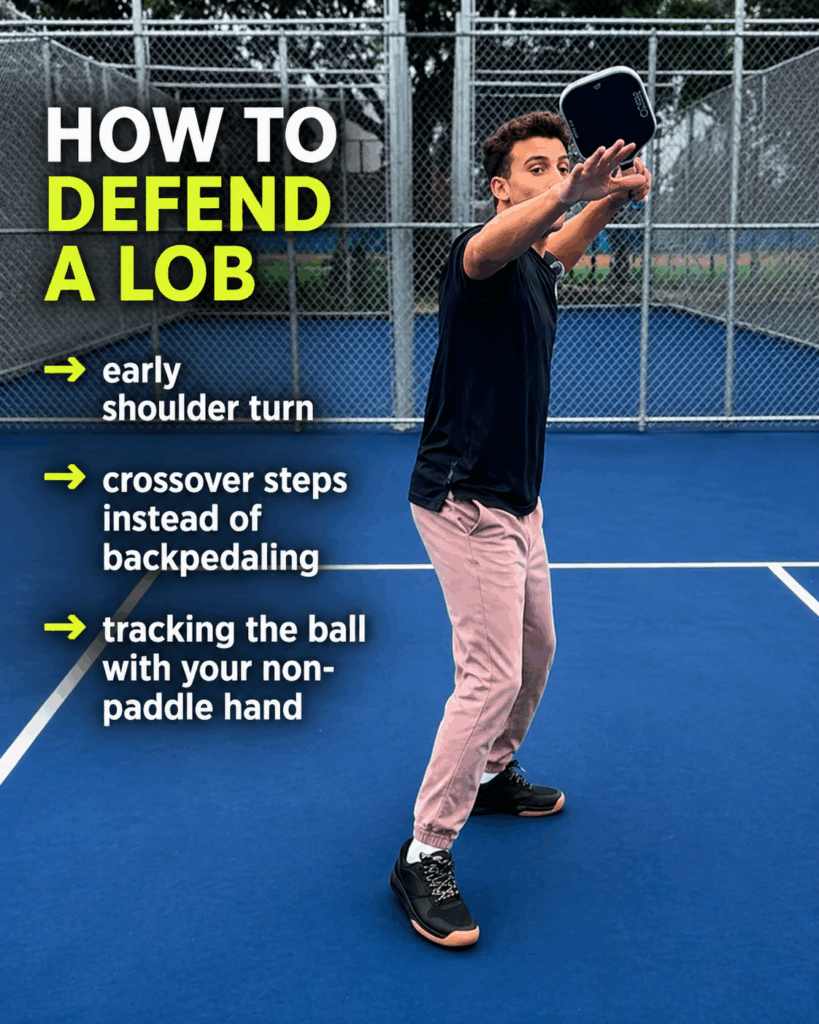
The tweener is not a substitute for those skills. It’s a backup.
Why It’s Still Worth Learning
So if it’s rare, risky, and low-percentage… why learn it? Because it teaches things that actually transfer:
- timing under pressure
- coordination while moving
- staying loose in chaos
- recovering from bad positions
And those skills show up everywhere in pickleball.
Also… let’s be honest: It’s fun.
And every once in a while, you’ll hit one clean and surprise everyone — including yourself.