The lob serve is a legal, tactical serve that changes timing and contact height rather than relying on pace. It's most effective against players who step in early, attack returns aggressively, or struggle with high bounces. Use it as a changeup inside a varied serve pattern. Spamming it every point makes it predictable and easy to adjust to.
There are few things rec pickleball players love more than calling a legal shot “annoying.”
Drives are too hard. Drops are too soft. Slices are “junk.” Lobs are “cheap.” And now, apparently, the lob serve has entered the courtroom.
So let’s settle it clearly: A lob serve is not toxic.
But using it without awareness can absolutely make you the player people quietly avoid. That distinction matters.
Because the lob serve is not some fake pickleball trick. It is a real tactical serve. It changes timing, changes eye level, changes the receiver’s contact point, and can make an aggressive returner uncomfortable before the point even begins.
At higher levels, players are not using high, deep, spinny serves because they are trying to be cute. They are using them because a serve does not need to be fast to be disruptive.
But rec pickleball is also not a sterile tournament lab. It is a weird mix of competition, social rhythm, age gaps, skill gaps, court limitations, ego, and unwritten etiquette. That is why the lob serve can be completely fine in one game and obnoxious in another.
First, Let’s Be Clear: The Lob Serve Is Legal If the Serve Motion Is Legal
There is no special rule that says a serve cannot be high, deep, slow, loopy, or uncomfortable.
The serve still has to follow the normal serve rules. If you use a volley serve, the paddle must be moving in a clear upward arc, the paddle head must clearly not be above the wrist at contact, and the ball must clearly be no higher than the waist at contact.
If you use a drop serve, you drop the ball from a natural height, let it bounce, and then hit it. The ball also has to land in the correct diagonal service court and clear the non-volley zone.
A legal lob serve is no more “toxic” than a deep topspin serve, a slice return, a third-shot drive, or a dink to someone’s weaker side. Pickleball is a game of creating discomfort. The whole point of strategy is to give your opponent a ball they would rather not hit.
But there is a difference between creating discomfort and creating a bad game. That is the line rec players need to understand.
Why the Lob Serve Actually Works
The lob serve works because it attacks timing more than speed.
Most rec players are used to seeing serves on a flatter, more predictable path. They set up, track the ball, swing through it, and move forward. A good lob serve interrupts that routine. It hangs longer. It drops later. It may bounce higher than expected. If it has topspin, it can jump deep and push the receiver backward or jam them near the baseline.
That creates several problems at once.
The receiver has to decide whether to let the ball drop, take it on the rise, short-hop it, slice it, or back up and reset their spacing. That decision sounds simple until the ball is bouncing shoulder-high near the baseline and the receiver is already thinking, “I need to get to the kitchen.”
That is the hidden value of the lob serve: it makes the returner late in their brain before they are late with their paddle.
And against aggressive returners, that matters. Just ask Anna Leigh Waters who uses the lob serve on a regular basis:
A lot of 3.0 to 4.0 rec players love ripping returns. They see a normal serve, step into it, drive hard, and immediately pressure the serving team. A good high, deep serve can take away that comfortable forward move. It can force them to hit from deeper, swing from a less familiar height, or return with less clean weight transfer.
That does not mean the lob serve is magic. It means it is a useful changeup. The word “changeup” is important.
If you throw it in at the right time, it can be frustrating in a smart way. If you use it every single serve, it often becomes predictable, boring, and eventually punishable.
The Big Misunderstanding: “Slow” Does Not Mean “Easy”
This is where a lot of rec players misread the shot.
A lob serve looks generous because it is not screaming through the court. It can look like you are giving the receiver more time. But more time is not always more comfort.
A slow ball with a normal bounce can be easy.
A slow ball that lands deep, kicks high, and forces contact from an awkward body position is not easy.
@sheaunderwood Try These Lob Serve Strategies! #pickleball #selkirksport #selkirk #selkirkedit #wearepickleball ♬ original sound – Shea
That is why some players feel disrespected by it. They think, “Are you giving me a beginner serve?” But the ball is not actually a gift if it makes them move backward, contact late, or return short.
This is also why the lob serve can feel weird socially. A hard serve looks competitive. A high serve can look patronizing, even when it is tactically sharper.
So the server’s intention and the receiver’s perception can be completely different.
The server thinks: “I’m changing timing.”
The receiver thinks: “You’re messing with me.”
Both can be true in rec play.
My Opinion: Use the Lob Serve, But Don’t Build Your Whole Identity Around It
Here is the honest take: Every rec player should have some version of a high, deep serve.
Not necessarily a cartoonish moonball. Not necessarily a full lob that scrapes the lights. But a serve that climbs, lands deep, and makes the receiver uncomfortable above the strike zone.
That serve is especially useful against players who love to attack returns early, players who crowd the baseline, players with compact tennis-style drives, and players who get impatient when the ball takes longer to arrive.
But if your entire serving strategy is “lob, lob, lob, lob, lob,” you are not being clever anymore. You are being narrow.
And narrow strategies have two problems.
First, better players adjust. Once they read the bounce, they can take it early, slice it deep, drive it off the high bounce, or simply return it safely and get to the kitchen with no panic.
Second, rec players get bored. That may sound soft, but it matters. Open play is partly competitive and partly communal. If every point starts with the same awkward, slow, high ball, some players will not think, “Wow, what a tactician.” They will think, “This is not fun.”
That does not mean you owe everyone their preferred game style. But if you want repeat games, good partners, and better competition, you should care about the quality of the game you create.
The best players do not spam one annoyance. They build pressure through variety.
When the Lob Serve Is Smart
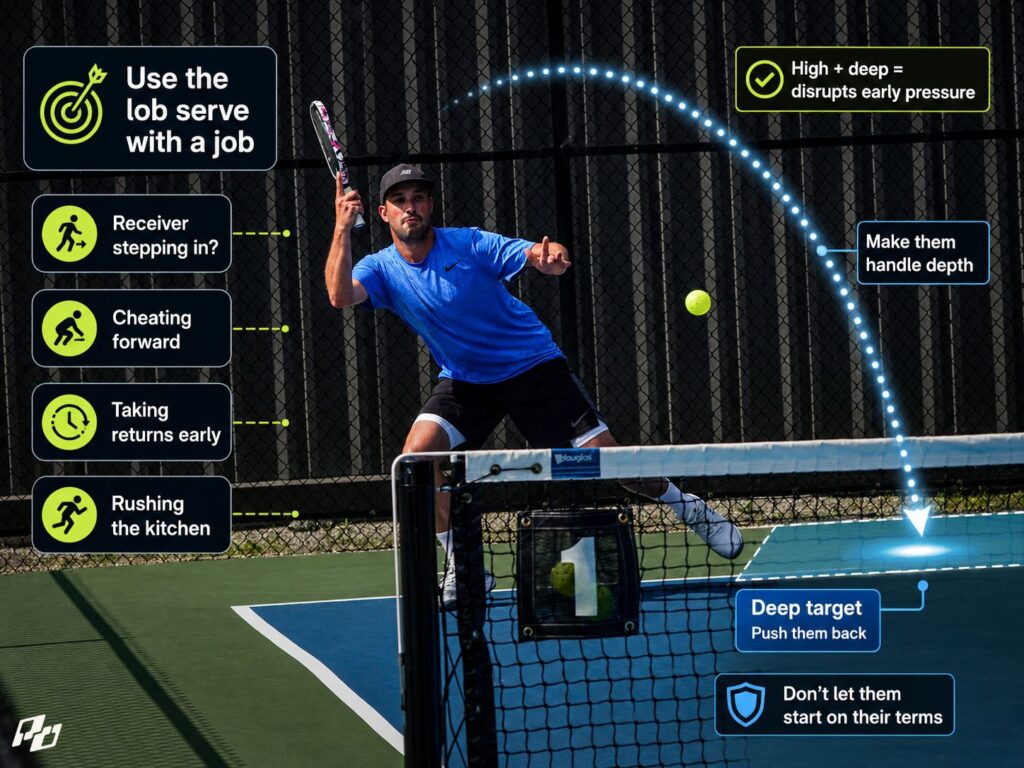
The lob serve is smart when it has a specific job.
Use it when the receiver is stepping in too aggressively. If they are cheating forward, taking returns early, and rushing the kitchen before the ball has really arrived, make them prove they can handle depth. A high, deep serve says, “You don’t get to start the point on your terms every time.”
Use it when the receiver’s return contact is too low and too flat. Some players are comfortable driving waist-high balls but much less comfortable hitting from shoulder height or from a falling contact point. A lob serve can move the return out of their favorite window.
Use it when you want a weaker third shot opportunity. This is the real goal. You are not trying to ace people. You are trying to produce a return that is shorter, floatier, more rushed, or less angled. If your lob serve creates an easier third shot, it is working.
Use it when the receiver has poor spacing discipline. Some players panic when the ball pushes them back. They backpedal, get tall, swing late, or return off balance. That is not a reason to humiliate beginners, but in competitive play, it is absolutely something to notice.
Use it as a score-pressure serve. At 8-8, 9-9, or side-out points, a new trajectory can make a receiver think too much. The lob serve is often most valuable when the opponent has not seen it for several points.
The cue is simple: Use the lob serve to disrupt a pattern, not to replace your whole serve package.
When the Lob Serve Becomes Bad Rec Play
The lob serve becomes questionable when the point is no longer about strategy and starts becoming about mismatch abuse.
If you are playing a new player who cannot read depth, cannot move backward safely, or is just trying to learn how to return consistently, spamming lob serves is not impressive. It is like body-bagging someone who barely knows ready position. Legal? Sure. Useful for the room? Not really.
The same applies in mixed-level open play where the goal is clearly social. If the court has beginners, older players with limited mobility, or people who did not sign up for competitive ladder-style play, you need more judgment.
That does not mean baby the ball. Nobody likes being patronized either. But there is a middle ground between “I will donate every point” and “I will repeatedly exploit the one movement pattern this player cannot safely handle.”
The best rec players know how to compete without making the game miserable. That is a skill too.
A good standard is this: If the group is competitive, leveled, and score-focused, use your weapons.
If the group is mixed, social, and clearly not built around results, use the lob serve as a changeup, not a punishment.
If the opponent physically cannot deal with it safely, stop using it as a main tactic.
And if someone complains only because they dislike being challenged? That is different. You are not responsible for protecting another player from every uncomfortable legal shot.
The Court-Space Factor Nobody Talks About Enough
A deep lob serve is much more annoying on courts with limited space behind the baseline.
On a proper court with enough room, the receiver can back up, let the ball drop, and choose a sane return. On cramped gym courts, converted tennis courts, crowded indoor facilities, or courts with fences close behind the baseline, that same serve can become much nastier.
This is one of the few situations where the “annoying” complaint has real merit.
If a high, deep serve forces someone into a fence, wall, curtain, bench, or another court, the problem is not just skill. It is environment. Yes, players still need to adapt. But rec players should not pretend court geometry does not matter.
So here is the practical rule: The tighter the backcourt, the less often you should use the extreme version of the lob serve in casual play.
You can still serve high and deep. But maybe do not aim for a ball that kicks shoulder-high into a fence three feet behind the baseline.
That is not toughness. That is using the facility as your doubles partner.
What Different Rec Levels Should Do
Use the lob serve differently as you move up levels: beginners should use it to learn depth and spacing, intermediate players can use it to disrupt timing, and advanced players should treat it as a selective pattern-breaker, not a default serve:
| Level | If You’re Serving | If You’re Receiving | Key Cue |
|---|---|---|---|
| 2.5–3.0 | Use it as a controlled depth tool, not a trick shot. Aim for the back third and prioritize repeatable placement over height or spin. | Do not rush forward early. Track the bounce, stay behind the ball, and return deep. | Calm spacing beats panic swings. |
| 3.0–3.5 | Use it to test spacing against players who step in early, crowd the baseline, or only like waist-high returns. Go deep middle, high backhand, or body-line. | Do not attack just because the ball is high. Take pace off, aim middle-deep, and deny the server a short return. | A high ball from deep is often a trap. |
| 3.5–4.0 | Use it inside a serve pattern: pace to height, wide to middle, body to high backhand. The goal is a weaker return and cleaner third shot. | Adjust early, stay balanced, and return with depth before trying to punish it. | Steal balance, don’t donate rhythm. |
| 4.0+ | Use it sparingly and with quality. Depth matters more than height, spin more than float, disguise more than drama. | Short-hop it, slice it deep, drive only when balanced, or lob-return it back. Make it unprofitable. | Force a decision, not just a high bounce. |
How to Hit a Better Lob Serve Without Making It a Gimmick
The mistake most rec players make is thinking the lob serve is about height. It is not. It is about depth, bounce behavior, and receiver discomfort.
A good lob serve should land deep enough that the receiver cannot step forward comfortably. It should have enough shape to change the contact height. And ideally, it should have enough spin or directional intent that the ball does not just sit up like a practice feed.
Here are the non-obvious details that matter.
Your target should be the last few feet of the service box, but not the actual baseline every time. If you aim only for the line, you will miss long too often. Give yourself margin. A serve that lands two feet inside the baseline and climbs is often better than a serve that misses long while trying to be perfect.
Your contact should feel lifted but not lazy. If the ball floats without spin, better players will have time to organize. If the ball climbs with topspin, it feels heavier after the bounce.
Your finish should send the ball through the court, not just up. The worst lob serves go high but land short. That gives the receiver time and forward momentum. The better version goes high enough to change eye level but still drives deep enough to hold the receiver back.
Your best target is often not the sideline. It is the deep middle or the receiver’s uncomfortable shoulder-side bounce. Wide lob serves can be useful, but they also create sharper return angles if the receiver handles them well. Deep middle serves reduce angles and create indecision.
And most importantly, your lob serve should have a purpose before you hit it.
Do not think: “I’m going to lob serve.”
Think: “I want this returner contacting late and high on the backhand side.”
That is a real plan.
The Etiquette Rule Rec Players Actually Need
Here is the cleanest way to think about it:
In competitive play, make them solve it.
In social play, do not make one weakness the whole game.
That is not softness. That is court awareness.
If you are in a rated ladder, league, tournament, or serious 3.5+ open play, opponents should expect legal pressure. If they cannot return a lob serve, that is information. Use it.
If you are in a mixed beginner/intermediate open play session, use more judgment. You can still use the serve, but you do not need to turn every point into a referendum on someone’s mobility, timing, or inexperience.
The same principle applies to drives, speedups, lobs, targeting, and body shots. Legal shots can still be poor choices in the wrong setting.
Strong rec players understand the difference between playing to win and playing like the only person on the court whose experience matters.