

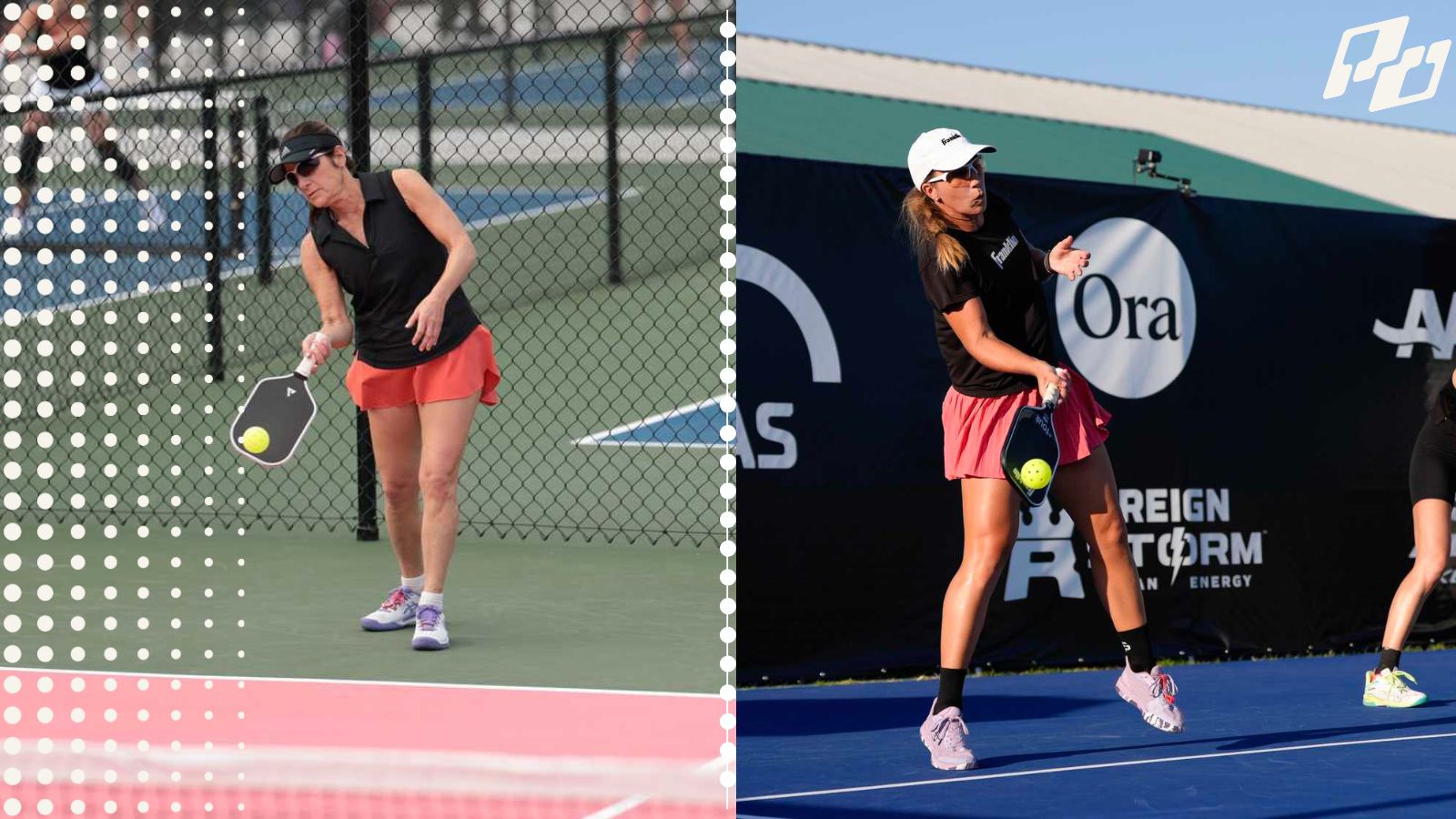
Let’s be honest: most rec players treat the serve like a formality. Tap the ball over, shuffle in, and hope for a playable third shot. But at higher levels, the serve isn’t just a box to check; it’s a setup shot. And at the pro level, it’s practically a weapon.
So what exactly separates your average Saturday-morning serve from what we see on the pro circuit?
First, the Ground Rules (Per the 2025 USA Pickleball Rulebook)
Whether you’re at a rec center or playing for prize money, every legal serve must follow these rules:
- Paddle contacts the ball at/below the waist (navel) — volley serve only.
- Arm is moving in an upward arc — volley serve only.
- Paddle head is below the wrist at contact — volley serve only.
- Or use a drop serve — strike after a bounce; the three motion limits above don’t apply.
- Feet at contact — at least one foot on the playing surface behind the baseline; neither foot may touch the court on/inside the baseline or outside the serving area.
- Placement — the serve must land diagonally in the correct box and clear the NVZ and its line (it may land on other service-court lines; the NVZ line is short).
- Ball release — you may release the ball by hand or paddle, but you can’t manipulate or pre-spin it during the release (natural rotation is fine). For a drop serve, you may let the ball roll off the paddle by gravity.
Now that we’re playing by the book, let’s talk about how the intent behind the serve radically changes from rec to pro.
What You See at the Rec Level (and Why It’s Not “Wrong”)
At most local games, the serve follows a familiar pattern:
- Light pace.
- Not particularly deep.
- Some occasional side spin.
- Zero pre-serve routine.
- Zero target selection.
It’s not necessarily bad—it’s just under-leveraged. Against beginner or intermediate players, these serves often work just fine. But against stronger competition, they quickly get exposed.
Why?
Because better players pounce on short or floaty serves. If you don’t back them up with depth or disguise, they’ll push you into a defensive position before you’ve even hit your third shot.
What You See at the Pro Level (and Why It’s Intentional)
Pro-level serves aren’t flashy—they’re purposeful. They are:
- Deep, often within a foot of the baseline.
- Topspin-heavy to increase margin while kicking deep. That extra kick buys you a half-step for a stronger third shot.
- Unpredictable in location and speed.
- Biomechanically sound, powered from the legs and core.
- Rehearsed, with tight pre-serve routines to optimize consistency.
It’s not about hitting aces (which are rare in doubles). It’s about dictating the return—slowing your opponent’s transition to the kitchen, or forcing them into an awkward position to begin the point on your terms.
Watch Coach Shea Underwood demo beginner-to-pro serve mechanics in slo-mo:
The Power of the Pre-Serve Routine
If you want a consistent, powerful serve, start before you even touch the ball.
Why a Pre-Serve Routine Matters
Think of it like a basketball free throw or a golf tee shot. A consistent routine helps:
- Set your stance and foot positioning
- Regulate your breathing and tempo
- Trigger muscle memory
- Minimize nervous tension
Build Your Routine Like the Pros
Here’s a simple 4-step example modeled after players like Ben Johns and James Ignatowich:
- Bounce or drop the ball once or twice – sets timing.
- Look at your target area – pick a spot (e.g., backhand corner).
- Grip and paddle check – reset your hold, relax your shoulders.
- Exhale and initiate the serve with your chosen motion.
Timing cue: Start your motion on the end of your exhale—it steadies tempo and kills the yips.
How to Practice Like a Pro (Even If You’re Not One)
If you’re not practicing your serve… you’re just hoping it holds up. Here’s how to get better on purpose:
1. Target-Based Serving
Set up cones or markers:
- One deep to each corner.
- One body-width inside the centerline.
- One short just past the kitchen.
Try hitting each target 10x in a row without missing the service box. Then rotate paddle angles or spins while aiming for the same targets.
2. Practice in Sets
Just like a workout, group your serves:
- 20 deep topspin to backhand
- 10 short center serves
- 10 hard body serves
Why? To simulate actual match variety—and build muscle memory under fatigue.
3. Record and Review
Use your phone. Watch:
- Contact point (too low/high?)
- Paddle face (open/closed?)
- Serve depth
- Foot fault potential
Small tweaks (like a slightly more closed stance or relaxed wrist) can make a massive difference in your serve quality.
4. Mix Reps With Situational Practice
Invite a partner and call out return scenarios:
- “Return is aggressive and crosscourt—serve deep to body.”
- “Opponent hugging baseline—go short and soft.”
- “Lefty opponent—test their inside-out return.”
You’re not just grooving technique. You’re developing serve IQ.
What to Track to Know You’re Improving
Want a better serve? Don’t guess—track. Here’s what to monitor over time to pinpoint what’s actually improving and where you’re still vulnerable.
1. Serve-In Percentage (Accuracy)
What it tracks: How often your serve lands legally in the correct service box.
How to track: Tally total serves attempted vs. total legal serves. Break it down by serve type if you’re mixing styles.
Goal: Maintain 95–98% serve-in rate for your primary serve. If you’re trying more aggressive variations (e.g. power, angle, short drop serves), aim for 90–92% minimum.
| Serve Type | Attempts | In-Play | % In |
|---|---|---|---|
| Topspin deep | 20 | 19 | 95% |
| Short angle | 10 | 8 | 80% |
| Power flat | 15 | 14 | 93% |
2. Depth (Serve Effectiveness)
What it tracks: Where the serve bounces—short, midcourt, or deep (last 3 feet of the court).
Why it matters: Deep serves force weaker returns and buy you time to set up your 3rd shot. Midcourt serves are more likely to be attacked.
How to track: Use a visual cue or mark on the court (cones or tape). During practice, assign points:
- Deep (ideal)
- Midcourt (neutral/attackable)
- Short (danger zone)
Goal: 70%+ of serves should land deep (within 3 feet of the baseline).
3. Target Zone Accuracy (Placement Variety)
What it tracks: Where your serve lands: backhand, body, or forehand.
Why it matters: Varying location keeps opponents guessing and prevents them from camping on one return zone.
How to track: Keep a running tally of serve targets in a game or drill session.
| Target | Count |
|---|---|
| Deep backhand | 12 |
| Deep forehand | 6 |
| Body | 4 |
4. Return Quality Triggered by Serve
What it tracks: What kind of return your serve generates: weak, neutral, or aggressive.
How to track (per serve):
| Return Result | Definition |
|---|---|
| Weak | Short, floaty, or high return |
| Neutral | Deep and safe, but not aggressive |
| Strong | Deep with pace, pushes you back/side |
5. Serve Variety Used (Tactical Layering)
What it tracks: How many different serve types or speeds you use across a match or drill set.
Serve types could include:
- Topspin drive
- High loopy serve
- Soft short-angle serve
- Body serve
- Power flat serve
Why it matters: A predictable serve is easier to return. Variety forces hesitation, mistakes, and weaker contact.
Goal: Use at least 3 serve types or placements per match. Bonus: randomize your sequence.
6. Free Points Earned (Serve Payoff)
What it tracks: How often your serve directly gives you an advantage—or wins you the point outright.
Examples of free points:
- Ace – no return attempt
- Return Error – return goes into the net or out
- Short/Pop-up Return – sets up an easy third shot or putaway
- No Advantage – return is deep and neutral
Simple tally method (per serve):
| Symbol | Meaning |
|---|---|
| A | Ace |
| E | Return error |
| S | Short/pop-up return |
| N | No advantage (neutral return) |
Sample tracking line:S, N, E, N, A, S, S, N, E
Goal:
- Earn 1–2 free points per game via A (aces), E (errors), or S (short returns)
- More than 30–40% N’s (no advantage) may indicate predictable or ineffective serving
Quick Fixes (Fault-Finder)
1. Long
Cause: Face too open; contact too late.
Fix: Close the face 2–3° and make contact 2–3″ farther in front.
2. Short
Cause: Decel, low apex, weak leg drive.
Fix: Narrow your stance, aim 12–18″ higher over the net, and drive off the back leg longer.
3. Floaty
Cause: Flat hit; stiff wrist.
Fix: Add brush (topspin) with a relaxed wrist—don’t punch the ball.
4. Net tape
Cause: Aiming at the tape instead of creating an apex.
Fix: Pick a higher apex just past the net, not a deeper target.
Serve Like You Mean It
Here’s the truth: your serve is the only shot in pickleball you have total control over. It’s your chance to set the tone, shape the point, and force your opponent to react.
So why waste it?
Don’t settle for “just get it in.” Build a serve that earns you advantages—even if it’s just a slightly weaker return or a delay in their kitchen transition. That’s how the point begins to tilt in your favor.
Will you miss a few more serves as you push your ceiling? Sure. But you’ll also gain:
- Deeper returns
- More 3rd shot options
- Confidence at the line
- A noticeable rise in how your opponents treat your serve—with respect
You don’t have to serve like a pro to start thinking like one. Build a routine. Choose a target. Develop your spin. Practice with purpose.
And next time you step up to the baseline, don’t just serve.
Start the point with intent.