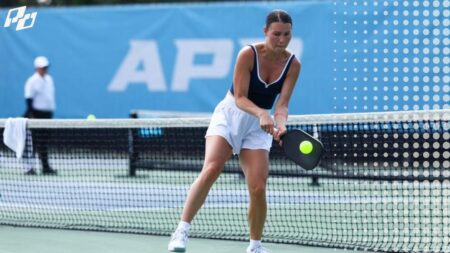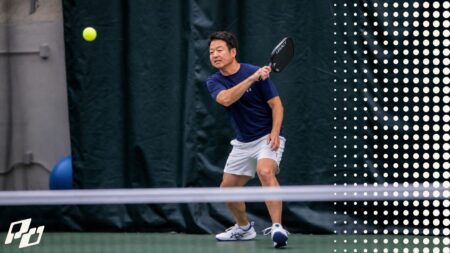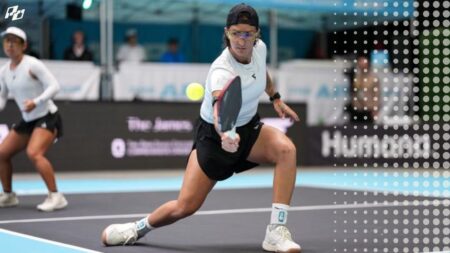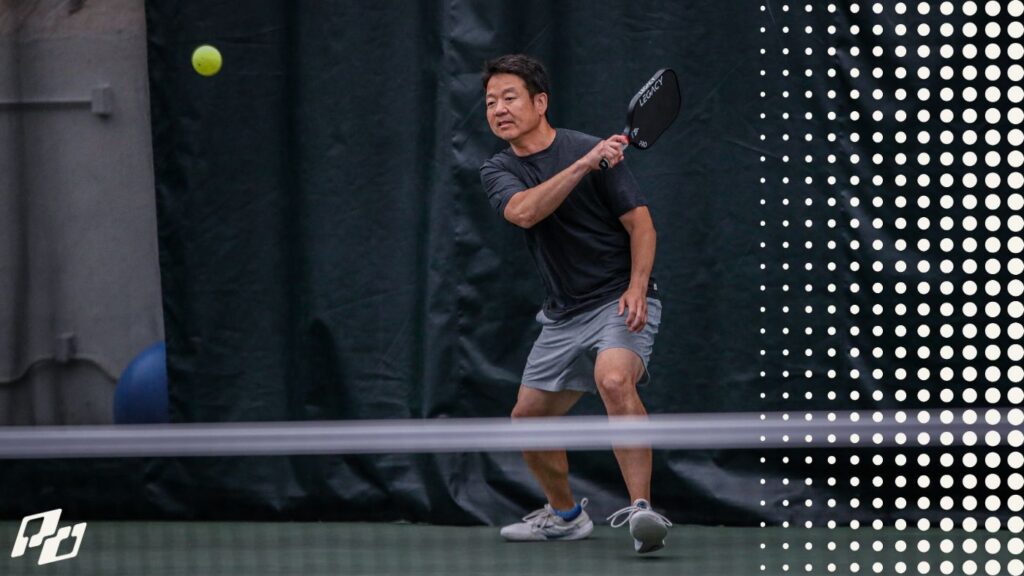
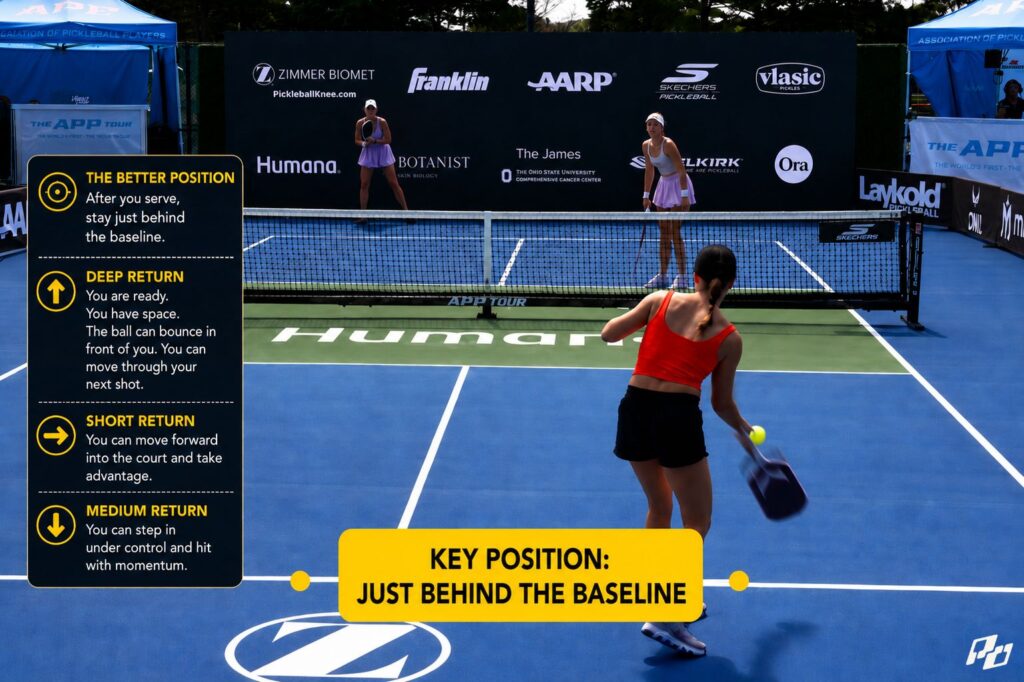
After serving in doubles pickleball, don’t rush inside the baseline too early. Stay just behind the baseline until you read the return. This keeps deep returns from jamming your feet, helps you stay balanced, and lets you move forward at the right time instead of guessing.
Most rec players have heard the same pickleball advice over and over:
Get to the kitchen.
Take the net.
Move forward.
And that advice is not wrong.
In doubles, you usually do want to work your way to the kitchen line. The problem is that a lot of players take that advice too literally right after they serve.
They serve the ball, then immediately start walking or running into the court.
At first, it feels like the right thing to do. You are being aggressive. You are taking space. You are trying not to get stuck at the baseline.
But if you move in too early after serving, you can create the exact problem you are trying to avoid.
A deep return comes back.
Now you are too far forward.
The ball lands near your feet.
You are caught on your back foot.
Instead of stepping into your next shot, you are reaching, leaning, or backing up.
That is why so many 3.0 and 3.5 players feel rushed after they serve. They are not always missing because their third-shot drop or drive is terrible. They are missing because they moved into the wrong spot before the return came back.
Good pickleball is not about getting forward as fast as possible. It is about getting forward at the right time.
Want the full picture first? Our pickleball serve guide covers the rules, the step-by-step motion and where to aim.
Why Players Rush In After Serving
This mistake usually comes from good intentions.
At the 3.0 level, players are starting to understand that the kitchen line matters. They have probably lost plenty of points from being stuck deep in the court. So once they serve, they feel like they need to start moving in right away.
At the 3.5 level, the mistake becomes even more common because players are more confident. They want to be aggressive. They want to pressure opponents. They want to play faster, stronger pickleball.
But here is the trap:
They confuse moving forward with being in control.
Those are not the same thing.
You can move forward and still be in trouble. In fact, after the serve, moving forward too early often makes you easier to attack.
The returning team wants to keep you back. A smart returner will hit deep because they know you have to let the return bounce. If you have already moved inside the court, that deep return does not need to be perfect.
It just has to land close enough to your feet to make your next shot uncomfortable.
That is why this mistake shows up so much around 3.0 to 3.5.
These players know the kitchen is important, but they have not fully learned the timing of how to get there.
Why Moving In Too Early Is a Problem
After you serve, the return must bounce before you can hit it. That means you cannot take the return out of the air and keep moving forward. You have to let it bounce first.
So when you serve and immediately walk or run into the court, you are gambling. You are hoping the return will be short enough or soft enough that your forward movement helps you.
But if the return is deep, your movement works against you. Now the ball is coming into your body instead of landing comfortably in front of you. You may have to stop suddenly, lean back, or take an awkward retreating step.
That is a terrible place to hit from.
A good next shot after the return needs balance. Whether you are hitting a drop, a drive, or a safer neutral ball, you need:
- Space between your body and the ball
- Your feet underneath you
- A contact point you can control
- The ability to move through the shot
When you are caught too far inside the court, you lose those things.
Your contact point gets crowded.
Your paddle swing gets rushed.
Your weight often falls backward.
Your shot choices shrink.
That last part is important.
When you are balanced, you have options. You can drop. You can drive. You can roll. You can step in on a short return and attack.
When you are jammed, you mostly just survive.
That is why this mistake costs so many points. It does not just make one shot harder. It takes away your ability to choose the right shot.
The Better Position After You Serve
The better move is simple:
After you serve, stay just behind the baseline until you read the return.
That does not mean you freeze.
⮕ It does not mean you stand flat-footed.
⮕ It does not mean you are playing scared.
⮕ It means you recover into a balanced position where a deep return cannot jam you.
Think of it as holding your ground for one extra moment.
You serve, then settle just behind the baseline with your weight balanced and your eyes on the returner.
From there, you can respond to the ball you actually receive instead of guessing.
- If the return is deep, you are ready. You have space. The ball can bounce in front of you. You can move through your next shot instead of falling away from it.
- If the return is shorter, you can move forward into the court and take advantage.
- If the return is medium depth, you can step in under control and hit with momentum.
That is the whole idea.
You are not refusing to move forward. You are earning the move forward.
The Cue That Fixes the Habit
Here is the cue I would give a 3.5 player:
Do not enter the court until the return lets you.
That does not mean you never step in. It means the return has to give you permission.
✔️ A short return gives you permission.
✔️ A weak floating return gives you permission.
✔️ A medium ball you can step through gives you permission.
X A deep return usually does not give you permission to keep drifting forward before you hit the next ball.
A deep return is telling you to stay balanced, keep space, and hit the next ball cleanly.
Another useful cue:
Make the return land in front of you, not under you.
If the return is landing at your feet, you are probably too far in. If it is landing in front of you and you can step into the ball, your spacing is much better.
That is the feeling you want.
A Common Rec Player Example
Let’s say you are playing at 3.5.
You serve deep to the returner’s backhand. Because the serve felt good, you immediately start moving forward.
The return comes back deep. Now you are stuck.
The ball is dropping near your feet, and you are still moving into the court. You try to hit a third-shot drop, but your body is not balanced.
The ball floats too high.
Your opponents attack.
You might think: “I missed the drop.”
But the real issue happened earlier. You gave up your baseline cushion before you knew where the return was going.
Now replay it the better way.
You serve deep, then recover just behind the baseline. You stay balanced and watch the return.
The return comes back deep.
This time, there is no panic.
The ball lands in front of you. You step through it and hit your next shot from a stable position.
Maybe the shot is not perfect. But it is playable. You and your partner can now work forward under control.
Same serve.
Same return.
Different position.
Completely different result.
But Shouldn’t You Be Trying to Get to the Kitchen?
Yes. You still want to get to the kitchen.
But you want to arrive there because your shot allowed you to move forward, not because you sprinted in before the rally developed.
This is one of the big differences between improving rec players and stronger players.
A 3.0 or 3.5 player often thinks:
“I served. Now I need to get in.”
A stronger player thinks:
“I served. Now I need to handle the return and earn my way in.”
That is better pickleball.
The kitchen is still the goal. But after serving, the return is the first obstacle. If you ignore that obstacle and rush forward, you often make the next shot harder than it needs to be.
What Should Your Partner Do?
This advice is mostly for doubles, and it applies to both players on the serving team.
After the serve, the server should not rush inside the baseline too early. But the server’s partner should not blindly charge forward either.
Because the return has to bounce, both players on the serving team need to respect a deep return. If the partner takes off too soon while the server is still handling a deep ball, the team can get stretched. One player is back, one player is moving forward, and the middle of the court becomes easier to attack.
The partner’s job is to read the return and the server’s next shot.
- If the return is deep and the server is under pressure, the partner should hold back and be ready to defend.
- If the server hits a controlled drop, both players can start moving forward together.
- If the server drives and forces a weak block, the partner can move in, but still under control.
- If the server’s shot floats high, the partner should stop instead of running into trouble.
A simple doubles rule is:
Move forward as a team, not as two separate players.
The kitchen is still the goal. But in doubles, arriving too early by yourself can be just as bad as staying back too long. Your partner’s shot has to give you permission to move, too.
A Simple Way to Practice It
In your next game, try this for one full game:
After every serve, stay just behind the baseline until you see the return.
Do not drift forward automatically.
Do not guess.
Just serve, hold your position, and read the ball.
Then react.
- If the return is deep, stay balanced and hit from space.
- If the return is short, move in.
- If the return is medium, step through it.
You will probably notice something right away: Deep returns feel less rushed.
That is the point. You are not making the opponent’s return worse. You are making your position better.
And when your position is better, your next shot gets easier.
Quick Self-Check
After you miss the ball following a serve, ask yourself:
Was I moving backward or leaning backward when I hit it?
If yes, there is a good chance you moved in too early after your serve.
You want the opposite feeling.
You want to be able to move forward through the ball, even against a deep return. That does not happen if you are already too far inside the court.
Another good self-check:
Did the return land at my feet?
If it did, do not immediately blame your swing. Check your starting position after the serve.
One More Thing: Watch the Returner, Not the Ball
Most players watch the ball after they serve. That is understandable, but it costs you a half-second of reading time you could really use.
Instead, train yourself to watch your opponent’s body and paddle as they set up for the return. You will start picking up information before the ball even leaves their paddle.
A few things to look for:
⮕ If they are moving comfortably into the ball with a full swing, expect depth. Hold your ground.
⮕ If they are reaching, off-balance, or late to the ball, expect something shorter or weaker. That is your cue to start thinking forward.
⮕ If their paddle face is open and they are chopping down, expect a high, floaty return you may be able to step into and attack.
None of this will be perfect, especially at first. But even reading the returner correctly half the time gives you a real edge. You stop reacting and start anticipating.
That is the difference between a player who survives after the serve and one who uses the serve to set up the whole point.
Serve with intention. Read the returner. Let the return tell you where to go. Then move with a purpose instead of a guess.