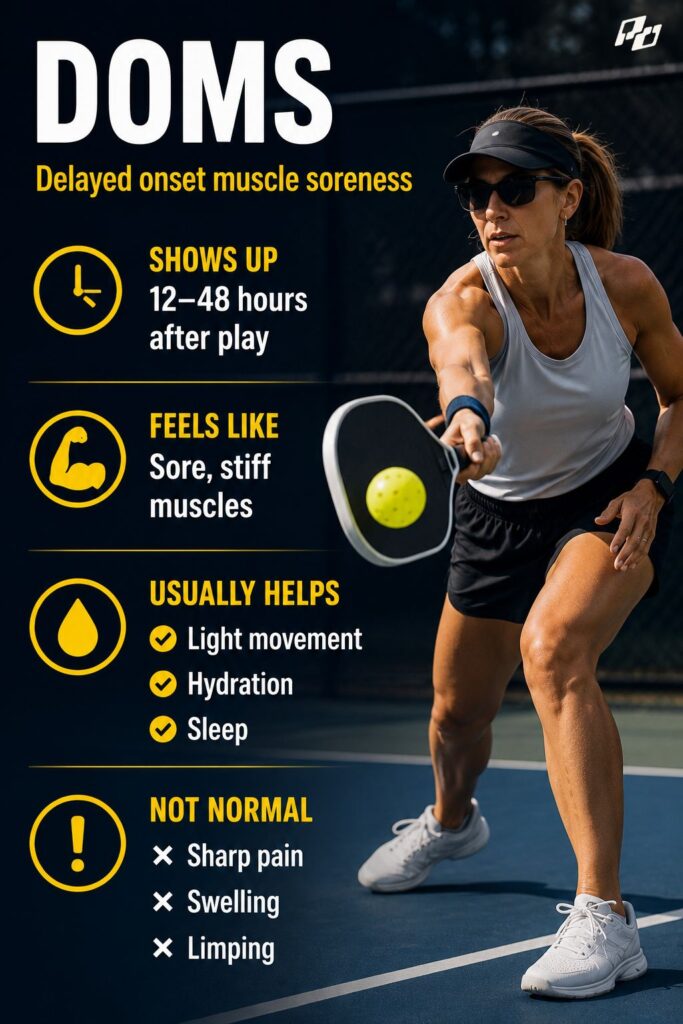
Pickleball soreness usually comes from sudden stops, lunges, twisting, hard-court impact, and playing more than your body is ready to recover from. Mild muscle soreness is normal, especially for newer players, but sharp pain, swelling, limping, or soreness that changes how you move means it’s time to back off.
You leave the court feeling fine. A little tired, maybe. Maybe your legs feel worked. Maybe your shoulder feels like it did something. But nothing alarming.
Then the next morning hits. Your calves are tight. Your knees feel cranky. Your hips are stiff. Your lower back is talking. Your shoulder, elbow, or forearm reminds you of every volley, reset, and overhead you hit.
So you wonder: Is this normal soreness, or is pickleball starting to beat up my body?
The answer is: sometimes, yes, soreness is normal. It is especially common if you are new to pickleball, playing more often, coming back after time off, or not used to the stop-start, side-to-side movement the game demands.
But there is a big difference between normal soreness and pain you should not ignore.
Pickleball may look easy from the outside, but your body knows better. It asks you to shuffle, stop, lunge, twist, reach, backpedal, split step, rotate, and react — often on a hard court, for long sessions, with very little buildup.
The good news? Most soreness can be managed. The catch? A quick stretch and wishful thinking usually are not enough.
Why Pickleball Makes You Sore
Pickleball soreness usually comes down to one main thing: your body is being asked to handle more load than it is currently ready to recover from.
That does not mean you are weak. It does not mean you are too old. It does not mean you should stop playing. It means your body is adapting to a specific kind of stress.
Pickleball is sneaky because it does not always feel like a brutal workout while you are playing. In doubles, you get short breaks. You rotate. You talk. You may not feel out of breath the way you would during running, cycling, or singles tennis.
But your body is still doing a lot.
Every wide dink requires a side step or lunge. Every drop shot asks you to move forward and stop. Every lob makes you turn, retreat, and reset. Every speedup asks your hand, forearm, shoulder, and trunk to react quickly. Every point adds more little stops, starts, reaches, and corrections.
You may not feel “cardio tired.” But your legs, feet, hips, knees, back, and paddle arm may still be overloaded.
That is why you can walk off the court thinking, “That wasn’t too bad,” and wake up the next day feeling like you secretly did a leg workout.
Soreness Is Not Just About Muscles
A lot of players assume soreness means their muscles are tight. Sometimes that is true. But pickleball soreness is often more than a muscle issue.
Your body is dealing with repeated impact, braking, twisting, gripping, reaching, and sudden changes of direction. That can stress your muscles, but it can also stress your tendons, joints, fascia, feet, and connective tissue.
This matters because muscles often adapt faster than tendons and joints. You might feel fit enough to play four or five times a week before your Achilles, knees, plantar fascia, hips, or shoulder are ready for that much repetition.
That is where many overuse problems begin.
Next-day exercise soreness is often called delayed onset muscle soreness, or DOMS. It usually shows up after unfamiliar or demanding movement, especially movements where your muscles lengthen while controlling force.
That includes lowering into a lunge, braking after a wide step, absorbing a sudden stop, reaching low for a dink, or pushing off repeatedly on a hard court.
And no, next-day soreness is not usually because lactic acid is trapped in your legs. Gentle movement can help you feel better, but soreness is usually your body responding to workload, not your body needing to “flush out” lactic acid.
What Your Sore Spot May Be Telling You
Where you feel soreness can give you clues about what your body is struggling to handle.
Sore quads and glutes
This is common after long sessions, competitive games, or lots of kitchen play.
Pickleball can become a sneaky squat workout. You stay low, push off, recover, lunge, and repeat. Your quads and glutes help you hold position, move in and out of the kitchen, and control your body when you stop.
This kind of soreness is often normal if it feels broad, muscular, and improves after a day or two.
But pay closer attention if your knees also hurt, your legs feel unstable, or stairs feel unusually difficult. That may be a sign your body needs more recovery, better strength, or a lighter next session.
Sore calves, heels, or feet
This is one of the most common pickleball complaints.
Hard courts are unforgiving. Your calves and feet absorb split steps, push-offs, quick shuffles, and sudden stops. If your shoes are worn out, too soft, too narrow, or not built for lateral movement, your feet have to work even harder.
Mild calf soreness can be normal. Heel pain deserves more attention.
If your first steps in the morning hurt, your Achilles feels stiff, or the bottom of your heel keeps flaring up after play, do not brush it off. That can be an early sign that your foot and tendon tissues are not tolerating the workload.
Sore knees
Knee soreness often comes from braking.
Most players think the hard part is getting to the ball. Your knees care about what happens when you arrive.
If you rush forward, plant hard, twist late, or lunge without control, your knees absorb the stop. If your hips, glutes, hamstrings, calves, and feet are not helping enough, the knee takes more of the stress.
General knee achiness after a long session may settle with recovery. Sharp pain, swelling, limping, or pain that keeps returning in the same spot is different. That is not something to “play through” for weeks and hope it magically disappears.
Sore hips or lower back
Hip and lower-back soreness often happen when you reach instead of move.
When your feet are late, your back and hips try to rescue the shot. You lean, twist, scoop, bend, and rotate from awkward positions. Do that for two hours, and your lower back may feel like it did more work than your paddle.
Lower-back soreness can also come from staying in a low ready position for too long without enough hip strength or trunk endurance.
The answer is not always “stand taller.” Often, the better answer is to arrive earlier, use smaller adjustment steps, stay balanced, rotate better, and stop asking your spine to save every late ball.
Sore shoulder, elbow, or forearm
This is often a tension problem.
Many rec players grip the paddle much harder than they realize, especially during fast exchanges, blocks, dinks, and resets. That tension travels into the forearm, elbow, shoulder, and even the neck.
Late contact also makes the arm work harder. When the ball gets too close to your body or behind you, you tend to muscle it.
A sore forearm may not be just a forearm problem. It may be a grip-pressure problem, a timing problem, a spacing problem, a contact-point problem, or even a paddle-weight problem.
The arm often complains when the rest of the body is not helping enough.
What Actually Helps Soreness After Pickleball
There is no single magic fix. The best solution is a combination of smarter play volume, better warmups, strength work, recovery, court shoes, and knowing when to back off.
1. Build up gradually
This is the big one.
Pickleball is addictive. You start with one day a week. Then two. Then open play. Then a round robin. Then someone invites you to another group. Suddenly, you are playing five days a week and wondering why your knees and heels are angry.
Your body can adapt to a lot. But it needs time.
If you recently started playing, returned after a layoff, or increased your weekly hours, treat pickleball like any other athletic activity. Build gradually.
A smart goal is not: “How much can I survive this week?”
A smarter goal is: “Can I recover well enough to play well next time?”
That question will save a lot of players from overuse injuries. You do not have to stop playing, but you may need to change the mix.
Make some sessions shorter. Replace one open-play day with drilling. Take a recovery day after your hardest session. Avoid stacking several long, competitive days in a row.
Not every court session needs to be a full-body stress test.
2. Warm up with movement, not just stretching
A lot of players say they stretch before playing. That is fine, but stretching is not the same as warming up.
Pickleball is movement. Your warmup should be movement too.
Before you play, your body needs to gradually prepare for the actual demands of the sport: side steps, forward movement, stopping, rotating, reaching, and reacting.
A good warmup should feel like slowly turning up the volume.
Try this before you play:
- Walk around the court
- Add side shuffles
- Add gentle backpedals
- Do a few shallow lunges
- Make small split steps
- Circle your shoulders
- Rotate your trunk
- Hit easy balls while actually moving your feet
Do not just stand at the kitchen line and tap dinks for two minutes. Your first hard lunge should not happen during the first point.
Simple version: Move before you play. Stretch after if it feels good.
3. Cool down before you sit down
This is one of the easiest fixes, and most players skip it.
A common post-pickleball routine looks like this: finish the last game, chat for a few minutes, sit in the car, drive home, try to get out of the car, and regret all your life choices.
That stiffness is not surprising. You went from stop-start court movement straight into sitting. Give your body a transition.
After your last game, walk for five to ten minutes. Let your breathing settle. Let your hips and legs move easily. Then stretch gently if it feels good.
You are not trying to win a flexibility contest. You are just helping your body come down from the session.
Good areas to focus on include calves, quads, hip flexors, glutes, hamstrings, forearms, chest, shoulders, and upper back.
Keep the promise realistic. Stretching may help you feel looser. Walking may help you cool down. Neither one erases a workload your body was not ready for.
4. Strength train if you want soreness to improve long term
Stretching may help you feel better today. Strength training helps your body tolerate more pickleball tomorrow.
That is the difference.
Pickleball requires braking, lunging, pushing off, rotating, stabilizing, and absorbing impact. Stronger muscles help share that load so your joints and tendons do not take all of it.
You do not need to train like a professional athlete. But if you want your knees, hips, feet, back, and shoulders to feel better over time, you need some strength.
The most useful areas for pickleball players are:
- Legs
- Hips
- Calves
- Feet and ankles
- Core
- Upper back
- Shoulders
- Grip and forearm endurance
The most useful quality is control.
Can you lower into a lunge without collapsing? Can you step sideways and stop quietly? Can you push off without your knee diving inward? Can your trunk rotate without your lower back doing everything? Can your shoulder stay relaxed while your hand reacts quickly?
That is what strength training should support.
Helpful exercises include step-downs, split squats, lateral lunges, calf raises, glute bridges, rows, band external rotations, carries, and controlled core work.
For most rec players, two short strength sessions per week can make a real difference. Do not chase gym soreness. Build capacity.
5. Wear court shoes, not just comfortable shoes
Shoes matter more than many players want to admit.
Pickleball is a lateral sport. You move side to side, stop, plant, and push off. Running shoes are usually designed more for forward motion. Walking shoes may feel comfortable but often lack the lateral stability needed for quick court movement.
If your foot slides inside the shoe, your toes jam forward, your heel lifts, or the shoe collapses when you move sideways, your body has to stabilize every step.
That extra work can show up as sore feet, knees, hips, or lower back.
A good court shoe should feel stable during side shuffles and stops. Your foot should feel secure without being squeezed. The outsole should have enough grip and support.
And if your shoes are worn smooth on the bottom, they are done — even if they still look fine from the top.
6. Use recovery tools as helpers, not solutions
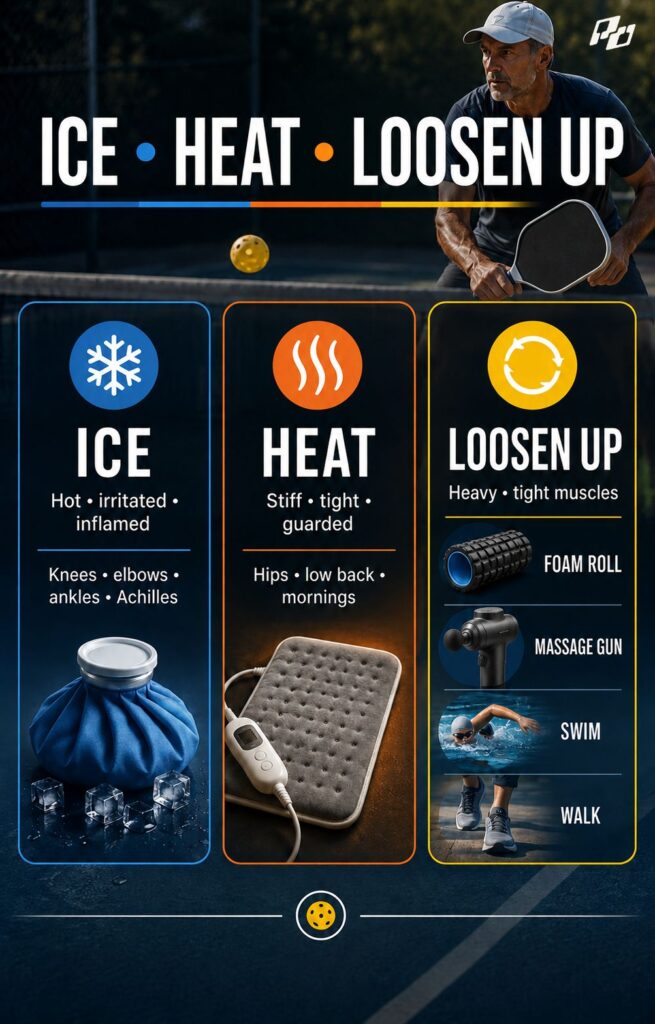
Plenty of players use recovery tools after pickleball: massage guns, foam rollers, hot tubs, cold showers, Epsom salt baths, compression sleeves, TENS units, topical creams, ice packs, and heat pads.
Some of these can be useful, especially if they help you relax, move better, or calm down a sore area. But they are helpers, not the foundation.
The key is matching the tool to the problem.
If an area feels hot, irritated, or inflamed, ice may feel better. This is common with knees, elbows, ankles, or Achilles irritation.
If you feel stiff, tight, or guarded, heat may feel better. This is common with hips, lower back, or general morning stiffness.
If your muscles feel heavy or tight, a foam roller, massage gun, easy swim, or short walk may help you loosen up.
Use these tools gently. If you are wincing, holding your breath, or bruising yourself, you are doing too much. Recovery work should make movement feel better afterward. It should not feel like punishment.
And if you need a brace, sleeve, tape, topical pain reliever, or pain medicine every time you play, treat that as information.
It may help you get through a session, but it also means your body may be asking for better load management, more strength, better shoes, or a professional opinion.
The safest mindset is this: Use recovery tools to support your body, not override it.
7. Hydrate, but do not blame everything on hydration
Hydration in pickleball matters, especially if you play outside, sweat heavily, play long sessions, or play in hot weather. Electrolytes can help during longer or hotter sessions.
But hydration is not a cure-all.
If your knee hurts because you played four hard days in a row, another electrolyte packet is not going to solve that. If your heel hurts every morning, the problem is probably not that you forgot one water bottle.
Think of hydration as one part of recovery.
Show up hydrated. Sip during play. Replace fluids afterward. Eat real food. Sleep. Manage your workload.
That combination works better than obsessing over one drink mix.
8. Eat enough protein
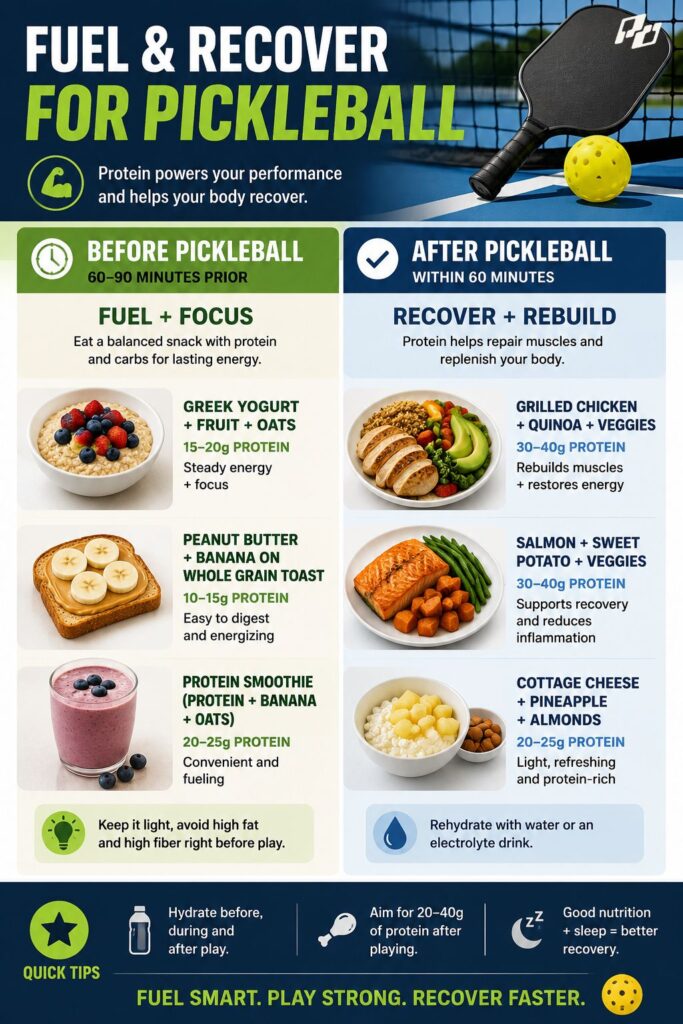
Protein is one of the few recovery topics that deserves real attention.
If you are playing often, strength training, or trying to recover better, your body needs enough building material. This is especially important for older players, who may need to be more intentional about protein intake to support muscle.
You do not need to make this complicated. Have protein at breakfast. Have protein after play. Have protein with dinner.
Do not let your biggest pickleball days become coffee-and-crackers days.
Supplements like BCAAs, collagen, creatine, turmeric, and magnesium may help some people in specific situations, but none of them replaces the basics.
Enough food. Enough protein. Enough sleep. Enough strength. Enough recovery. A sensible playing schedule.
That is the real stack.
What Rec Players Say Has Helped Them Most
Beyond the usual recovery advice, a few practical habits come up again and again from players who have dealt with pickleball soreness themselves.
These are not replacements for smart recovery, strength work, or medical advice if pain keeps coming back. But they can be useful additions, especially if you are trying to stay on court without constantly feeling beat up.
Make tired days easier days
One of the smartest ideas is to change what “playing” means when your body is already sore.
If you still want to be on court, do not automatically turn it into another two-hour battle session. Make it a drilling day instead.
Work on serves. Hit returns. Practice dinks. Do cooperative kitchen reps. Work on resets without keeping score.
You still get touches, timing, movement, and the social fun of being on court. But you are not asking your knees, hips, feet, back, and paddle arm to survive another full-speed open play session.
That small adjustment can make a big difference.
Keep moving after you play
Another habit many players mention is light movement after a session.
That might mean a short walk, an easy bike ride, a gentle swim, or a few minutes with resistance bands.
The goal is not to train harder after you already played. The goal is simply to keep blood moving before you sit down, cool off, and stiffen up.
For a lot of players, the worst soreness does not hit during the game. It shows up later, after they have sat for an hour and everything starts to tighten.
A little easy movement can help that transition feel smoother.
Try legs up the wall
Some players like putting their legs up the wall after long sessions.
It is exactly what it sounds like: lie on your back, place your legs up against a wall, and relax there for 10–15 minutes. You can gently move your ankles while you do it.
Is it magic? No. But after a long day of standing, shuffling, lunging, and pounding around on a hard court, it can feel surprisingly good.
Stay warm between games
This one matters a lot during round robins, ladders, and busy open play sessions.
If you have a long wait between games, try not to sit completely still the whole time. When you cool down too much, then jump straight into a hard point, your body may feel stiff, slow, and creaky.
Instead, stay slightly warm.
Walk around. Do a few heel raises. Swing your arms. Take a few easy practice steps. Loosen up your hips and shoulders before you go back on court.
You do not need a full warmup every time. But you also do not want to go from cold and seated to sprinting for a wide ball in three seconds.
Add movement outside of pickleball
Some players feel better when they add gentle movement outside of pickleball, such as yoga, Pilates, swimming, biking, water aerobics, or mobility work.
That makes sense. Pickleball uses a lot of repeated patterns: short steps, quick stops, lunges, reaches, paddle swings, and hard-court impact. Cross-training gives your body different inputs without always adding more pickleball stress.
You are still building strength, balance, mobility, and endurance. You are just doing it in ways that may be a little kinder to your joints.
What Does Not Work as Well as People Think
Some common soreness advice sounds good but can lead players in the wrong direction.
“Just play more”
This works for some players because the body adapts with repeated exposure. But it backfires when the workload is too much, too soon.
If soreness is mild and improving, consistent play may help your body adapt. But if pain is getting worse, changing your movement, or returning in the same joint or tendon every time you play, “just play more” is bad advice.
Your body needs enough stress to adapt. It also needs enough recovery to actually adapt.
Stretching as the entire solution
Stretching can feel good. It may help you feel looser. It can be a useful part of your cooldown.
But stretching alone will not fix poor shoes, weak hips, too much playing volume, hard-court impact, late footwork, or repeated overuse.
If you are sore because your body cannot tolerate the load yet, flexibility is only one small piece of the answer.
Painkillers before every session
This is one of the biggest caution areas.
Pain relievers can be appropriate sometimes. But using ibuprofen, naproxen, acetaminophen, or other medications routinely so you can keep playing through pain is not a good long-term plan.
Pain is information. Sometimes it is annoying information, but it is still information.
Pain medicine can turn down the alarm without fixing the problem. Do not make painkillers your warmup routine.
Miracle recovery products
If a gadget, powder, cream, supplement, or device promises to solve soreness without changing your training load, be skeptical.
Some tools may feel good. Some may help certain people. Some may be mostly placebo. Some may not be worth the money.
The better question is: Would this still matter if I fixed my playing volume, shoes, warmup, cooldown, strength, sleep, and nutrition first?
If the answer is no, it is probably not the main solution.
Be Careful With “It Worked for Me” Advice
Pickleball players are generous with advice. That is mostly a good thing. But soreness advice can get messy because what helps one person may not help another.
One player may feel great after a hot tub. Another may need ice. One player may handle five days a week. Another may flare up after three. One player may swear by turmeric, magnesium, collagen, BCAAs, or creatine. Another may get no benefit at all.
The problem is not that those players are wrong. The problem is that soreness has different causes.
Sore quads from a hard day of lunging are not the same as Achilles pain that hurts every morning. A stiff lower back after sitting in the car is not the same as sharp knee pain during every lateral step. General muscle soreness is not the same as an overuse injury.
So instead of copying someone else’s full routine, ask a better question: What problem am I actually trying to solve?
If you are generally sore, you may need better recovery. If the same joint hurts every time, you may need less volume and more strength. If your feet hurt, you may need better shoes or less hard-court time. If your arm hurts, you may need to look at grip pressure, contact point, paddle weight, or technique.
Advice is useful only when it matches the reason you are sore.
When Soreness Is Not Just Soreness
This is the most important part.
Normal soreness usually feels broad and muscular. It may show up the next day. It may feel stiff when you first get moving, then improve after walking around. It usually fades within a day or two.
That kind of soreness is usually part of adaptation. But soreness is not “normal” if it behaves like an injury.
Be careful when pain is:
- Sharp instead of achy
- In one specific spot
- Only on one side
- Causing you to limp
- Changing your swing or footwork
- Getting worse during play
- Warming up during play but coming back worse later
- Waking you at night
- Paired with swelling, bruising, numbness, or tingling
- Making stairs difficult
- Affecting normal daily tasks
- Lasting more than several days without improving
Also pay attention to morning heel or Achilles pain that keeps returning.
Here is the simplest rule: If it changes how you move, it is no longer just soreness.
That does not mean panic. It means adjust.
Take a lighter day. Reduce your volume. Skip the competitive session. Do gentle movement. If the same pain keeps returning, see a physical therapist or sports medicine professional.
A good physical therapist will not just tell you to quit pickleball. The right person will help you figure out what your body is not tolerating yet and build a smarter path back.
The “Same Spot” Rule
Here is another simple rule that helps rec players make better decisions: If the same spot hurts every time you play, pay attention.
Normal soreness often moves around. One day your quads feel worked. Another day your glutes are tired. After a long session, your whole body may feel generally stiff.
But recurring pain in the same spot is different.
The same heel every morning. The same knee during every game. The same elbow after every session. The same shoulder on every overhead. The same low-back pinch after every long point.
That pattern usually means one area is not tolerating the load.
It may be a strength issue. It may be a mobility issue. It may be poor shoes, too much volume, technique, paddle grip, or recovery. But it is worth respecting before it becomes the thing that forces you off the court.
You do not need to panic. But you should adjust sooner rather than later.
A Simple Recovery Plan for Rec Players
Recovery does not have to be complicated. The goal is to help your body feel ready before play, calm down after play, and recover well enough for your next session.
| When | What to do | Why it helps |
|---|---|---|
| Before you play | Move for 8–12 minutes: walk, shuffle, rotate, lunge lightly, and hit easy balls. | Gets your body ready for pickleball movements before the first real point. |
| During play | Notice signs of fatigue: heavy legs, late reaches, tight grip, loud steps, or sloppy recovery. | These are clues your body may need a break before soreness turns into pain. |
| Right after play | Walk for 5–10 minutes before sitting. Stretch gently if it feels good. | Helps prevent that stiff, locked-up feeling after you stop playing. |
| Later that day | Eat a real meal, drink fluids, use ice for irritated spots and heat for stiffness. | Helps your body repair and settle down after court time. |
| On non-play days | Do basic strength work for your legs, hips, calves, core, shoulders, and balance. | Builds a body that can handle more pickleball with less soreness. |
| The next morning | Move around before judging how sore you are. If you loosen up, good. If you limp, feel sharp pain, or feel worse, back off. | Helps you tell normal soreness from something that needs attention. |
The main idea: Not every pickleball day should be hard.
Some days can be for hard games. Others should be lighter, focused on drilling, recovery, or strength. That balance is how you keep playing without constantly feeling beat up.
A Few Player-Tested Tweaks Worth Trying
If your soreness is mild and you are looking for small changes, try one at a time.
| Player-tested tweak | When it may help | Keep in mind |
|---|---|---|
| Shorter play blocks | You feel fine during play but sore for days afterward. | Stop before your movement gets sloppy, not after. |
| Drilling instead of games | You want court time without another hard session. | Serves, returns, dinks, and resets are easier to control than open play. |
| Easy walk or bike after play | You stiffen up after sitting or driving home. | Keep it light. This is a cooldown, not another workout. |
| Legs up the wall | Your legs feel heavy after long sessions. | Use it as a comfort tool, not a fix for injury pain. |
| Yoga, Pilates, swimming, or biking | You need fitness work that is not more hard-court pounding. | Great for variety, but still keep strength training in the mix. |
| Warm movement between games | You sit during round robin and feel stiff restarting. | Walk, do heel raises, and take a few easy steps before the next game. |
| Better court shoes | Your feet, heels, knees, or hips feel beat up. | Look for lateral stability, not just cushion. |
The goal is not to build a giant recovery routine. It is to find the few habits that help your body feel ready for the next session.
My Best Advice? Listen Before Your Body Gets Louder
If there is one thing I would tell most rec players, it is this: your body is not trying to ruin your fun. It is trying to give you feedback.
The players who stay on court the longest are usually not the ones who push through every ache. They are the ones who adjust early.
That might mean stopping after three good games instead of chasing two sloppy ones. It might mean drilling on a tired day, replacing worn-out shoes, or finally paying attention to that same heel, knee, elbow, or shoulder that keeps complaining.
And that is not “taking it easy.” That is playing smarter.
A simple rule: do not judge your pickleball habits only by how you feel during the game. Judge them by how well you recover for the next one.
Some soreness is normal. But if pain changes how you move, keeps coming back in the same spot, or feels worse after you “warm up,” listen sooner.
Keep playing. Keep improving. Keep enjoying the game.
Just give your body a fair deal: warm up, cool down, build strength, take easier days when you need them, and do not wait until a small warning becomes a forced break.
Pickleball should challenge your body. It should not constantly punish it.