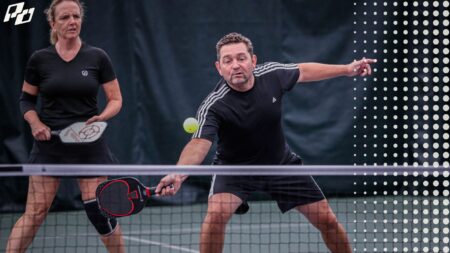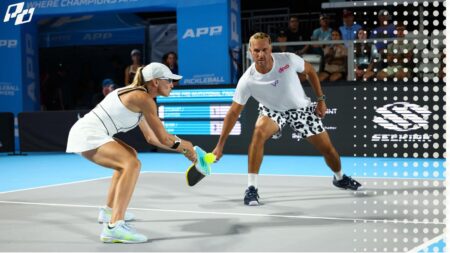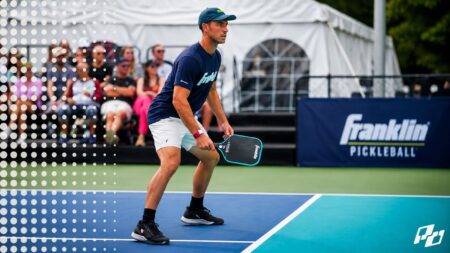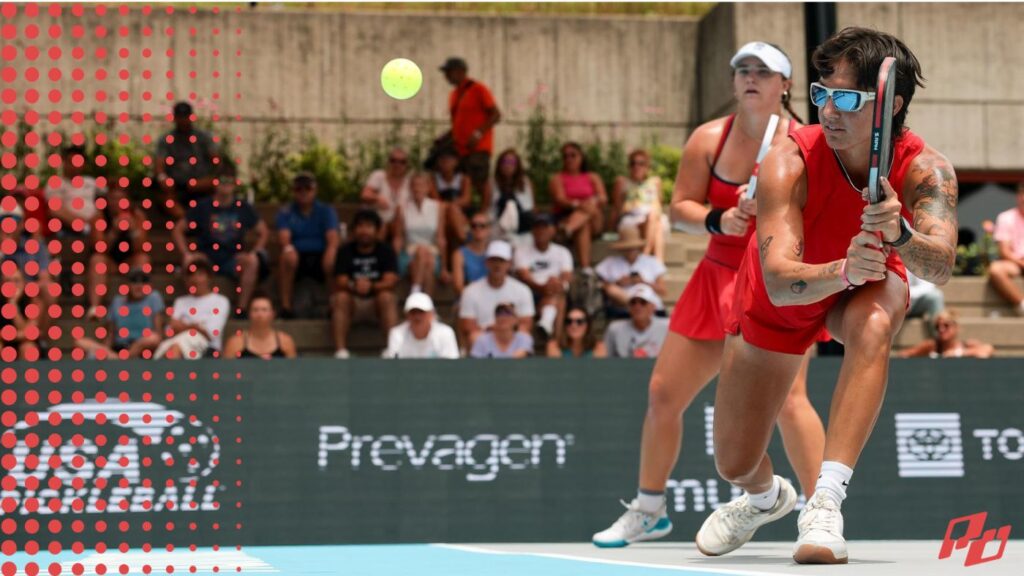
Loading at the pickleball kitchen means setting your weight into your legs before you hit, instead of reaching late with your paddle. To do it, move behind the ball, sink slightly into your outside leg, keep your chest quiet, and hold balance through contact. A good load gives you more control, disguise, power, and recovery.
A lot of rec players lose control at the kitchen because they are late.
Not late with the paddle.
Late with the body.
They wait until the ball is already near them, then try to solve everything with their hands: reach, flick, scoop, block, stab, or rush a speedup. Sometimes it works. But under pressure, that kind of kitchen game breaks down fast.
The better players are doing something quieter and harder to notice.
They are getting into their legs before the ball arrives.
That one adjustment changes everything. It helps you get under the ball, keep your paddle prepared, stay balanced, disguise your options, and recover for the next shot.
Coaches often talk about kitchen success through balance, compact preparation, efficient footwork, and better attack selection — not just softer hands or faster reactions. USA Pickleball, for example, emphasizes that movement and a low, balanced stance are what keep you alive when points speed up at the kitchen.
The goal is simple: Get loaded early enough that you are choosing the shot, not surviving it.
The Real Problem: You’re Reaching Instead of Loading
At the kitchen, reaching feels normal.
The ball is close. The point is fast. You think you can just lean, stick the paddle out, and guide it back.
But reaching creates three problems:
- You lose your base.
- You lose your paddle control.
- You lose your next-shot recovery.
That is why so many intermediate players can dink well in warmups but panic in games. The issue is not always touch. It is that their body is not set early enough to give their touch a chance.
Good kitchen movement is not about taking a huge step or looking athletic. It is about arriving in a position where your legs are underneath you, your paddle is prepared, and your body can still go somewhere after contact.
Better cue: Load first. Hit second. Recover third.
That is the rhythm.
Adjustment 1: Load Into the Outside Leg Before Contact
When the ball pulls you to one side at the kitchen, your outside leg becomes your anchor.
⮕ If the ball moves to your right, load into the right leg.
⮕ If the ball moves to your left, load into the left leg.
That does not mean lunging wildly. It means letting that outside leg accept your weight before you hit.
Most rec players do this too late. They move the paddle first, then the feet follow. Better players reverse it: they move into the ball with the body first, then let the paddle work from a stable base.
Why does this matter?
Because the outside-leg load gives you time.
Not actual extra seconds, but usable time. When your body is already organized, the ball feels slower. You can see the height better. You can decide whether to dink, roll, speed up, or reset. You are no longer forced into the first shot your hands can find.
Watch Federico Staksrud’s foot movement at the kitchen and you’ll see the point right away.
Players need to move efficiently, stay low and balanced, and avoid relying too much on the arms when the ball dips below net height.
What this fixes: rushed dinks, pop-ups, late speedups, stabbed blocks, and recovery mistakes after wide balls.
The feel: your outside leg catches your body before your paddle catches the ball.
Cue: “Catch the ball with your legs first.”
Adjustment 2: Get Below the Ball Without Scooping It
A lot of players hear “get under the ball” and turn it into a paddle move. They drop the paddle head. They scoop upward. The ball floats.
That is not the version you want.
At the kitchen, getting below the ball should start with your legs. When your knees and hips lower early, your paddle can stay calm and prepared. You are not trying to lift the ball with your wrist at the last second.
This matters most on low dinks, roll dinks, and speedup opportunities that sit just high enough to attack. If your body is tall, you have only two choices: push the ball flat into the net or scoop it high enough to get attacked.
When your body is loaded, you get a better third option: shape the ball with control.
What this fixes: floating dinks, wristy rolls, low balls hit into the net, and speedups that sit up.
The feel: you are not lifting the ball from panic. You are playing it from underneath with structure.
Cue: “Lower your body, not just your paddle.”
That cue is more useful than “bend your knees,” because it tells you why you are doing it. You are creating a better contact window.
Adjustment 3: Use the Outside Leg to Recover, Not Just Reach
The outside leg is not only there to help you get to the ball. It is also there to help you get back.
This is where a lot of rec players leak points. They hit the dink, but their body stays outside the court. They block the speedup, but their weight falls forward. They attack, but they cannot handle the counter.
The shot might be fine.
The recovery is not.
A good outside-leg load should feel like a small spring. You load into it, play the ball, then push back toward balance. That push does not have to be dramatic. It just has to happen soon enough that you are not stuck watching the next ball.
Good footwork progressions reinforce the same idea: move behind the ball, make contact in front, then return to balance through live dinking patterns.
What this fixes: getting pulled wide, losing the middle, falling into the kitchen, and being late for the next ball.
The feel: outside leg catches you, then sends you back.
Cue: “Load out. Push back.”
If you hit a good ball but cannot recover, the movement was not finished.
Adjustment 4: Build Your Kitchen Game Around Options, Not Shots
This is the part many intermediate players miss. They think in single shots:
“I’m going to dink.”
“I’m going to speed up.”
“I’m going to roll this.”
“I’m going to counter.”
Better players think in options. They load early enough that they can wait a fraction longer and let the ball tell them what to do.
- If the ball stays low, dink.
- If it sits up, pressure it.
- If the opponent is leaning, change direction.
- If you are stretched, reset.
- If you are balanced and the contact is clean, attack.
That is a very different mindset from forcing offense because you are tired of dinking.
The best kitchen players are not slow because they are passive. They look slow because their body is prepared early, so they do not need to rush.
What this fixes: attacking the wrong ball, panicking during dink rallies, speeding up from below the net, and turning neutral balls into errors.
The feel: you are prepared early but choosing late.
Cue: “Prepare early. Decide late.”
That is how you create time without actually slowing the rally down.
A Better Way to Practice It
Do not start by playing full-speed points. Start with a controlled kitchen drill that forces the right movement.
Stand crosscourt at the kitchen. Have your partner dink you side to side, but not too aggressively. Your job is not to win the rally. Your job is to feel the outside-leg load before each shot.
For five minutes, focus only on this pattern:
- Load into the outside leg.
- Contact in front.
- Push back to balance.
- Reset your paddle.
- Repeat.
Then add one rule: your partner can occasionally leave a ball slightly higher. You may attack only if your body is already loaded and balanced.
That rule matters.
It teaches you not to attack because you are impatient. It teaches you to attack because your position gives you permission.
Drill cue: “No load, no attack.”
That single rule can clean up a lot of messy kitchen decisions.
The Quick Self-Check
Use this during your next rec game.
If your dinks are floating, ask:
Am I tall at contact?
If your speedups are obvious, ask:
Did my setup change too early?
If you are late after wide dinks, ask:
Did I push back after loading?
If you are attacking bad balls, ask:
Was I balanced enough to choose, or was I rushing?
If your hands feel frantic, ask:
Did my legs prepare early enough?
Most players look for a paddle fix or a hand-speed fix. Sometimes the real fix is lower: your feet, legs, and recovery pattern.
The Cues That Actually Matter
“Catch the ball with your legs first.”
Do not let your paddle be the first thing that reacts.
“Lower your body, not just your paddle.”
This prevents scoops and floating dinks.
“Same setup. Later decision.”
This keeps your dink, roll, and speedup available longer.
“Load out. Push back.”
This keeps you from getting stuck after wide balls.
“No load, no attack.”
This stops forced speedups from bad positions.
The Kitchen Skill Nobody Brags About
Here is the uncomfortable truth: a lot of rec players are addicted to the shot that comes next.
They dink, but they are already thinking about the speedup.
They speed up, but they are already hoping for the winner.
They get pulled wide, but they are already trying to counter.
That is why the kitchen feels frantic.
The better players are not playing one shot ahead because they are smarter. They are playing one shot ahead because their body gives them permission to wait.
That is the underrated value of loading well. It buys you patience. Not emotional patience — physical patience. The kind where you can hold your ground, let the ball develop, and avoid making the first available mistake just because the rally got uncomfortable.
My favorite way to think about it is this: Your legs decide how many choices your hands get.
Bad base? One choice. Usually a rushed one.
Good base? Two or three choices. Dink, hold, roll, counter, reset.
That is the hidden skill.
You are not just trying to look balanced. You are trying to become harder to predict because you are no longer forced into one obvious answer.
And once opponents feel that, the rally changes.
They stop leaning early.
They stop sitting on your dink.
They stop assuming your speedup is coming.
They start waiting on you.
That is when you know the adjustment is working. Not when you hit a highlight. When the other team gets a little less comfortable because your setup no longer gives away the ending.