
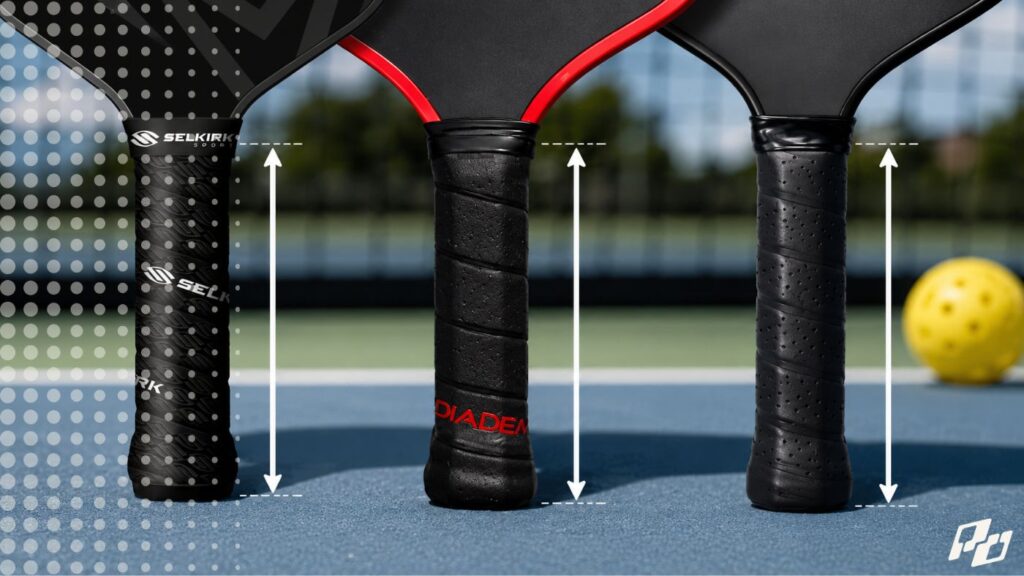
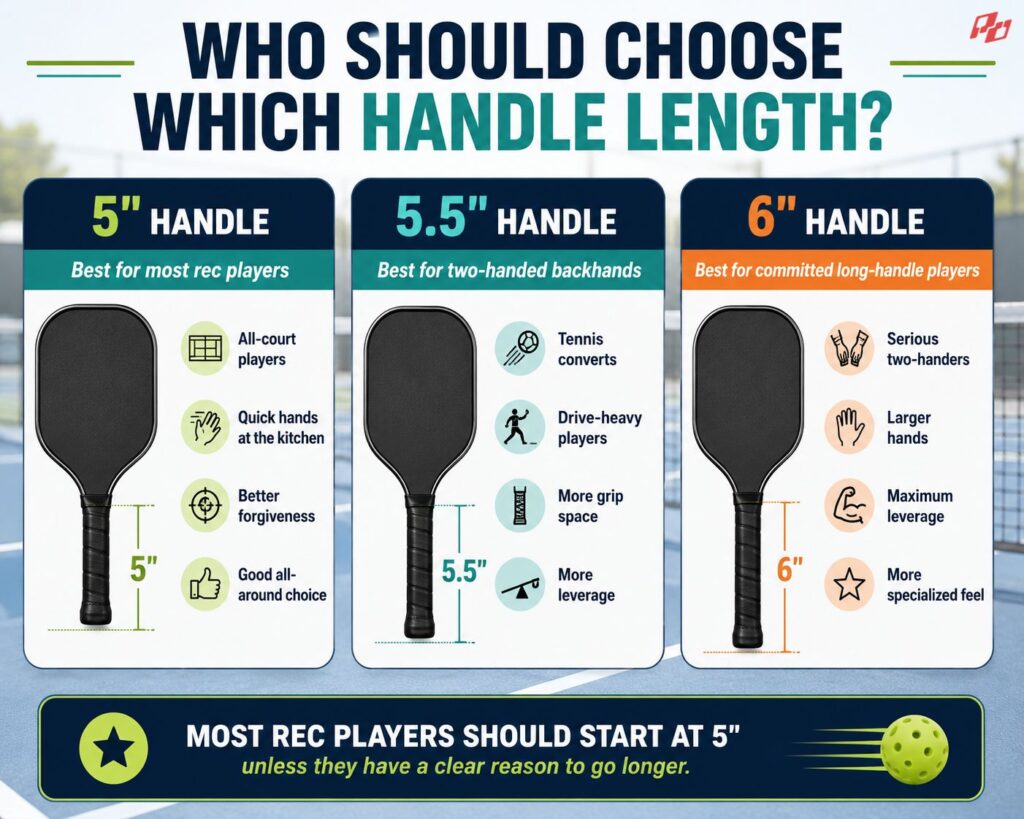
Pickleball paddle handle length changes how much grip space, leverage, paddle face, and hand speed you get. A 5-inch handle usually fits all-court players who want quick hands and forgiveness. A 5.5-inch handle gives more room for a two-handed backhand. A 6-inch handle adds maximum leverage but may reduce face size and quickness.
Recently, we broke down the difference between 14mm and 16mm paddle thickness — how thickness changes feel, dwell time, pop, resets, drives, and control.
Not sure where you land? Find your paddle first, then come back and read why it scored the way it did.
Today, it is worth looking at another paddle spec that gets overlooked just as often: handle length.
Most paddle buyers obsess over thickness, face material, power, spin, and weight. Then they barely look at the handle.
That is a mistake.
Handle length changes how the paddle swings, how much room you have for a two-handed backhand, how quick your hands feel at the kitchen, and how forgiving the paddle face feels on off-center contact.
It is not just a comfort spec.
It is a shot-shaping spec.
And because legal paddles have size limits — maximum paddle length is 17 inches, and combined length plus width cannot exceed 24 inches — a longer handle usually means something else gets smaller, narrower, or less forgiving on the face.
A longer handle may give you more leverage, more room for a two-handed backhand, and a more familiar feel if you come from tennis.
But that extra handle length usually comes from somewhere — often the paddle face.
So the real question is: Does the longer handle help your game enough to justify what you may lose in face size, forgiveness, or hand speed?
That is where handle length finally starts to make sense.
Ten questions, three paddles matched to how you play, scored on lab data.
The Simple Handle-Length Breakdown
| Handle Length | What It Usually Feels Like | Best Fit |
|---|---|---|
| 4.5 inches | Short, quick, face-forward, forgiving | One-handed players, kitchen players, control-first doubles |
| 5 inches | Balanced, familiar, enough room for many players | Most rec players, all-court players, compact two-handers |
| 5.25 inches | Small step toward leverage without going full long-handle | Players who want a little more room but still care about hand speed |
| 5.5 inches | Long enough for most two-handed backhands, more leverage | Tennis converts, two-handed backhand players, drive-heavy players |
| 6 inches | Maximum handle real estate, more racquet-like feel | Serious two-handers, players with larger hands, power/leverage players |
The most common premium paddle handle lengths tend to cluster around 5 and 5.5 inches, while shorter handles around 4.5 inches and extra-long handles around 6 inches are more specialized choices.
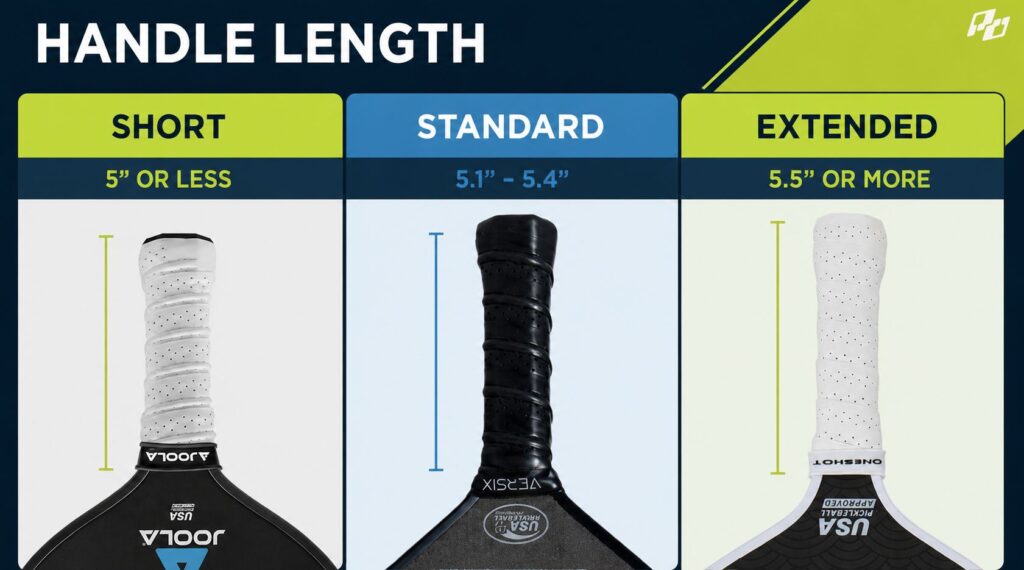
Several gear guides describe 5 to 5.5 inches as the long-handle range, especially for two-handed backhands and tennis-style mechanics.
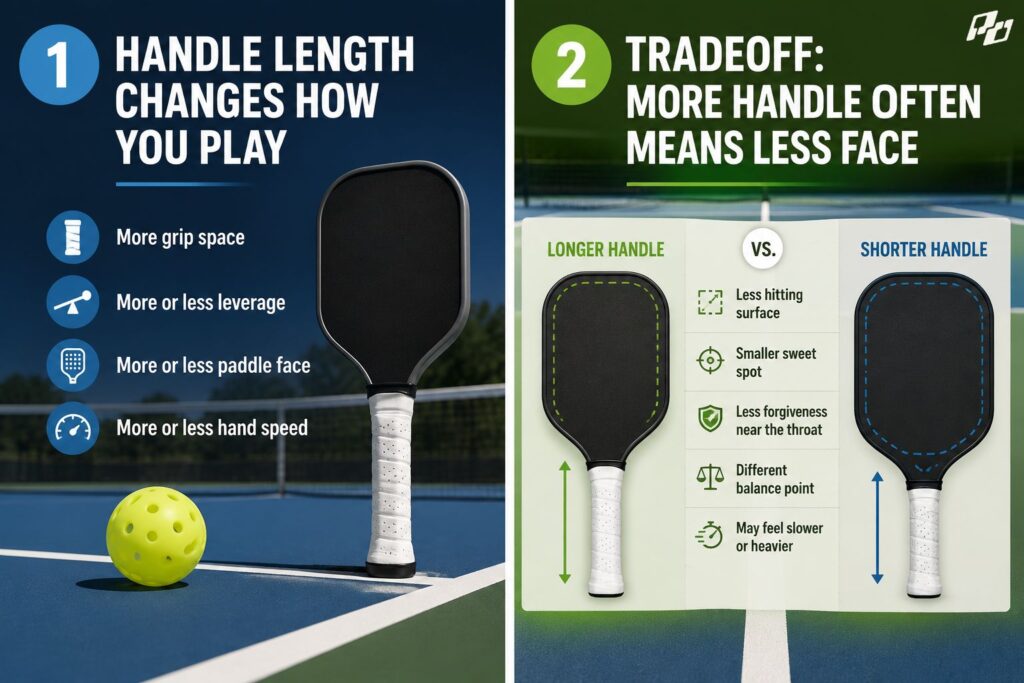
The Hidden Tradeoff: More Handle Usually Means Less Paddle Face
This is the part rec players often miss.
A paddle cannot just keep getting longer forever. If the handle gets longer inside the legal paddle envelope, the face usually gives something back.
That can mean:
- less hitting surface
- a slightly smaller sweet spot
- less forgiveness near the throat
- a different balance point
- a slower or heavier feel depending on shape and swing weight
That does not make longer handles bad. It just means they are not free.
A 5.5- or 6-inch handle can give you more leverage and make two-handed shots feel more comfortable. But if your contact is inconsistent, you may miss the larger hitting surface and forgiveness that usually come with a shorter handle.
That is the tradeoff most players need to respect: extra handle length has to earn its place.
5-Inch Handles: The Safe Middle That Fits More Games
A 5-inch handle is the “don’t overthink it” zone for a lot of rec players.
It gives you enough grip length for a comfortable one-handed game, enough room for some players to sneak a second hand onto the paddle, and usually keeps the paddle from feeling too handle-heavy or face-starved.
This is often the best fit if you play mostly doubles and your game is mixed: some drives, some resets, some counters, some kitchen work.
Where 5 inches works well:
| Shot/Need | Why 5 Inches Helps |
|---|---|
| Dinks and resets | Keeps more paddle face available and feels easier to maneuver |
| Counters | Does not usually feel as slow as longer handles |
| One-handed backhands | Enough grip without extra unused handle |
| All-court doubles | Balanced between leverage and forgiveness |
| Compact two-handers | Can work if your hands are smaller or overlap comfortably |
The catch?
If you hit a true two-handed backhand and your top hand feels crowded near the throat, 5 inches may feel like a compromise. You can make it work, but your wrists may feel jammed and your swing may shorten in the wrong way.
If your second hand has to negotiate for space, the handle is probably too short.
5.5-Inch Handles: The Real Two-Handed Backhand Sweet Spot
A 5.5-inch handle is where many two-handed backhand players start to feel the paddle “unlock.”
You get enough room for both hands without going fully into the extra-long handle category. For tennis converts, it feels more familiar. For drive-heavy players, it can add leverage. For players who like to roll backhands, counter with two hands, or use a two-handed backhand return, it usually feels more natural.
That is why so many long-handle recommendations cluster around 5.25 to 5.5 inches. Pickleball Central, ARTI, and other gear sources generally frame longer handles as useful for two-handed backhands, leverage, and players who come from tennis-style mechanics.
Where 5.5 inches works well:
| Shot/Need | Why 5.5 Inches Helps |
|---|---|
| Two-handed backhand drives | More room for the top hand and cleaner rotation |
| Returns | More leverage through the ball |
| Roll volleys | Easier to use the top hand without feeling cramped |
| Tennis-style swings | More familiar handle length and leverage |
| Larger hands | Less crowding near the throat |
But 5.5 is not automatically better.
If you mostly block, reset, dink, and counter in doubles, the extra handle may not help you enough to justify the smaller face or slower hand feel.
Go 5.5 when the second hand is part of your game, not just part of your highlight reel.
6-Inch Handles: Powerful, Comfortable, and More Demanding
A 6-inch handle is a more specialized choice.
It gives you the most room for a two-handed grip, especially if you have larger hands or come from tennis. It can make backhand drives, two-handed counters, and full-swing returns feel more connected. The paddle can feel more like a short racquet than a compact paddle.
But the cost is real.
A 6-inch handle often leaves less face above the handle. Depending on the paddle shape, that can make the sweet spot feel higher, smaller, or less forgiving. It can also change how fast the paddle feels in hand battles.
A longer handle can help create racquet-head speed, but you still need clean contact to benefit from it. This lines up with the broader gear advice from pros like Tyson McGuffin and Catherine Parenteau: paddle choice should come down to how the weight, grip, shape, and overall feel match your game, and players should demo when possible rather than buying from specs alone.
Where 6 inches works well:
| Shot/Need | Why 6 Inches Helps |
|---|---|
| Full two-handed backhands | Maximum room for both hands |
| Big returns and drives | More leverage and swing freedom |
| Tennis converts | Familiar grip length and spacing |
| Large hands | Less cramped top-hand position |
| Players who choke up/down | More room to adjust hand placement |
Where it can hurt:
| Problem | Why It Happens |
|---|---|
| Kitchen hands feel late | Extra length and balance may slow quick exchanges |
| Mishits feel worse | Less usable face can punish imperfect contact |
| Dinks feel less forgiving | More handle can mean less face helping you |
| One-handed players waste space | Extra grip length gives no real benefit |
Choose 6 inches only if you will actually use the handle.
Unused handle length is just sweet-spot space you gave away.
The Shot-by-Shot Difference
Handle length matters most when you connect it to real shots.
| Shot | Shorter Handle: 4.5–5 Inches | Longer Handle: 5.5–6 Inches |
|---|---|---|
| Dinks | More face, easier touch, quicker small adjustments | Can feel stable, but less forgiving if face is smaller |
| Resets | Usually easier if you need maximum paddle face | Works if you have clean contact and like two-hand stability |
| Counters | Faster hands, easier reloads | Stronger two-hand counters, but may feel slower |
| Drives | Compact, quick, direct | More leverage, more room for top-hand power |
| Returns | Easier to control with compact swings | More plow and racquet-like rhythm |
| Roll volleys | Quicker paddle position changes | More top-hand control and shape |
| Overheads | Fast and simple | More whip and handle leverage |
| Mishits | Usually more forgiving face | Can punish off-center contact more |
The important part: handle length does not work alone.
A 5.5-inch handle on a light, fast hybrid paddle may feel quicker than a 5-inch handle on a head-heavy elongated paddle. Paddle shape also changes reach, sweet spot, leverage, hand speed, and how demanding the paddle feels on imperfect contact.
So never judge the handle in isolation. Judge the whole build.
The Two-Handed Backhand Test
This is the fastest way to know whether you need more handle. Pick up the paddle and put both hands on it the way you actually hit your backhand.
Now check three things:
1. Is your top hand fully on the grip?
If your top hand is partly on the throat or edge of the face, the handle is probably too short.
2. Can your wrists relax?
If your hands feel stacked, cramped, or jammed, you will tighten up under pressure.
3. Can you swing without changing your grip?
If you have to slide, cheat, or reposition before every two-hander, the handle is not matching your shot.
A two-handed backhand does not automatically require a 6-inch handle. Many players are fine at 5.5. Some can manage 5.25 or 5 if they overlap their hands or have smaller hands.
But if the two-hander is one of your best weapons, do not pretend a short handle is “fine” just because the paddle has good reviews.
Your best shot should not feel cramped.
The Kitchen Test
Longer handles can feel great from the baseline and suspicious at the kitchen. That is where you need to test them honestly.
Stand at the kitchen and have a partner feed controlled speedups. Do not judge the first block. Judge the third and fourth ball in the exchange.
Ask:
Can I counter without being late?
Can I reset without the face feeling too small?
Can I reload quickly after contact?
Do I feel the paddle face or just the handle?
This is where many rec players discover the truth. A longer handle may help their backhand drive, but hurt their everyday doubles game.
And doubles is mostly an everyday game: counters, resets, dinks, blocks, awkward balls, and fast hands.
Do not buy a baseline paddle if you lose most points at the kitchen.
The Better Buying Framework
Do not choose handle length by ego. Choose it by what your game asks for.
| Your Game Looks Like This | Start Here |
|---|---|
| You hit one-handed on both sides | 4.5–5 inches |
| You play mostly doubles and value quick hands | 5 inches |
| You use a compact two-handed backhand sometimes | 5–5.25 inches |
| Your two-handed backhand is a real weapon | 5.5 inches |
| You have large hands and a committed two-hander | 5.5–6 inches |
| You come from tennis and want familiar grip space | 5.5–6 inches |
| You struggle with mishits and want forgiveness | 4.5–5 inches |
| You drive and return heavy from the baseline | 5.5–6 inches |
| You play soft, reset-heavy doubles | 4.5–5 inches |
| Your kitchen hands feel slow already | Be careful with 6 inches |
The Mistake I See Rec Players Make
The most common mistake is buying a long handle because it feels “more advanced.” That is backwards.
A longer handle does not make you better. It makes some shots easier and other shots less forgiving.
If you use two hands, drive often, and make clean contact, a 5.5 or 6-inch handle can make the paddle feel more powerful and natural.
If you mostly play doubles, dink, block, reset, and win with consistency, a shorter handle may quietly help you more because it preserves face size and hand speed.
My opinion: most rec players should start around 5 inches unless they have a clear reason to go longer.
The clear reason is not “I might use a two-handed backhand someday.”
The clear reason is: “I already use it, and my current handle is limiting it.”
Quick Verdict: 5 vs. 5.5 vs. 6
Choose 5 inches if you want the safest all-court fit. It is usually the best blend of hand speed, forgiveness, and enough handle for most rec games.
Choose 5.5 inches if your two-handed backhand matters. This is the most practical long-handle choice for many players because it gives room and leverage without going too extreme.
Choose 6 inches if you are fully committed to the two-hander, have larger hands, come from tennis, or want the most racquet-like feel. Just make sure the paddle still works in fast kitchen exchanges.
The final rule is simple: The right handle length is the one that improves your best shots without making your worst shots worse.