
The trigger finger tip helps control your pickleball backhand flick by giving your hand a clear reference point on the paddle. Extending the index finger slightly up the handle can stabilize the paddle face, reduce wristy misses, and make backhand flicks or rolls more precise when attacking balls in front.
The backhand flick looks easy in a drill.
Then the game starts, the ball comes faster, and suddenly the shot turns into a wristy pop-up, a tape ball, or a speedup that sails long.
That is why Roscoe Bellamy’s trigger finger tip is worth trying.
Bellamy, a pro pickleball player and PPA gold medalist, shares a simple idea: instead of trying to control the entire paddle head, give your hand one clear reference point.
For rec players, that matters because the backhand flick is not supposed to be a wild wrist slap. It should be a compact pressure shot with a stable face, quick pop, and enough control to guide the ball where you want it.
Many intermediate players think they need more wrist.
Most actually need better paddle-face control.
That is where the trigger finger can help.
What the Trigger Finger Does
The idea is simple:
Instead of wrapping every finger fully around the grip, you extend your index finger slightly up the back of the paddle handle or throat area, depending on your grip and paddle shape.
Not dramatically. Not like you are pointing at the ball. Just enough that the finger gives you a clearer sense of where the paddle face is.
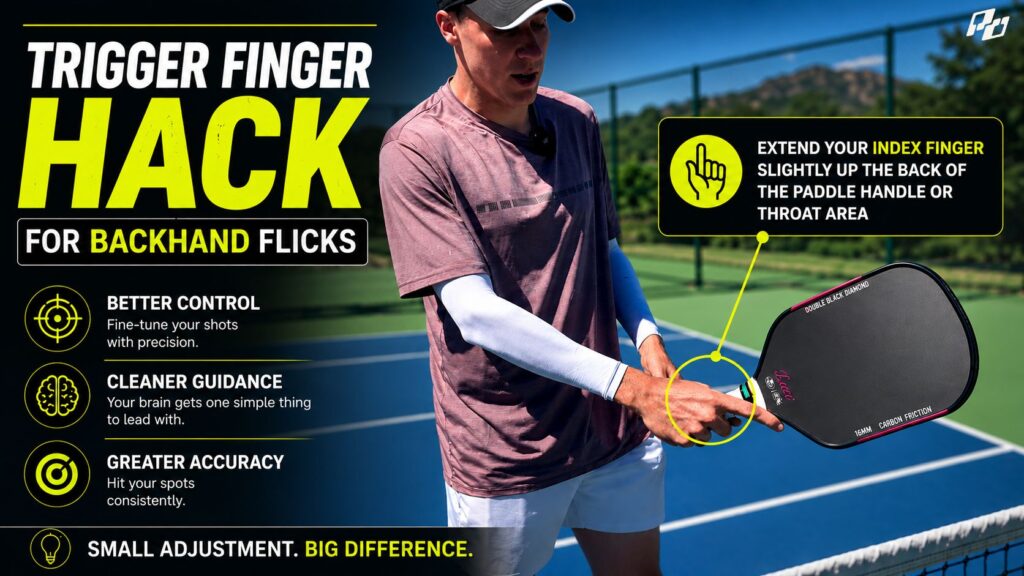
That does two useful things.
| What It Helps | Why It Matters |
|---|---|
| Paddle-face awareness | You feel where the face is pointing without thinking about the whole paddle head. |
| Wrist stability | It discourages the loose, floppy wrist that makes flicks spray or float. |
| Cleaner guidance | Your brain gets one simple thing to lead with instead of trying to control the entire swing. |
| Less over-snapping | You can create shape without turning the shot into a wrist-only gamble. |
This is the key distinction: The trigger finger does not create the flick for you. It helps organize the flick.
That is why it can feel like a cheat code for some players. It gives the hand a clearer steering wheel.
Why This Helps Rec Players More Than “Use More Wrist”
A lot of backhand flick advice gets misunderstood because players hear the word wrist and immediately overdo it.
Yes, the flick has wrist involvement. But if the wrist becomes the whole shot, the paddle face changes too much through contact.
That is when you see the classic misses:
- long because the face opens
- into the net because the wrist rolls over
- wide because the paddle cuts across the ball
- soft and attackable because there was no structure behind the snap
A better flick has a stable base, a clean paddle face, and just enough acceleration to put pressure on the opponent.
That lines up with what many coaches emphasize: the backhand flick works best when the ball is in front, the motion is compact, and the player can reload for the next shot instead of admiring the attack.
The trigger finger helps because it gives you a way to feel the paddle face without locking your entire hand.
Think of it like this: Your wrist supplies the pop. Your trigger finger keeps the face from getting sloppy.
That is the useful version.
The Trigger Finger Setup
Here is the reader-friendly version. Hold your paddle normally.
Now let your index finger extend slightly up the back of the handle or toward the paddle throat. You should feel like the finger gives you a better sense of the paddle face.
You are not trying to make the grip weird. You are trying to make the paddle face easier to track.
The pressure should stay light. If the finger is jammed, stiff, or tense, it defeats the purpose.
Good feeling: the finger guides the paddle face.
Bad feeling: the finger locks the wrist and makes the hand rigid.
You still need relaxed acceleration. You just do not want a wrist that flops around with no face control.
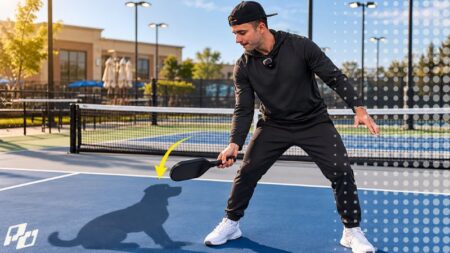
Roscoe Bellamy shows exactly where to place the trigger finger:
@roscoebellamy The trick I use to master the backhand flick! Click the link in my bio to join our 30 day challenge!
♬ original sound – roscoebellamy
Cue: “Point the face, then pop the shot.”
That means the finger organizes first. The acceleration comes second.
What It Should Feel Like
A clean backhand flick with the trigger finger should feel more guided than forced.
You should feel the paddle face stay connected to the finger as you move through the ball. The shot should not feel like you are throwing the wrist at the ball and hoping the face shows up correctly.
The best sensation is: stable face, quick finish, immediate reload.
If the paddle keeps drifting after contact, you are doing too much. If your wrist feels frozen, you are doing too little.
The trigger finger is not there to make the shot stiff.
It is there to make the shot readable to your hand.
Flick vs. Roll: Don’t Blend Them Into One Bad Shot
This is where intermediate players get stuck. The backhand flick and backhand roll are related, but they are not identical.
| Shot | Best Ball | Feel | Main Risk |
|---|---|---|---|
| Backhand flick | Ball high enough to attack quickly | Short, snappy, compact | Overusing wrist and losing face control |
| Backhand roll | Ball at or around net height where you need shape | More upward brush, more shoulder/arm shape | Scooping or floating |
| Backhand punch | Ball coming fast into your zone | Firm block/press | Hitting too big from too close |
Coach breakdowns often describe the flick as more wrist-driven and fast-twitch, while the roll uses more shoulder lift and controlled shape.
The trigger finger can help both shots, but in slightly different ways.
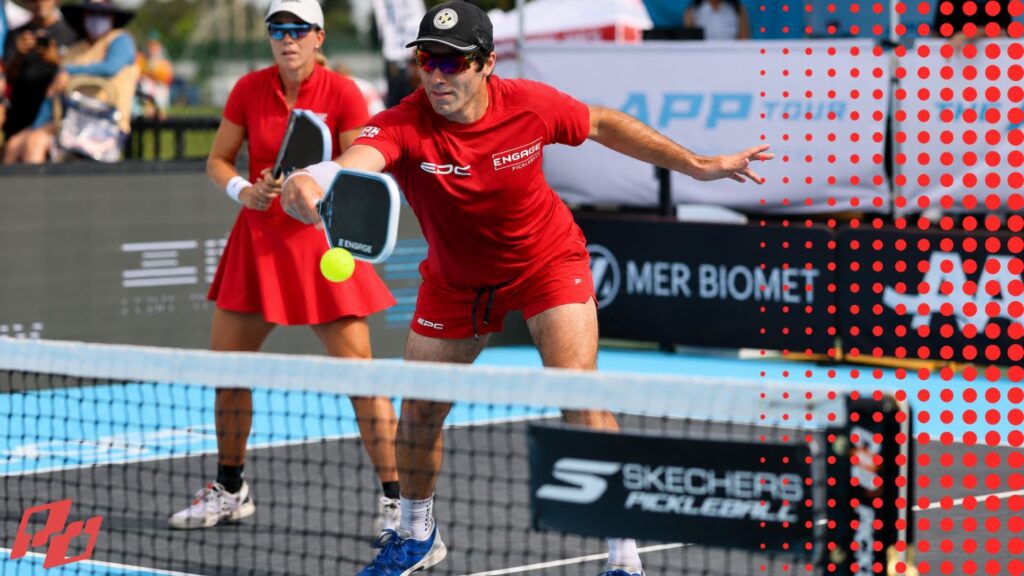
⮕ For the flick, it keeps the paddle face from flying open while you accelerate.
⮕ For the roll, it helps you guide the face through the upward brush without scooping.
The key is not naming the shot perfectly. The key is knowing whether you are trying to snap pressure or shape pressure.
The Mistake: Thinking the Finger Replaces Footwork
The trigger finger is useful, but it cannot save a bad contact point. If the ball is too close, too low, or already behind you, the finger will not magically fix it.
That is where players turn a good hack into a bad habit. They start reaching because the paddle feels more stable. Then the flick becomes a poke.
Use the trigger finger only after the body has earned the shot.
You still need:
- enough space
- contact in front
- a stable base
- a ball high enough to pressure
- a quick reload after contact
That is why this is an intermediate concept. It is not the whole technique. It is a refinement that makes an existing shot cleaner.
Cue: “Finger guides. Feet decide.”
If your feet did not put you in position, do not blame the finger.
The Drill That Makes It Stick
Start at the kitchen with a partner feeding soft balls to your backhand side. Your goal is not to rip the ball. Your goal is to feel the trigger finger guide the paddle face through contact.
Do three quick rounds:
Round 1: Face Control
Hit 10 slow backhand rolls or flicks at about 50% speed. Focus only on keeping the paddle face stable.
Round 2: Target Control
Hit 10 balls toward the middle seam or your opponent’s feet. Still controlled. No max-speed flicks yet.
Round 3: Decision Control
Have your partner mix in low dinks and slightly higher balls. Flick only the balls that sit up. Dink or reset everything else.
That third round is the important one.
Anyone can flick a perfect feed. The real skill is knowing which ball deserves the flick.
Practice rule: No clean window, no flick.
Quick Fixes for Common Misses
| What Happens | Likely Cause | Better Fix |
|---|---|---|
| Ball flies long | Wrist snaps open or paddle face lifts | Let the trigger finger keep the face calmer |
| Ball hits the net | You rolled over it or contacted late | Meet it farther in front |
| Ball floats | Too much lift, not enough forward pressure | Think forward through the target |
| Ball sprays wide | Paddle cuts across the body | Guide the face through the line longer |
| Shot feels weak | Grip is too tight or contact is too close | Relax the hand and create more space |
| You cannot reload | Follow-through is too big | Flick, finish, recover |
When This Hack Is Not for You
Not every player will like the trigger finger.
Skip it or use it carefully if:
⮕ It makes your hand tense.
The finger should guide, not freeze the paddle.
⮕ It bothers your finger, wrist, or elbow.
No tip is worth joint pain.
⮕ You already have clean face control.
Some players do not need the extra reference point.
⮕ You use a grip that makes the finger position awkward.
Do not force a grip change just to copy the idea.
⮕ It makes you flick too many balls.
That is the sneaky danger. A better-feeling flick can tempt you into bad shot selection.
The Cues That Actually Help
“Lead with the finger.”
Give your brain a smaller, clearer focus than the whole paddle.
“Stable face, quick pop.”
Do not make the wrist do everything.
“Finger guides. Feet decide.”
The hack helps only if your contact window is good.
“Flick to create the next mistake.”
Do not over-hit just because the shot feels cleaner.
“No clean window, no flick.”
Bad balls still need dinks, resets, or blocks.
This Is a Control Hack, Not a Power Hack
The trigger finger is useful because it solves the problem most rec players actually have.
Not lack of power.
Lack of face control.
A lot of players can generate enough speed on a backhand flick. What they cannot do is keep the paddle face organized while the point gets fast.
That is why this tip is worth trying.
It gives your hand a clearer job. It gives your brain a simpler focus. And it can make the flick feel less like a risky wrist shot and more like a guided pressure ball.
But use it with discipline.
If the ball is low, dink it.
If you are late, reset it.
If you are jammed, block it.
If the ball sits up in front, then use the trigger finger and make the opponent uncomfortable.
That is where this hack becomes valuable. Not because it makes the backhand flick flashier. Because it makes the shot calmer, cleaner, and much harder to read.