Pickleball Union earns a commission on purchases made through links in this article, at no extra cost to you. Our reviews are editorially independent – brands do not see or approve content before publication.
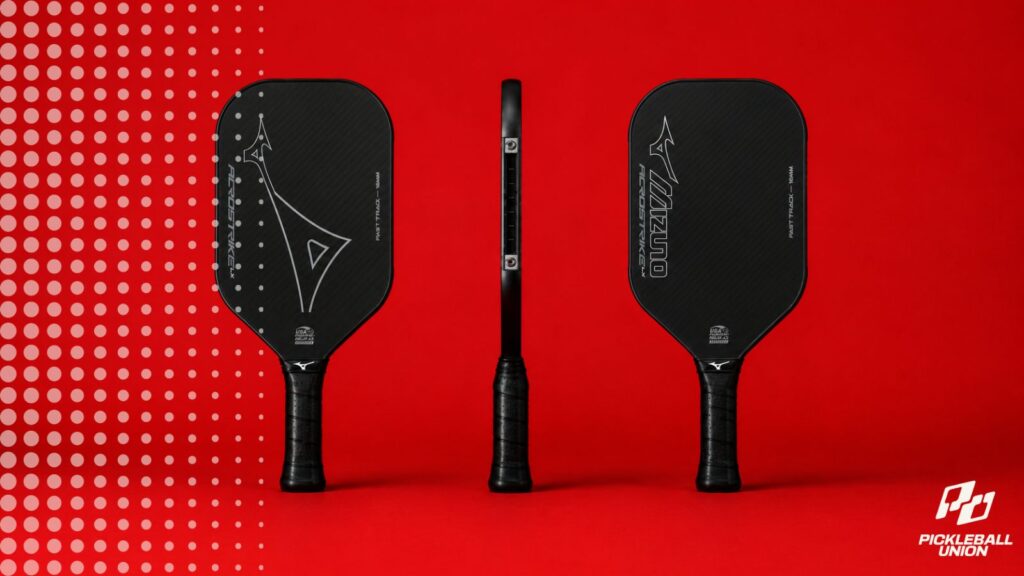
The Mizuno Acrostrike LX 16mm Elongated is best suited to experienced, balanced players who generate their own pace and want elite spin, solid stability, an edgeless shape, and an adjustable weighting system.
What happens when a 120-year-old Japanese sporting-goods brand enters pickleball? You get the Mizuno Acrostrike LX: an edgeless Gen 2 paddle with excellent spin, adjustable weighting, and a $294.95 price tag.
As a longtime runner, I’ve always associated Mizuno with quality since their shoes are top shelf, so I expected a lot. After a month of testing, though, I’m giving it 3.75 balls out of 5.
This all-court paddle improved as I adjusted to it and moved the weights higher. Control became more reliable, and the spin was outstanding. But the limited free power, smaller sweet spot, and premium price made it difficult to recommend over stronger alternatives.
A review tells you how a paddle played for us. The paddle quiz tells you which three fit you, scored on the same lab data.
It may suit experienced 3.5–5.0 players who generate their own pace and value spin, stability, and customization.
Players wanting easy power, more forgiveness, or better value should look elsewhere.
✅ Adjustable weight system
✅ Spin-enhancing carbon face
✅ Stable 16 mm core
✅ Elongated shape with long handle
✅ Larger edgeless hitting surface
Ten questions, three paddles matched to how you play, scored on lab data.
Quick Verdict
| Category | Takeaway |
|---|---|
| Overall feel | Solid, stable, head-heavy, and more demanding than forgiving |
| Power | Average and mostly player-generated |
| Control | Improved with acclimation but falls short of the best premium control paddles |
| Touch | Usable and increasingly predictable after adjustment |
| Spin | Elite; clearly the paddle’s strongest performance trait |
| Sweet spot | Smaller and less forgiving than expected |
| Hand speed | Better than the head-heavy measurements suggest |
| Stability | Strong, especially on reasonably centered contact |
| Best trait | Exceptional spin plus easy weight customization |
| Main tradeoff | Premium price without premium all-around performance |
| Bottom line | A specialized, customizable spin paddle for experienced players—not a safe recommendation for everyone |
Pros
✅ Elite spin potential
✅ Adjustable Fast Track weighting system
✅ Solid stability and consistency
✅ Elongated shape provides useful reach
✅ Faster in hand than the head-heavy balance suggests
✅ Edgeless design offers a clean, modern look
✅ Improved control and touch after acclimation
✅ Strong build quality from an established sporting brand
✅ USA Pickleball approved
Cons
❌ Expensive at $294.95
❌ Limited free power
❌ Small and less-forgiving sweet spot
❌ Requires meaningful acclimation
❌ Traditional Gen 2 honeycomb construction at a premium price
❌ Shorter handle than many elongated paddles
❌ Surface-grit durability is still unknown
❌ Not ideal for beginners
❌ Strong alternatives cost substantially less
Who This Paddle Is For | Who Should Skip It
| Who This Paddle Is For | Who Should Skip It |
|---|---|
| ✔ Experienced 3.5–5.0 players | ✖ Beginners needing easy forgiveness |
| ✔ Players who generate their own pace | ✖ Players looking for effortless power |
| ✔ Spin-heavy all-court players | ✖ Players who regularly miss outside the sweet spot |
| ✔ Players who like elongated paddles | ✖ Players wanting a long two-handed-backhand handle |
| ✔ Players who appreciate head-heavy stability | ✖ Players who strongly prefer head-light paddles |
| ✔ Players who enjoy adjusting paddle weight | ✖ Players who want a simple, ready-to-go setup |
| ✔ Mizuno fans who trust the company’s engineering | ✖ Value-conscious buyers |
| ✔ Players comfortable with traditional honeycomb cores | ✖ Players specifically seeking modern foam-core technology |
Mizuno Acrostrike LX Specs and Build
| Category | Details |
|---|---|
| Shape | Elongated and edgeless |
| Length | 16.375 inches |
| Width | 7.375 inches |
| Core thickness | 16 mm |
| Grip length | 5.2 inches |
| Grip circumference | 4.25 inches |
| Weight tested | 8.35 ounces |
| Marketed average weight | 8.4 ounces |
| Core | Thermoformed polypropylene honeycomb |
| Face | MZ-36C carbon |
| Surface | SpinTek coating |
| Grip | Tennis-style comfort grip |
| Weighting system | Fast Track movable side weights |
| Included accessory | Torx wrench for weight adjustment |
| Colorway | Black with silver graphics |
| Approval | USA Pickleball approved |
| Warranty | One-year manufacturing-defect warranty |
| Price | $294.95 |
What Makes the Acrostrike LX Different
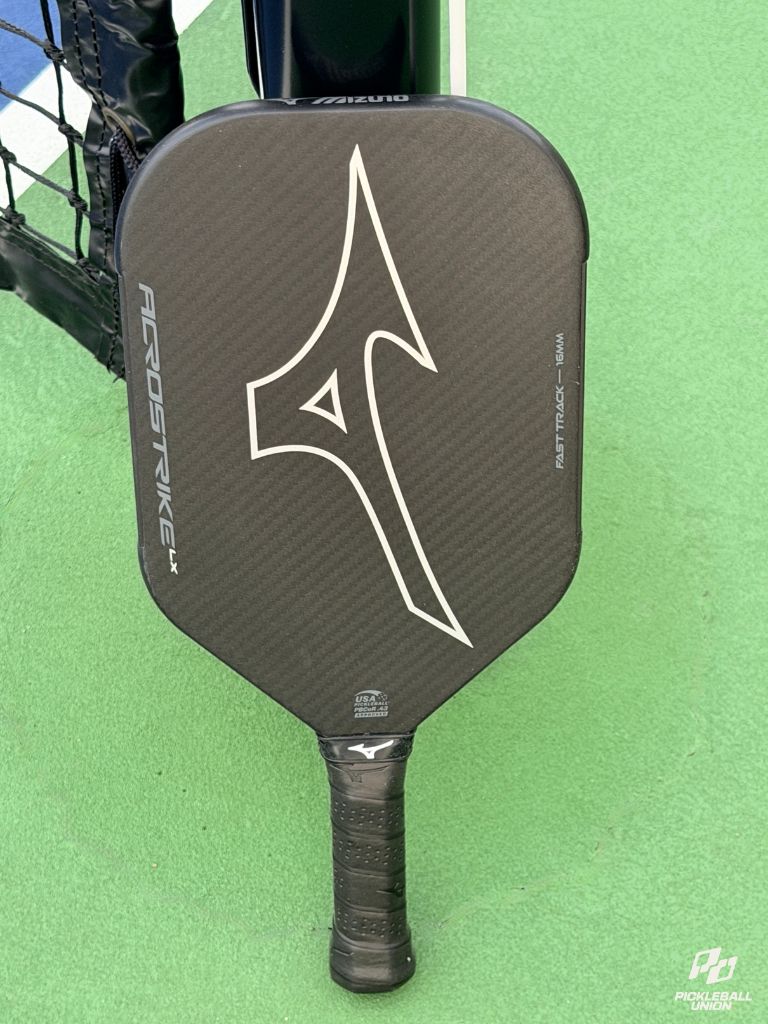
The Acrostrike combines a thermoformed honeycomb core, edgeless elongated shape, and Mizuno’s MZ-36C carbon face.
Its Gen 2-style construction is proven, but not especially new for a paddle priced at $295. The real standouts are the SpinTek surface and Fast Track weighting system.
SpinTek produced excellent bite on serves, drives, rolls, and dinks. The movable side weights can be repositioned with the included Torx wrench, letting you add plow-through up top or preserve more hand speed lower on the face.
The system is simple, useful, and cleaner than adding aftermarket tape.
First Impressions
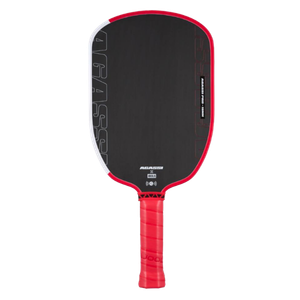
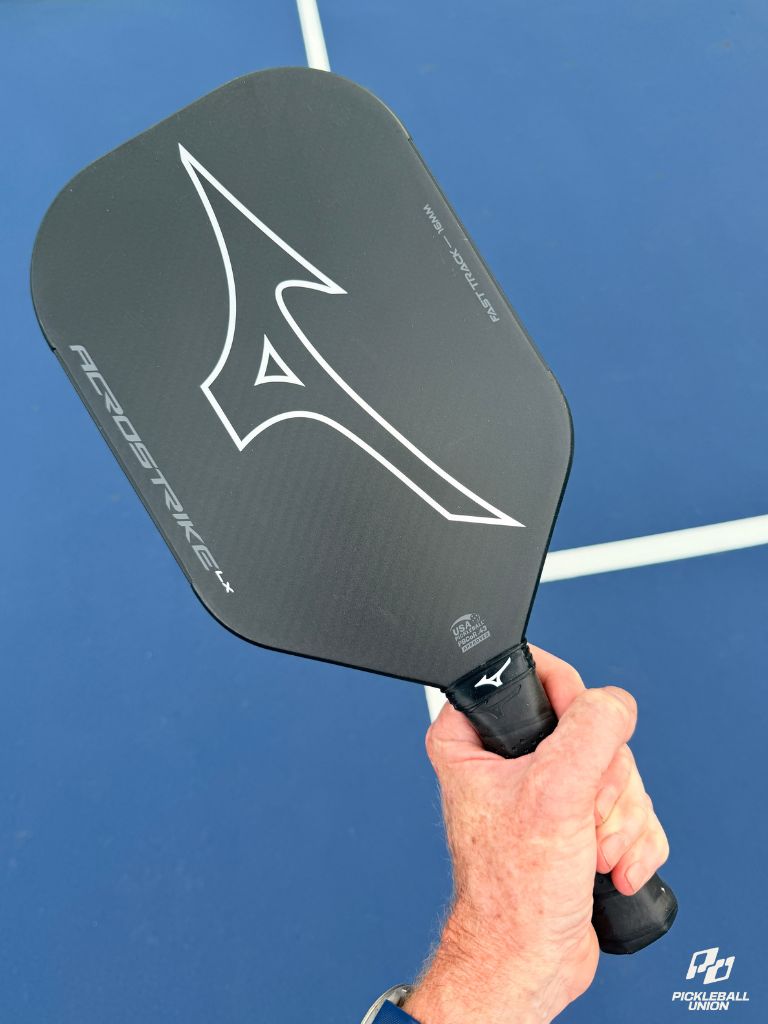
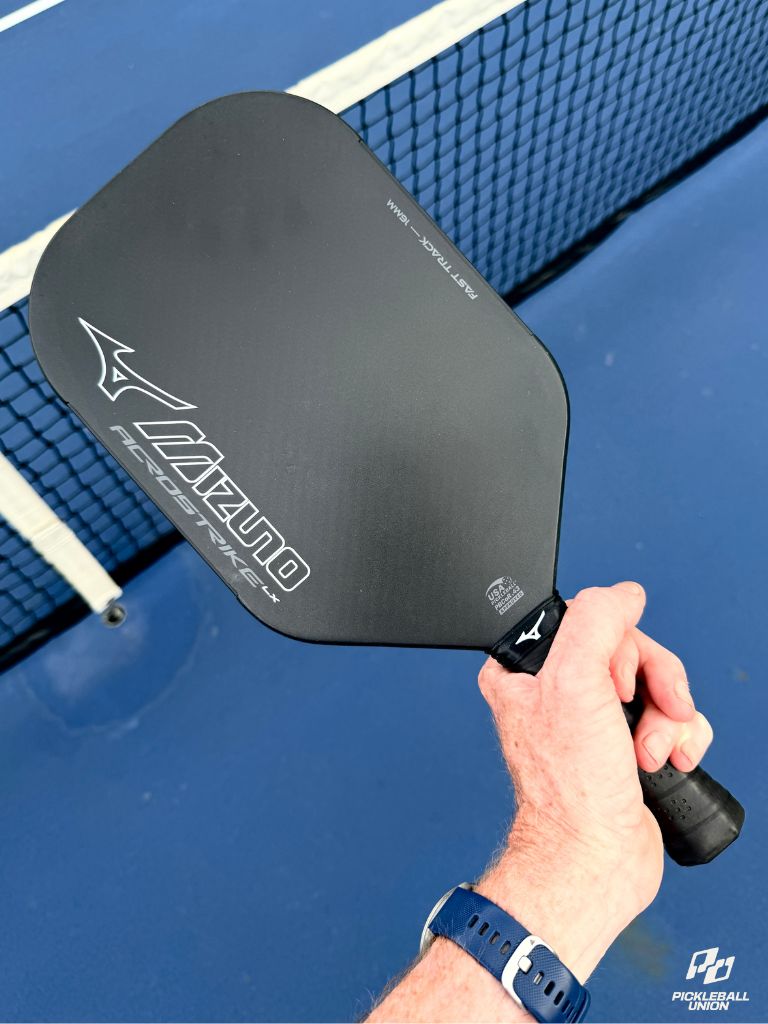
The Acrostrike LX has a thin, simple, understated appearance.
The black face, silver Mizuno branding, subtle carbon pattern, and edgeless outline give it a sleek look without much visual noise. The movable side weights are the most noticeable design element.
It reminded me of earlier CPX designs crossed with the adjustable bolt system on the Adidas Metalbone.
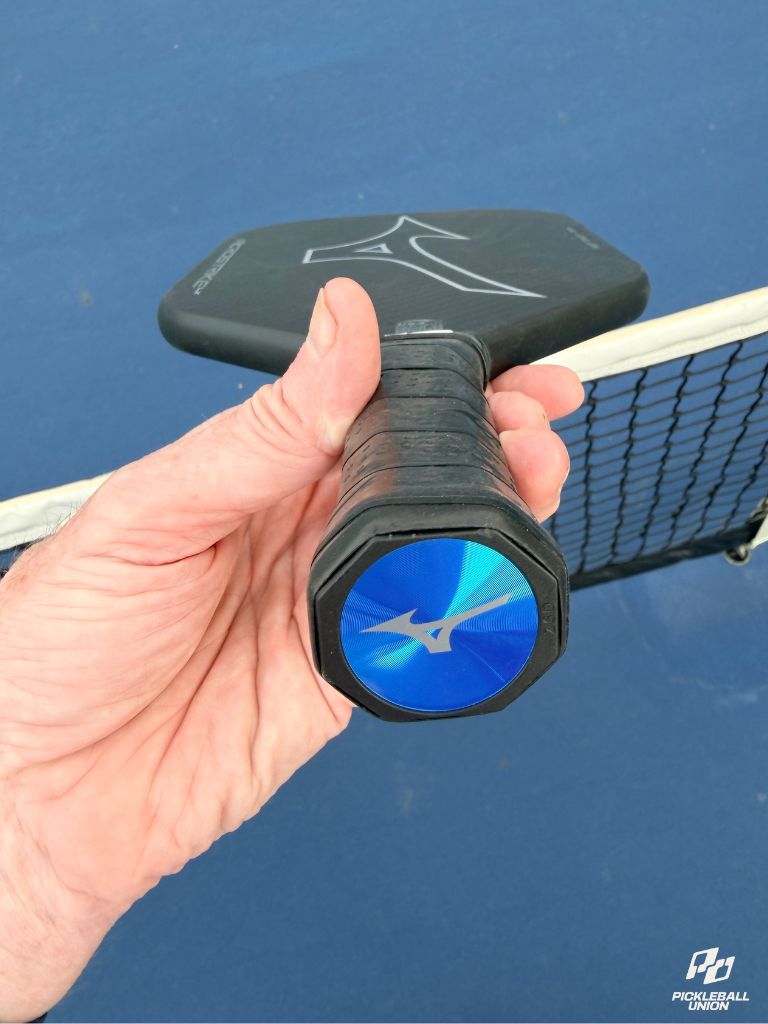
The grip had average tackiness, and the 4.25-inch circumference worked well. The 5.2-inch handle was shorter than I prefer, especially on an elongated paddle, but it should be adequate for most one-handed players.
Two-handed backhand players may want more space.
The surface felt moderately gritty by hand. It did not immediately feel as extreme as some highly textured paddles, but that impression proved misleading once I started playing. The spin performance was excellent.
Despite the 8.35-ounce tested weight and very head-heavy Paddle Lab balance measurement, the paddle did not feel especially cumbersome during practice swings.
I kept the weighting system in its stock position for the first two sessions. That eventually changed.
Game On… Playtesting
My first 15 minutes with the Acrostrike made me want to grab another paddle.
After an hour of drilling, I still struggled with placement, found very little free power, and expected more from a paddle with nearly a $300 price point.
The second session was slightly better. My soft game improved, and the excellent spin became obvious on serves, rolls, and shaped shots. Power, however, still required too much effort.
Before session three, I moved the adjustable weights to the top positions. The paddle became more head-heavy, but the added plow-through produced noticeably better pace.
Over the next three weeks, my control, touch, and confidence improved as I adjusted to the paddle. I also learned to use its spin more effectively.
But the price remained difficult to ignore.
At the premium price point, the Acrostrike needed to compete with the best premium paddles available. For me, it never quite got there.
Paddle Performance
1. Power ★★★¾☆
Power was average at best.
The elongated shape and head-heavy weighting provide some natural leverage, but the ball does not jump from the face the way it does with true power paddles.
I had to generate most of the pace with swing speed and body rotation.
Moving the Fast Track weights toward the top improved plow-through and made drives and serves more effective, but even then, the Acrostrike did not approach the free power of the JOOLA Agassi Pro, Selkirk Boomstik, or CPX Ultra.
Players with strong mechanics can still create pace. Players hoping the paddle will supply it may be disappointed.
2. Control ★★★¾☆
Control improved considerably after several sessions.
Once I became comfortable with the response, crosscourt dinks, drops, and targeting became more dependable.
However, the paddle never reached the control level of my favorite premium options. It did not provide the same combination of plushness, dwell, forgiveness, and predictable response I experienced with paddles such as the Selkirk OMNI or CRBN TruFoam models.
The smaller sweet spot also affected confidence. When contact moved farther from center, accuracy and feel dropped more sharply than I would expect from a paddle in this price category.
3. Touch
Touch was initially difficult to read.
The paddle did not feel excessively lively, but I still struggled to judge distance and placement in the first sessions.
With time, the response became easier to predict. Resets, dinks, and softer volleys improved as I learned how much input the paddle needed. Players willing to spend time adapting may find usable touch.
I would not describe it as immediately intuitive.
4. Sweet Spot & Forgiveness
This was one of the weakest parts of the paddle for me.
The useful hitting area felt much smaller than on most premium paddles I have recently tested. Clear mishits lost more quality, and the edgeless elongated shape did not provide the broad, confidence-building forgiveness found in several modern foam and widebody designs.
The paddle is stable when contact is reasonably good. That does not mean the sweet spot feels large.
Those are related but different qualities: stability describes resistance to twisting and variation at impact, while forgiveness describes how much useful performance remains when contact moves farther from center.
The Acrostrike performed better in the first category than the second.
5. Spin ★★★★★
Spin is outstanding. This is the paddle’s clearest strength.
The SpinTek surface produced excellent bite on the ball, and Paddle Lab’s measured spin rate confirmed what I experienced on court.
I could shape serves, add dip to drives, roll balls at the kitchen, and create sharper crosscourt angles.
The Acrostrike belongs among the better spin-producing paddles I have tested.
The unanswered question is durability. Applied or coated surfaces can lose texture with use, and the one-month test period was not long enough to determine how well SpinTek will retain its peak performance.
6. Hand Speed & Maneuverability
The Acrostrike played faster than its measurements suggested.
It is head-heavy, but it never felt as slow or awkward as I expected. I could move between forehand and backhand blocks reasonably well and did not feel significantly late during normal kitchen exchanges.
It is not the quickest paddle I have tested. The Franklin C45 Tempo and Versix Vector XL remain better options for pure hand speed.
Still, the Acrostrike was surprisingly manageable for an 8.35-ounce elongated paddle with a 9.66-inch balance point.
7. Stability
Stability was solid.
The head-heavy balance and higher swing weight helped the paddle resist movement at contact, especially on blocks, drives, and firmer volleys.
This lined up with Paddle Lab’s consistency result.
Again, stability should not be confused with a large sweet spot. When I struck the ball within a reasonable central area, the response was repeatable. Bigger misses were less forgiving.
The Fast Track Adjustable Weighting System
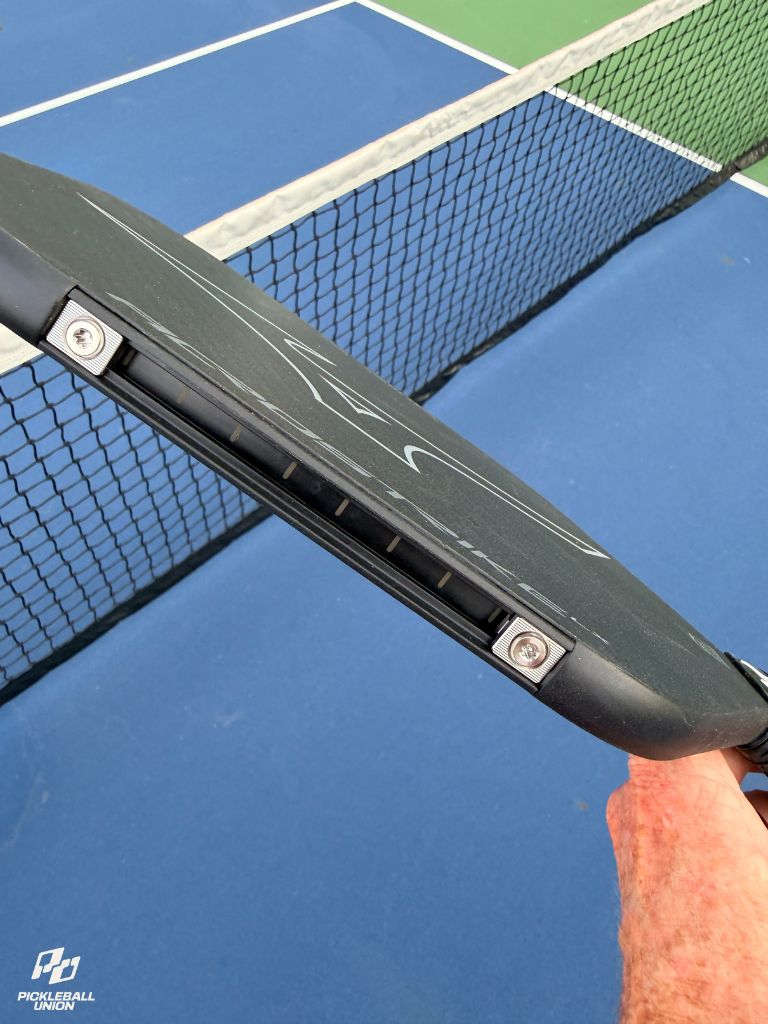
The Fast Track system is one of the best reasons to consider this paddle.
The removable bolt-style weights can be repositioned along the sides of the face using the included Torx wrench.
Moving the weights higher increases swing weight, plow-through, and potential power. Keeping them lower should make the paddle easier to maneuver.
I generally test paddles in their stock configuration, but the Acrostrike’s adjustability is a central part of its design. Repositioning the supplied weights still felt like testing the paddle as intended.
With the weights in the upper positions, I found better drive and serve performance. The paddle became more head-heavy, but the increase in power was worth the tradeoff for me.
The system will appeal to players who enjoy fine-tuning equipment but dislike applying and removing strips of lead tape. With the Fast Track weighting system, you can change the weighting as often as you like without the hassle of adhesive weights.
It is practical, clean, and genuinely useful—not a gimmick.
How Paddle Lab’s Data Compares
JustPaddles’ Paddle Lab uses standardized testing to measure spin, exit velocity, consistency, balance point, and swing weight, giving players an objective comparison alongside real-world playtesting.
For the Mizuno Acrostrike LX, Paddle Lab recorded:
| Metric | Result | What It Means |
|---|---|---|
| Spin rate | 1,556.79 RPM | Elite spin potential |
| Consistency | 2.61 SD | Highly repeatable output |
| Exit velocity | 39.50 MPH | Good speed potential, but below true power paddles |
| Balance point | 9.66 in | Clearly head-heavy |
| Swing weight | 956.74 oz/sq in | Strong plow-through and stability |
The spin, balance, and swing-weight numbers matched my experience. Spin was the paddle’s best feature, while the head-heavy setup helped stability and improved pace when I moved the weights higher.
The main difference was power. Paddle Lab classifies it as a good power hitter, but I found very little free pop during games. That is not necessarily a contradiction: exit velocity measures speed under controlled conditions, while on-court power also reflects how easily a paddle produces pace on compact counters, defensive swings, serves, and putaways.
The consistency score also does not mean the paddle has a large sweet spot. It appears highly repeatable within its effective hitting area, but noticeable mishits still felt less forgiving than on several competing premium paddles.
That is why the two perspectives work well together: Paddle Lab shows what the paddle can produce under controlled testing, while playtesting shows how easily that performance translates into real points.
How the Mizuno Acrostrike Compares to Other Paddles I’ve Tested
At nearly $295, the Acrostrike competes against some of the strongest premium paddles available.
| What You Care About | How the Acrostrike Performs | Paddles That Compete Closely |
|---|---|---|
| Power | Average and player-generated | Franklin FS Tour Tempo 12, Head Radical Pro EX 15, Avoura Revaya |
| Control | Solid after acclimation but not category-leading | Head Radical Pro EX 15, CPX Pro, CPX Air |
| Forgiveness | Below average for its price | Avoura paddles, Head Gravity Pro EX 15 |
| Spin | Elite | Selkirk OMNI, Boomstik, Holbrook Aero T, Holbrook Arma |
| Hand speed | Better than expected | Selkirk OMNI; behind Franklin C45 Tempo and Versix Vector XL |
| Stability | Strong within the effective hitting area | Several elongated thermoformed paddles |
| Customization | Excellent | Selkirk OMNI is the closest direct premium comparison |
| Value | Difficult to justify | Franklin C45, Bread & Butter Invader, Proton Series Four Roadrunner |
Best Alternatives If…
⮕ You want more power
JOOLA Agassi Pro, Selkirk Boomstik, or CPX Ultra
All three provide considerably more free pace. They are better options for players who want help on serves, drives, counters, and putaways.
⮕ You want a larger sweet spot
Selkirk OMNI, Bread & Butter Invader, or JOOLA Agassi Pro V
These options offer more forgiving hitting areas and better performance on off-center contact.
⮕ You want better control
Selkirk OMNI, CRBN TruFoam Wave, or JOOLA Perseus Pro IV
These paddles provide a more trustworthy combination of touch, dwell, and forgiveness.
⮕ You want faster hands
Franklin C45 Tempo or Versix Vector XL
The Acrostrike moves better than expected, but both alternatives feel quicker during rapid kitchen exchanges.
⮕ You want elite spin
Selkirk OMNI, Boomstik, Holbrook Aero T, Holbrook Arma, or Six Zero Double Black Diamond
Spin is the category where the Acrostrike genuinely belongs among top competitors.
⮕ You want a better-value Gen 2 all-court paddle
Franklin C45 series, Bread & Butter Invader, or Proton Series Four Roadrunner
These paddles cost approximately $70–$130 less while providing strong all-court performance.
⮕ You want a premium customizable paddle and price is not a concern
The OMNI is the clearest direct alternative. It costs roughly the same, also provides an integrated weighting system, and offers a larger sweet spot, better control, and greater overall forgiveness.
FAQ: Mizuno Acrostrike LX 16mm Elongated
1. Does the Mizuno Acrostrike need a break-in period?
It required a significant acclimation period for me.
My first two sessions were disappointing. Control, touch, and confidence improved over the next several weeks.
I cannot say whether the core physically changed or I simply adapted to the response, but I would not judge the paddle after one short session.
2. Is the Mizuno Acrostrike powerful?
It offers usable power, but most of it is player-generated.
Paddle Lab recorded a 39.50 MPH exit velocity, indicating good speed potential. During games, however, I needed strong mechanics and acceleration to access that pace.
3. Does it have a large sweet spot?
Not in my experience.
The paddle felt consistent on reasonably centered contact, but obvious mishits lost more performance than they did with many competing premium paddles.
4. Is the Acrostrike good for spin?
Yes.
Spin is exceptional and arguably the best reason to buy the paddle. Paddle Lab measured 1,556.79 RPM.
5. Is it good for control?
Control became solid after acclimation, particularly for dinks and softer kitchen shots.
It does not match the best premium control paddles for forgiveness, dwell, or immediately predictable touch.
6. Is the paddle head-heavy?
Yes.
Paddle Lab measured the balance point at 9.66 inches. On court, it felt quicker than that figure might suggest.
7. How useful is the adjustable weighting system?
Very useful.
The Fast Track system makes it easy to add more head weight or preserve maneuverability without applying aftermarket tape.
Moving the weights higher improved power and plow-through during my testing.
8. Is the handle suitable for two-handed backhands?
The 5.2-inch handle may feel short to players who regularly use two hands. Players with smaller hands or compact grips may find it adequate.
9. Is the SpinTek surface durable?
That remains unknown.
The initial spin is excellent, but longer-term testing is needed to determine how quickly the applied texture wears.
10. Is the Mizuno Acrostrike good for beginners?
Probably not.
The smaller sweet spot, limited free power, adjustment period, and premium price make it a better fit for experienced players.
11. Is the Mizuno Acrostrike worth $294.95?
For most players, I do not think so.
The spin and weighting system are excellent, but other paddles offer more complete performance or better value.
Players who strongly prefer Mizuno, generate their own pace, and enjoy equipment customization may feel differently.
The Final Score
| Category | Rating (1 Out of 5) |
|---|---|
| Design / Build | 🎾🎾🎾🎾¼ |
| Grip | 🎾🎾🎾🎾 |
| Control | 🎾🎾🎾¾ |
| Spin | 🎾🎾🎾🎾🎾 |
| Power | 🎾🎾🎾¾ |
| Price Point / Value | 🎾🎾½ |
| Overall | 🎾🎾🎾¾ |
I expected a lot from Mizuno, and the Acrostrike LX does deliver elite spin, useful weight customization, solid stability, and better hand speed than its head-heavy specs suggest.
But at $294.95, that isn’t enough to outweigh the small sweet spot, limited free power, short handle, and lengthy adjustment period.
Players who generate their own pace and value spin and customization may enjoy it. Everyone else should demo before buying.
At nearly $300, the paddle needs to do more than feel interesting. It needs to make you play better.
Pickle on, my friends… pickle on.