Get more from your pickleball paddle by adjusting grip pressure, hand position, weighting, and setup to match your game. Small changes can improve touch, stability, power, and maneuverability—often without buying a new paddle.
You can spend $300 on a paddle with elite spin, a huge sweet spot, and carefully engineered balance—and still make it play like a $50 paddle.
Not because the paddle is bad.
Because you are part of the equipment system.
Grip pressure changes how much pace the paddle absorbs. Hand position changes leverage and maneuverability. A few grams of weight can alter stability and swing weight. Even dirt embedded in a textured face can affect how consistently the surface interacts with the ball.
That means before buying another paddle, it is worth asking a more useful question:
Am I actually getting everything my current paddle can give me?
For many recreational players, the answer is no.
Here are the adjustments that make the biggest difference.
1. Stop Using One Grip Pressure for Every Shot
Grip pressure is probably the most underused paddle adjustment because it costs nothing and can change from shot to shot.
Coaches commonly use a 1–10 scale, where 1 means the paddle could almost be pulled from your hand and 10 is a maximum squeeze. For dinks, drops, and resets, instruction frequently falls around 3–5 out of 10. A softer hand allows the paddle to absorb more incoming pace instead of rebounding it aggressively.
That does not mean every shot should be hit at a 3. A useful starting point is:
| Shot | Approx. Grip Pressure | Why |
|---|---|---|
| Dink | 3–4/10 | More feel and less rebound |
| Reset | 3–4/10 | Helps absorb incoming pace |
| Drop | 3–5/10 | Keeps the stroke relaxed and controllable |
| Punch volley / counter | 5–7/10 | More stability against incoming pace |
| Drive / serve | 5–7/10 | Supports acceleration without locking the arm |
| Overhead / putaway | 6–8/10 | Firmer contact when maximum stability matters |
Those are cues, not laboratory prescriptions. The real mistake is staying at 7 all the time.
If you death-grip a plush control paddle during resets, you reduce one of the characteristics you paid for: its ability to soften pace.
Likewise, if your hand remains extremely loose during a hard counter, the paddle can become less stable at impact.
Think of grip pressure as part of shot selection.
Cue
Soft shot, softer hand. Hard contact, firmer hand. Relax again immediately.
That final part matters. Do not remain tense after the ball leaves.
2. Use Your Hand Position as a Leverage Adjustment
Where you hold the handle also changes how the paddle behaves.
Holding closer to the bottom of the handle effectively gives you a longer lever. That can help produce paddle-head speed and reach on serves and drives.
Choking up slightly shortens that lever. Some players find this makes the paddle easier to control during fast kitchen exchanges because there is less paddle extending beyond the hand.
This is not a universal rule, and I would not recommend constantly sliding your hand around during every rally.
But it is worth experimenting with if:
- your paddle feels slow at the kitchen
- you use an especially long handle
- you struggle to control the paddle during hand battles
- your baseline strokes feel underpowered despite good mechanics
Try moving the hand only half an inch before making a major change.
At the baseline, test your normal grip and then one slightly lower.
At the kitchen, test your normal grip and then one slightly higher.
You may discover that the paddle itself is not too slow or too weak—you simply prefer a different leverage point for different parts of the court.
The tradeoff is important:
Lower hand = more leverage and reach. Higher hand = less leverage but potentially easier maneuverability.
Do not sacrifice useful reach at the kitchen simply because choking up sounds advanced.
3. Add Weight to Fix a Specific Problem—not to “Upgrade” the Paddle
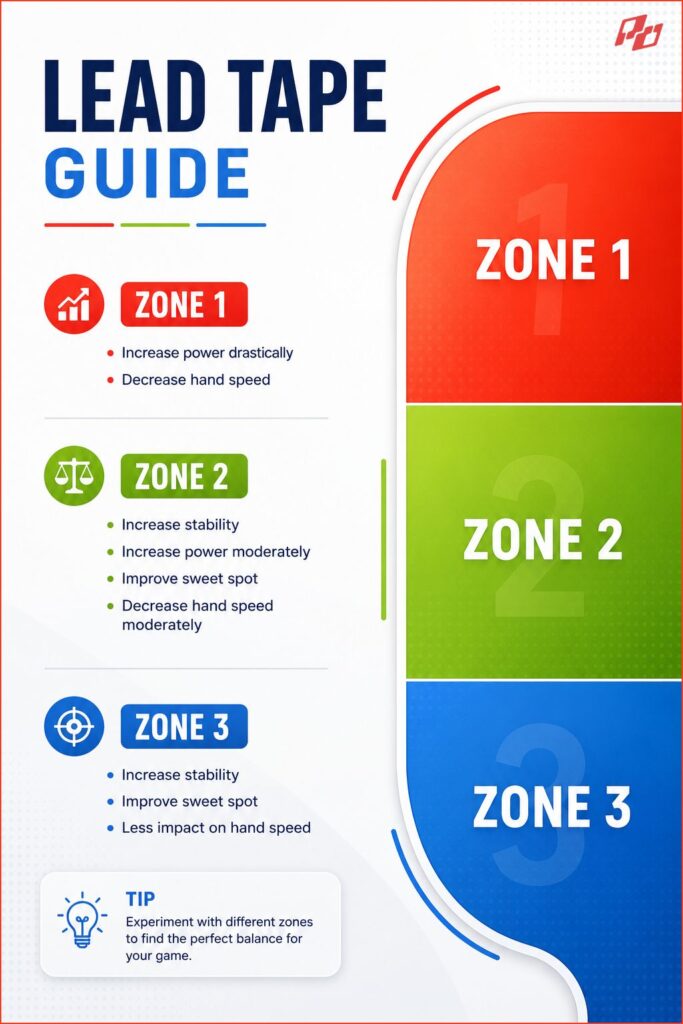
Weighted tape is one of the most effective ways to change how a paddle plays, but recreational players often use it backwards.
They hear:
“Lead tape makes the paddle better.”
Then they put six grams around the edge and wonder why their hands suddenly feel slow. Weight placement changes where the paddle resists movement.
Paddle Lab testing explains two important measurements:
- Swing weight describes how difficult the paddle is to accelerate and reposition.
- Twist weight describes how strongly it resists rotating on off-center contact.
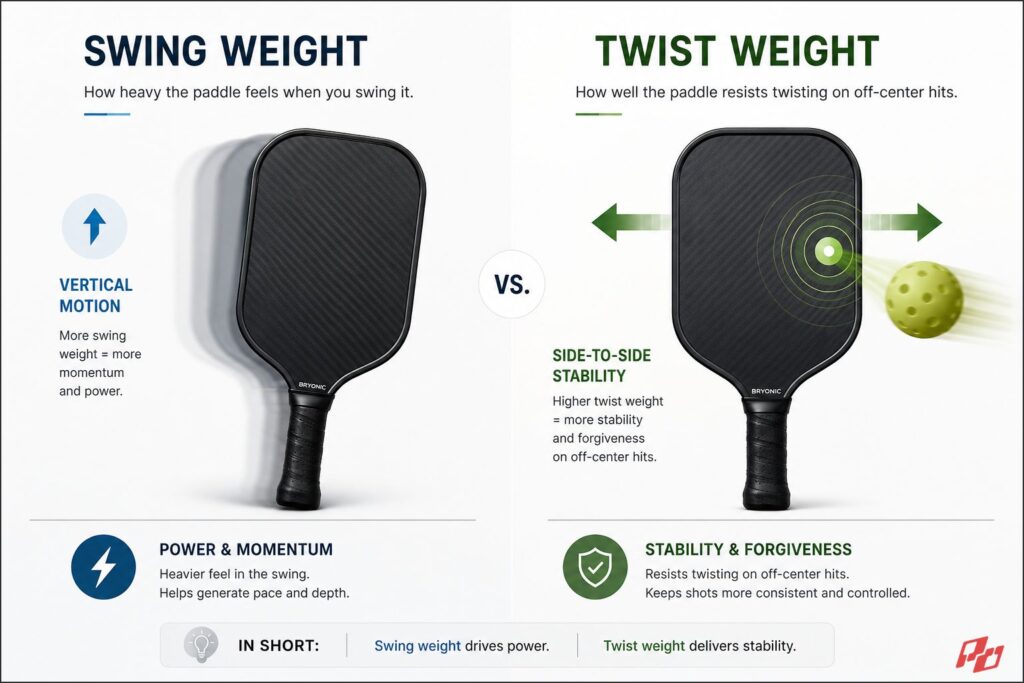
That means tape placement should solve a specific complaint.
⮕ If you want more plow-through and power
Add a small amount near 12 o’clock or the upper corners.
Weight farther from your hand raises swing weight more noticeably, increasing momentum through the ball—but also making the paddle slower to reposition.
⮕ If the paddle twists on mishits
Try weight around 3 and 9 o’clock.
This increases resistance to twisting and can make off-center contact feel more forgiving. Technically, you are not magically enlarging the physical sweet spot; you are making the paddle more stable when you miss it slightly.
⮕ If you want stability without destroying hand speed
Start lower—around the lower sides or throat area.
Weight closer to the hand adds mass while increasing swing weight less dramatically than weight near the tip.
⮕ Best rule
Start with 2–4 grams total, play several sessions, then adjust.
Do not turn your paddle into a physics experiment after one bad game.
4. Stop Treating “Sweet Spot” as Something the Manufacturer Owns
Your paddle may have a large sweet spot. That does not mean you are using it.
Many intermediate players consistently contact the ball slightly high, low, or toward one edge of the face and then blame the paddle for feeling inconsistent.
Do a simple test.
Have a partner feed 20 controlled balls while you deliberately pay attention to where contact occurs. If possible, use removable impact tape or inspect ball marks on the face.
Then compare:
- centered contacts
- upper-face contacts
- lower-face contacts
- outside-edge contacts
If most of your poor shots come from one area, the problem may not be the paddle. It may be spacing.
This is particularly useful with elongated paddles, which can offer extra reach but may also feel less forgiving laterally than widebody shapes.
A high twist-weight paddle can reduce how much the paddle rotates on mishits, but no weighting system completely compensates for poor contact. Paddle Lab’s testing shows why: higher twist weight improves stability when impact moves away from center, but it does not make every part of the face identical.
Cue
Before changing paddles, find out where you actually hit yours.
5. Match the Grip Size to Your Hand Before Changing the Paddle
Players obsess over cores and carbon fiber while ignoring the only part of the paddle they physically hold.
A grip that is too small may encourage excess squeezing or make the paddle rotate more in the hand.
A grip that feels too large can make grip changes and fine wrist adjustments uncomfortable.
The fix may be as simple as:
✔️ Adding an overgrip
✔️ Replacing a compressed factory grip
✔️ Slightly building up the handle
✔️ Reducing excessive wrap buildup
This can also change balance.
Adding weight to the handle moves the paddle’s overall balance slightly toward your hand. It will not transform a very head-heavy paddle into a hand-speed monster, but it can change how the paddle feels in motion.
The key is to change one variable at a time.
If you add an overgrip, six grams of tape, and a new edge guard simultaneously, you will have no idea which change helped.
6. Clean the Face Before Declaring the Spin “Dead”
Spin surfaces collect ball residue, dust, and grime.
On textured carbon and high-grit faces, that buildup can reduce how cleanly the surface interacts with the ball.
Some manufacturers recommend periodically cleaning paddle faces with a microfiber cloth and a mild soap-and-water solution while avoiding aggressive chemicals that could damage the surface.
Do not assume every paddle should be scrubbed with an abrasive carbon eraser. Surface technologies differ, and an aggressive cleaning method appropriate for one raw-carbon face may damage another coated or applied-grit surface.
Check the manufacturer’s instructions first.
And remember: Cleaning restores a dirty surface. It does not restore physically worn-off grit.
If a coating has genuinely worn smooth, no cleaning trick will make it new again.
7. Give the Paddle Enough Time Before “Fixing” It
One of the easiest ways to hold back a great paddle is constantly changing it.
New paddle Monday.
Lead tape Tuesday.
Different overgrip Wednesday.
Weights moved Thursday.
Back to the old paddle Friday.
You never learn what any configuration actually does.
There is also a motor-learning component. A different swing weight, balance point, launch response, or handle length changes your timing.
If you switch from a light control paddle to a head-heavy power paddle, your contact point may initially be late.
That does not automatically mean the new paddle has slow hands. Your timing may simply still be calibrated to the old one.
Unless something is obviously wrong, give a new setup several focused sessions before making another adjustment.
During those sessions, evaluate specific shots:
- third-shot drop
- counter
- serve
- drive
- reset
- dink
- overhead
Do not judge the paddle based on whether you won three recreational games.
8. Tune the Paddle Around Your Miss—not Your Fantasy Game
This is the biggest mistake I see with customization. Players build the paddle for the player they want to be.
Not the player they actually are.
A 3.5 player who already hits hard but misses the sweet spot does not necessarily need tape at 12 o’clock for more power. They may need stability at 3 and 9.
A player with excellent touch but weak serves may benefit from slightly more head weight.
A player constantly late in firefights may need to remove weight instead of adding more.
Ask:
What ball am I losing most often because of the paddle’s current setup?
Then make one adjustment. That is much more useful than asking:
“How do I make this paddle better?”
How I’d Tune a Paddle Before Buying Another One
If I liked a paddle but felt something was missing, I would not immediately replace it. I would run four tests.
First, I would deliberately vary grip pressure and see whether my touch problems are actually hand-tension problems.
Second, I would map where I am making contact on the face.
Third, I would decide whether I need more swing weight or more twist stability—because those are not the same thing.
Finally, I would make sure the grip and surface are in good condition.
Only after that would I start shopping. Because the truth is that a great paddle does not automatically produce great paddle performance.
You still have to give it the conditions it was designed for.
Sometimes the biggest paddle upgrade costs $300.
Sometimes it is loosening your hand from a 7 to a 4.