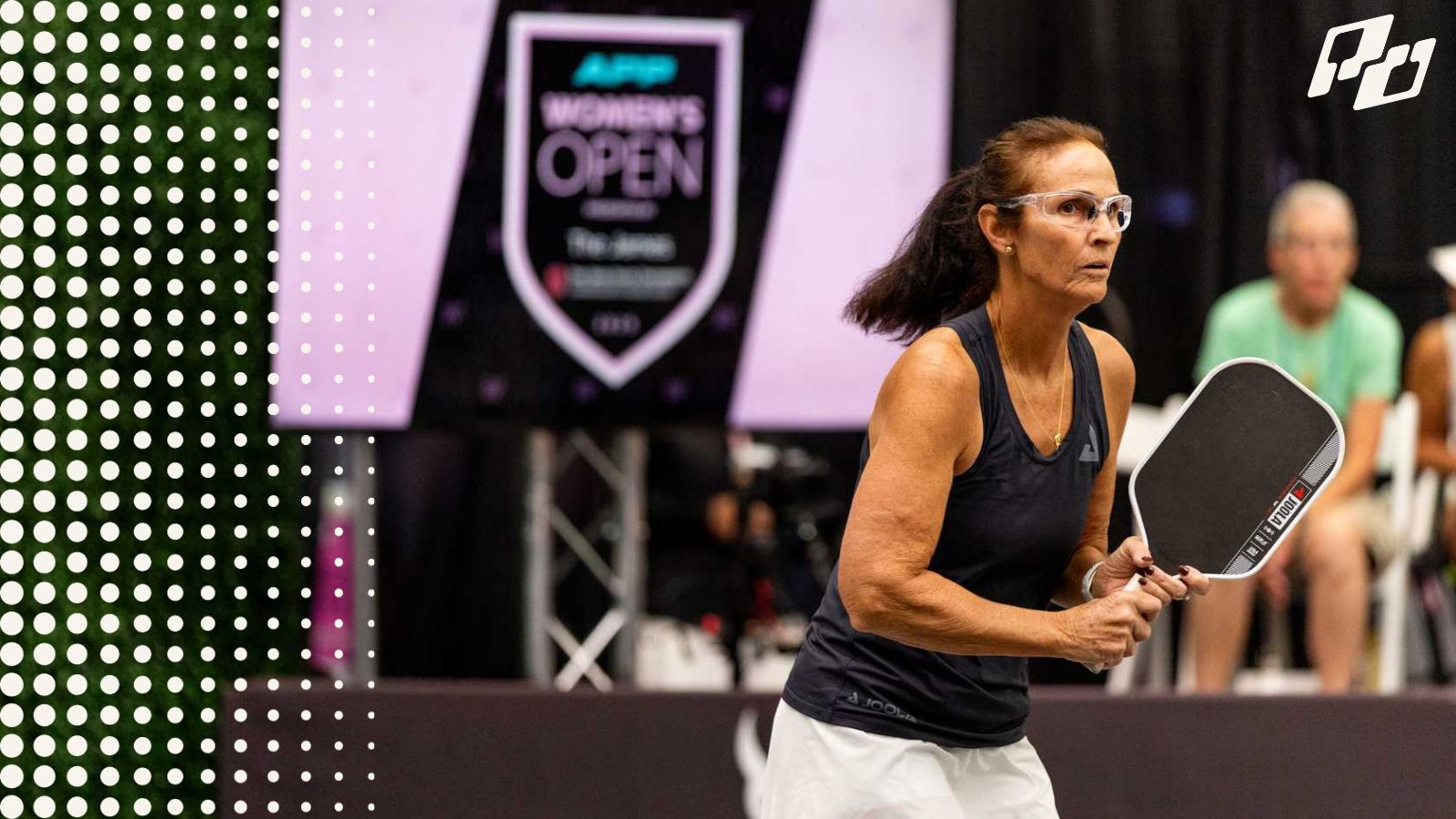
Choking up on a pickleball paddle means moving your hand higher on the handle to shorten the lever. This can increase hand speed, improve reset stability, and enhance dink control — but it reduces reach and slightly limits leverage on drives and serves. It’s most useful for players who prioritize quick kitchen exchanges and control over maximum power.
We recently came across some advice from Mari Humberg about choking up on the paddle, and it caught our attention — especially since so many rec players are experimenting with grip position right now.
On the surface, it sounds minor. Just move your hand up a little.
But grip position changes leverage, paddle speed, reach, stability, and even how your wrist handles pressure. This isn’t cosmetic — it’s mechanical.
And when a pro makes an adjustment like this, it’s usually a response to how fast the game is getting.
So let’s break down what choking up actually does, why it works for her, and when (and if) it makes sense for recreational players.
First: What “Choking Up” Actually Changes (Mechanically)

When you choke up, you shorten the lever. That’s the core idea.
A paddle is a lever system. The farther your hand is from the paddle face, the longer the lever arm.
Longer lever =
- More reach
- More whip potential
- More leverage
- Slightly more power ceiling
Shorter lever (choking up) =
- Faster maneuverability
- Less paddle lag
- Less torque on mishits
- Slightly less reach
- Slightly less maximum leverage
Think of holding a hammer.
Grip it at the bottom → more force, more reach.
Grip it higher → quicker control, less extension.
That’s exactly what Mari changed.
This lever change applies to both forehand and backhand, but the impact may feel different on each side. Players with weaker one-handed backhands may notice reduced reach, while two-handed backhand players may benefit more from added stability and hand speed.
On the forehand, the trade-off is usually between maximum drive leverage and quicker kitchen maneuverability.
Why It Works for Mari Humberg
Mari’s game is compact and aggressive at the kitchen. She thrives in:
- Fast hand battles
- Counter exchanges
- Quick resets
- Tight transition play
She’s not relying on huge baseline drives. She’s operating in compressed space. And in compressed space, maneuverability matters more than leverage.
1️⃣ Faster Hands
This is the most obvious benefit. When you shorten the lever, the effective swing weight drops and the paddle becomes easier to rotate. That means:
- The paddle accelerates faster
- The paddle stops faster
- Direction changes happen quicker
In hands battles, you’re not swinging big. You’re reacting. Choking up reduces “tip drag” — that feeling of the paddle head lagging behind your hand.
If you’ve ever felt slightly late in a kitchen firefight, this is why choking up can help. It doesn’t make you stronger.
It makes you quicker.
2️⃣ Better Resets
Resets are not about power. They’re about stability. When you hold at the very bottom of the paddle:
- The paddle head feels heavier
- Off-center contact creates more twist
- Your wrist absorbs more torque
When you choke up:
- The paddle feels more stable
- Mishits twist less
- The face feels easier to control
That’s why Mari noticed better resets. It’s not magic. It’s reduced lever stress.
For rec players who struggle with resets popping up or sailing long, this is where choking up can actually make a noticeable difference.
3️⃣ Dink Control Improves
This is a subtle but important one.
When your hand is closer to the paddle face, your feel improves. You gain better proprioception — meaning you feel the paddle angle more precisely. Dinks are tiny adjustments:
- 1–2 degrees of face angle matter
- 2–3 inches of depth matter
Choking up makes those micro-adjustments easier. That’s likely why Mari said her dinks improved.
Less wobble.
More face awareness.
Cleaner contact.
The Downsides (And They’re Real)
This is not a free upgrade. Every mechanical change costs something.
1️⃣ You Lose Reach
Simple math: move your hand up 1 inch → lose 1 inch of reach.
At the kitchen, that can mean:
- One extra shuffle step
- Slightly less stretch on wide balls
- Harder time reaching aggressive crosscourt angles
If you’re already getting beat wide, choking up might exaggerate that weakness.
For pros with elite footwork, that’s manageable.
For slower recreational players, it might not be.
2️⃣ You Lose Some Leverage and Pace
Longer levers generate more whip. When you choke up:
- Serves may lose slight pop
- Drives may feel less explosive
- Overheads may lose some extension
Now — this isn’t dramatic. You’re not losing 20% power. But if you already struggle to generate depth from the baseline, this won’t help that problem.
Again, it depends what you’re trying to solve.
Who Should Try This?
Let’s be practical.
Beginner Players (2.5–3.0)
Probably not yet. Beginners typically need:
- More reach
- More margin
- More depth
- Cleaner fundamentals
Choking up can make the paddle feel easier to control — but it may reduce reach and power before fundamentals are solid.
Focus on mechanics first.
Developing Intermediates (3.0–3.5)
Now we’re in experiment territory. If you feel like:
- You lose hands battles
- Your resets pop up
- You feel slightly late at the kitchen
- Your dinks lack control
Try choking up slightly. Not dramatically. Try ½ inch.
Play one session like that and observe:
Do counters feel quicker?
Do resets feel calmer?
Do you miss reach?
Don’t commit forever. Test intentionally.
Strong Intermediates / Advanced Rec (3.5–4.5)
This is where this adjustment makes the most sense. If your game identity is:
- Compact
- Counter-heavy
- Fast hands
- Reset-focused
Choking up can amplify your strengths. Many high-level players even adjust situationally:
- Choke up at the kitchen
- Slide down for serves
- Slide down for overheads
Grip position does not have to be permanent.
Situational Adjustment vs Permanent Change
This is something most rec players don’t consider. You don’t have to choose one forever. In fact, many advanced players subtly adjust grip position depending on the phase of the rally.
Kitchen firefight? Slight choke up.
Baseline serve? Slide down.
Overhead smash? Bottom of handle.
Mari appears to have made a more permanent change because it fits her pro-level speed game.
You can be more flexible.
The Hidden Variable: Paddle Length
If you use an elongated paddle, choking up might still leave you with normal reach. If you use a standard shorter paddle, choking up may shorten you more than expected.
- Equipment matters.
- Handle length matters.
- Paddle shape matters.
Always test within your specific setup.
The Right Questions to Ask Before Choking Up
If you asked me: “Should I choke up?”
I’d ask:
- Are you losing hands battles?
- Are your resets unstable?
- Is control a bigger issue than power?
- Do you move well enough to offset lost reach?
If yes → test it.
If no → probably stay at the bottom.
The question isn’t what Mari does. The question is what your game needs.