A reliable pickleball overhead smash starts with footwork, not power. Turn sideways, get behind the lob, use a throwing-style weight transfer, and contact the ball high and in front. If you cannot reach that contact point while balanced, let the lob bounce instead of forcing the overhead.
The overhead smash looks like one of the easiest shots in pickleball. The ball is high. You have time. Your opponents are probably already backing up.
Then you bury it in the net—or launch it three feet beyond the baseline.
Our Pickleball Union coach Marko Grgic recently filmed a new video, How to Hit an Overhead Smash in Pickleball: 3 Simple Steps, breaking the shot down into three essentials: positioning, swing mechanics, and contact point. You can watch the full video below to see each step demonstrated on court.
It is a useful framework because most recreational players make the wrong diagnosis when their overhead fails. They assume they did not swing hard enough.
Usually, power is the least important problem.
The overhead is a sequencing shot. Your feet have to put your body in the right place, your body has to create the swing, and your contact point has to convert that motion into a controlled downward ball.
Get one link wrong and the entire shot changes.
Step 1: Get Behind the Ball Before You Think About Smashing It
This is the part recreational players rush.
When an opponent lobs, many players immediately raise the paddle and start thinking about the swing.
Your first job is actually your feet.
As soon as you recognize the lob, turn your shoulders and hips so you are roughly sideways to the net. Then move back while tracking the ball.
Do not make backpedaling your default.
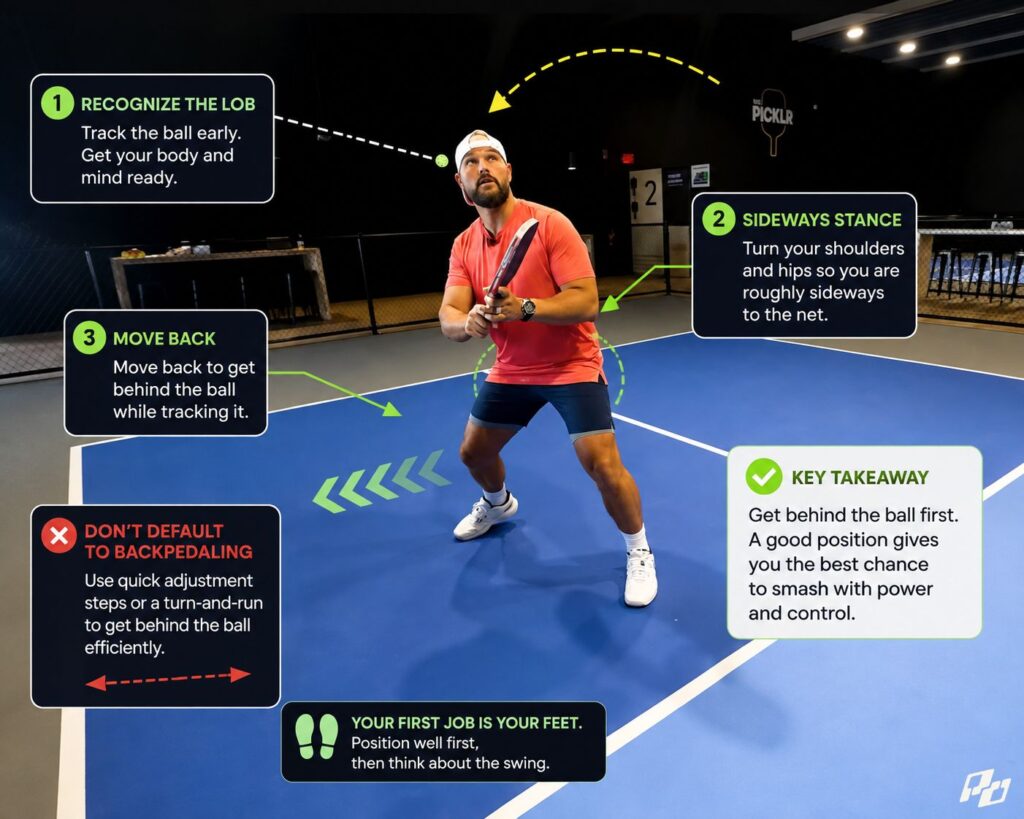
Current overhead instruction consistently emphasizes a pivot or drop-step followed by a side shuffle, crossover, or combination of the two. Backpedaling is less stable and increases the risk of falling backward.
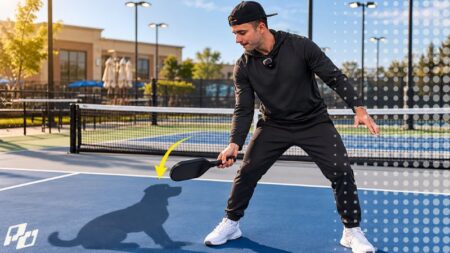
Marko describes the sideways position almost like standing on a surfboard: balanced, loaded, and ready to transfer weight forward.
That image works.
The important detail is that you want to move far enough behind the ball that you can come forward into contact.
This is where two classic misses come from.
If you do not retreat far enough, the ball gets behind your head. Your paddle face tends to open and the overhead sails long.
Go too far back, and you reach forward or contact too low. Now the ball often dives into the net.
Cue
Get behind it so you can hit forward into it.
That is much better than simply thinking, “Get under the lob.”
⮕ Your Non-Paddle Hand Is More Important Than It Looks
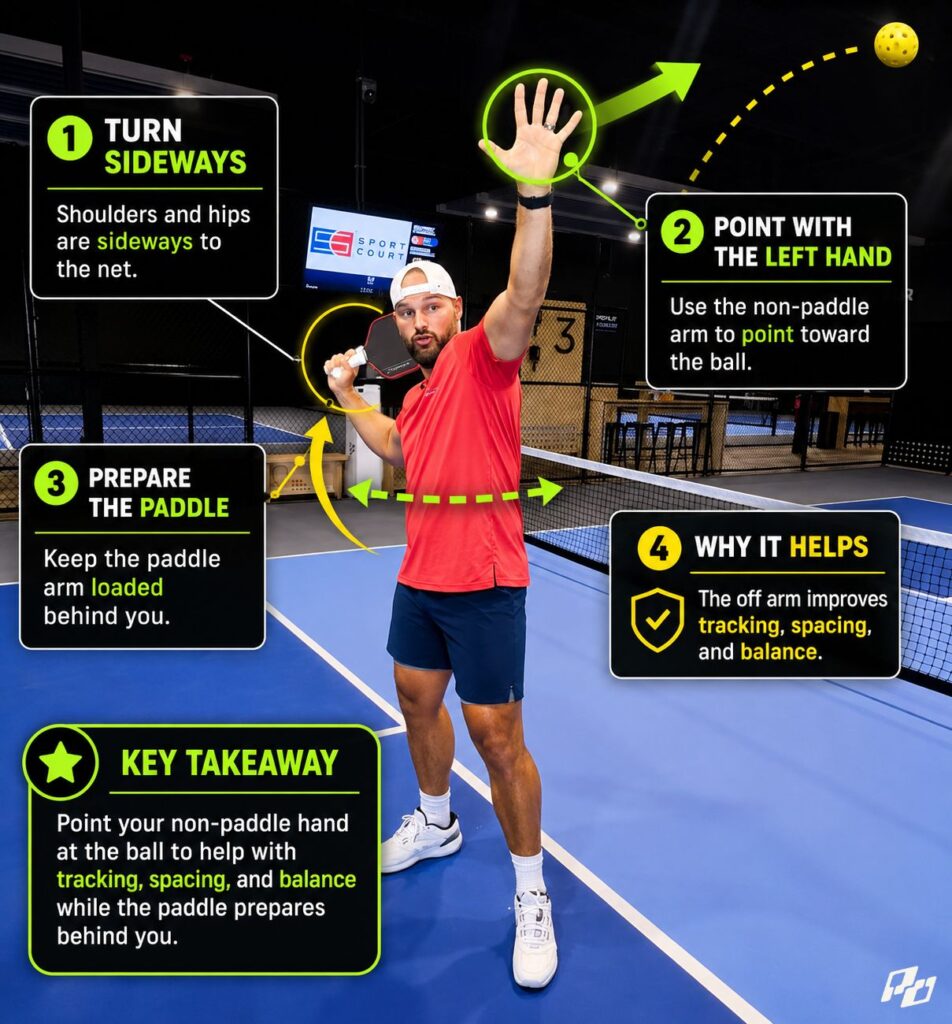
Once you turn sideways, get the non-paddle arm involved.
For a right-handed player, point the left hand toward the ball while preparing the paddle behind you.
That does several things at once.
It helps you track the descending ball, encourages shoulder rotation, keeps your chest from opening too early, and gives you a reference for spacing.
Marko uses an especially simple cue: point to where you want to make contact.
Then your paddle hand effectively replaces your pointing hand as you rotate and swing.
That is far more useful than trying to calculate the perfect contact point while a lob is dropping out of the sky.
Step 2: Throw the Paddle—Don’t Muscle the Ball
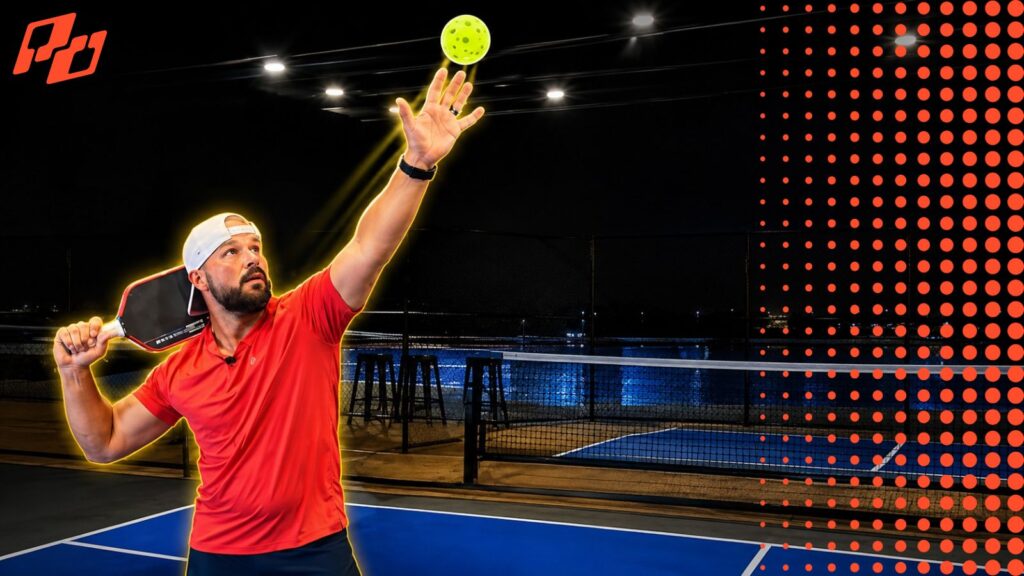
Once your feet are organized, the overhead should feel much more like a throwing motion than a giant forehand.
Marko teaches it by starting with the paddle near the shoulder, body turned, non-paddle hand pointing toward the imaginary ball, and weight loaded primarily on the back side.
From there, the elbow begins the forward sequence and the body rotates through. The important word is sequence.
The power should travel roughly:
ground → legs → hips/torso → shoulder → arm → paddle.
If you remove the rotation and simply swing the arm downward, you can still hit the ball hard—but you are working much harder for the speed and usually sacrificing control.
This is why players with tennis, throwing, or serving backgrounds often pick up the overhead quickly. The kinetic pattern is familiar.
Try Marko’s No-Ball Drill
You can rehearse this at home:
- Turn sideways.
- Rest the paddle around the shoulder.
- Point upward with the non-paddle hand.
- Load the back side.
- Initiate the forward throwing motion.
- Transfer your weight forward and finish balanced.
Do it slowly before adding speed.
You are teaching the sequence, not trying to produce maximum paddle-head velocity in your living room.
Watch Marko Break Down the Three Steps
This is one shot where seeing the spacing and body rotation is considerably easier than describing it.
In the video below, Marko demonstrates the sideways movement, throwing action, and—most importantly—the difference between good and bad contact points.
Pay particular attention to how much space he creates behind the ball before moving forward into it. That is the piece many recreational players skip.
Step 3: Contact Out Front—Not Directly Over Your Head
This is Marko’s most important step, and other coaches make the same distinction. The name overhead is slightly misleading.
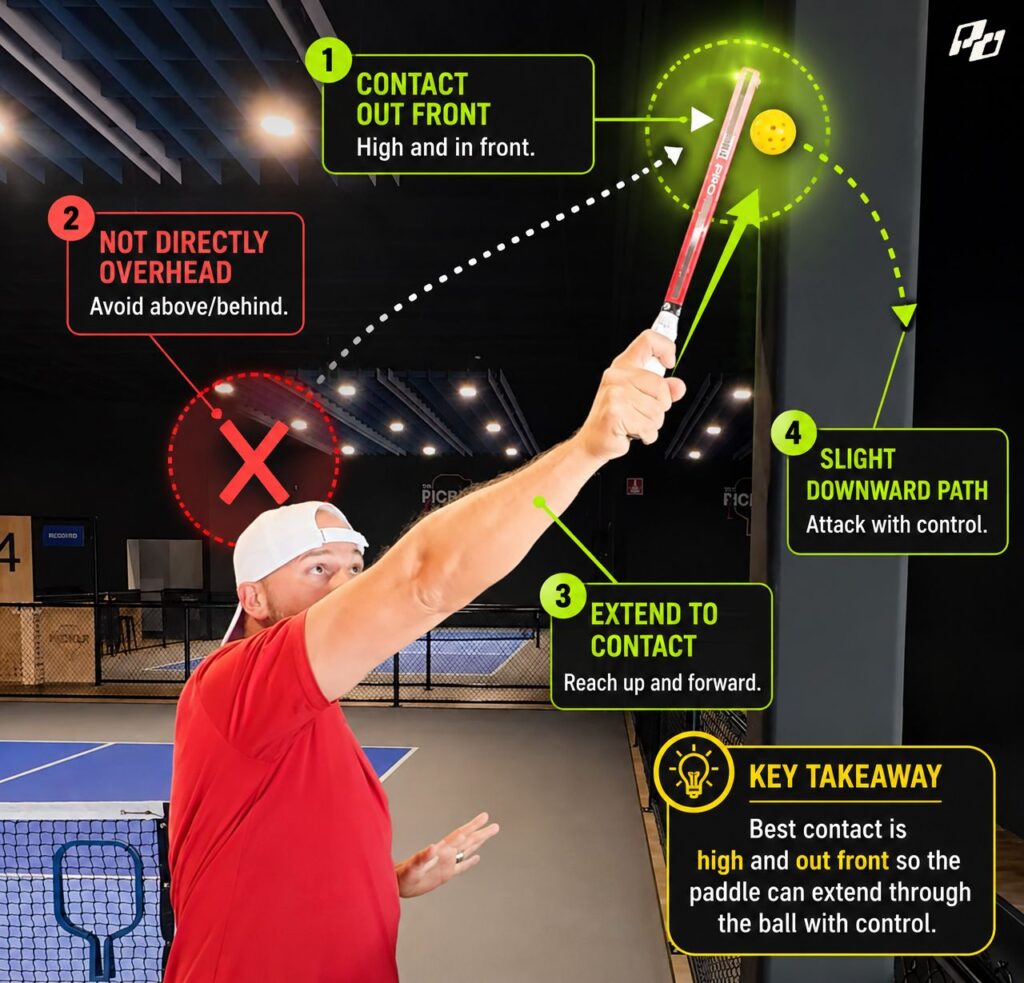
You generally do not want your ideal attacking contact buried directly above or behind your head.
You want the ball high and somewhat in front of you, where the paddle can extend through contact with a controlled downward trajectory. Recent instruction from multiple pro coaches similarly emphasizes contact in front rather than literally over the head.
Imagine a wall several feet in front of you.
If your spacing is correct, your arm and paddle should be able to extend toward that wall at a slightly downward angle without your body collapsing forward or leaning backward.
That is your strike zone.
⮕ Too far behind you
You lean back.
The paddle face tends to open.
The ball sails long.
⮕ Too far in front
You reach.
Contact drops lower.
The ball tends to find the net.
⮕ In the right place
You are extended, balanced, and moving through the ball.
Now you can create power without forcing it.
Stop Trying to Hit Every Overhead at 100%
This is one of the biggest upgrades I would add for intermediate players. A good overhead does not have to be your hardest overhead.
If your opponent has thrown up a weak lob and is already scrambling backward, you often need 70% power and a good target, not 100% power and a prayer.
Think about what your opponents are giving you.
If both are retreating, hit toward their feet. If one player has been pulled out of position, attack the open court.
If you can contact comfortably in front and create an angle, use the sideline rather than automatically pounding toward the baseline.
Cue
Placement first. Power second.
Not Every Lob Deserves an Overhead
This may be the most important tactical addition to Marko’s three steps. Sometimes the correct overhead technique is not hitting an overhead at all.
If a lob gets deep enough that you would have to:
- backpedal desperately
- lean backward
- contact behind your head
- jump while falling away
- reach at full extension without balance
let it bounce.
Turn, move back safely, allow the ball to land, and play the next shot. That may mean giving up your kitchen position.
Fine.
Losing court position is better than losing your balance—or giving the opponent an easy ball because you attempted an overhead from a terrible contact point.
For 50+ recreational players especially, this decision deserves more attention than it gets.
You do not earn extra points for refusing to let a lob bounce.
How to Decide in One Second
When the lob goes up, ask: can I get behind this ball and still move forward into contact?
If yes, overhead.
If maybe, move first and decide.
If no, turn and let it bounce.
That decision should happen before you start the swing.
The worst option is committing to an overhead, realizing too late that the ball is behind you, and then trying to rescue it while falling backward.
What About a Lob Over Your Backhand Shoulder?
This is where footwork becomes even more important.
A lob over your paddle-side shoulder is generally easier to organize because you can turn and establish the normal overhead position.
A ball traveling over the opposite shoulder may require more movement and rotation to get around it.
Do not contort yourself just to preserve a forehand overhead. If you cannot safely get into position, turn and chase the bounce.
At higher levels you will see more advanced overhead variations, including backhand overheads and scissor-style movement. Intermediate recreational players do not need those before they own the basic positioning pattern.
Your Overhead Isn’t Finished at Contact
Another overlooked mistake: admiring the smash. After contact, recover your balance immediately.
A strong opponent may block the first overhead.
And the second.
Sometimes even the third.
If you smash, remain balanced, and expect another ball, you maintain the advantage.
If you hit at 100%, spin around, and take two recovery steps, you may turn your own attack into a neutral rally.
Think: smash → recover → expect another smash.
Do not assume the point is over until it actually is.
A Better Way to Practice Overheads
Random lobs are useful eventually, but they are not where I would start. First isolate spacing.
Have a partner feed predictable lobs and deliberately move to three positions:
Too close → correct → too far.
Feel how each changes your contact point. Then practice the throwing sequence at moderate pace. Only after the contact becomes reliable should you start trying to hit harder.
Finally, randomize the feeds so some balls are:
- comfortable overheads
- marginal
- clearly too deep
Now you have to decide whether to smash or let the ball bounce. That last progression matters because match play is not just an overhead-hitting test.
It is an overhead-decision test.
The Three-Step Checklist I’d Actually Use
Marko’s framework gives recreational players exactly the right foundation:
- Position: Turn sideways and get behind the ball.
- Mechanics: Use rotation, weight transfer, and a fluid throwing motion instead of swinging only with the arm.
- Contact: Strike high and out in front so the paddle can send the ball forward and downward.
But I would add a fourth idea mentally: you don’t have to smash it.
If you cannot complete steps one through three while balanced, let the ball bounce. And when you do have the right ball, stop trying to prove how hard you can hit it.
Get behind it.
Point to it.
Throw through it.
Contact it in front.
Then put it somewhere your opponents really do not want to see it.
That is what turns an overhead from a wild swing at an easy ball into one of the most reliable finishing shots in your game.