In doubles pickleball, don’t automatically recover to the middle after every shot. Your best position depends on where you hit, your partner’s location, and the opponent’s available angles. Shade with the ball, protect the most dangerous lane, and keep your team spacing connected.
You hit a good dink.
You recover toward the middle.
Your opponent attacks the gap you just created.
And afterward, it doesn’t even feel like a positioning mistake.
That’s what makes this one so sneaky. A lot of 3.0–4.0 players have absorbed some version of: “Hit the ball, then recover to the middle.”
That’s useful advice in singles.
In doubles, it can be completely wrong.
Your best recovery position changes constantly according to where your ball went, where your partner is, and which angles your opponents can realistically attack next.
Good doubles players don’t keep returning to one favorite spot. They shade with the ball.
And once you understand why, you start seeing open courts before the opponent does.
The Problem With “Get Back to the Middle”
Imagine you’re the right-side player at the kitchen. You hit a crosscourt dink toward the opponent’s right sideline.
Your instinct says: Recover toward the center of my half.
But your opponent now has several possible replies, and they don’t all carry equal risk.
The player directly in front of the ball needs to protect the dangerous down-the-line lane. Their partner therefore shifts with them and helps close the middle.
Coach Athena Trouillot teaches this as “follow the ball”: both partners adjust laterally according to where the ball is, rather than independently returning to predetermined positions.
That’s the key.
You’re not recovering toward a painted line. You’re recovering toward the threat.
Think “Shading,” Not “Centering”
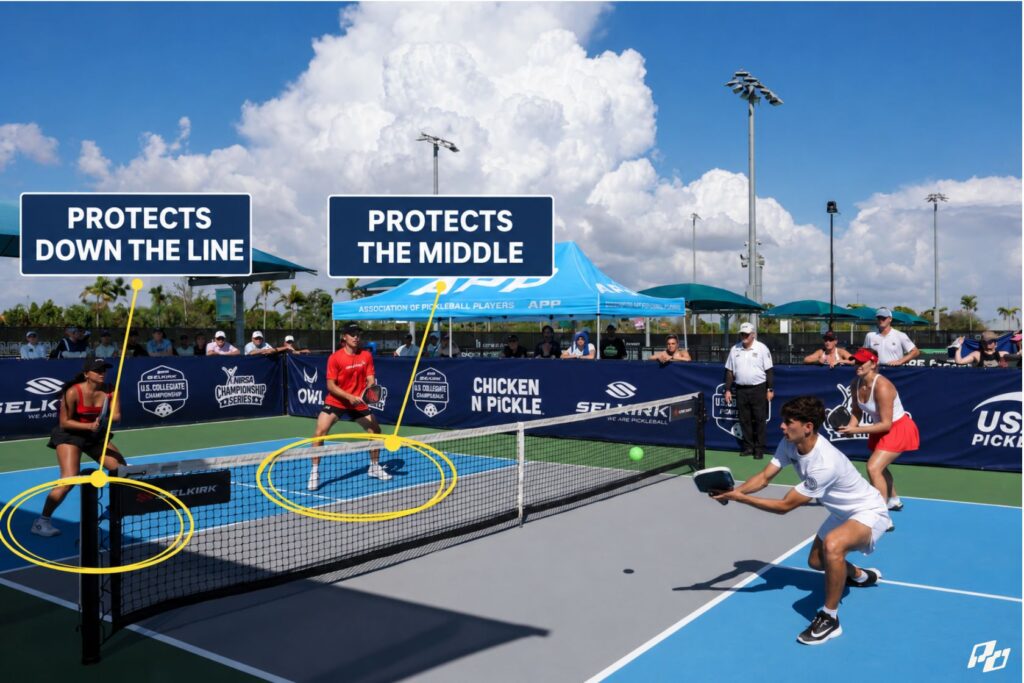
Pickleball coaches commonly call this movement shading.
Coach Jordan Briones explains it simply: if the ball goes toward one side, both partners should move in that direction. The player closest to the sideline protects the line while the other shifts over to protect the middle.
Picture the two of you connected by an invisible bar.
Ball goes left?
Both shift left.
Ball goes right?
Both shift right.
Not equally, necessarily. But together.
If the ball moves but your team shape doesn’t, somebody is probably defending the wrong piece of court.
Here’s Why the Geometry Changes
The opponent cannot hit every shot equally well from every location. That’s why recovery position has to change.
Suppose you dink directly into the middle. You’ve reduced your opponent’s usable angles.
Now hit a sharp crosscourt dink near the sideline. You’ve created a different geometry.
Your opponent can potentially:
- go back crosscourt
- attack through the middle
- or go down the line
But those lanes don’t have equal distance, net clearance, or margin.
In doubles, think about defending three main threats: crosscourt, middle, and down the line.
Most of the time, your team should protect the middle first and make opponents beat you with the tougher angle.
So after your shot, the question isn’t: “Where is the center?”
It’s: “Where can this opponent hurt us from here?”
That is a much better positioning question.
The Wide-Dink Example Every 3.5 Should Understand
Let’s make it concrete.
You’re on the right. Your partner is on the left. Your partner hits a sharp crosscourt dink that pulls the opponent wide toward their sideline.
What should happen?
Your partner shades toward their own sideline to protect the opponent’s easiest down-the-line reply.
You move toward the middle.
Why?
Because your partner’s movement has opened space between you, and the middle is now your responsibility.
Now reverse the rally. You hit crosscourt from the right side. You protect your line. Your partner shades toward you and helps close middle.
This continual side-to-side adjustment is why high-level doubles teams can appear to move almost as one unit.
They aren’t protecting two permanent halves.
They’re protecting one changing court.
The Biggest Rec-Player Error: Both Players Drift Apart
Here’s where automatic recovery causes real damage. One player gets pulled wide and starts returning toward “their” normal position. The other player stays glued to “their” side. Suddenly there is a giant window through the middle.
That’s exactly the lane stronger players are looking for.
And the fix isn’t: “Everyone cover more court.”
It’s: Close the gap together.
If your partner is dragged several feet outside the sideline, your job changes immediately. Don’t stand politely on your half.
Slide toward the middle and temporarily cover more court while your partner recovers. Once they get back? Your shape expands again.
This is doubles positioning, not property ownership.
Your Recovery Position Also Depends on the Shot You Hit
This is another layer intermediate players often miss. The quality and direction of your shot determine how aggressively you can position.
Hit a deep, neutral ball through the middle?
Your opponents have fewer sharp angles. You and your partner can hold a strong central shape.
Hit a short, wide ball that allows an opponent to attack from outside the sideline?
Now the angles widen dramatically. Your positioning has to react. Your recovery therefore starts with the shot you just hit.
A good question immediately after contact is: “Where did I send them?”
Because that’s where the next ball begins.
Stop Recovering to Where You Started
This habit is especially common after dinks.
You begin the rally in a comfortable kitchen position.
You get pulled wide.
You hit.
Then you sprint back to the exact spot where you started.
But the geometry has already changed.
- The opponent has moved.
- Your partner has moved.
- The ball has moved.
Your original position may now be the wrong one. This is why “recover” can actually be a misleading word.
Sometimes you’re not returning anywhere. You’re moving into the next correct position.
That’s a subtle distinction, but it completely changes how you think about doubles movement.
The Ball Tells You Which Player Protects the Middle
There’s another useful concept here.
Briones teaches that when you hit the ball wide crosscourt, the crosscourt player should become more responsible for middle, while the partner closer to the ball protects the line.
Tony Roig’s “Respect the X” system approaches middle responsibility from a related angle: rather than automatically declaring that “forehand takes middle,” responsibility changes according to the ball’s diagonal path and the players’ positions.
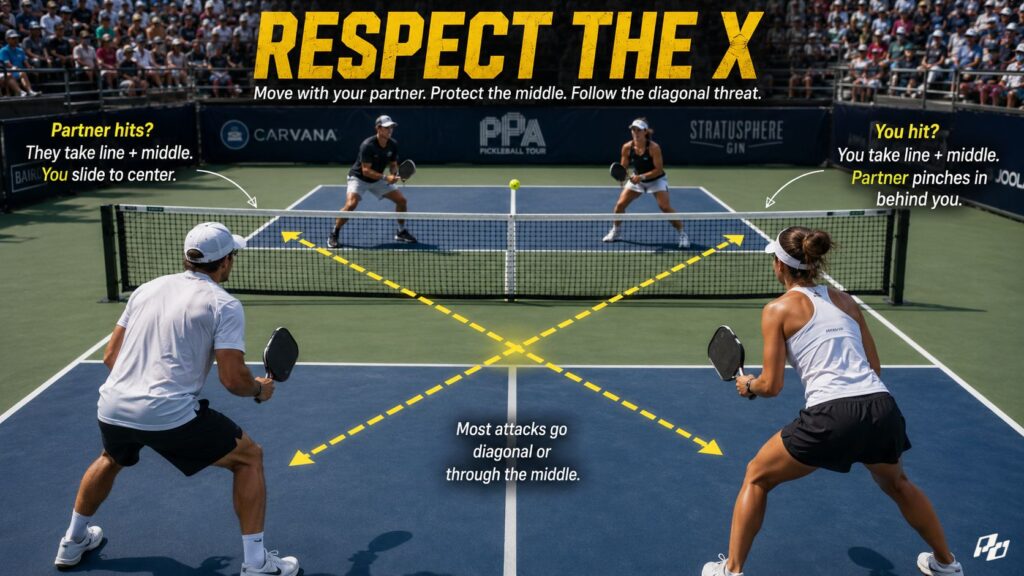
You don’t have to memorize either system perfectly to improve immediately.
Just understand the underlying principle: The middle belongs to whoever is best positioned to protect it on that particular ball.
That can change during the rally.
When Recovering Toward the Middle Is Correct
None of this means the middle is bad. Quite the opposite. The middle is incredibly valuable territory in doubles.
If your partner has been pulled wide, you should usually compress toward them and protect the open center.
If you’ve chased a ball outside the sideline, your own recovery will often be diagonally back toward the middle while your partner temporarily covers for you.
If opponents are attacking from a central position, staying compact protects the easiest lanes.
And if you hit through the middle, you have reduced their available angles, so a more central team position often makes sense.
The mistake isn’t moving toward the middle.
It’s doing it automatically after every shot.
Why This Is Different From Singles
This may be where the bad habit starts.
In singles, recovering toward center is a foundational strategy because one player must defend the entire court.
Coaches explicitly teach singles players to hit and recover toward the middle because otherwise the opponent has too much open court available. It also specifically notes that doubles is different because you’re sharing coverage with a partner.
That’s the distinction rec players need.
Singles: find the position that best covers the opponent’s available court.
Doubles: you and your partner create that coverage together.
The center of your half isn’t automatically the center of your team’s defense.
Use This One Cue: “Follow My Ball”
Most players don’t need more positioning theory while they’re playing. They need a trigger.
Try: Follow my ball.
If you send the ball left, shade left.
If you send it right, shade right.
Then glance at your partner and keep the space between you compact.
Eventually, you won’t consciously say anything. Your feet will move because you recognize the geometry.