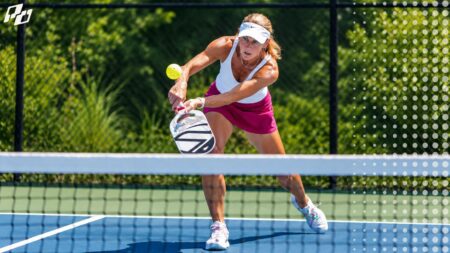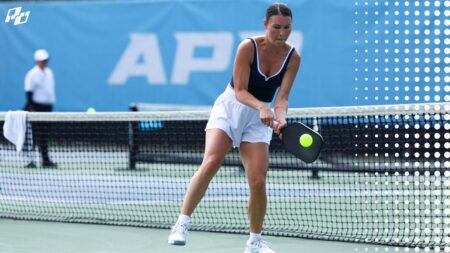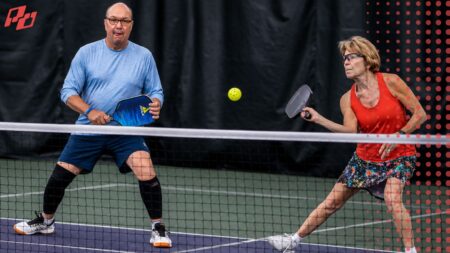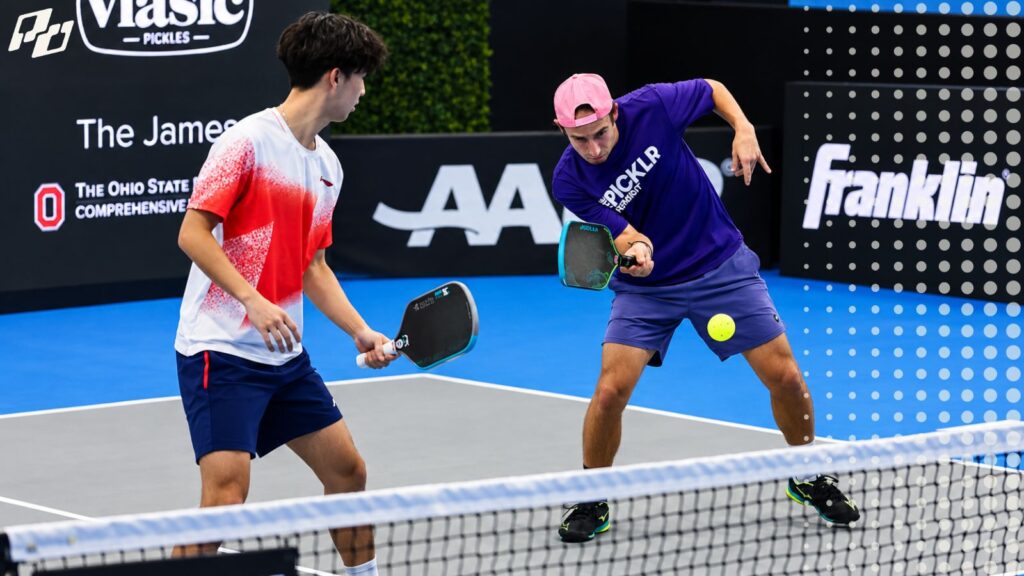
Pickleball misdirection works by making one shot look like another until late in the swing. Keep your setup familiar, delay the directional cue, then make a small paddle-face and swing-path adjustment toward the new target. The goal is not a flashy fake—it is getting your opponent to lean, commit, or prepare for the wrong ball.
The best misdirects barely look like fakes.
No giant shoulder feint.
No theatrical no-look.
No desperate wrist flick at the last instant.
You simply show your opponent one believable shot long enough for them to start leaning toward it—then send the ball somewhere else.
That sounds advanced. Mechanically, it is simpler than most rec players make it. The real trick is this: Keep the setup the same. Change the direction late.
That is what makes the opponent guess.
Why Misdirection Actually Works
Better players do not wait until the ball leaves your paddle before reacting. They anticipate.
Racket-sport research shows skilled players use information from an opponent’s body, racket, movement, and court position before contact to predict where the next shot is going.
That anticipation is normally an advantage. Deception turns it against them.
An analysis of Federer and Djokovic found something even more practical: disguised groundstrokes caused more incorrect anticipatory movements and were significantly more likely to create an advantageous point situation than undisguised strokes.
Different sport, same tactical idea: If your opponent commits before your paddle reveals the truth, you gain time without hitting harder.
That is why a good misdirect can feel faster than a harder ball.
Watch pro player Rachel Rohrabacher execute a perfect misdirection shot — same setup, different finish:
What a Misdirect Actually Is
Suppose you are taking a high forehand at the kitchen. Everything initially suggests crosscourt:
- your shoulders
- your stance
- your paddle preparation
- and perhaps the pattern of the previous few balls
Then, close to contact, you slightly change the paddle face and send the swing toward the open line.
The ball goes line.
Your opponent goes crosscourt.
That is misdirection.
The mistake is thinking you need two completely different swings. You don’t. You want the two shots to look as similar as possible until they have to become different.
Paddle Face First, Swing Path Second
Here is the technical part rec players need.
When you redirect a ball, two things have to agree:
The paddle face must point toward the intended launch direction.
The paddle must continue moving through that direction.
This is why “just flick the face open at the last second” is unreliable. If your face points line but your arm is still violently swinging crosscourt, the ball may float, skid sideways, pop up, or miss entirely.
A cleaner cue is: Face there. Finish there.
Want the forehand to look crosscourt and finish down the line? Keep the preparation neutral. Near contact, open or close the face only as much as needed. Then allow the final part of the stroke to travel toward the line target.
You’re not changing the entire swing. You’re changing the last useful piece.
Watch coach Preston Bies show a simple redirect: short swing, paddle face toward the target;
Don’t Make the Wrist Do Everything
This is where a lot of rec players turn misdirection into a trick shot. They try to show one direction, then violently flick the wrist at the last second to send the ball somewhere else.
That usually costs you control.
A good misdirect is much smaller than that. Keep your normal preparation, then make a late but controlled adjustment to the paddle face and the final direction of the swing.
If you want to show crosscourt and send the ball down the line, you might hold the familiar crosscourt setup a fraction longer, then slightly change the paddle face and let the paddle finish toward the line.
The wrist can help make that adjustment, but it shouldn’t be doing the entire job. Too much last-second wrist action tends to reduce:
- contact stability
- directional control
- repeatability
- margin over the net
A better cue is: Same setup. Small late change.
If the misdirect requires a dramatic wrist snap to work, you’re probably trying to change direction too late or create too sharp an angle.
The Best Fake Is the Shot You’ve Already Made Them Expect
Misdirection becomes much more effective when your opponent already expects a certain ball.
Suppose you’ve exchanged several crosscourt dinks.
Your opponent begins leaning and positioning for another crosscourt shot.
Now the down-the-line redirect becomes dangerous—not because the shot itself is extraordinary, but because you’ve made the opponent expect something else.
That gives misdirection a simple sequence: Establish the pattern → create the expectation → break the pattern.
For example:
Hit two or three solid crosscourt dinks using the same preparation.
On the next suitable ball, show that same preparation again.
Then redirect late up the line.
The disguise works because the first few shots taught your opponent what they thought they were about to see.
That’s much more reliable than trying to manufacture a fake from nowhere.
Where Body Fakes Fit In
Yes, you can sell the wrong direction with your body. But body deception should be the final layer—not the first.
A slight shoulder orientation or weight presentation can reinforce the shot you’re pretending to hit. The danger is overdoing it.
If you throw your torso dramatically crosscourt and then try to hit line, you may:
- lose balance
- jam your contact
- open the paddle too much
- or force the arm to work independently from the body
Research on deception in sport suggests the most effective fakes preserve believable movement information until late rather than relying only on one exaggerated false cue.
So use: Body suggestion, not body acting.
Make the opponent see the familiar setup. Then let the paddle change the answer.
The Forehand Misdirect Is the Best Place to Start
For most rec players, start on a forehand ball above dink height. Why? Because you have:
- more comfortable reach
- more room to adjust the paddle face
- and more ability to redirect without compromising the stroke
A good progression is:
1. Crosscourt: Hit five normal forehands and notice your setup.
2. Same setup, go line: Keep the preparation identical, then redirect late.
3. Randomize: Have your partner guess “Cross” or “Line” before contact.
If they correctly read you almost every time, you’re changing something too early. That drill immediately tells you whether your disguise is real.
Watch coach Mark Price break down the misdirect (forehand inside-out) — a deceptive attack you can use on a slightly higher ball:
Where Misdirection Works Best
Use it when you have time and control:
✔ High dink — hold it, then redirect late.
✔ Short transition ball — catch opponents leaning.
✔ Forehand speed-up — disguise body, line, or seam.
✔ Controlled putaway — let their read work against them.
Avoid it when you’re:
✘ Reaching wide
✘ Jammed on the backhand
✘ Digging a ball off your shoelaces
✘ Barely controlling contact
Simple rule: You can’t disguise a shot you don’t own.
The Low-Ball Rule
This one will save rec players a lot of errors: The lower the contact, the less ambitious the misdirection.
When contact is below net height, you already need lift and margin. Trying to manufacture a sharp last-second angle adds another variable to a difficult ball.
Use the misdirect when you have:
- time
- balance
- and a comfortable contact point
That lets deception improve the shot instead of becoming the reason you miss it.
The Three Best Targets
You don’t need six options. These three cover most situations:
✔ Behind the moving opponent — make them stop and reverse direction.
✔ Up the line after a crosscourt pattern — perfect after a few repeated crosscourt dinks.
✔ Into the body — jam the hip or shoulder when they’re expecting the open angle.
The key: Misdirection isn’t always about hitting where nobody is standing.
Sometimes it’s about hitting where your opponent is least prepared to defend.
Don’t Chase Impossible Angles
One reason misdirection fails at the rec level is that players think the fake needs to produce a spectacular winner. It doesn’t.
In fact, the deceptive ball often deserves less pace.
The recent “slice and dice” coaching example makes this point clearly: when redirecting up the line, the court is shorter and the net is higher than on the crosscourt dink, so excessive pace only shrinks your margin.
The deception already gave you the advantage. Don’t throw that advantage away trying to make the shot look impressive.
Think: make them wrong first.
Then make the next ball difficult.
The Best Drill: Defender Calls the Shot
Both players start at the kitchen.
The hitter chooses:
✔ Crosscourt dink
✔ Line redirect
Before contact, the defender must call: “Cross!” or “Line!”
Scoring:
Hitter gets 1 point if the defender guesses wrong.
Defender gets 1 point if they read the direction correctly before contact.
At first, ignore who wins the rally. You’re training disguise, not point construction. Once the defender can’t reliably read the setup, start playing the point out.
That’s much more realistic than practicing 50 obvious misdirects in a row.
Then Add the “Sell”
Only after you can change direction cleanly should you add a slight fake.
Maybe:
- a little shoulder presentation
- a tiny hold
- or a familiar crosscourt setup
Nothing dramatic. Your objective is to delay recognition—not win an acting award.
Research consistently shows that expert players gain an anticipatory advantage from pre-contact cues, but deception can reduce that advantage when the false information is maintained late enough into the movement.
So if your misdirect is visible half a second before contact, it’s not much of a misdirect.
One Cue Is Enough
You do not want to think: Same stance, fake shoulder, hold paddle, open face, wrist soft, hit line…during a hands battle.
Use: Show one. Send two.
“Show one” means present the expected shot.
“Send two” means change the final direction.
Or, if you prefer something more technical: Same setup. Late exit. That’s really what high-quality misdirection is.
The Point Isn’t to Fool Them Every Time
This is the final piece. If you misdirect every third ball, it stops being deceptive. A fake only works because the normal shot remains believable.
That’s why high-level deception and normal execution are connected.
The better your ordinary crosscourt dink looks, the stronger your line fake becomes. The better your normal speedup mechanics, the harder it is to read the redirect. And the more comfortable you are hitting the basic shot, the later you can safely reveal the alternative.
That is what separates useful deception from trick-shot pickleball.
The goal isn’t to hit a ball nobody understands. It’s to make your opponent commit first. Then hit the ball where their feet no longer want to go.