
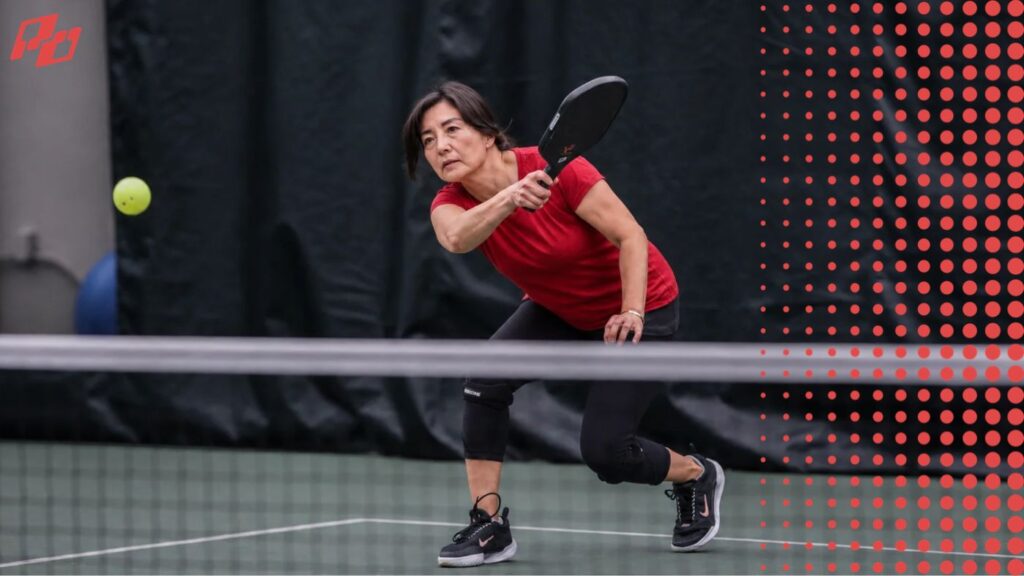
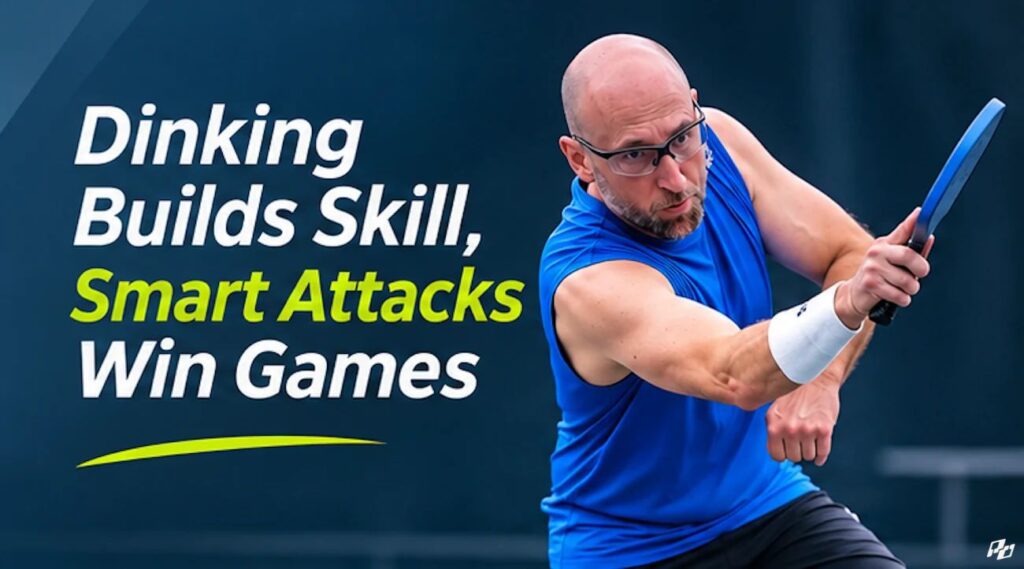
At 3.5, dinking is still important—but automatic dinking can make you too passive. If a ball is high, comfortable, and in front, apply pressure instead of giving it back soft. The goal is not to dink less for the sake of it. It’s to attack the right balls sooner.
Watch ten reasonably competitive 3.0–3.5 rec games and you may notice something strange. Some groups barely dink.
Other groups with exactly the same advertised rating can spend half the game patiently exchanging soft balls at the kitchen.
Same rating.
Completely different pickleball.
So when we heard the claim that 3.0–3.5 players may actually be dinking too much, it sounded wrong at first.
We have spent years telling developing players to learn the soft game.
In fact, I have previously called dinking “non-negotiable” for players trying to progress from 3.0 toward 4.0.
I still believe that.
But there is an important difference between: learning to dink and choosing to dink when your opponent has already given you an attack.
That distinction matters much more in modern pickleball.
The 3.5 dinking paradox
Here is the paradox: you probably need a better dink game to become a 4.0 player. But you may not need to dink very much to beat some 3.5 players.
USA Pickleball’s own skill descriptions hint at why.
A 3.5 player is expected to have increased dink consistency, sustain medium-length rallies, develop drops, and begin varying between the hard and soft game.
At 4.0, the description gets more specific: the player should sustain controlled dink rallies, recognize which balls are attackable, vary pace, reset, and use the kitchen more deliberately.
That is a meaningful difference.
The skill is no longer simply: can you dink?
It becomes: do you know when not to?
Why 3.5 games often contain so little dinking
There is a simple reason. Somebody usually gives the rally away before a long dink exchange ever develops.
The third-shot drop sits high.
The fourth ball gets volleyed aggressively.
Someone drives.
A transition ball floats.
A dink gets popped up.
Or a player speeds up something questionable and the hands battle starts.
Rec players themselves repeatedly describe 3.5 open play this way. In one recent discussion, a player noticed that open play involved very little dinking despite clinics emphasizing it heavily. Another 3.5 player described becoming so committed to soft play that obvious attack opportunities started passing them by.
That does not prove dinking is useless.
It tells us something more interesting: the first exploitable ball often appears before a dink rally has time to develop.
If your opponent gives you that ball, refusing to attack it merely because you have been taught to “get into the dink” makes little sense.
Modern pickleball has changed the question
Several years ago, the default strategy was much more conservative.
- Get to the kitchen.
- Keep the ball low.
- Wait.
- Do not attack unless the ball is obviously high.
That game still works. But the threshold for offense has moved.
Jordan Briones, a professional pickleball coach and longtime instructional creator who has worked extensively with intermediate and advanced players, has pointed out how dramatically the game has changed in recent years—from more spin and aggressive volleys to stronger drives and attacks from positions that players once would have neutralized.
The 2026 shift is toward smart aggression—especially attacking some “yellow-light” balls that older strategy would have automatically sent back softly.
Pickleball Union has moved in that direction too.
Our older third-shot guidance emphasized the drop as perhaps the most important shot in the rally. More recent strategy pieces have become much more contextual:
drive when the ball invites pressure, dink to create something, reset when you are disadvantaged, and attack when the next-ball geometry favors you.
That is not a contradiction. The game got better. So the decision tree got more complicated.
The advice I would not follow literally
One version of this argument says: “You shouldn’t be dinking much at 3.5.”
Too absolute.
Another version says: “If it’s above the net, attack it.”
Better—but still incomplete.
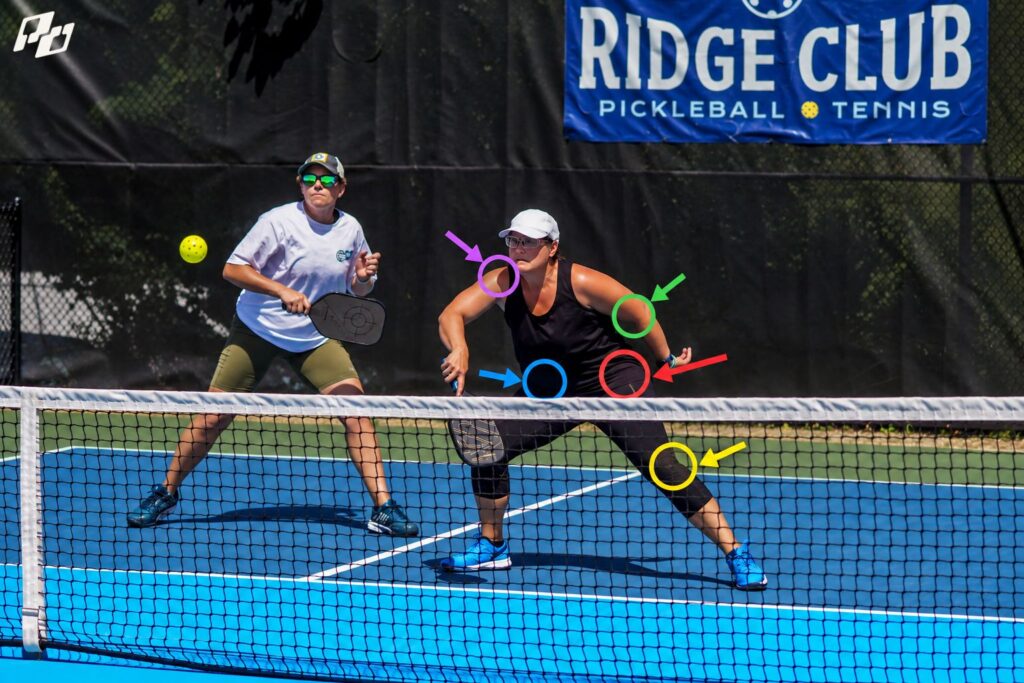
Ball height matters enormously, but so do:
- your balance
- your contact point
- your paddle position
- your partner’s readiness
- and the opponent’s position
A ball can technically be above net height while you are leaning sideways, late, reaching, or falling into the kitchen.
That is not necessarily a green light. The better rule is: attack the ball when both the ball and your body give you permission.
The biggest opportunity: stop donating time
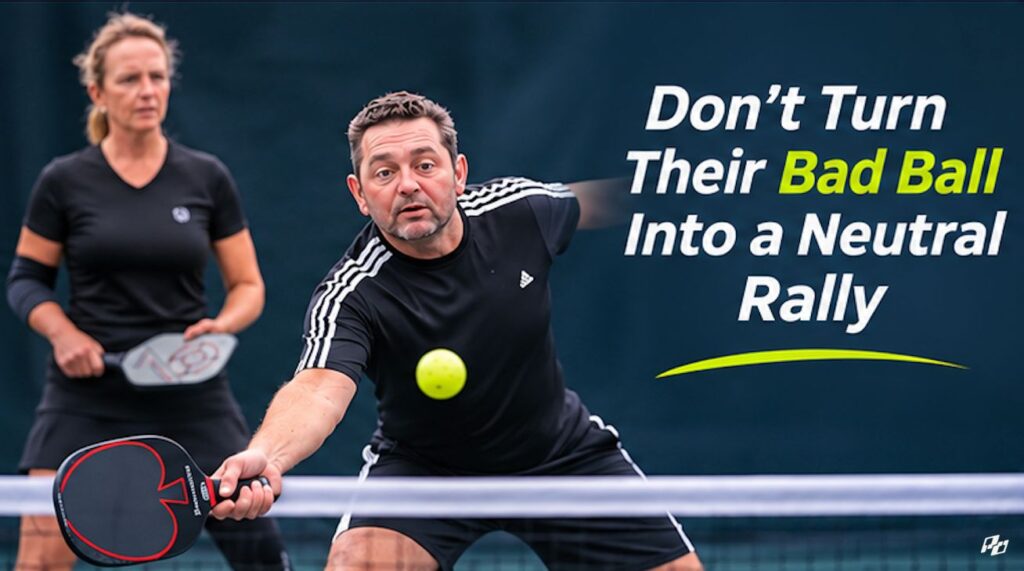
Many 3.5 players do something like this: opponent floats a ball toward the kitchen. You could comfortably reach it before the bounce.
Instead, you step backward.
Let it bounce.
Wait for it to drop.
Then softly dink it back.
You just transformed their mediocre shot into a comfortable neutral rally.
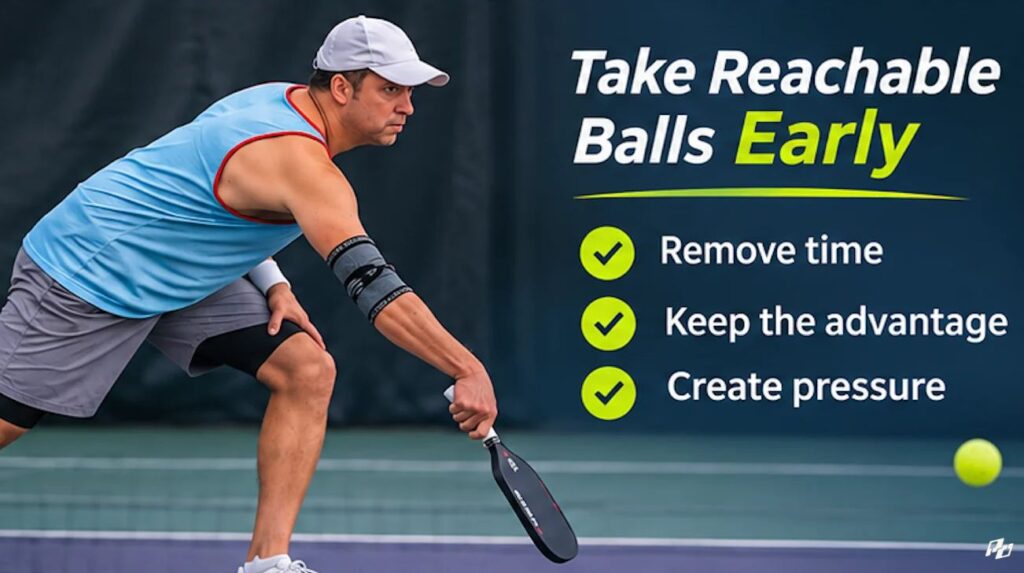
Zane Navratil, a longtime PPA Tour professional, former top-three singles player, and multiple-time pro champion known for his analytical approach to strategy, has recently emphasized this exact mistake: recreational players frequently let balls bounce that stronger players would take out of the air. Taking a reachable ball early removes time from the opponent and prevents them from recovering position.
That does not always mean smashing it. You might:
- roll it
- punch it
- redirect it
- volley-dink aggressively
- or send it firmly toward the feet
The important part is that you preserve the advantage the opponent gave you.
A good cue: don’t turn their bad ball into your neutral ball.
What happens when you attack a typical 3.5 player?
This is why the idea is worth testing in rec play.
At higher levels, attacking a mediocre ball can be dangerous. The counter may come back faster than your attack.
At many 3.0–3.5 courts, the response is different. A firm ball toward the feet or body often produces:
✔ A late paddle
✔ A pop-up
✔ A defensive block
✔ A rushed decision
✔ An attempted counter that sails long
This is especially true if the player is still moving forward.
Our recent piece on bangers versus dinkers makes essentially this point: intermediate strategy should be built around what the opponent actually struggles with, not around loyalty to a “soft” or “hard” identity. Some players hate pace. Others are perfectly comfortable with pace but break down when forced to dink.
That is the real lesson.
Do not dink because good pickleball players dink. Do not bang because modern pickleball is aggressive.
Make the opponent prove which game they can handle.
Try pressure first
Here is a rec-play experiment I like. For the first several attackable balls of a game, do not automatically soften them.
If you get:
✅ A comfortable volley above net height
✅ A floating fourth
✅ A dink you can contact well in front
✅ A transition ball your opponent leaves sitting
apply controlled pressure.
Not 100 percent power.
Maybe 65–80 percent.
Aim at:
- the feet
- the paddle-side hip
- the body
- or the seam
Then watch what happens.
Can they counter?
Do they block it back weakly?
Do they panic?
Do they let balls fly?
That gives you information.
If the opponent comfortably absorbs everything, then you have learned something: now you may need the dink game.
Move them.
Change height.
Pull them wide.
Wait for a better opening.
That is smarter than deciding before warm-up that tonight will be a “soft game.”
This does not mean dinking is old-fashioned
Quite the opposite.
At higher levels, dinking becomes more important partly because easy attacks disappear. Players reach the kitchen consistently.
Drops improve.
Resets improve.
Counters improve.
Bad speed-ups get punished.
So both teams are often forced to stay neutral longer before one finally creates leverage.
That is why you see more meaningful dink sequences at strong 4.0, 4.5 and pro levels—not because those players are less aggressive.
They are often more aggressive, but they are also harder to attack safely. Modern high-level dinking is not two people politely tapping the ball around.
Roscoe Bellamy, a 26-year-old PPA Tour pro and former nationally top-ranked junior tennis player who turned pro in pickleball in 2023, recently described modern dinking as an active battle over position, pressure, and attack creation. Bellamy is currently ranked No. 6 in PPA men’s singles and has won two career PPA singles titles.
Pickleball Union has made the same distinction in our recent aggressive-dinking coverage: a good dink should move somebody, change their contact, create a predictable reply, or build toward an attack.
A neutral dink with no purpose is very different from an offensive dink.
Our old advice needs one update
We previously wrote: dinking is non-negotiable if you want to move from 3.0 toward 4.0.
I would still publish that sentence today.
But I would add another: dinking ability is non-negotiable. Dinking frequency is not.
Those are different things.
✓ You need the soft game because eventually opponents will stop giving you easy attacks.
✓ You need drops because sometimes you cannot drive your way to the kitchen.
✓ You need resets because sometimes the opponent owns the rally.
✓ And you need dinks because sometimes neither team has an offensive ball.
But once the opponent gives you one? Stop proving how patient you are.
What should a 3.0 player do?
Do not suddenly attack everything.
At 3.0, unforced errors still dominate many games, and USA Pickleball’s skill matrix describes players at this stage as still developing stroke consistency and basic strategy. Your experiment should be simple.
Pick one obvious ball per game:
High
Comfortable
In front
Balanced
Attack that one.
You are training recognition, not aggression.
What about 3.5?
Now increase the test. Instead of waiting for an enormous pop-up, begin taking more reachable balls out of the air.
Pressure the feet.
Attack some knee-to-waist-height balls when you can generate topspin.
Stop automatically stepping backward from the kitchen.
And when you dink, ask: what am I trying to make happen?
Move them?
Jam them?
Create a weaker backhand?
Make them reach?
Set up your next speed-up?
If the answer is simply: “Because we’re dinking now,” you may be playing the rally by tradition rather than by advantage.
There is one big trap
The danger of articles like this is that someone reads: ATTACK MORE and spends Saturday morning launching every ball from ankle height.
That is not modern pickleball.
That is impatience.
Players trying to move toward 4.0 often attack balls they should drop or reset, speeding up directly into prepared opponents, and giving away points through poor decisions rather than lack of skill.
So the progression is not: soft → aggressive.
It is: automatic → selective.
That is the real upgrade.
Try one ball
Next time you play, do not promise yourself: “I’m going to dink less.” That is too vague.
Instead, notice the first ball you normally would have backed away from or softly returned even though you could comfortably attack it.
Step in.
Take it early.
Send it toward the feet or body.
Then watch.
Maybe they handle it beautifully. Good. You learned something. But maybe they panic, pop it up, or give you a ball you can finish.
Then you learned something even more useful: you did not need to invite them into a dink rally in the first place.
Dinking is not disappearing from pickleball. But the reason for dinking has changed. You are no longer trying to prove you can play soft.
You are playing soft because the opponent has not yet given you permission to do anything better.