
Pickleball Union earns a commission on purchases made through links in this article, at no extra cost to you. Our reviews are editorially independent – brands do not see or approve content before publication.
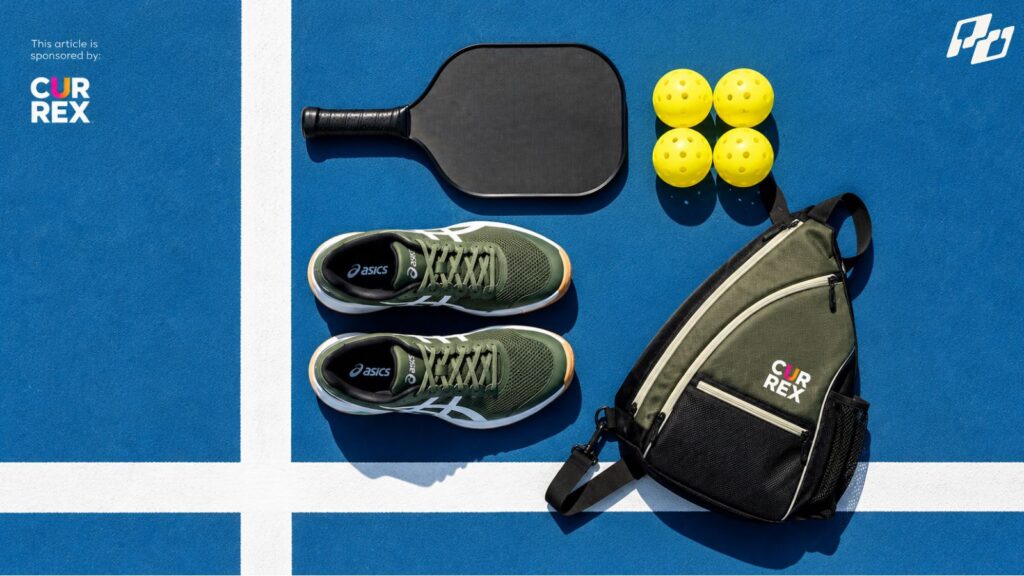
This article is brought to you by CURREX, the performance insoles trusted by the Pickleball Union team. Like us, CURREX is focused on helping players stay comfortable, move better, and keep playing longer. Use code PBUNION20 for 20% off CURREX products on Amazon.
Pickleball has become big enough that almost everything now comes in a pickleball version.
Pickleball shoes.
Pickleball eyewear.
Pickleball insoles.
Pickleball overgrips.
Pickleball bags.
Pickleball socks.
And some players have started asking a fair question: are these products actually better for pickleball—or are we sometimes paying extra for the word on the package?
The answer is not as simple as “pickleball gear is overpriced.”
In several categories, established tennis and court-sport products can work just as well.
But pickleball-specific gear can also be genuinely useful when manufacturers adapt the product to the sport’s shorter movements, frequent lateral stops, compact equipment, or long open-play sessions.
So the better buying question is: “What is different about this product—and does that difference help me?”
That is how you avoid paying for marketing without dismissing useful design.
Start Here: What Actually Needs to Be Pickleball-Specific?
For most accessories, the answer is: almost nothing absolutely has to be.
But that doesn’t mean the pickleball version is pointless.
| Gear | Must Say Pickleball? | When Pickleball-Specific Can Be Better |
|---|---|---|
| Shoes | No | Weight, cushioning, fit and tread tuned for short-court movement |
| Overgrip | No | Correct pre-cut length or thickness for paddle handles |
| Eyewear | No | Coverage, ventilation and fit optimized for pickleball |
| Insoles | No | Cushioning and grip designed around repeated stops and lateral cuts |
| Bag | No | Better dimensions and compartments for paddles and balls |
| Clothing | No | Pickleball-specific pocketing, fit or court comfort |
| Socks | No | Not usually; fit and friction management matter more |
The trick is knowing when those differences are meaningful.
Shoes: “Court-Specific” Matters More Than “Pickleball-Specific”
This is one category where buying the wrong type of gear matters. Pickleball involves:
- hard lateral cuts
- split steps
- short accelerations
- quick stops
- and repeated direction changes
That means a running shoe is usually a poor choice because it is primarily designed for forward motion. A proper court shoe gives you a more stable platform and better lateral containment.
But that court shoe does not have to say pickleball.
Current pickleball footwear guidance explicitly notes that quality tennis shoes work very well because tennis and pickleball share many of the same lateral-movement demands.
So why buy a pickleball-specific shoe? Because some genuinely make useful adjustments. Manufacturers may make them:
✔ Lighter
✔ More flexible through the forefoot
✔ More cushioned for repeated short impacts
or use tread patterns aimed at the smaller movement envelope of a pickleball court.
For a player who spends three hours moving around a 20-by-44-foot court, those differences may feel worthwhile.
⮕ What should decide the purchase?
Not the category name. Try this test:
Can you stop laterally without your foot sliding inside the shoe?
Does the heel stay locked?
Does the forefoot feel secure without crushing your toes?
Does the platform feel stable when you lunge?
Does the outsole match the surface you play on?
If the tennis shoe wins those tests, buy the tennis shoe. If the pickleball model fits better and feels quicker or more comfortable, that is a legitimate reason to pay for it.
Verdict:
Pickleball-specific: useful, not necessary.
Overgrips: This Is Mostly About Your Hand, Not Your Sport
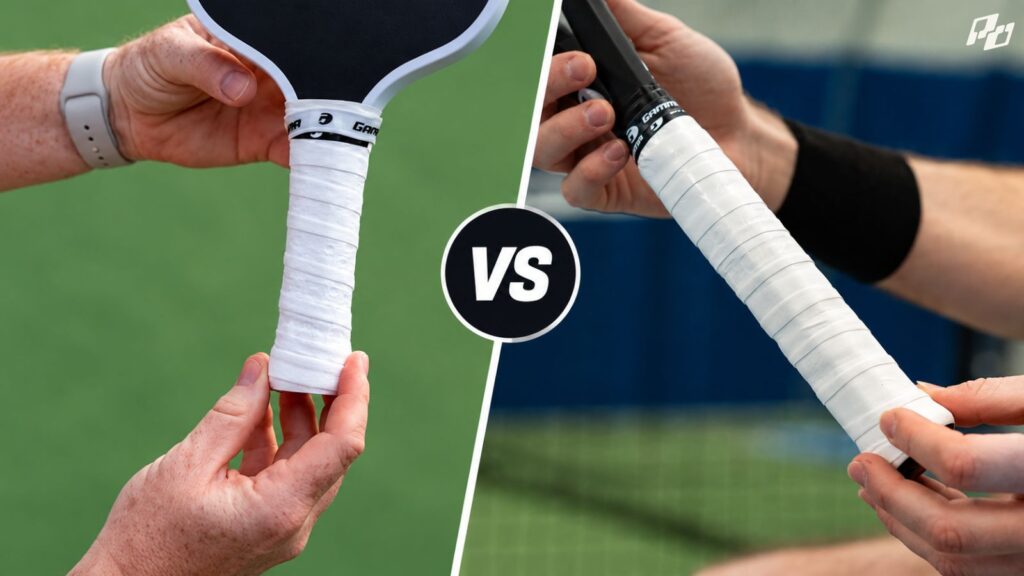
Pickleball players can get strangely particular about overgrips. But from a functional standpoint, there is very little reason a quality tennis overgrip cannot work on a pickleball paddle.
The same basic job exists:
- absorb moisture
- increase tack
- adjust handle thickness
- and keep the paddle from moving in your hand
The main difference can simply be length. A tennis grip may give you more material than you need because tennis racquet handles are longer.
You wrap it.
Trim it.
Done.
That said, a pickleball-specific overgrip can still be convenient. It may be cut closer to paddle-handle length, sold in smaller packs, or offered in thicknesses intended for players who don’t want to enlarge a relatively short paddle grip.
So there is nothing wrong with buying the pickleball version. Just understand what you’re buying.
⮕ Shop for:
- Dry feel if your hands sweat heavily.
- Tack if the paddle tends to move.
- Thin material if you want to preserve handle size and bevel feel.
- Thicker material if you want more cushioning or a slightly larger grip.
Verdict:
The performance difference is usually in the material—not the word pickleball.
Eyewear: Ignore the Sport Label and Look for the Protection
This category deserves more attention because a marketing label can create a false sense of security. “Pickleball eyewear” does not automatically mean protective eyewear.
And ordinary sports sunglasses do not necessarily provide the kind of impact protection you want from a ball or paddle strike.
ASTM F3164 specifically covers protective eyewear for racket sports including pickleball, tennis, squash and racquetball. It addresses impact resistance and other performance requirements, and ASTM identifies polycarbonate as the most impact-resistant common spectacle-lens material.
That tells you something important:
- The safety requirement is already multi-sport.
- You do not need eyewear that only says pickleball.
- You need eyewear that offers suitable impact protection.
But pickleball-specific models can still have advantages.
The sport involves a lot of close-range play, frequent upward and downward head movement, long outdoor sessions, and players who may want clear or lightly tinted lenses rather than traditional sunglasses.
A thoughtfully designed pickleball model may therefore offer:
✔ Better peripheral coverage
✔ Anti-fog ventilation
✔ Secure temples
✔ Interchangeable lenses
✔ A shape that works better when looking down toward the kitchen
Those are useful features. The word itself isn’t.
Verdict:
Don’t pay for “pickleball eyewear.” Pay for protection, vision, fit and ventilation.
Insoles: One of the More Interesting Pickleball-Specific Categories
At first glance, a pickleball insole sounds like peak marketing. But this one is more nuanced. Pickleball repeatedly loads the forefoot and asks players to:
- push laterally
- brake
- pivot
- split step
- and spend long periods standing and moving on hard courts
A court-sport insole can address those demands whether it is marketed for tennis or pickleball.
For example, CURREX’s ACEPRO tennis/court insole is designed around fast footwork, stable landings and multidirectional movement.
Their PICKLEBALLPRO uses many of those same court-sport principles but adds pickleball-specific positioning around forefoot cushioning, anti-slip surface grip and repeated short directional changes. CURREX itself notes that the product can also be used for tennis, padel, racquetball and squash—which tells you how much these movement demands overlap.
That is actually a good example of the whole “pickleball tax” question.
Is the technology completely unique to pickleball?
No.
Could the product still be particularly well suited to pickleball?
Absolutely.
⮕ When it may be worth considering
✔ If your stock insole feels flat or slippery.
✔ If your foot moves inside the shoe during lateral cuts.
✔ If you want more forefoot cushioning during long sessions.
✔ If an arch-profile option fits your foot better.
Just remember: an insole should improve the shoe.
If it lifts your heel, crowds the toe box or makes the shoe unstable, the upgrade is actually a downgrade.
Verdict:
Pickleball-specific can be useful here, but fit and function still win.
Bags: This Is Where Pickleball-Specific Design Makes the Most Sense Without Improving Performance
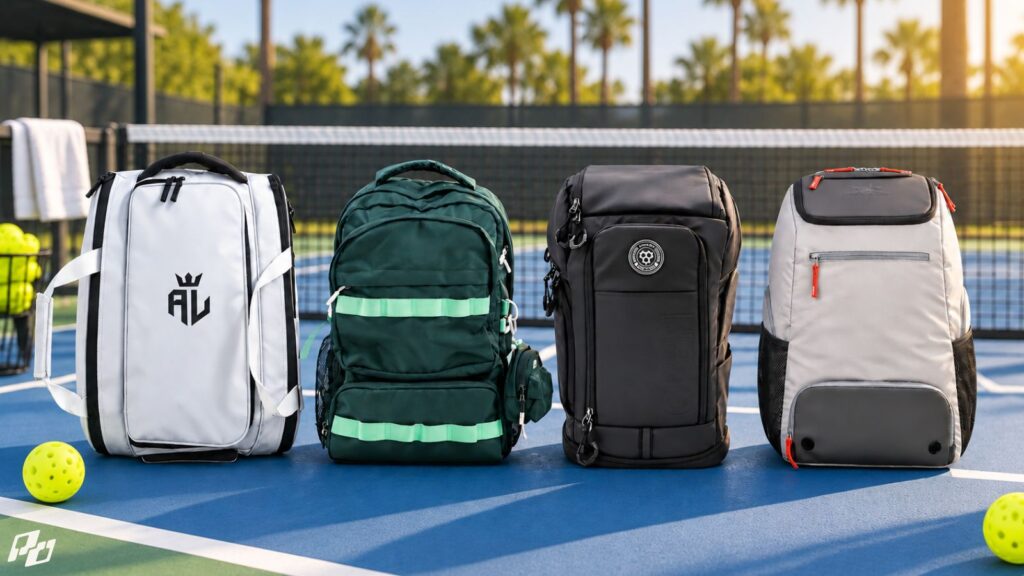
A tennis bag will carry pickleball gear. So will a normal backpack. That settles the “need” question.
But dedicated pickleball bags can be genuinely better designed for what pickleball players actually carry.
A tennis bag is shaped around long racquets. A pickleball bag can use that same space more efficiently for:
- several shorter paddles
- balls
- court shoes
- water bottles
- eyewear
- towels
- and accessories
That can make it:
✔ More compact
✔ Easier to organize
✔ Less awkward to hang on a fence
So yes, you might pay more for the pickleball bag. But unlike pure logo marketing, you’re potentially paying for better geometry.
⮕ The question is simple:
Are you using the pickleball-specific features?
If you love the dedicated paddle compartments, fence hook, shoe section and compact shape, then they’re worth something.
If all you carry is one paddle and a bottle of water, your existing backpack may be the better purchase.
Verdict:
Not necessary—but one of the easiest pickleball-specific purchases to justify.
Apparel: Mostly Lifestyle, With a Few Exceptions
You do not need pickleball shorts. Your body doesn’t know whether the shirt says tennis, running, golf or pickleball. For most clothing, what matters is:
- mobility
- breathability
- comfort
- sweat management
- and whether the waistband stays where it belongs during lunges
That said, pickleball clothing can occasionally solve small sport-specific annoyances.
For example:
✔ Roomier pockets for pickleballs
✔ Built for repeated crouching and lateral movement
✔ UV-focused outdoor fabrics
✔ Lighter pieces for long, hot sessions
Are those revolutionary?
No.
Can they make playing more comfortable?
Sure.
There’s also nothing wrong with buying pickleball apparel simply because you like it. Just separate performance purchase from lifestyle purchase.
Both are legitimate.
Verdict:
Buy it because it fits and feels good—not because you think it will improve your third-shot drop.
Socks: Don’t Overthink This One
“Pickleball socks” are usually still socks. For court play, useful features include:
- good fit
- moisture management
- padding where you need it
- and enough friction to keep your foot stable inside the shoe
Some players prefer thicker socks because they reduce movement inside a slightly roomy shoe. Others need thinner socks because their court shoes already fit snugly.
That matters much more than sport branding.
Verdict:
Very little reason to insist on pickleball-specific.
So Is the “Pickleball Tax” Real?
Sometimes. But it is better thought of as a branding premium than a universal tax.
Pickleball is a fast-growing consumer category, so brands naturally create sport-specific versions of products that already exist.
Sometimes the differences are tiny.
Sometimes they’re meaningful.
And sometimes the pickleball version is actually better for a pickleball player.
The mistake works both ways.
Bad assumption No. 1:
“It says pickleball, so it must be better for pickleball.”
Not necessarily.
Bad assumption No. 2:
“It’s pickleball-specific, so it’s just marketing.”
Also not necessarily. A dedicated product may genuinely fit your use case better.
The goal isn’t to avoid pickleball brands. It’s to make them earn the premium.
The Four Questions I’d Ask Before Paying More
When you’re comparing a pickleball product with a tennis or generic sports equivalent, ignore the logo for a minute.
Ask:
✔ Does the pickleball version fit me better?
Especially with shoes, eyewear, and insoles.
✔ Does it solve a pickleball-specific problem?
Think paddle storage, lateral support, forefoot cushioning, or court-friendly sizing.
✔ Is something actually different?
Rubber? Cushioning? Fit? Lens coverage?
Or just the graphics?
✔ Would I notice it while playing?
That may be the best test of all. If the feature disappears the moment you step on court, you probably don’t need to pay extra for it.
Where Pickleball-Specific Gear Can Be Worth Paying More
I’d be most open to paying a premium in four areas.
1. Shoes
Because even subtle differences in weight, fit, cushioning, outsole grip, and lateral stability can matter during frequent play.
2. Eyewear
If a pickleball-designed frame gives you better coverage, visibility, ventilation, and anti-fog performance while still offering appropriate impact protection.
3. Insoles
Because pickleball involves repeated lateral pushes, quick stops, forefoot loading, and long sessions on hard courts. A pickleball-specific insole can make sense if it improves cushioning, foot security, or support without compromising shoe fit.
That said, a good tennis or court-sport insole may work just as well. The deciding factor should still be fit and function, not the label.
4. Bags
Because paddle-sized organization can genuinely be more convenient than carrying a bag designed around 27-inch tennis racquets.
For overgrips, apparel, and socks, I’m much less concerned about the sport on the label.
The Better Buying Rule
The “pickleball tax” isn’t really about whether a company printed a pickleball on the box. It’s about whether you’re paying extra without receiving anything useful in return.
A tennis shoe that fits perfectly can be an outstanding pickleball shoe.
A pickleball shoe that feels lighter and more stable can also be worth every dollar.
A tennis overgrip may perform identically.
A pickleball bag may genuinely fit your equipment better.
Racquet-sport eyewear may provide exactly the protection you need.
A pickleball-specific frame may give you better visibility and comfort.
So don’t shop by category loyalty. Shop by: fit, function, protection, durability and convenience.
Then ask one final question: If the word “pickleball” disappeared from the package, would I still pay this price for these features?
If the answer is yes, you’re probably buying the gear.
If the answer is no, you’re probably buying the label.